




Abstract
T

For how long are workers guaranteed paid sick leave by country? Source: World Policy Center.
For example, although the Family Medical Leave Act (FMLA) serves as job protection for up to 12 weeks for personal and family medical reasons, the leave is unpaid and available to less than 60% of US workers.2,3 It excludes those at companies with fewer than 50 employees, meaning there is a contingent of American workers who lack job security in the event of extended medical leave. 3 Further, only “serious health conditions” requiring hospitalization or ongoing medical treatment are covered by FMLA, meaning that a cold or stomach virus would not qualify for this protection. Because of this, if a person is quarantined because he or she has been exposed to an illness, but he or she did not actually have the illness, it is not 100% clear that the person would be covered by FMLA. 4 But it does not have to be this way.
Even a minimum of 1 week of paid leave could alleviate some financial burden for a person quarantined during a measles outbreak, in which observation typically lasts between 21 and 28 days. 5 The United States is 1 of only 2 high-income countries that do not offer any paid sick leave. It is time to ask ourselves: Do we value our residents as much as the other 90 countries that offer 1 to 26 weeks or more (Figure 2)? 1
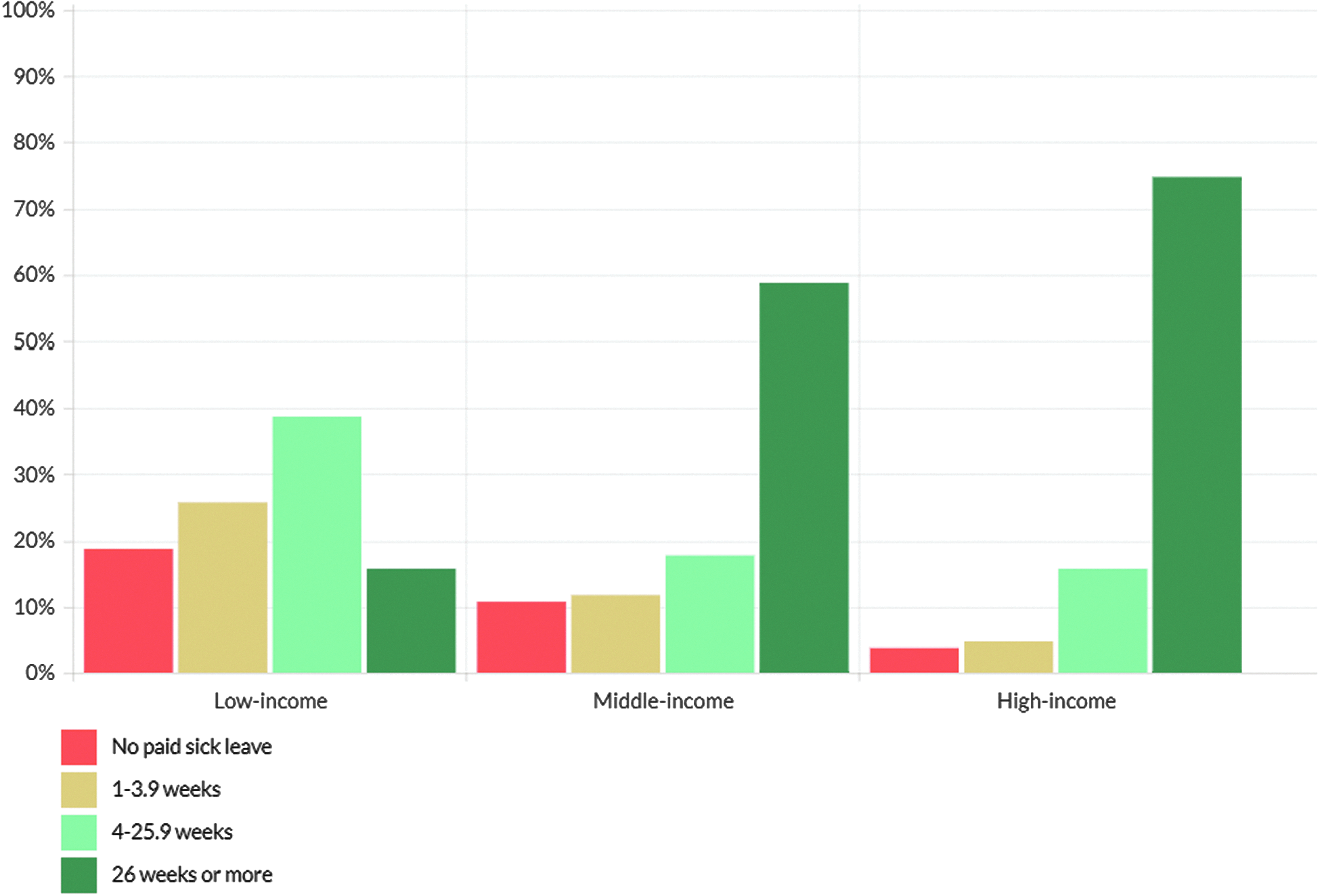
For how long are workers guaranteed paid sick leave? Low, middle, and high-income countries. Source: World Policy Center.
Conversely, when policies are put in place that protect the public's ability to earn wages during times of illness, the benefits to the community can outweigh the cost to employers. For example, San Francisco, California, passed a law in 2007 by which employees accrued 1 hour of paid sick leave for every 30 hours worked. 6 Three years later, 20% of parents with paid sick leave were less likely to send their child to school with a contagious illness. The growth of businesses and the number of employed residents in the city outstripped surrounding areas, due, in part, to increased productivity: Typical workers used an average of only 3 paid sick days per year, below the maximum of 5 to 9 days available to them. 7
At the time of this writing, there are 9 states (CA, CT, WA, OR, VT, RI, AZ, WA, and MA) and 33 localities, including New York City, Los Angeles, Chicago, and Washington, DC, that require businesses within their jurisdiction to provide sick leave to their employees. It is important to note that paid sick leave amounts vary from state to state and city to city and that some jurisdictions do not require smaller businesses to pay their employees, but in all cases jobs are protected.8,9 When paid sick leave is available, workers are able to rest and recover before returning to work. This enables them to perform at a higher level and prevents the spread of illness to co-workers, which minimizes company-wide productivity loss. 7
Though some cities and states are making strides toward legislation, approximately 28% of civilian workers in the United States, many of whom are low-income, lack access to sick leave. 10 When people cannot afford to stay home from work to recover, it is a risk to the public's health. During the 2010 H1N1 pandemic, it is estimated that 7 million additional individuals contracted the disease and 1,500 additional deaths occurred because contagious residents did not stay home from work. 7 In these cases, encouraging or even mandating residents to stay home may be necessary to prevent the spread of disease. However, for the 28% of civilian workers without access to sick leave, the consequences of exposure or infection affect more than just their health—they affect their ability to provide for themselves and their families.
Enforcement and Compliance of Quarantine and Isolation
The purpose of quarantine and isolation—isolation is used when people are sick, and quarantine is used when they have been exposed but are not yet symptomatic—is to prevent people who have contracted, or are suspected of having contracted, a contagious disease from interacting with the public in order to keep the disease from spreading. For example, in the case of measles, the incubation period is 7 to 21 days; a person who has been exposed to the measles virus and cannot produce a vaccination record will be quarantined for a minimum of 21 days. Typically, households are quarantined together, as it is probable that the entire household has been exposed if 1 member is confirmed to be infected. If tests come back negative for the disease, they are allowed to leave quarantine. 5
To give a sense of scale to how many people can be affected by quarantine and isolation orders, we can look at the 2014 Ebola outbreak, in which 4 individuals tested positive for Ebola, but a total of 458 US residents in Ohio, New York, and Texas completed the 21-day monitoring period in either quarantine or isolation. 11 The number of people affected by an investigation depends on how quickly those who have come into contact with the disease are quarantined. When residents do not comply with quarantine orders, they will likely increase the number of people they have contact with and make the investigation larger.
By law, workers must adhere to quarantine procedures. There are state quarantine and isolation statutes that impose misdemeanor charges or fines on individuals who fail to maintain quarantine, but there are no statutes regarding compensation for the loss of income they will incur while complying. 12 Some organizations alleviate the financial stress by allowing employees to use accrued sick or vacation leave. However, not all employers offer that option, particularly because a person in quarantine may not actually be ill, and it can be difficult for employers to justify the use of sick leave to cover their absence. Because of this, 3 states—Vermont, Arizona, and Washington—as well as several localities have passed legislation that states that one of the purposes of required sick leave is for when schools or places of business are closed for public health reasons, particularly recognizing that while residents and their children may not be ill, they need to stay home in order to contain the spread of the disease. 9 The law should mandate that employees be allowed to use sick leave any time they are under an order of quarantine or isolation. If residents are forced to miss work, there should be a system in place to repay lost wages.
Workers who do not receive sick leave face the dilemma of spreading their disease or missing out on wages. In the United States, only 48% of workers in the service industry have access to paid sick leave, and just 56% of businesses with 99 or fewer people provide paid sick leave. 10 One reason smaller businesses—for example, independently owned restaurants—do not offer sick leave is that it can cost them “double”: They would have to pay the sick employee and cover the wages of a substitute employee. However, without paid sick days, employees are more likely to go to work and spread their illness to the people around them instead of staying home. In these instances, public health officials occasionally have to force people to comply with a law.
In June 2014, as Director of Health in Kansas City, MO, I found myself in this difficult situation during a measles outbreak. Under my authority as the local health official, I quarantined 5 multigenerational families in their homes, and the residents were unable to return to work for a few weeks. In this short time, the quarantine took a toll. For example, families received food donations that included, in part, a case of peanut butter with nothing to put it on; a 5-pound bag of dried cranberries; a case of cereal with not enough milk; canned stews, soups, and vegetables; and frozen meat. While the recipients appreciated the donations, these items did not constitute complete meals.
Beyond that, 1 household was evicted from their apartment because they owed rent prior to the quarantine, and weeks of missed paychecks made it impossible to catch up. Two children from another household were critically hospitalized, and the subsequent hospital bills added to their debt. And unpaid phone bills led to cell phones being shut off, preventing families from communicating with the hospital, the health department, and their employers. Imagine being trapped inside your home for weeks with 9 family members, strange meals, no way to communicate with the outside world, bills piling up, and no idea of when you can return to work. This is what quarantine looks like for many families in the United States.
Fortunately, my health department has strong relationships with the local food establishments in Kansas City, so the restaurants where most of the quarantined residents worked did not terminate them. To thank the restaurants and prevent future outbreaks among the community, we offered free hepatitis A and measles, mumps, and rubella (MMR) vaccinations to restaurant employees, even though they were not exposed.
Recommendations: Improving America's Sick Leave Policy
What makes the United States unique compared to the rest of the world's developed countries is that we tie benefits to employers instead of to the government. In America, you have to work for the right company or in the right industry to receive paid leave for an illness. In almost every other country in the world, health is simply a right.
The danger in not providing sick or quarantine leave is that residents may avoid health officials and disregard quarantine orders so they can earn a “living” wage, which puts other individuals at substantial risk for disease. Though the families in our city complied with our instructions, they were left in tenuous financial situations. It does not seem fair that compliance with a quarantine order left a household in a desperate circumstance that led to eviction. Public health officials should not have to sacrifice the livelihood of a family in order to do our job, and mandatory sick leave is the obvious solution.
At a national level, mandatory sick leave and quarantine leave would ensure more compliance and less financial risk to workers and employers during disease investigations. Yet, while we collectively hold our breath for a national mandate, there are other options on a local scale to alleviate some of the financial burden. Four of the states and many localities that have passed sick leave legislation include protections for a public health emergency, whether or not a resident or his or her child is ill. In addition, all of these states and localities allow residents to use sick time to care for loved ones, ranging from children and spouses and domestic partners to parents, grandparents, or any other related family member. 9 The residents in these states and localities will not suffer the financial burden that an unforeseen health event such as the 2010 H1N1 pandemic caused when their place of business or child's school closed to prevent the spread of contagious illness.
Outbreak investigations, and sometimes isolation and quarantine, are necessary to prevent the spread of disease. As more states and localities look into passing paid sick leave legislation, inclusion of public health emergencies as allowable for leave is essential in containing the spread of illness. For residents caught in the crosshairs of an outbreak in a state or locality without paid sick leave legislation, the cost of compliance can be loss of income, loss of job, loss of home, or the inability to care for and feed family members. There is a way to alleviate the very real stress that people face when complying with these regulations. As public health officials, we need to work toward a national mandate that will not only prevent further hardship for this country's residents, but will better protect everyone from communicable disease outbreaks.