




Abstract
Public health threats, such as emerging infectious diseases, terrorism, environmental catastrophes, and natural disasters, all require effective communication. Emergency risk communication is a critical component of public health emergency planning and response. It is a complex process involving a variety of constructs that interact in dynamic ways over time. While emergency risk communication is generally recognized as an important tool for risk management and emergency response, the specific elements, processes, and outcomes are not well described and have not been systematically assessed. In this article, we describe a conceptual model for public health developed in collaboration with the Centers for Disease Control and Prevention (CDC). We propose using this model to inform practice and to guide evaluations of emergency risk communication. The model was informed by an extensive review of the emergency risk communication literature, interviews with researchers, and discussions with CDC stakeholders. This model can be adapted for a wide range of emergency events and incorporates key constructs to assess internal processes, as well as outcomes of emergency risk communication on audiences. Evaluating internal processes can help identify and correct messaging deficiencies. Outcome constructs describe expected target audience responses to emergency risk communication, such as changes in knowledge, attitudes, beliefs, and behaviors that may occur over time. This can help public health communicators learn how their various activities contribute to emergency risk communication outcomes.
The authors describe a conceptual model for public health emergency risk communication developed in collaboration with the CDC. The model was informed by an extensive review of the emergency risk communication literature, interviews with researchers, and discussions with CDC stakeholders. It can be adapted for a wide range of emergency events and incorporates key constructs to assess internal processes, as well as outcomes of emergency risk communication on audiences.
I
Emergency risk communication is an essential component of the emergency planning and response process.5,6 It occurs in a complex context with competing messages, emerging forms of communication, and, often, reduced trust in public authorities. It is defined as the combination of risk communication and crisis communication elements into an integrated process that extends over various crisis stages or phases. 7 The approach provides researchers, practitioners, and professionals with a comprehensive and integrated approach to crisis, risk, and emergency response communication. 8 While emergency risk communication is widely recognized as a critical approach for risk management and emergency responders, the specific elements, constructs, processes, and outcomes are not well described and have not been systematically assessed.
We describe the development of an emergency risk communication evaluation model for public health. This included an extensive review of the emergency risk communication literature, interviews with academic researchers, and discussions with CDC stakeholders. Emergency risk communication in the context of public health is a complex process involving constructs that interact in dynamic ways over time. Therefore, the goal was to create a comprehensive model that identified the most important measurable constructs of emergency risk communication and to understand its impact. Although developed for CDC, this evaluation model can be adapted by public health departments at state, territorial, local, and tribal levels; healthcare providers; and other emergency response organizations to assess the development of emergency risk communication messages and their impact on audiences. We first describe emergency risk communication processes and then outline the expected outcomes of these processes. Next, we identify the key constructs of the emergency risk communication model and describe the logically apparent relationships between them. Finally, we describe how this model can be used in assessing the impact of emergency risk communication and to inform practice.
Emergency Risk Communication
Emergency risk communication is a broad integrative approach to communication that draws on elements of risk communication and crisis communication over the life cycle of a crisis event. 7 The CDC's Crisis and Emergency Risk Communication (CERC) model, for example, incorporates “public health methodologies for risk communication with the principles of crisis communication” to provide practitioners and professionals with a comprehensive and integrated approach to crisis, risk, and emergency response communication.8(pp40-41) Savoia, Lin, and Gamhewage's 9 risk communication evaluation (RICE) framework provides guidance for assessing communication outcomes at different levels (eg, information environment, population, public health system) during public health emergencies. While this model is helpful, it included a limited set of practice-based constructs.
Emergency risk communication models generally incorporate a broad set of contingencies and functions, such as educating and encouraging preparation, informing the public to help mitigate harm, facilitating media and stakeholder relations, educating and persuading people to follow protective behaviors (eg, evacuation), coordinating activities, informing and refining responses, and learning from events. 8 Structural components and processes such as joint information centers, community response networks and partnerships, emergency operations centers, joint aid agreements, warning and notification systems, and crisis communication plans are also part of the emergency risk communication approach. Additional considerations include audience-centered factors (eg, culture, language, needs of special populations 10 ), contextual factors (eg, nature of the event, affected geographic or physical locations), and larger processes of risk perception.11,12
Emergency risk communication can be used to guide communication strategy for a range of threats, including chemical, natural, radiological, infectious disease outbreak, and human-caused crises. 13 The elements are part of an “all-hazards” approach to disaster management that seeks to create structures and capacities that are flexible and applicable to a wide range of natural and human-caused crisis events. 14 While the all-hazards approach has been adopted by agencies such as the Federal Emergency Management Agency (FEMA), specific risk factors, location, scope, history, and the nature of the affected population must also be considered in communicating and responding. 15 In addition, the emergency risk communication function is part of the larger National Incident Management System, which recognizes that “effective and accurate communication can save lives and property, and helps ensure credibility and public trust.”16(p1)
Message Development
The emergency risk communication message development process in public health involves several elements. Messages produced by CDC are crafted to address information needs for public health practitioners, the community, local and state authorities, and the public at large before, during, and after an emergency. They reflect agency policy, current scientific knowledge, and input about content, channels, and sources from partners, stakeholders, and affected groups. Formative research with target audiences may be conducted to help refine messaging. All messages go through a development and review process intended to ensure scientific accuracy and consistency with agency and federal policies. During an emergency response, CDC collaborates and coordinates with many public health stakeholders, including state and local health officials, who are critical partners for disseminating emergency risk communication–framed information. Emergency risk communication messages are delivered through a variety of forms and channels, including social and legacy media, websites, responses to direct inquiries, distribution of printed materials, and statements from agency subject matter experts and independent public health professionals.
Evaluation Throughout an Emergency
Emergency risk communication needs to be evaluated throughout the life cycle of an emergency event. During the initial phase of an emergency, formative evaluation helps guide development and refinement of messages. 17 Ongoing monitoring of audience reactions to emergency risk communication functions as a feedback loop to support continuous program improvement. For example, if the public perceives messages from different sources as inconsistent, the emergency risk communication framework suggests improving coordination and alignment of messages to enhance consistency. Evaluating emergency risk communication–framed efforts also helps refine practices by identifying constructs that are most closely associated with positive outcomes. Later in the emergency life cycle, summative evaluations are needed to demonstrate the impact of emergency risk communication. Examples of summative data include message exposure and changes in learning, attitudes, and behaviors. 17 Demonstrating emergency risk communication's impact is also important for resource allocation. As public health and emergency management resources become limited, program areas need to demonstrate their value in managing risk and reducing harm. Evaluation helps inform program priorities during the intense and short response times associated with emergencies and is also important for building the evidence base to support emergency risk communication interventions.
While the value of evaluation is broadly recognized, measuring the impact of emergency risk communication is complex, and attributing outcomes to a communication intervention is challenging. Outcomes are influenced by many factors, including information source, message content, and contextual variables (eg, prior knowledge and experience, demographics, nature of the threat). An additional complication for emergency risk communication evaluation is that data collection activities with target audiences may be constrained by the emergency. Moreover, resources to conduct comprehensive evaluations of emergency risk communication are often limited. However, evaluation is scalable; even a little evaluation is better than none, and cost-cutting strategies such as analyzing secondary data, reducing survey sample sizes, and relying on naturally occurring data (eg, calls to information lines, webpage views) 18 can be used to assess emergency risk communication outcomes.
Evaluating emergency risk communication requires understanding the elements of the emergency risk communication process and characterizing the relationship between these elements, including how the process evolves over time and how constructs may be related both to one another and to outcomes. The overall goal of a system of emergency risk communication is to encourage behaviors that avoid and reduce harm.
Emergency Risk Communication Conceptual Model
Figure 1 presents the emergency risk communication conceptual model. Key inputs to emergency risk communication as depicted in the model were drawn from emergency response experiences at CDC and from feedback of public health partners, audiences, and subject matter experts outside of CDC. The model incorporates constructs relevant for assessing emergency risk communication message development and dissemination processes and emergency risk communication outcomes on audiences. The outcome component uses terms that suggest temporal sequence (eg, short-term, long-term). However, these terms do not correspond to absolute time periods; the length of each emergency response varies considerably, as does timing and transition across phases. Rather, these terms are used generally, to provide a sense of temporal ordering of concepts. We describe constructs and relationships between them in Figure 1.
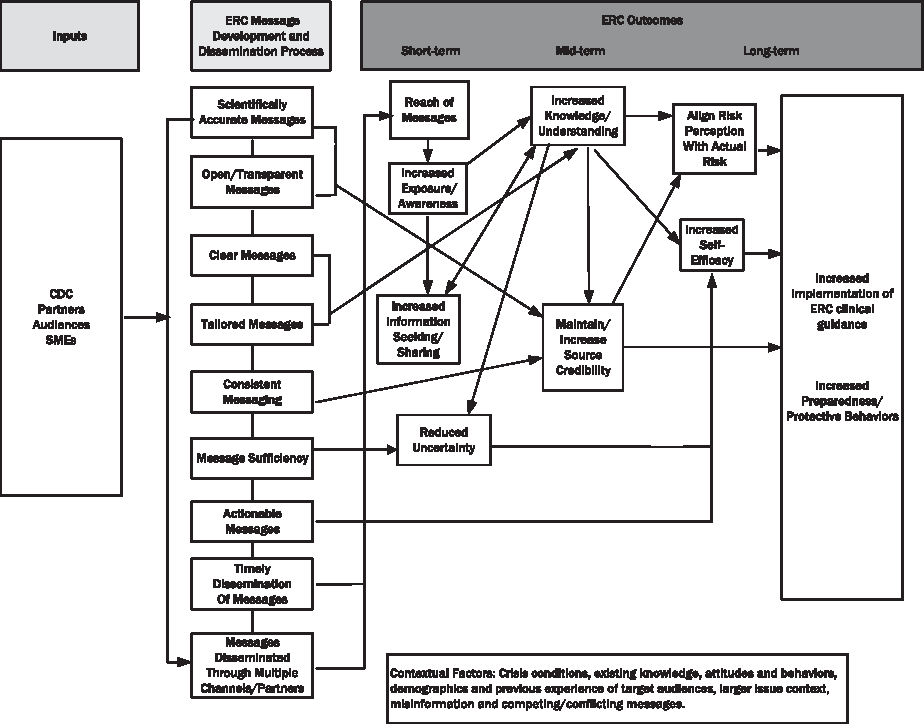
The emergency risk communication (ERC) conceptual model
Relevant Process Constructs
Internal agency processes that support emergency risk communication development and dissemination can lead, directly or in combination with other processes, to particular outcomes. Identifying processes for measurement is critical for detecting system weaknesses that must be addressed to ensure better outcomes. Key emergency risk communication processes and their relationships with other processes and outcomes are discussed below.
Scientifically Accurate Messages
Information during an emergency is often evolving and uncertain, posing challenges for public health communicators and emergency responders. Providing inaccurate information not only contributes to public distrust and reduces the credibility of the source, but it can lead to additional harm.19,20 Therefore, emergency risk communication messages need to be based on the most accurate information available at the time. Communicators also need to set expectations that recommended protective actions may change as scientific knowledge increases. 21 Emergency risk communication messages must undergo scientific review to ensure accuracy of content.
Open and Transparent Messages
Openness and transparency in the context of emergency risk communication is defined as providing candid information to key audiences in an immediate and accessible way.5,21 It also acknowledges uncertainties, including what is not yet known. 19 Emergency risk communication messages that are open and transparent can enhance understanding of message content and increase trust and source credibility; messages and processes that are not open and transparent can lead to misunderstanding and distrust.22,23 Perceptions of limited openness and transparency, for example, undermined trust during the 2016 Flint water crisis.
Clear Messages
Crisis-induced stress can reduce the capacity to process information. Messages framed using plain language are more likely to be understood and increase the chances of compliance. 24 Message clarity has been shown to increase risk perception and likelihood of taking protective actions.20,25 Emergency risk communication messages should be designed to be easily shared, received, and interpreted, even under unfavorable conditions. Explaining the mechanisms of Legionnaires' disease, for example, can create challenges for a lay audience. Plain language is necessary to ensure messages are understood as intended.
Messages Tailored to Target Audiences
Tailoring refers to the process of adapting messages so they take into account the information needs, cultural preferences, and existing knowledge of specific audiences. Messages adapted to audience needs and tailored to at-risk populations—for example, to pregnant women and their partners during Zika and travelers to West Africa during Ebola—can increase understanding of and adherence to health protection recommendations.10,26 Message tailoring also enhances audience members' perception of their ability to carry out recommended actions (self-efficacy), while taking into account the specific messaging characteristics that increase the likelihood of action across diverse audience groups. 27
Consistent Messaging
Members of key audiences are likely to compare what they hear across different sources. It is important, therefore, that messages from various sources contain similar information and guidance. Consistency does not imply that messages are exactly the same. Messages that are consistent in their overall content reduce the level of uncertainty perceived by the public and increase levels of trust. 20 Messages that are inconsistent with others increase confusion and reduce the likelihood that the audience will take protective actions. 5 The public may perceive messages released by different public health agencies as coming from the same source, so it is particularly important to ensure public health messages are consistent. 20 During the 2014 Ebola outbreak in West Africa, inconsistent messages from federal and state government officials about the risk of a US-based outbreak from returning healthcare workers created confusion and misgivings among the public. 28
Message Sufficiency
Sufficiency refers to the amount of information an individual perceives he or she needs to deal with a given risk. The public may need appropriate background information before they feel sufficiently informed for a given emergency. Communicators draw on the concept of “sufficiency threshold” to identify the point at which people feel confident about their knowledge of a given risk.29,30 People are more likely to seek additional information if their current knowledge is lower than their sufficiency threshold. Information sufficiency is useful for assessing whether information needs of audiences were met.30,31
Actionable Messages
A primary goal of emergency risk communication is to promote protective actions that can limit and contain harm during emergencies. In some cases, the “action” may simply be to refer target audiences to other information sources, such as a website or their physician. 32 Emergency risk communication messages that describe specific actions increase self-efficacy and are generally more effective at producing health-protective behaviors.32,33 Telling farmers to avoid contact with animals because of zoonotic diseases, for example, may not be considered an actionable message, so additional actions, such as wearing protective equipment and thoroughly washing hands, should be given.
Timely Dissemination of Messages
In an emergency, audiences need information quickly. Messages will be judged by the speed with which they are communicated.19,26 The speed of spreading a message can be more important than its comprehensiveness, and waiting too long to release a message can lead to the perception that sources are not transparent and to delays in protective actions.19,34 Timeliness is often a function of how long it takes for emergency risk communication messages to be cleared and released. However, it is important to acknowledge that sometimes messages containing protective recommendations get ahead of circumstances and may provide additional challenges for communicators (eg, recommending a vaccine that is not available yet).
Messages Disseminated Through Multiple Channels
Common transmission channels for emergency information include television, newspapers, internet (including social and digital media), radio, telephones, and text messages.22,35 Studies suggest it is important to consider a channel's coverage and rely on multiple channels in disseminating emergency risk communication messages, as each channel has its limitations.22,36,37 The use of multiple channels, often involving various community and public health partners, helps disseminate emergency risk communication messages more widely than any one source can do on its own. CDC uses a variety of partners, such as state, territorial, local, and tribal agencies; nongovernment organizations; professional associations; and healthcare providers among many others to disseminate information and reach diverse audiences. Partners also may have direct access to target audiences and be viewed as credible information sources. Identifying appropriate channels for each target audience is critical for effective emergency risk communication.
Relevant Outcome Constructs
Communication outcomes are the impact of emergency risk communication messages on target audiences. The message development and dissemination processes described above lead to 9 outcomes. The outcomes, described below, are complex, interactive, and often indirect, posing measurement and assessment challenges.
Reach of Messages
The reach of a message is defined as the number of people who received the message within a specific time frame. It can vary depending on how broadly a message is disseminated. Diffusion through the media typically follows an “S-curve,” where the diffusion starts slowly, builds, and then flattens out toward the end of the distribution. 38 In general, the greater the number of channels, the greater the reach.36,37,39 Social media can significantly expand the reach of public health messages. 40 Access to channels and information is not evenly distributed across populations and is often limited during a crisis. Specifically, channels may be disrupted, and infrastructure damage can limit access to established media. However, even in optimal conditions, not every member of the target audience will receive the message in a timely manner. In 2017, 1 month after Hurricane Maria made landfall, 40% of Puerto Rico residents still lacked cell phone service. 41 Lack of access to electricity also hindered other forms of communication. Loss of roads and bridges isolated people in rural communities.
Increased Exposure and Awareness
Awareness of critical information depends on reach and is one of the earliest outcomes in any communication process. Communicators need to bring risks to the attention of target audiences before members can process messages or take actions. Awareness prompts a target audience to pay attention to a public health threat and any subsequent health protection guidance.34,35 Awareness can be generated more quickly and more broadly through use of social media. 40
Increased Information Seeking and Sharing
Seeking additional information is associated with behavior change in response to a message.36,37,42 Information seeking can take the form of following what is being said in news and social media or obtaining advice from a healthcare provider. Because it requires some effort, seeking information represents a form of self-efficacy. 32 Sharing of information is also a desired behavior following risk messages and can be understood as both a form of self-efficacy and network behavior. 37 Both sending and receiving information have been enabled by new technology and mobile devices.
Reduced Uncertainty
Uncertainty is the perceived degree to which risks and outcomes cannot be accurately predicted. 5 Effective communication generally leads to enhanced knowledge and an overall reduction in crisis-related uncertainty. Reducing uncertainty moderates the psychological impact of the crisis and facilitates informed decision making and harm-reducing actions. 7
Increased Knowledge and Understanding
A key measure of effective health communication generally is enhanced knowledge and understanding. Promoting a better understanding of risk factors and protective actions is likely to result in improved decision making in response to risks.25,43,44 Increased understanding is a primary goal of emergency risk communication and is necessary to reduce the negative psychological impact of a crisis and increase informed decision making and harm-reducing behaviors.
Maintain or Increase Source Credibility
Source credibility is a message, process, and channel characteristic and, in some cases, an outcome. For CDC, agency credibility is critical to efforts to improve public health, both in and out of emergencies. Credibility is central to promoting understanding and generating desired actions and behaviors. Audiences are unlikely to follow recommendations from sources they do not think are correct or whom they believe are not looking out for their best interests.23,45,46 While credibility involves several subconstructs, trustworthiness and expertise are 2 of the most important. 47 Expertise is typically established through credentials, affiliation, experience, and the nature of the information. Trustworthiness is situational and subjective and is grounded in shared values, history of interaction, reputation, and affiliation. Some sources, such as legacy media, may be seen as more credible, while others, such as social media, may be less credible (although this may be moderated by cues referencing expert authority). 48
Align Risk Perception with Actual Risk
Another important outcome of emergency risk communication is that audiences' perceived level of risk associated with a public health hazard is aligned with the actual risks.49-51 When perceived risk is higher than actual risk, demand for services can overwhelm available resources. When perceived risk is lower than actual risk, source and message credibility may be undermined, increasing the likelihood that people will forego needed protections. 39 The 2014 Ebola outbreak was characterized by a misalignment of high public concern and the scientific understanding of low risk under the healthcare management conditions in the United States.
Increased Self-Efficacy
Self-efficacy is an individual's belief that she or he can carry out a recommended action. 52 Emergency risk communication messages that describe specific and realistic risk-mitigating and risk-reducing actions are considered more effective and lead to increased self-efficacy. Self-efficacy can serve as a mediator between knowledge and behavior change and has proven to be a significant predictor of behavior in health and risk contexts.20,43,52
Behavior Change
The core and long-term goal of most emergency risk communication is to influence behavior among target audiences in ways that reduce risk and limit, contain, or mitigate harm.5,7 Behavioral goals for affected individuals include a wide range of recommended activities, from heightened awareness and monitoring of developments, washing hands, boiling water, seeking medical attention, or, in some cases, sheltering in place or evacuating. CDC, in collaboration with partner public health organizations and healthcare associations, regularly develops clinical guidance during emergencies to educate healthcare providers themselves (eg, clinical manifestations of infection or illness, including signs and symptoms, infection control procedures) and information for healthcare providers to discuss with patients (eg, preventive measures, available treatments). In addition to affected individuals and healthcare providers, groups, agencies, and organizations may shift behaviors in response to emergency risk communication messages. Organizational, community, and group learning from a crisis is generally recognized as a key process in creating new response capacity and developing resilience for future events.53,54
Relationships Between Constructs
Emergency risk communication processes and outcomes are interdependent and dynamic. As seen from the construct descriptions above, evaluating emergency risk communication efforts requires understanding the key constructs of the emergency risk communication process and characterizing the relationships between constructs. These relationships are represented by arrows in Figure 1.
Agency processes that support emergency risk communication message development and dissemination can lead, directly or in combination with other processes, to outcomes. Process constructs scientifically accurate messages, open and transparent messages, and consistent messaging are associated with the mid-term outcome maintain/increase source credibility. This is because source credibility is defined in terms of expertise (eg, scientific accuracy) and trustworthiness (eg, openness and transparency). Inconsistent messaging from different spokespersons can also decrease organizational credibility. Consistency in messaging by designated spokespersons would likely have increased CDC's credibility during the response to the 2001 anthrax event. 55
The 2 process constructs dissemination through multiple channels/partners and timely dissemination are related to the short-term outcome reach of messages. Dissemination through multiple channels/partners can extend the reach of an organization's messages, while timely dissemination can reduce the response timeframe. Evacuation notices for Florida residents prior to the 2017 Hurricane Irma were disseminated early, through multiple channels, and in several languages, allowing for timely evacuation or sheltering in place. By understanding these processes and their relationship to outcomes, an agency can structure emergency risk communication message development and dissemination procedures to increase the likelihood of positive outcomes.
Outcomes may also be interrelated. The overarching goal of emergency risk communication is to enhance use of health protection behaviors and reduce the likelihood of risky behaviors so that affected populations will have better health outcomes than they would have without emergency risk communication messages. While the overall goal of emergency risk communication is the long-term outcome of behavior change, several outcomes need to be successfully accomplished before behavior change can occur.
Reach of messages is a necessary short-term outcome for all subsequent outcomes such as increased exposure/awareness and increased information seeking and sharing. Awareness of the message cannot occur before its receipt. Increased awareness typically creates a need for information seeking for purposes of clarification and validation, and thus awareness enhances information seeking and sharing. Increased knowledge and understanding is a key mid-term outcome and thus is related to a number of outcome components (eg, increased information seeking, reduced uncertainty, and increased self-efficacy).
The long-term emergency risk communication outcome alignment of risk perceptions to actual risk is critical for managing public concern and engendering appropriate responses by the target audience. Risk perceptions that are too high may result in unnecessary concerns and actions, including some that may increase harm. Ongoing use of bottled water long after water advisories have expired, for example, is a well-documented phenomenon resulting in needless expense. Risk perceptions that are too low may result in failure to take recommended actions. People not evacuating in the face of hurricane warnings, for example, is an ongoing challenge for emergency managers. Increased knowledge and understanding and increased self-efficacy through actionable messages are related to behavior change. Seasonal flu messages, for example, emphasize understanding how the virus is transmitted, and give advice on nonpharmaceutical actions, such as social distancing and school closures, to reduce transmission. When an audience has an understanding of the actions they can take, they are more likely to take them. For other groups and agencies, behavior changes may involve a variety of recommendations, resource allocation decisions, or specific interventions and therapies. These individual, group, and agency changes are themselves associated with reduced levels of mortality and morbidity during and after an emergency.
Contextual Factors
As with many communication models, this emergency risk communication evaluation model includes a recognition of larger contextual factors that influence how an emergency unfolds (see Figure 1). All crises are contextual, and communicators need to understand how outside factors influence communication strategy and messages. Contextual factors include specific crisis conditions, existing knowledge, attitudes, behaviors, target audience demographics, health literacy, and experience with previous crises. The specific conditions of a public health emergency are particularly important considerations given the variability of risk factors and crisis types. 8 These factors will influence what information needs to be communicated to whom and how that information may be received and interpreted. Other contextual variables include location, scope of impact, and type of hazard. Previous experience is especially influential in determining how emergency risk communication strategy and messages are developed, shared, and refined.8,56
Discussion
The elements, relationships, and stages identified in emergency risk communication—as with other forms of communication—are dynamic and interact in often complex and unanticipated ways. The dynamics of a public health emergency are especially challenging for communicators when circumstances are evolving quickly, scientific understanding is incomplete or uncertain, and routine information flows are disrupted. 8 The purpose of explicating an evaluation model for emergency risk communication efforts in public health is to identify the constructs that are most important to operationalize and measure to understand the impact of communication efforts. The process of communicating effectively during an emergency is complex, multi-directional, interactive, and highly contingent. Members of target audiences may not progress through the communication process at the same pace. People may receive information about an emergency at different times. Moreover, changes in messages or the inclusion of new audiences will require communicators to go through messaging strategy iteratively while also taking into account information already received. Iterations of messaging can result in the perception that information is contradictory and inconsistent, and that sources lack transparency and openness. Other relationships between the elements of the emergency risk communication process may be more or less salient depending on the specific event. For example, timely messaging may be less salient with slow-moving crises. Message sufficiency may be less important when the risk is well understood and familiar.
The emergency risk communication evaluation model also illustrates the complexity of the overall communication process. Achieving understanding and supporting adherence to behavioral recommendations in the context of an uncertain and threatening situation requires a number of steps and processes functioning in a relatively coherent and systematic manner. Measuring the constructs described above will provide insight into how emergency risk communication works and what specific practices are likely to have the most impact on health-related outcomes. Message dissemination through multiple channels or partners, for example, is a critical early step in the emergency risk communication process and is closely associated with timing, which is often tied to the agency review process to ensure scientifically accurate messages. Similarly, behavior change is the consequence of a variety of interacting factors, and many may be beyond the control of the agency managing the event. It is important that public health communicators and their emergency management counterparts understand, operationalize, measure, and analyze the complexities of the communication process, knowing that systemic and behavioral changes are not easily attained. The model presented here defines the key constructs of emergency risk communication for evaluation while noting influences on communication in a public health emergency response that may facilitate or limit the impact of messages and messaging strategy.
Application of the Model
The emergency risk communication model was developed as the first step in an effort to assess the effectiveness of a program of public health communication in a crisis context. The next steps are to operationalize the constructs in ways that allow for measurement. Some constructs, such as clear messages and scientific accuracy, are more easily measured, while others, such as message sufficiency and openness and transparency, will be challenging. Specifying the relationships between constructs and identifying associations with the level of harm associated with an emergency will create additional challenges, since different threats can have different levels and scopes of potential harm. Moreover, determining the level of harm that may have resulted in the absence of emergency risk communication presents a host of methodological challenges common across prevention efforts.
Practical Application
While the emergency risk communication model was developed as a conceptual framework for assessment, as we have noted at several points, it has other implications and practical applications. The emergency risk communication model describes constructs and relationships that can inform practice. First, by clarifying and describing the various constructs and processes in emergency risk communication, places for enhanced attention and resources are identified. For example, public health partners are important at several points in the process. Insufficient numbers of partners, or partners that are not affiliated with critical audiences, may limit the effectiveness of emergency risk communication and suggest to agencies that they need to invest in developing partnerships. Similarly, the model suggests that social media can be important at several places in the emergency risk communication process, which may point to the need to develop enhanced social media capacity.
Second, sharing the emergency risk communication model as a general conceptual framework for emergency risk communication may enhance the ability of public health partners, response agencies, and the public to coordinate activities and participate in preparation and response. The processes, goals, and values represented in the model can provide the broad understanding that allows others to more effectively coordinate activities. Moreover, disseminating the model enhances transparency of the emergency risk communication process.
Third, the model helps demonstrate the role and value of emergency risk communication. Promoting understanding by administrators and managers is a critical step in resource allocation. Moreover, understanding is helpful in positioning communication as a strategic management function for preparing and responding to a range of threats and events.
Finally, the model highlights issues and identifies specific focus areas that communicators can consider when developing communication strategy and monitor over the course of a response to improve the impact of their efforts during public health emergencies. The emergency risk communication model represents a set of evidence-based message development and dissemination processes, outcomes, and characteristics associated with effective communication. Understanding the relationships between these elements may also help public health communicators understand how specific activities can support improved health outcomes.
Future Directions
Further refinement of the emergency risk communication model will require additional empirical testing of the relationships between variables. While many of these relationships have already been specified in the literature on emergency risk communication, they have not been positioned within a larger system of communication as described in the model presented here. In addition, the emergency risk communication model was developed in the context of public health emergencies and the communication initiated by public health agencies, such as the CDC, during response efforts. Public health, as noted earlier, is a relatively new participant in larger emergency risk communication processes. Generalizing these elements and relationships to other contexts and agencies with extensive emergency risk communication experience (eg, FEMA, World Health Organization) creates an additional opportunity to extend the model to other partners at multiple levels of government. Additional investigation is necessary to validate and refine the model in ways that allow for measurement and assessment.
Although emergency risk communication is generally recognized as central to risk management and emergency response, there are few efforts to systematically assess its impact. Assessment is necessary for benchmarking, refining understanding, and improving practice. In addition, assessment can also help improve subsequent crisis planning and preparation. Models such as this can be helpful during the uncertainty and chaos of an event.
Conclusions
A significant body of empirical research, anecdotal experience, and case studies suggest that communication plays a central role in successful management of emergencies. The specific mechanisms of the impact of emergency risk communication have not been clarified, tested, or assessed. Doing so ultimately has the potential to improve the effectiveness of emergency risk communication in containing and reducing harm. This project used the evidence-based literature to describe the elements of emergency risk communication and how they interact. The emergency risk communication evaluation model developed through this process contributes to a comprehensive understanding of the ways communication may function to protect public health during emergencies.