




Abstract
Recent developments in synthetic biology tools and techniques are driving commercialization of a wide range of products for human health, agriculture, environmental stewardship, and other purposes. This article reviews some of the trends in synthetic biology applications as well as some of the tools enabling these and future advances. These tools and capabilities are being developed in the context of a rapidly changing industry, which may have an impact on the rate and direction of progress. Final products are subject to a regulatory framework that is being challenged by the pace, scale, and novelty of this new era of biotechnology. This article includes discussion of these factors and how they may affect product design and the types of applications that are most likely to be supported and pursued commercially. The final section provides perspective on the security implications of these advances, with a focus on US interests.
Recent developments in synthetic biology tools and techniques are driving commercialization of a wide range of products for human health, agriculture, environmental stewardship, and other purposes. This article reviews some of the trends in synthetic biology applications as well as some of the tools enabling these and future advances.
S
Applications Making an Economic Impact
Applications discussed here are those with substantial recent interest and economic investment, particularly in the United States. These include genome editing in human cells, genome-edited plants, biosensors, and metabolic engineering. Companies and some of their anticipated products are also mentioned. A key enabler of many, though not all, of these applications is the advent of RNA-guided genome editing based on CRISPR (Clustered Regularly Interspaced Short Palindromic Repeats), which was first described as an engineering tool in 2012. 4 The CRISPR-based products discussed in this section represent only the first generation; newer advances and some likely directions for CRISPR-based applications are considered in the following section.
Genome Editing in Human Cells
The promise of treating human disease through genetics has been a key driver of investment in CRISPR. Several companies pursuing therapies based on CRISPR have raised funds by the $10s to $100s of millions, including CRISPR Therapeutics, Editas Medicine, and Caribou Biosciences. 5 Clinical trials of CRISPR-based genome editing for treatment of intractable genetic blood disorders sickle cell anemia and β-thalassemia are beginning this year in the US and Europe.6,7 Human genome editing using an earlier genome-editing technique (zinc-finger nucleases) has also entered clinical trials, including investigational treatments from Sangamo Therapeutics for HIV and another for a genetic metabolic disorder.8,9 China is reportedly well ahead of the US in testing CRISPR-based interventions in humans. 10 These recent advances and investments likely represent just the beginning of a longer-term trend for genome editing in the treatment of genetic disease and cancer. However, these interventions face significant challenges, similar to traditional gene therapy, including tissue-specific delivery, 11 potential immunogenic responses in patients, 12 and the possibility of promoting cancer. 13 To date, only a few gene therapies of any kind have been approved by the US Food and Drug Administration (FDA), though approval of many more is anticipated in the next few years. 14
Advances in CRISPR tool development are likely to increase the success and application space of genome editing. For example, novel CRISPR nucleases are being discovered and engineered to have fewer off-target edits and to allow easier packaging for tissue-specific delivery. Recently, CRISPR nucleases have been engineered to edit single bases of DNA without a double-stranded break in the DNA, thus avoiding some cellular immune responses, 15 while another engineered CRISPR nuclease targets RNA rather than DNA. 16 The company Beam Therapeutics, based on these capabilities, has already received significant investment. 17 Despite the many advances in CRISPR technology, an intellectual property dispute for the use of specific gene-editing proteins delayed some investment,18,19 but this dispute was recently resolved. 20
Genome-Edited Plants
Agriculture is one of the largest sectors for biotechnology in the United States, with annual revenues in the $100s of billions. 21 CRISPR-based tools, rather than the use of traditional transgenes, can yield products that are not subject to regulation by the US Department of Agriculture (USDA) 22 and may have the potential to be marketed more extensively worldwide. Accordingly, significant investments have already been made in CRISPR genome editing by major seed companies,23,24 including for newer CRISPR-based editing technologies. 25
CRISPR-based editing of plant genomes has expanded the possibilities for plant engineering, including both the varieties of plants as well as the traits expressed in those plants, 26 though transformation of plants (ie, incorporating DNA into a plant genome) remains a key bottleneck. 27 Although traditional agricultural biotechnology has focused on commodity crops such as corn and soybeans with traits primarily beneficial to farmers, CRISPR may enable a wider range of products to be marketed,28,29 such as sweeter strawberries with a longer shelf life 30 and low-gluten wheat. 31 Genome editing using an older technique, transcription activator-like effector nucleases (TALENs), has been used by the company Calyxt to make soybeans that produce healthier oil; these soybeans are already entering the market. 32
Biosensors
Biosensors based on synthetic DNA circuits or CRISPR-based tools are under development, with sensors for biomedical applications leading the way. Cell-free, CRISPR-based systems for disease detection are already being commercialized. Mammoth Biosciences was recently launched to provide point-of-care and in-home detection of a variety of pathogens, 33 based on DETECTR (DNA Endonuclease Targeted CRISPR Trans Reporter) technology developed by the Doudna lab. 34 Another CRISPR-based detection system called SHERLOCK (Specific High-sensitivity Enzymatic Reporter unLOCKing) also detects genetic sequences of interest and has been developed into a paper-based diagnostic tool.35,36 These biosensors will compete on their accuracy, low cost, and ease of use and may have a significant impact on the $45 billion in vitro diagnostics market. 33 They represent the first generation of CRISPR-based sensors; as new tools are rapidly developed, improved versions are likely to be brought to market.
Biosensors not based on CRISPR are also being developed, including a cell-based “biomedical tattoo” that is implanted under the skin to detect cancer 37 and an ingestible capsule that combines microbial sensing with an electronic device to monitor gut health. 38 Future biosensors are likely to be used for a wide variety of purposes beyond just biomedical diagnostics—for example, a cell-free sensor that detects food contamination 39 and fluorescent bacteria that detect landmines. 40 Advanced materials and coatings developed using bioengineering may also provide expanded use and packaging of sensor and therapeutic components. 41 Further into the future, plants may also be engineered as biosensors to sense and report a variety of compounds or conditions in real time, 42 such as bomb-sniffing plants that detect explosives. 43
Metabolic Engineering
Metabolic engineering is a capability that is poised to make a significant impact across a wide range of economic sectors. It involves “the purposeful modification of metabolic, gene regulatory, and signaling networks to achieve enhanced production of desired chemicals,”2 as well as engineering organisms with desired characteristics for direct use. Ginkgo Bioworks, for example, is a metabolic engineering company that was recently valued at over $1 billion. 44 It designs organisms for a wide variety of purposes, including production of fragrances for cosmetics and personal care products, 45 nitrogen fixation in plants, 46 cannabinoids for therapeutic purposes, 47 and metabolic functions in the human gut. 48 Other companies that have developed metabolic engineering platforms to support a wide range of products include Zymergen, 49 Amyris, 50 and smaller start-ups such as Arzeda, which uses proprietary bioinformatic resources for designer proteins, and Lumen Bioscience, which has developed a cyanobacteria as a chassis for protein production. Metabolic engineering is also being adopted by established companies, including multinational corporations, such as DowDupont, BASF, and Exxon, that focus on production of specialty chemicals51,52 and commodity chemicals such as biofuels. 53
Tools That Will Support Future Applications
In addition to enabling new scientific discoveries and applications, synthetic biology tools accelerate development of successful products. The tools described in this section are undergoing constant improvements in their cost, capability, and potential, underscoring the iterative nature of synthetic biology development. One critical industry trend is the rapid and dramatic decrease in the cost of synthetic DNA over the past 15 years. Additional long-term trends include improved bioinformatic capabilities and development of microbes for potential open release applications. Development of CRISPR-based tools and gene drives are more recent trends and are advancing at a rapid pace. In addition to development of products that are already on the horizon, these tools underlie a major acceleration in basic research in the life sciences that will form the basis for future biotechnologies. How these tools relate to different application areas is shown in Figure 1.
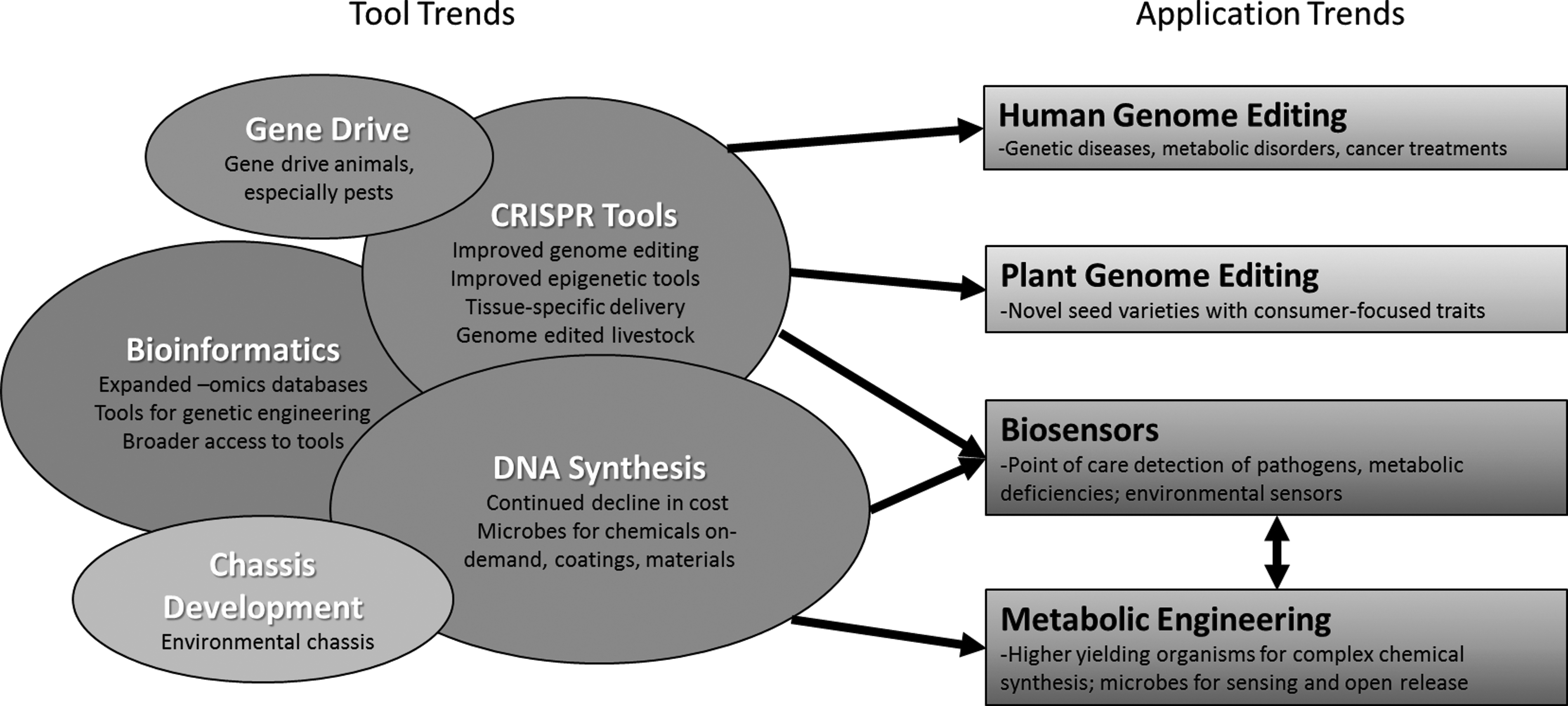
Tool and Application Trends in Synthetic Biology. The bubbles on the left show tools that are contributing to new discoveries and applications in synthetic biology. The boxes on the right show applications of synthetic biology that are already making an economic impact. Arrows show the tools and capabilities most critical to advances in the different application areas.
DNA Synthesis
DNA synthesis continues to become cheaper and more efficient, 54 driven by advances in technology 55 and increased demand for synthetic DNA, including for both biological applications and potential use of DNA for information storage. 56 Metabolic engineering companies in particular have benefited from this trend, which accelerates the design-build-test cycle. Last year, Ginkgo Bioworks bought the DNA synthesis company Gen9 57 and recently signed an agreement with Twist Biosciences to provide an additional 1 billion base pairs of DNA, 58 demonstrating the close links between metabolic engineering and synthetic DNA. In addition to improved synthesis, methods continue to improve for assembly of DNA into larger constructs,59,60 including assembly of entire genomes.61-63 Future microbes could be engineered to produce chemicals on-site and on-demand, 64 as living materials,65,66 for complex biomaterials such as spider silk, 67 or as electronic components. 68
Bioinformatic Capabilities
New bioinformatic tools and resources are becoming available at a rapid pace. Some resources have been available for decades, such as GenBank, 69 the DNA sequence database hosted by NIH, which is freely available and widely used. Many databases that include genomes, transcriptomes, proteomes, metabolomes, epigenomes, and microbiomes are being developed, including by companies pursuing human therapeutics 70 and agricultural applications, 71 along with tools to understand and visualize these data.
Recently, as understanding of genetic engineering has expanded, bioinformatic tools for constructing successful and optimized genetic pathways are being developed. These include, for example, Autodesk's Genetic Constructor with an easy interface 72 and Cello, a software program for automated genetic circuit design. 73 Metabolic engineering companies are also driving advances in bioinformatics, including the integration of artificial intelligence with sequence databases 74 (though it is yet to be seen if this integration will yield significant advances). Tools for design of modular proteins, such as Pinecone from start-up company Serotiny, 75 are also available. For CRISPR-based genome editing, there are many online tools for development of guide RNAs (an essential CRISPR component), with recent advances that better predict off-target activity. 76
Bioinformatic capabilities are also driving identification and expression of novel potential therapeutics. Advances in understanding of metabolic pathways have allowed companies seeking new therapeutics to computationally mine genomic databases for gene clusters that may yield undiscovered bioactive compounds.77,78 Advances in expressing these newly identified gene clusters in genetically tractable organisms 60 help support such efforts.
Microbes Capable of Surviving in Complex Environments
To date, nearly all applications involving engineered microbes, including most of the metabolic engineering efforts described above, use well-domesticated organisms that are grown in bioreactors, such as the bacteria Escherichia coli and the yeast Saccharomyces cerevisiae. These engineered strains do not survive well in the complex microbial communities found in the natural environment. 79 Efforts are under way to engineer these traditional microbes to be more robust so that they can be used for open release applications such as bioremediation, environmental sensing, and novel coatings and materials. 80 Development of photosynthetic microalgae as metabolic engineering chassis for use in the open environment is also under way, 81 and CRISPR is likely to facilitate this development. 82
Naturally occurring microbes thrive in a variety of environments, but the use of nontraditional and often unculturable microbes as chassis for engineering remains aspirational,83,84 though at least one company (Microbyre) has been formed to help address this need. 85 There have been recent advances expanding knowledge of nontraditional microbes, including single-cell sequencing, 86 cell-free methods for characterization of gene expression, 87 and improved methods for understanding how to culture such microbes.88,89 In addition, multiple groups have shown that CRISPR-based tools allow for easier engineering of intractable microbes.90,91 All of these advances will support the use of a wider variety of microbes for synthetic biology applications and will expand the types of environments in which they can be used. The environmental consequences and regulatory procedures for synthetic biology applications with likely environmental exposure have been much discussed.1,92,93
Advances in CRISPR Capabilities
The use of CRISPR-based tools has increased dramatically in recent years, along with publications, citations, and patent applications.94,95 New CRISPR-based capabilities for basic research continue to be developed, including methods for rapid, multiplexed mutagenesis in yeast96-98 and tools that report on the internal state of a cell, such as CAMERA (CRISPR-mediated analog multi-event recording apparatus) 99 and CRISPR-based imaging of genomic loci. 100 In plants, too, CRISPR has enabled rapid production of mutant strains that will expedite understanding of plant genomics as well as support commercial development of plant varieties. 101
Much ongoing research is focused on improving and expanding CRISPR as a tool. The specificity of CRISPR tools—that is, their ability to cut DNA at the appropriate site while limiting off-target cuts—is one area of focus, with one group demonstrating evolved, much improved variants of the nuclease Cas9. 102 CRISPR base editing that substitutes DNA base pairs without fully cutting the DNA has also been developed, 15 and it has already been licensed for commercial applications in plants 25 and for therapeutics. 17 Development of tools to use CRISPR to target RNA rather than DNA16,103 is already moving toward commercialization as well. 17 These methods to use CRISPR to control gene expression are expanding, 104 and significant investments are being made to advance these tools, particularly for therapeutic purposes. 105 CRISPR is also being developed as a tool to combat antimicrobial resistance. 106
Significant obstacles remain for the use of CRISPR constructs as human therapeutics, including the challenge of tissue-specific delivery. Most applications to date sidestep this issue by editing the genomes of cells that are removed from the body and replaced (eg, hematopoietic stem cells 6 or circulating immune cells 107 ) or are easily accessible (eg, cells in the eye 108 ). In addition to new versions of the CRISPR nuclease that are smaller and more easily transported, a range of new vectors and approaches are being developed for tissue-specific delivery of genome editing constructs, including lipids, nanoparticle vesicles,11,109 and other delivery methods such as electroporation. 110 The National Institutes of Health recently initiated a $190 million program to address these challenges. 111
Gene Drive
Gene drive is an approach that allows an engineered trait to be preferentially inherited in the offspring of sexually reproducing organisms. 112 An organism that has a gene drive mates with its wild counterparts and passes on the engineered traits in a biased way, thus “driving” those traits into and throughout that population. CRISPR-based gene drives have already been demonstrated in fruit flies113,114 and mosquitoes,115,116 with nearly all of the offspring inheriting the engineered trait, and in mice with lower efficiency. 117 These techniques have the potential to be used for a wide range of purposes, 118 including elimination of disease vectors such as mosquitoes that carry malaria,119,120 Zika, and dengue, 121 as well as pest species that threaten agriculture or ecosystems, such as fruit flies that damage cherries114,122 and invasive mice that prey on endangered birds. 123 Overcoming population resistance to gene drives124,125 and methods to better control their geographical and temporal reach126,127 are active areas of research. Scientists are also working to develop “replacement” drives, which would work by changing the characteristics of the target population rather than eliminating it—for example, to make mosquitoes unable to transmit malaria. 116
Gene drives have generated interest because of their significant potential benefits, as well as their uncertain environmental risks. 112 They will face considerable regulatory challenges, because they are intended to interact with the natural environment, 128 and it is unclear how publics might perceive the technology. It is widely believed that these issues, rather than laboratory advances, will be the critical bottlenecks for the eventual testing and use of the technology. Guidance is still being developed on how to test the safety and effectiveness of these organisms, to conduct environmental assessments, and to ensure that product developers have community authorization before significant testing moves forward.129,130
Industry and Oversight
Dynamic changes in the industry structure as well as regulatory oversight of biotechnology products will affect how readily products are commercialized. Genome editing, in particular, has raised questions about regulatory oversight of biotechnologies in the United States and internationally. The increasing number, complexity, and scope of potential products with intended persistence in the environment will also challenge regulatory frameworks. 1 Beyond regulatory oversight, some types of biotechnologies may face significant hurdles in public acceptance, which may limit their adoption.
Industry Structure, Oversight Challenges
The synthetic biology industry is maturing and is increasingly characterized by the availability of an extensive array of capabilities to an increasingly broad set of actors. Small companies, laboratories, and even do-it-yourself (DIY) hobbyist biologists have access to cheap synthetic DNA, bioinformatic resources, metabolic engineering, custom protein and chemical production, and laboratory robotics. Moreover, the number of companies as well as the amount of investment in synthetic biology companies is dramatically increasing. 131 With these changes, the industry is expected to produce a wide diversity of engineered organisms and other products that will challenge regulatory frameworks. 1 How regulatory systems adapt will play a key role in product design and development.
This new industry will also require a new approach to biosecurity and biodefense. 3 Currently, there are few mechanisms for oversight of the synthetic biology research enterprise, with many US government requirements linked to federal funding of the research. 132 A key policy for the industry is the Screening Framework Guidance issued by the US Department of Health and Human Services (HHS), which provides a framework for DNA synthesis companies to screen customers and ordered DNA sequences to ensure that only legitimate customers get access to genes with sequences that match DNA from dangerous pathogens. 133 This guidance has been reasonably well adopted within the industry, particularly by members of the International Gene Synthesis Consortium, but has ongoing challenges, including the declining cost of DNA synthesis. 134 Moreover, the direct customers of DNA synthesis companies are increasingly third-party businesses providing value-added DNA constructs, organisms, or services before sending the constructs to the end-user of the DNA. This has resulted in DNA synthesis companies placing an increased emphasis on validated end-users rather than direct customers, 135 but the security and sustainability of this arrangement is unclear. The adequacy and sustainability of the Screening Framework Guidance is much discussed,136,137 and new challenges may arise as the DNA synthesis market continues to expand and diversify.
A New Regulatory Paradigm for Genome Editing
Genome editing of humans, plants, and animals has raised significant issues for regulation, both within the United States and internationally. Within the United States, genome editing for human therapeutic purposes has so far been restricted to somatic applications, while discussions continue on the ethical challenges related to germline genome editing.138,139 The FDA will not consider treatments involving genome editing of embryos or germline cells, and federal funding will not support such studies. 140 China has fewer restrictions and has moved ahead quickly with CRISPR-based somatic treatments, particularly for cancer, 10 and Chinese scientists were the first to experiment with CRISPR genome editing of human embryos.141,142 Outside of China, genome editing techniques have been used in human embryos in the UK 143 and in the United States 144 (because federal funding for such efforts is prohibited in the US, this effort was funded privately). Although research involving human germline editing is limited, CRISPR-based editing in germline cells of nonhuman mammals is advancing rapidly, including in laboratory mice145,146 and livestock.147,148
Genome editing of plants for agriculture is flourishing, with significant economic investment already under way. A major driver of these technologies in the United States is that many of these products will fall outside of the regulatory purview of the USDA because they are “indistinguishable” from plants derived through traditional breeding techniques. 22 These products will avoid many of the development costs associated with regulatory review, which can be substantial. 149 Plants grown for human or animal consumption may still be subject to the FDA's voluntary process for genetically engineered foods, but the FDA has not yet released guidance on this point. 150 The EPA's rules governing pesticides would still apply in cases where the genome edit is intended to act as a pesticide, though many new applications do not include this trait.
In animals, genome editing is currently a small commercial niche, with only 1 product close to commercialization (hornless cattle from Recombinetics 151 ). However, many more products are under development, including male-only cattle, pigs resistant to disease, pigs with humanized organs suitable for transplantation, and others.152,153 These products are primarily focused on germline edits of these animals, though some somatic applications are also discussed, such as gene therapy or contraception for pets.154,155 There is currently a great deal of uncertainty about how germline-edited animals will be regulated. FDA guidance currently states that the FDA will regulate any animals that have been edited under their animal drug authorities, and its stance on the issue was recently reaffirmed by FDA Commissioner Scott Gottlieb. 156 However, the FDA is under pressure to reverse that guidance,157,158 particularly in the context of USDA's stance that genome-edited plants are indistinguishable from those bred conventionally. The FDA has previously used its discretion to reduce the regulatory burden for low-risk biotechnologies, such as Glofish, 159 but it is not clear if and how such discretion might be applied to genome-edited animals. The FDA is currently working to address regulatory issues related to genome editing. 160 How these regulatory questions are resolved will affect the amount of investment and the types of products that will be pursued.
Regulatory questions about genome-edited plants and animals are being considered in international contexts as well. 161 The Court of Justice in the European Union recently decided that genome-edited organisms meet the definition of genetically modified organisms (GMOs) and so fall under stringent regulations specific to GMOs, though it is unclear how each country will implement the ruling. 162 This decision may also be influential in Africa and other parts of the world that often follow Europe's lead, though the idea has been raised that genome editing might be an opportunity for Africa to leave restrictive GMO rules behind.163,164 In China, too, there are signs that genome editing may represent a new opportunity for product developers to pursue a wide range of engineered plants and animals, 165 which would be a shift from its more precautionary stance on traditional agricultural biotechnology. 166 Given that genetically engineered crops account for more than $100 billion annually for US companies, 21 these regulatory decisions will have significant consequences for investments and trade.
Challenges in Regulation Environmental Applications
Many synthetic biology products in this new generation of biotechnologies will have intended or probable exposure to the natural environment, and regulatory agencies in the United States will struggle to assess and mitigate their impacts.1,92 In particular, it will be a challenge to address applications that persist in the environment or have intended interactions with native species, such as gene drives112,128 and other types of environmental applications.79,93 Compounding this challenge in the United States is that there has been limited interaction between the biotechnology regulatory agencies and the land management and environmental agencies. 1 Although there has been some progress along these lines, 167 close coordination will be critical for field testing and potential release. The possibility of international spread of these technologies creates an even greater challenge, involving regulatory systems from multiple countries as well as international agreements specific to cross-border movements of genetically engineered organisms. 168
Public Perceptions
Public acceptance of synthetic biology and its many applications will be critical to the long-term adoption of these technologies, from human genome editing to agricultural applications to the use of engineered organisms in the environment. Genome editing of the human germline has raised significant ethical concerns, and there have been calls for public debate on the topic before any such editing is performed, as well as discussion on the best ways to accommodate public input.138,139,169 Scientific leaders from around the world continue to meet to best ensure that these technologies are pursued responsibly. 170
For many synthetic biology practitioners, the controversies of previous biotechnology products provide a cautionary tale and have led to calls for increased transparency and public engagement in the development of new applications. For example, for gene drive technologies, guidance calling for public engagement has been established by the US National Academies 112 and international groups, 129 reinforced by funders of the research, 171 and followed by leaders in the field.172,173 Public perceptions may also be affected by the significant nontraditional backing of gene drive research, for example, from the nonprofit Bill and Melinda Gates Foundation 172 and conservation organizations. 174
Genome-edited plants will be developed in the context of controversies surrounding older generations of genetically engineered crops, which have been driven largely by opposition to large, industrial agricultural businesses selling crops with traits beneficial to the producer and not necessarily to the end consumer. 175 Genome-editing technologies will continue to be pursued by large companies to improve crop yields and nutrient requirements, but may also allow smaller companies to develop crops with a wider range of traits, which may help change public perceptions.28,29 Regulatory bodies in the United States and elsewhere that conclude that genome-edited plants are indistinguishable from nonengineered varieties may also have an impact on public opinion. Many product developers are hoping that these new plants will be considered more favorably than traditional genetically engineered plants, 32 and there are some indications that they may be right. 176
Security Implications
The development and commercialization of synthetic biology tools and applications will have significant implications for national security in the United States. Most directly, the US military and civilian populations will benefit from availability of these technologies with health, environmental, agricultural, and other benefits. The United States is also poised to benefit economically, though competitiveness and trade issues in some sectors may arise. At the same time, the advancement and dissemination of these capabilities may increase risks of accidental or intentional misuse.
Supporting US Military Interests
The US military will benefit from the wide range of synthetic biology products that are likely to become available in the coming years. These include applications that will help protect the warfighter, such as medical countermeasures, biosensors as cheap diagnostics, advanced materials for protection, and engineered organisms to eliminate harmful vectors of disease; applications to support military lands in the United States and abroad, such as biosensors and bioremediation technologies to detect and eliminate hazards and pollutants; and applications that can improve military operations, such as advanced coatings and structural materials, biosensors that provide surveillance and awareness in field forward situations, and organisms engineered to efficiently produce fuels and other necessary materials on site. It is no coincidence that development of many of these technologies has been supported by the Department of Defense (DoD). 177
Economic Implications
The commercial opportunities for synthetic biology products are just beginning to be realized, and the economic impacts for the United States are likely to be significant, although difficult to quantify. 21 The United States, however, is not the only country engaged in technology development. China, in particular, has quickly advanced genome editing for human therapeutics, 10 leading to the belief that China may overtake the United States in this field of biomedicine.178,179 Such a scenario would have implications beyond economic competitiveness; the leaders in the field will also determine future research trajectories as well as set ethical and safety standards for how the science is conducted. 180 China's investment activity in US companies focused on genetic data may compound security issues, and inadequate safety measures for human genomic sequences may provide weak points for malicious actors to exploit. 181 These developments have led to calls for improved “cyberbiosecurity” to better safeguard these genetic resources, 182 which will be critical to advances in gene therapy (as well as traditional pharmaceuticals) and its economic benefits.
There are significant economic implications for synthetic biology outside of human genome editing as well. At the national level, investments in synthetic biology capabilities, including for agricultural and industrial biotechnologies, are significant in the United States, China, and in the UK, 183 and are expanding in other countries such as Singapore. 184 Trade may also be affected, particularly by the advent of genome editing, which challenges current regulatory frameworks and may similarly require some adjustments in trade regimes as they struggle to determine whether genome-edited organisms are “like” nonengineered varieties. 185
Biosafety, Accidental Release, Unintended Consequences
Synthetic biology tools and techniques allow for more organisms to be engineered with a wider variety of genetic alterations much more quickly than was previously possible. This may lead to biosafety concerns for metabolic engineering through, for example, the unanticipated production of toxic metabolites or compounds. Laboratories aiming to discover new therapeutics and bioactive compounds may need to be particularly cautious. CRISPR-based constructs that alter mammalian DNA may also pose a hazard to laboratory workers, particularly when they are used with vectors capable of delivery of CRISPR constructs within the body.
For pathogen research, there has been an increase in the number of high-containment BSL-4 laboratories in the past decade all over the world, including in China, India, and Malaysia, which raises some biosafety concerns.186-188 This expansion is driven primarily by interest in naturally occurring infectious diseases, but synthetic biology tools and techniques are likely to facilitate basic research with pathogens to understand physiology, bacteriology, and virology. Biosafety in laboratories is governed primarily by adherence to guidance developed in the United States and internationally, 189 but oversight and awareness vary.
Potential environmental impacts from synthetic biology products are largely captured through adherence to laboratory biosafety guidelines and by regulatory oversight,1,92 though products that are intended to interact with the environment pose a particular regulatory challenge, as discussed above. Modeling has suggested that some types of gene drive organisms may spread their engineered traits widely in a wild population after the introduction of only a few individuals, so an accidental release could have a significant impact. Scientists in the field have warned that such a release could damage public perceptions of the technology, even if the ecological and health impacts are minimal, 190 and they have taken steps to safeguard against accidental releases. 191 However, the possibility of an accidental or premature release may increase as gene drive technologies are developed more widely, especially in international contexts. 192
Intentional Misuse of Tools and Applications
Many of the tools described above have the potential to be misused by individuals, groups, or countries that want to deliberately cause harm. 3 A long-standing hazard of the synthetic biology era is the potential to synthesize a pathogen genome and make it infectious. 193 As synthetic DNA becomes more accessible, this process becomes more plausible (eg, the synthesis of horsepox, a virus related to smallpox, has already been demonstrated62,137) and oversight becomes more challenging. 134 Further into the future, synthetic biology efforts to expand the types of organisms that can be cultured and used for engineering could also be misused. Although the specter of genetically engineered pathogens has captured imaginations, 194 it remains very difficult to construct an infectious agent that is more dangerous than those found in nature. Moreover, the research, development, and testing of such an agent would likely require significant resources that could attract attention (though a state-sponsored effort could be hidden among legitimate research). There are ongoing efforts, primarily in the United States, to raise awareness among the scientific community and to implement policies to mitigate the risks associated with research on dangerous pathogens.195-197 Because development of a novel pathogen by nefarious actors would likely build on findings from legitimate researchers, there have been discussions on how to address the risks associated with dissemination of information and data from these researchers.132,198,199
Outside of pathogen development, metabolic engineering and advanced screening methods also have the potential to be misused, particularly by groups interested in producing toxic compounds or illicit drugs. The wide range of tools under development for discovery of novel pharmaceutical compounds could also be misapplied. For example, recent advances in metabolic engineering of opiates may improve the efficiency of yeast-based production for medical use 200 but may also draw interest from groups and individuals with criminal intentions. The availability of increasingly sophisticated bioinformatic resources and tools may facilitate the activities of these actors.
The possibility of misuse of CRISPR and other genome editing tools for nefarious purposes has been raised repeatedly.201-203 Its potential use for development of novel infectious agents remains unclear, but as challenges for gene therapy are overcome (particularly efficient delivery in the body), the potential for misuse of CRISPR for editing the human genome may increase. Already, a DIY biohacker has injected himself with a CRISPR construct for self-improvement purposes, 204 showing the potential for capricious and unsafe use. If and when CRISPR-based tools for gene therapy become more refined and reliable, more DIY and unapproved uses are likely to follow. The recent National Academies study on human genome editing found that human germline editing for therapeutic purposes may be ethically justified, but germline editing for enhancement is problematic. 138 Even so, it is likely that some would consider such editing to be desirable. 205 Because the FDA does not currently accept human germline editing applications, tools for such editing are not being pursued commercially in the United States, but research involving human embryos has already been conducted, and potentially relevant tools and capabilities in other mammals are advancing rapidly. It is not yet clear how or to what extent unapproved genome editing will be pursued, and these risks will likely depend on the still-unrealized promise of CRISPR-based therapies and how they are perceived by the public.
Conclusion
The development of synthetic biology applications and tools is rapidly accelerating, with each advance facilitating the next generation of discoveries and products. Those developing commercial products depend on these scientific discoveries and technological advancements, but also consider regulatory issues and public perceptions, which affect the types of products that will be successful. These issues are particularly salient for synthetic biology technologies that are intended to interact with the natural environment and for genome editing technologies used in humans, animals, and plants. Policymakers seeking to understand the implications of these technologies will similarly need to study their commercial drivers to best understand future scientific directions and new products. The security implications of synthetic biology advances are diverse and include benefits for the military as well as risks to economic interests, unintended biosafety and environmental risks, and the potential for unapproved and nefarious misuse. The slow process of policy development in the United States is no match for the pace, scale, and novelty of this industry. However, with some foresight and strategic thinking, policymakers can be prepared to address the challenges that these technologies raise.