




Abstract
Exploratory field analyses of the inactivation capacity of disinfectants on contaminated personal protective equipment (PPE) are required to select a suitable surrogate for biohazardous agents like spores of Bacillus anthracis. The objectives of our study were (1) the determination of an appropriate surrogate for the inactivation of spores of B. anthracis with peracetic acid (PAA), and (2) application of optimized inactivation conditions for an effective decontamination of PPE with PAA under field conditions. For inactivation studies, B. anthracis spores from different strains and B. thuringiensis spores were fixed by air drying on carriers prepared from PPE fabric. Time and concentration studies with PAA-based disinfectants revealed that the spores of the B. thuringiensis strain DSM 350 showed an inactivation profile comparable to that of the spores of the B. anthracis strain with the highest stability, implying that B. thuringiensis can serve as an appropriate surrogate. Rapid (3 to 5 minutes) and effective surface decontamination was achieved with 2% PAA/0.2% surfactant. In field studies, PPE contaminated with spores of B. thuringiensis was treated with the disinfectant. Optimizing the decontamination technique revealed that spraying in combination with brushing was effective within 5 minutes of exposure.
Exploratory field analyses of the inactivation capacity of disinfectants on contaminated personal protective equipment (PPE) are required to select a suitable surrogate for biohazardous agents like spores of Bacillus anthracis. The objectives of this study were (1) the determination of an appropriate surrogate for the inactivation of spores of B. anthracis with peracetic acid (PAA), and (2) application of optimized inactivation conditions for an effective decontamination of PPE with PAA under field conditions.
Biological agents such as spores of Bacillus anthracis have been used with terrorism-related intent, which initiated research aiming at the development of effective methods for the decontamination of the environment and of personal protective equipment (PPE).1-4 Spores of B. anthracis are considered to be the most challenging pathogen for decontamination procedures. Areas contaminated by weaponized B. anthracis spores have been decontaminated by fumigation with chlorine dioxide or vaporous hydrogen peroxide. 2
First-line responders must be protected by PPE when entering areas suspected to be contaminated. But as operation in full-body protective suits is strenuous, operation time is limited, and decontamination of PPE following operations should be rapid and safe before doffing the suits. Little information is available on methods for a realistic evaluation of PPE decontamination. 5 It can be assumed that decontamination occurs through 2 processes, by chemical reaction (disinfection) and by physical removal.
Although sodium hypochlorite is being widely used to decontaminate PPE, peracetic acid (PAA) might be considered as an environment-friendly and less toxic alternative, since in aqueous solutions PAA decomposes into harmless by-products like acetic acid, water, and oxygen.6-11 Both disinfectants belong to a small group with additional sporicidal properties.12-15 Because of their broad range of biocidal activity and nonflammable working concentrations, the disinfectants are of interest in disaster situations.
PAA has a long history as a disinfectant used in animal husbandry and human healthcare systems, the food industry, and disinfection of wastewater or wet weather flows.16-21 Recently, the development of carrier test methods as tools for determining the inactivation capacity of disinfectants on hydrophobic PPE surfaces was reported. 15 Bacillus subtilis spores, vaccinia and adeno viruses, as well as ricin were investigated as target agents, and disinfectants based on PAA were used. In this report it was shown that 1% PAA was able to inactivate B. subtilis and both viruses within 1 minute of exposure, and with 2% PAA a significant reduction of the activity of ricin was obtained. PAA was used in combination with anionic surfactants, which reduced the surface tension of the aqueous PAA solutions on the hydrophobic surface of the carriers and enabled the covering of the experimentally contaminated area with a thin layer of disinfectant, even when a low volume of the disinfectant was used. 15 An advantage of PAA in comparison to sodium hypochlorite appears to be its activity in a broader temperature range, its lesser pH dependence, and lower sensitivity against organic loads.15,22-24
PAA is favored by German Civil Protection for surface disinfection of PPE or of such objects as vehicles in the case of contamination with avian influenza virus. 25 However, data for PAA decontamination of PPE is needed using one of the most challenging bioagents, namely Bacillus spores, as a contaminant.
Evaluation of the efficacy of decontamination procedures with the highly pathogenic B. anthracis in the field is challenging, as the agent and its spores are classified as a risk group 3 (RG 3) pathogen. Therefore, experimental contamination of PPE suits with spores of B. anthracis and the decontamination process have to be performed under biosafety level 3 (BSL-3) conditions, which poses technical and biosafety challenges. Hence, it would be favorable to evaluate decontamination procedures with a spore-forming pathogen from RG 1, which should, however, show an inactivation profile comparable to that of B. anthracis.12,13,26
In several investigations, B. thuringiensis, classified as RG 1, served as a surrogate for B. anthracis because both belong to the B. cereus group, are genetically related, and show comparable morphological and physico-chemical properties.26-28 In comparative studies regarding time and concentration, we could show that the B. thuringiensis strain used showed an inactivation profile comparable to that of B. anthracis strains, which implied that spores of the B. thuringiensis strain are an appropriate surrogate to investigate the decontamination of PPE with PAA under field conditions. Using B. thuringiensis spores in field studies gave us the opportunity to test different application techniques of the disinfectant to achieve a sufficient decontamination of the PPE surfaces before first-line responders doffed their suits.
Materials and Methods
Bacillus Spores Used as Contaminants
B. anthracis strains were investigated under BSL-3 conditions and B. thuringiensis as well as B. subtilis under BSL-2 or, in field studies, under BSL-1 conditions (Table 1).29-31 The spores were produced following the European Norm 14347-0532 on manganese sulfate agar prepared in 175-cm2 flasks with filter caps (60 ml of agar per flask). Approximately 10 ml of sterile glass beads (∼3 mm in diameter) were added to the well-dried agar surface and the flasks inoculated with 8 ml of a fresh culture of bacteria in tryptic soy broth (TSB, Oxoid, Wesel, Germany). The beads were used for a homogenous distribution of the inoculum over the agar surface. After 2 days at 37°C and 18 to 20 days at room temperature (RT) in the dark, a sample was taken from each flask by using a loop and examined microscopically after Rakette staining. At a sporulation degree of ≥90% (green spores), the spores were harvested with 2 × 10 ml of double-distilled water (DDW) with the help of the glass beads. The supernatants were pooled and filtered through sterile gauze. The spores were pelleted by centrifugation at 3000 × g for 30 min at 4°C. The pellet was resuspended in 20 ml of isopropanol (70%) followed by incubation for 3 hours to disintegrate remaining vegetative bacteria. After 4 washing steps with ice-cold double-distilled water, the spores (≥108 spores/ml, Table 1) were stored in double-distilled water at 4°C.
Bacillus spores used in the study
The spores were produced on manganese sulfate agar and CFU ml−1 determined on TSA after harvest, clean-up, and resuspension in double-distilled water. The purity of the spore suspensions was monitored by Rakette staining. Genetic relations between B. anthracis strains and B. thuringiensis DSM 350 were investigated by Klee et al.29,30 No detailed information on crystal proteins for strain DSM 350 is available; however, parasporal crystal protein produced by B. thuringiensis DSM 350 was shown by scanning electron microscopy. 31
Before use, the purity of the spore preparations was controlled by Rakette and Gram staining. Blood agar cultivation was done to detect contamination. The spore sizes were not determined. Quantification (colony-forming units, CFU ml−1) was done by serial dilution of the spore suspension by a factor of 10, plating 100 μl of each dilution on tryptic soy agar (TSA) and incubating for up to 48 hours at 37°C. 33
The spore preparation methods described in this investigation do not meet ASTM International Standards for Bacillus spores.34,35 The different spore preparations produced of B. thuringiensis DSM 350 were investigated for their stability against 0.15% PAA exposed for 15 minutes in accordance with the susceptibility testing described in the European Norm. 32 Only preparations with a reduction of viable spores by a factor of ≥1.0 ± 0.5 log10 were used.
Disinfectant/Chemicals
PAA was prepared in concentrations of 1%, 2%, and 3% (pH 2.8 to pH 2.4) by diluting a commercial product containing 40% PAA (Wofasteril® E 400, now purchased as Wofasteril®; Kesla Pharma Wolfen GmbH, Wolfen, Germany). The actual PAA concentration was determined by iodometric titration. PAA was used in combination with 0.2% SDS (PAA/SDS) or with 0.2% sodium lauryl ether sulfate (SLES) (PAA/SLES), the latter being prepared from the commercially available surfactant solution Alcapur® N (Kesla Pharma Wolfen GmbH). The working solutions were prepared directly before use.
Neutralization of PAA
For PAA neutralization, a mixture of 3% TSB, 9% (v/v) Tween 80, 0.9% (w/v) lecithin, and 3% (w/v) histidine (all reagents from Carl Roth, Karlsruhe, Germany) was prepared as described elsewhere.33,36 After treatment with the disinfectant, carriers were transferred into 10 ml of neutralization medium (NM). In control experiments, in accordance with the EN 14347, 32 it was found that neither NM alone nor NM (10 ml) mixed with 100 μl of up to 5% PAA had an influence on the outgrowth of B. thuringiensis spores on TSB (spore viability of 3.12 log10 CFU ml−1 after incubation for 30 minutes in NM/PAA versus 3.18 log10 in NM or 3.08 log10 in TSB). Also, the results obtained with the B. anthracis strains suggested that the high content of Tween 80 had no negative influence on the bacterial germination and growth on TSA.33,36
Carrier Assay
Carriers (2.5 × 2.2 cm) were prepared from the PPE suit material Tychem® F (DuPont de Nemours, Contern, Luxembourg). 15 A circular mark covering an area of approximately 2 cm2 was made in the middle of the carrier surface. After sterilization by UV irradiation, each side with the dose of 4 J cm−2, the carriers were contaminated by spotting 5 × 2 μl of a spore suspension, corresponding to 1–4 × 10⁶ or 1 × 10⁷ spores (in the case of B. subtilis) per carrier, into one-half of the marked circle. In the case of B. anthracis and B. thuringiensis, the method does not meet the ASTM International challenge level of ≥107 Bacillus spores per carrier.34,35
After air drying for at least 40 minutes, the disinfectant (generally 10 μl) was placed onto the second half of the circular area and distributed with a plastic loop over the entire marked area within 20 s, resulting in a thin homogenous disinfectant layer. A second loop served to hold the carrier in place. After exposure for 0.5, 1, 2, 3, 5, and 10 minutes (20 s dispersion time included) each carrier was transferred into 10 ml of NM in a 20-ml plastic tube with a flat bottom 2.5 cm in diameter, which was designated then as NM/PAA. After shaking for 10 minutes at 475 rev min−1 and incubation for an additional 20 minutes, NM/PAA samples were 10-fold serially diluted in TSB (eg, 0.5 ml of NM/PAA in 4.5 ml of TSB, etc). From NM/PAA and the following dilutions 2 × 100 μl were plated on TSA plates. The plates and in parallel the corresponding liquid media (the remaining NM/PAA solutions containing the carriers and the tubes with the dilutions) were incubated at 37°C for 4 (TSA) or 7 days (liquid media) and monitored daily for growth of bacteria. Validating bacterial growth in the liquid media, in addition to determining the titer of viable spores on TSA plates, enabled the investigation of the influence of the disinfectant on germination or outgrowth in liquid and on solid media. In the case of samples where no viable spores could be found in the dilutions, incubation of the carriers in NM/PAA can give information on the presence of viable spores that might be attached to the carriers.
In each test series, contaminated carriers treated with 10 μl of 0.2% surfactant in double-distilled water and incubated for 10 minutes served as controls. 15 The carriers were transferred into NM. After shaking for 10 minutes and further incubation for 20 minutes, 10-fold serial dilutions were prepared and the number of spores calculated as CFU ml−1 after growth on TSA at 37°C for 24 hours.
Calculation of the log10 Reduction Factor
The titer of viable spores released into NM was determined by titration of samples on TSA plates (CFU ml−1). The reduction factor (RF) was calculated using the formula RF = log10 (A) – log10 (B). 37 A is the titer of the viable spores released from the contaminated carriers treated with 0.2% surfactant (control), and B the titer of viable spores released from the carrier after treatment with the disinfectant.
The calculation is based only on the log10 values of the viable spores released into NM. In most cases, the titers of the free-floating viable spores were close together both in the controls and after PAA treatment under similar conditions in the same test as well as in independent tests with standard deviations in the range of 0.05 to 0.5 log10.
Decontamination of PPE in Field Studies
In field trials, the B. thuringiensis spores were used for the contamination of PPE suits worn (1) by a mannequin or (2) by volunteers.
PPE on Mannequin
The fully protective suit Astro Protect® C (yellow) made from Tychem® C fabric (DuPont) and a hooded suit made from Tychem® F (grey) were used. The mannequin was dressed, and the suit was prepared for contamination by drawing groups of 3 circles each (diameter: 3 cm) in a vertical line in up to 16 positions on the suits (Figure 1). Gloves were marked with only 1 circle. The experiments were performed in an air-conditioned room of about 9 m2.
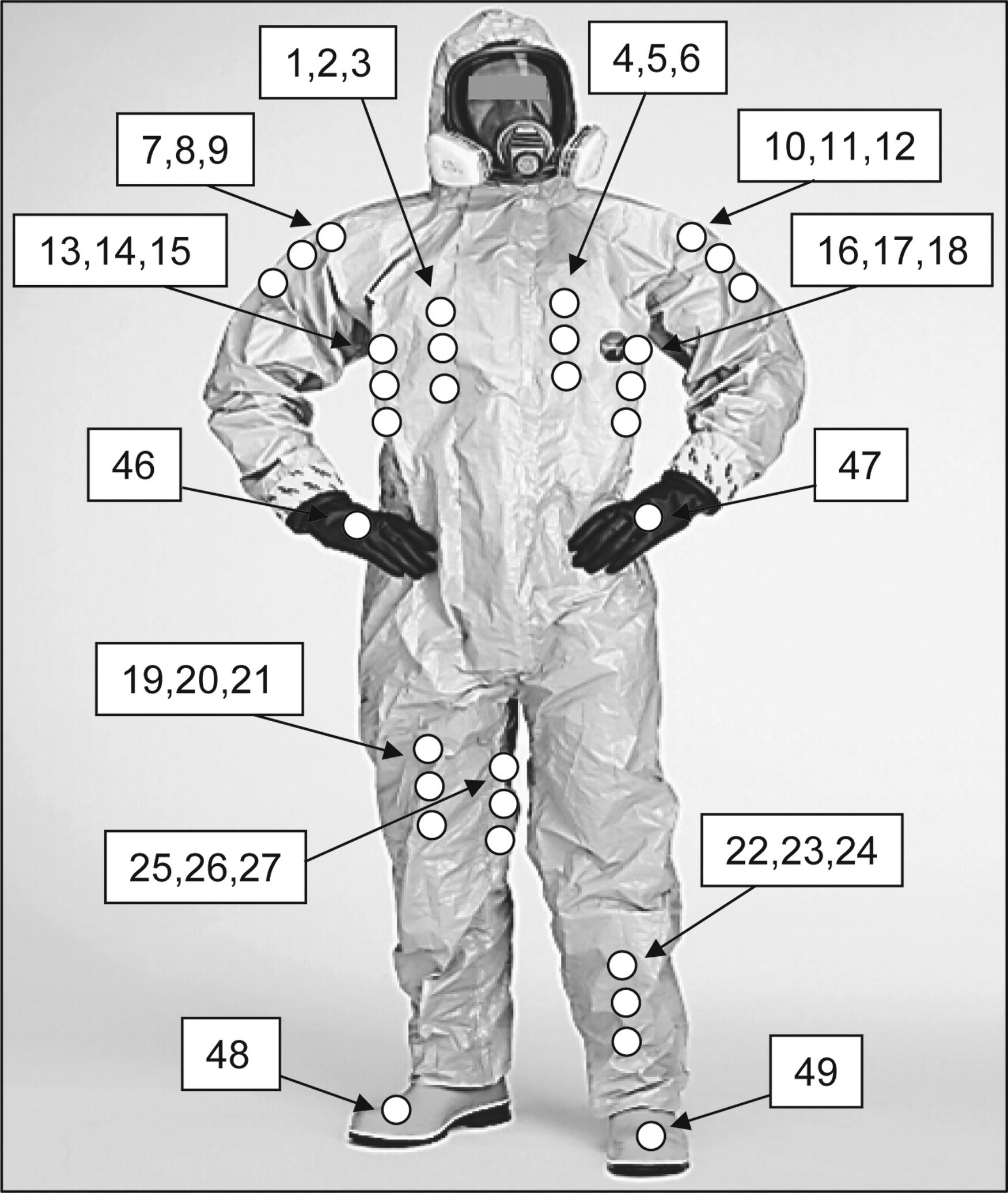
Representation of the sampling points on the front side of the PPE (photograph of the suit by courtesy of Du Pont de Nemours and Company)
Contamination of Suits
Spores of B. thuringiensis were used at a concentration of 1.0 to 2.0 × 10⁸ CFU ml−1. Only the top circle of each group was contaminated with the spore suspension in a pattern of 10 × 2-μl spots. The spores were fixed on the PPE surface by air-drying for approximately 50 minutes. The middle and bottom circles represented areas that might be contaminated by detached spores during the decontamination procedure (cross-contamination).
Decontamination
Treatment of suits with the different solutions was done with 4 liters of a mixture of 2% PAA/0.2% SLES, while controls were treated with 0.2% surfactant diluted in double-distilled water. A plastic watering can with a normal sprinkler head was used for disinfection by showering. The decontamination team wore Tychem® F suits and a full-face mask or a protective hood with overpressure created by a blower. Showering was performed without brushing (<1 min) or combined with brushing (1-1.5 min) as an additional step to enhance the homogenous distribution of the solutions on the PPE surfaces. For brushing, a flat brush of 10 cm length was used.
Showering was done by sprinkling the solutions from top to bottom (first by standing on a ladder and then by going around the mannequin). Exposure to the PAA/surfactant solution was limited to 3 minutes, and the time started from the beginning of showering. The treatment was stopped by sprinkling with 4 liters of double-distilled water.
Sampling
The surface of each circular area was wiped with a sterile new nylon flock fiber swab (Hain Lifescience GmbH, Nehren, Germany, part no. 502CS01) moistened with NM, starting with the bottom circle, then the middle, and finally the top circle. Each circular area was first wiped horizontally, followed by diagonal and vertical swabbing similar to the procedure described in the CDC standard method. 38 The swab head was transferred into a 50-ml plastic tube containing 10 ml of NM by cutting the swab shaft at the predetermined breaking point. After wiping, each circular area was cut out, always using a new set of sterile scissors and forceps, and transferred into the 20-ml plastic tube containing 10 ml of NM. The NM samples containing the swabs or the cut-out discs were shaken at 475 rev min−1 for 10 minutes to release spores from the swabs and the discs into the NM. Serial dilutions were prepared from the NM samples in TSB (0.5 ml in 4.5 ml), and all samples were incubated at 37°C for ≥7 days. To verify the growth of B. thuringiensis and to exclude cross-contamination with other microorganisms, 10 μl of the last dilution showing growth of bacteria were plated on TSA.
Estimation of Number of Viable Spores
The number of viable spores was determined either on a swab and/or on the corresponding cut-out circular area on the basis of growth of bacteria in the NM and the respective dilutions. If growth was observed in the first dilution step but not in the second one, the number of viable spores in a swab was estimated as 10, and if growth was found in the third dilution but not in the following one, the number of viable spores in the respective swab was set as 1,000. If no bacterial growth was detectable in NM containing the swab or the fabric disc and in the subsequent dilutions, the titer of viable spores was rated as zero.
PPE on Test Persons
Volunteer firefighters gave their declaration of consent to act as test persons wearing (1) the hooded suit Tychem® F (grey) with a mask, (2) the fully protective suit ProChem® III (red) also made from Tychem® F with a flow filter outside on the back, and (3) the fully protective and gastight suit Vautex Elite S (MSA Auer GmbH, Berlin, Germany) preferentially used against chemical and radioactive threats, where a compressed air breathing apparatus is worn inside. The experiments took place in an open tent.
Contamination
Suits were marked before dressing as described above. After dressing, each top circle was contaminated with 10 × 2 μl of the B. thuringiensis spore suspension. Additionally, boots were tested. After air-drying for approximately 50 minutes (depending on weather conditions), during which time the test persons used a standing aid, the decontamination procedure was started.
Decontamination
Decontamination was done with 2% PAA/0.2% SLES either by showering using a plastic can with 5 liters of disinfectant or by spraying under an operating pressure of 3 bar (pressure spray device DS 5, Kärcher Futuretech GmbH, Schwaikheim, Germany) with a starting volume of 2 liters of disinfectant. Both treatments were performed either without mechanical dispersal of the PAA/detergent solution or with dispersal (brushing) with a washing brush (Vetter, Zülpich, Germany).
Since wetting of the PPE on volunteers with disinfectant took more time than that required for the mannequin, the PPE was first wetted with the PAA/surfactant solution by showering or spraying without (1.5-2 min) or with brushing (2-3 min) and then incubated for 3 or 5 minutes, respectively. After wetting the head and front region, the volunteer turned around for treatment of the back, raised his arms, and put legs apart (as requested). The extended time of exposure (5 min) was used to repeat the decontamination treatment to ensure that the entire PPE surface was covered with the disinfectant.
Spraying was done with low pressure, but splashing in the immediate vicinity (within a diameter of about 1.5 m) could not be avoided.
To stop the treatment, the disinfectant was diluted by showering with tap water for 40 seconds (approximately 6 liters) in an inflatable tent. Sampling was done by swabbing the marked circular areas. Each swab was transferred into 10 ml of NM in a 50-ml plastic tube. The tubes were transported at 4°C to the laboratory, and the samples processed as described above.
Results
Inactivation Profiles of Bacillus Spores Attached to Carriers
As already shown, treatment of B. subtilis spores with 1% PAA/0.2% SDS inactivated the spores below the limit of detection (RF ≥6 log10) within 1 minute of exposure (Figure 2f). 15 B. anthracis strains showed a higher resistance against treatment with 1% PAA/0.2% SDS, as RFs between 1.6 log10 to 4 log10 were determined after treatment for 1 minute and RFs between 3.2 log10 and ≥6.2 log10 after 3 minutes (Figures 2a-d). Against 1% PAA/SDS, strain 527 appeared to be the most resistant one, followed by B22/39, B11/38, and the avirulent strain Stamatin Sokol.

Viable spores (log10 CFU ml−1) of B. anthracis strains 527 (a), B22/39 (b), B11/38 (c), and Stamatin Sokol (d) in comparison to B. thuringiensis strain DSM 350 (e) after treatment with 1% PAA/0.2% SDS (♦), 2% PAA/0.2% SDS (□), 2% PAA/0.2% SLES (▵) or 3% PAA/0.2% SDS (•) for 1 to 10 min. In comparison, the results obtained with spores of the B. subtilis strain ATCC 6633 are shown (f). The B. subtilis spores were incubated in 1% and 0.5% PAA/0.2% SDS (X) for 0.5 to 10 min. After 1 min with 1% or 2 min with 0.5% PAA no viable spores were detectable any longer. The standard deviations are shown only as plus (0.5%, 1% and 2% PAA/SDS) or minus (2% PAA/SLES and 3% PAA/SDS). The tests were performed as described in Material and Methods. The points connected by lines in the diagrams represent the mean of the results of 1 or 2 independent assays with B. anthracis (2 carriers per dose and time) and 2 independent tests with B. thuringiensis and B. subtilis (4 carriers per dose and time). The results could be confirmed by testing several independent preparations of B. thuringiensis and B. subtilis spores.
Increase of the PAA concentration to 2% resulted in faster inactivation, but after incubation for 1 minute, viable spores of all strains were still detectable. However, prolongation of the incubation time to 2 minutes resulted in a complete inactivation of spores of strains B22/39 and Stamatin Sokol and a marked reduction in viable spores of strains B11/38 and 527, which appeared to have the highest resistance against treatment with 2% PAA/0.2% SDS.
Increasing the PAA concentration to 3% reduced the number of viable spores of strain Stamatin Sokol below the limit of detection (LOD) already within 1 minute of exposure (Figure 2d). Further spore characterization would be needed to clarify the possibility that these results are dependent on strains rather than on differences in individual spore preparations. The inactivation profiles of B. anthracis, B. thuringiensis, and B. subtilis spores did not follow first-order kinetics, as was already shown earlier for the inactivation kinetics of B. cereus strains with PAA at different concentrations. 24
Investigation of the sensitivity of B. thuringiensis showed that the titer of viable spores was reduced by a factor of approximately 3 log10 when treated with 1% PAA/0.2% SDS for 1 minute, and the titer decreased below the LOD only after incubation for 10 minutes (Figure 2e). Increase of the concentration of PAA to 2% led to a significant reduction in the titer of viable spores within 3 minutes of incubation. The pattern of inactivation determined for B. thuringiensis was comparable to that of B. anthracis strains 527 and B11/38. The inactivation profile of spores of the B. subtilis strain ATCC 6633 showed a significantly higher sensitivity to PAA than the spores of B. anthracis and B. thuringiensis strains and was comparable to the inactivation profile described in an earlier investigation (Figure 2f). 15
Exchange of SDS for SLES did not significantly change the inactivation capacity of the PAA solutions against spores of either B. anthracis or B. thuringiensis (Figure 2). In principle, a good correlation was observed between the reduction of the titer of spores (by counting of colonies on TSA) (Figure 2) and the growth of bacteria in the liquid media, estimating the spore content as described above (data not shown). A comparison of the inactivation profiles of spores of B. anthracis and of B. thuringiensis revealed that B. thuringiensis appears to be an appropriate surrogate when investigating the decontamination of PPE under field conditions.
Decontamination of PPE on Mannequin
The hooded Tychem® F suits (similar to that shown in Figure 1) and the protective Tychem® C (Astro Protect®) full suits used in these experiments have comparable surface properties but differ in their flexibility and pressure resistance. Tychem® C suits are lighter, and the fabric is less rigid.
In the control experiments with Tychem® F suits, we investigated the effect of showering with a surfactant solution (0.2% SLES in double-distilled water) on the number of spores present in the contaminated circles, the carry-over to adjacent areas marked on the PPE, and the effect of brushing (Table 2). Furthermore, the analysis included the estimation of the number of spores collectible by swabbing the predetermined sampling points and of those attached to the fabric by cutting out the corresponding circles. In general, the number of spores recovered by swabbing was comparable to those still adhering to the fabric after swabbing. As expected, the highest number of spores was determined on the top circles originally contaminated with the spore suspension, with decreasing numbers from the top (105 to 106) to the middle (104 to 105) and lower (102 to 104) sampling points (Table 2). Therefore, showering with the surfactant solution caused partial detachment of the spores, leading to cross-contamination on the PPE surface. Showering in combination with brushing reduced the number of spores in the sampling areas by a factor of 102 to 103.
PPE on mannequin. Estimation of viable spores of B. thuringiensis after treatment with 0.2% surfactant solution
The order of the circles is shown in Figure 1.
Sampling regions not marked on the suit in Figure 1, corresponding to sampling regions Thigh right and Thigh inwards right.
Decontamination of the Astro Protect® C and Tychem® F suits with 2% PAA/0.2% SLES was investigated (Table 3). Determination of the number of spores on the different sampling points followed the strategy described above. As a control, a contaminated circular area on the lower right leg was treated only with the detergent solution, and spores were sampled before starting the decontamination process (Table 3, columns 1-4). As expected, showering with brushing slightly reduced the number of viable spores on the surface of the boots.
PPE on mannequin. Decontamination efficiency of 2.0% PAA/0.2% surfactant against spores of B. thuringiensis dried on PPE
The order of the circles is shown in Figure 1.
0 = no growth was observed in the respective sample or in all 3 samples from a given region either in the undiluted NM/PAA sample or in the TSB dilutions, 1 = growth was only observed in the undiluted sample, and 10 = growth was detectable up to the dilution 1:10 etc. n.d. = not done.
Gloves were marked with only 1 circle.
The control was treated similarly to the suits in Table 2.
Treatment of the Tychem® C suits with the disinfectant (2% PAA/0.2% SLES) with and without brushing reduced the number of viable spores below the LOD for the majority of sampling points (Table 3, columns 1-4). However, it revealed that the axle and thigh regions, and especially the inner thigh region, are critical areas for decontamination by showering. Especially the more rigid Tychem F® suits showed overhangs or folds in the leg regions. However, careful dispersal of the disinfectant by brushing ensured a better and more homogenous distribution of the disinfectant solution (Table 3, columns 5-8).
Decontamination of PPE on Volunteers
The analysis of the decontamination of PPE on the mannequin had revealed that the swabs and the corresponding cut-out circular areas showed comparable numbers of viable spores (Tables 2 and 3). With volunteers, collection of spores from the predetermined sampling points was therefore done only by swabbing (Table 4). The schedule of the decontamination procedure on the mannequin was slightly changed for volunteers: PPE was first wetted by showering or spraying without or with brushing and only then the exposure time of 3 or 5 minutes, respectively, started.
PPE on volunteers. Decontamination efficiency of 2.0% PAA/0.2% surfactant against spores of B. thuringiensis dried on PPE
The order of the circles is shown in Figure 1.
0 = no growth was observed in the respective sample or in all 3 samples from a given region either in the undiluted NM/PAA sample or in the TSB dilutions, 1 = growth was only observed in the undiluted sample, and 10 = growth was detectable up to the dilution 1:10 etc. n.d. = not done.
Gloves and boots were marked with only 1 circle.
A backpack-like bulge is integrated in the Vautex Elite containing the compressed air breathing apparatus, which is worn inside.
Showering with the disinfectant without brushing followed by 3 minutes of exposure decontaminated the surface of the hooded Tychem® F suit including gloves and boots (Table 4, column 1). A significant number of viable spores was detected only at 1 sampling point (inner right thigh). Low numbers of spores could be found at the sampling point on the left boot. No viable spores could be isolated from any other sampling point.
Spraying without brushing seemed to be less effective than showering, since up to 103 viable spores could be isolated from 3 sampling areas (Table 4, column 2). No spores or only low numbers of viable spores were detected at most of the sampling points. In a comparable experiment with prolonged exposure time, spraying without brushing was effective, too (Table 4, column 5). Only in 1 area (lower left leg) could a high number of viable spores be isolated.
The results shown in Table 4 (columns 3 and 4) revealed that careful wetting of the whole PPE is a prerequisite for the successful decontamination of suits. Due to technical problems with the shower technique, a defect of the sprinkler head prevented continuous pouring of the disinfectant (Table 4, column 3). In experiments using the spraying technique, a loss of pressure was observed which had to be built up again (Table 4, column 4). In both cases, several sampling areas were found with a high remaining load of viable spores, but there were also areas with no or only low numbers of viable spores.
In a series of experiments, the effect of brushing was investigated during decontamination of 3 different models of protective garments (Table 4, columns 6-8). Spraying in combination with brushing and repeating the procedure within the 5-minute exposure time increased the likelihood of obtaining a homogenous disinfectant layer all over the PPE. With this optimized technique, an effective decontamination was achieved, using only approximately 1.5 liters of disinfectant. Viable spores at the LOD were detected at only a few sampling points (Table 4, columns 6-8). From these findings, it can be assumed that the disinfectant and the technique of its application play a major role in effective decontamination, as no significant differences were observed when investigating protective garments like the Tychem® F suits or the Vautex Elite suit, which are produced from different protective fabrics but with similar hydrophobic flexible surfaces (Table 4, columns 6-8).
Discussion
A variety of studies have investigated the stability of bacterial spores treated with different disinfectants, focusing on the identification of organisms that can serve as an appropriate surrogate for B. anthracis in the evaluation of decontamination procedures.13,14,39,40 We investigated spores prepared from several B. anthracis strains and found that the spores of the investigated avirulent strain Stamatin Sokol showed a higher sensitivity against PAA than the virulent strains. Differences between avirulent and virulent spores were also described by March and coworkers, who used glutardialdehyde, ortho-phthalaldehyde, and sodium hypochlorite for the inactivation of spores in suspensions and reported that virulent B. anthracis strains showed a higher resistance than avirulent strains. 41 Treatment of virulent and avirulent B. anthracis strains and other Bacilli for 30 minutes showed no differences as prolonged incubation might possibly have masked differences in stability between Bacillus strains or isolates. 12
Our investigation revealed a PAA resistance profile of B. thuringiensis comparable to that of the investigated virulent B. anthracis strains, whereas B. subtilis spores showed a higher sensitivity. These results implied that the B. thuringiensis strain appears to be an appropriate surrogate for field studies to decontaminate PPE.
Decontamination of PPE Under Field Conditions
Little information is available in the literature on the decontamination of PPE after exposure or suspected exposure to biological agents like spores of B. anthracis. In the majority of reports, inactivation experiments were performed in the laboratory using different spores and different disinfectants, which were considered as a feasible basis for the decontamination of PPE. Different materials from the urban (outdoor, indoor) and military environment, stainless-steel discs, medical devices, and sample packaging materials were used or tested as carriers but, to our knowledge, only a few carriers were prepared from materials used for the production of PPE.12,13,42-45
In a comprehensive study of PPE on personnel, aerosol was contaminated with B. subtilis in a test chamber. 46 After treatment with a 0.5% solution of sodium hypochlorite, a distinct overall reduction in viable spores could be determined by swabbing, but viable spores were still isolated from several sampling points.
Based on our comparative studies on the sensitivity of B. anthracis and B. thuringiensis spores, the latter appeared to be an appropriate surrogate for B. anthracis spores in field studies. In basic experiments using a mannequin dressed in Tychem® suits, we investigated the mode of contamination, methods of decontamination, and determination of viable spores. In control experiments in which only the effect of the detergent solution (0.2% SLES in double-distilled water) with and without brushing was investigated, it could be shown that showering washed away a significant amount of spores from the points of contamination, resulting in cross-contamination of parts of the PPE below the point of contamination, which is detectable at the middle and lower sampling points of each area and most probably also on other parts of the suits. Treatment of Tychem® suits by showering with the disinfectant reduced the number of viable spores to an undetectable level on the majority of sampling points, regardless of whether swabs or cut-out sampling points were analyzed. Targeted brushing enhanced the probability that all parts of the PPE suits were covered by the disinfectant.
Having determined the recovery of spores by the swabbing technique used in our studies in comparison to the recovery of spores determined on the corresponding cut-out discs, swab analysis appeared to be a suitable measure for the determination of viable spores on the suits. 38 Therefore, swab analysis—as used in the field trials with PPE dressed on volunteers—can provide sufficient information on the decontamination efficiency of disinfectants.
With the mannequin as well as with volunteers dressed in suits from different fabrics, no significant differences in the decontamination capacity of the disinfectant were observed.
It is worth mentioning that less than 2 liters of disinfectant were needed when using the spraying technique in comparison to 5 liters when showering. Therefore, spraying resulted in a lower amount of waste. Since splashing in the immediate vicinity is hardly avoidable with both decontamination techniques, a protective barrier is useful.
Decontamination of PPE with PAA/surfactant appeared to be secure and effective. The procedure is not difficult to perform but requires training in order to carry out decontamination in disaster situations. 9 Careful application of the disinfectant can reduce the emergence of aerosol containing potentially infectious/dangerous materials. Using the optimized decontamination conditions (repeated spraying and brushing within 5 minutes of exposure) seems to carry little risk of a spore concentration that is high enough to infect humans. Furthermore, the significant reduction in viable spores on PPE reduces the risk of cross-contamination of first-line responders during the doffing of the protective clothing and for the personnel assisting the rescue squad. 2
In conclusion, investigation of the composition of the PAA-based disinfectant depending on PAA concentration and contact time revealed a comparable inactivation profile of B. anthracis (RG 3) and B. thuringiensis (RG 1). This finding emphasized the suitability of B. thuringiensis to serve as a surrogate for B. anthracis in the evaluation of the inactivation capacity to decontaminate PPE with PAA/surfactant under field conditions. Furthermore, in this and in recent investigations, it was shown that efficient decontamination of PPE with PAA/surfactant is possible, not only when contaminated with spores of B. anthracis but also when there is a potential contamination of PPE with viruses like poxviruses or the proteinaceous toxin ricin. 15
Footnotes
Acknowledgments
This project was funded by the German Federal Office of Civil Protection and Disaster Assistance (BBK), order number: BBK F 2-440-00-337. We are grateful to Renate Heinrich (†deceased 1 February 2017) for her excellent assistance and to Herbert Nattermann. Special thanks to the Berliner Feuerwehr (fire department), especially to Frieder Kircher, Directorate North, Wolfgang Maziejewski, and the volunteers from the Department Weißensee for their collaboration and generous support. We thank Hans-Rainer Steffens for providing the Tychem® F material, and especially Ursula Erikli for copyediting. We are grateful to Nahid Derakshani from the BBK and the members of its advisory board: Bärbel Niederwöhrmeier, Bernd Haupt, Markus Stemmler, Gerhard Ülpenich, Klaus-Michael Wollin, and especially Reinhard Steffler.