




Abstract
Nigeria is working to protect against and respond more effectively to disease outbreaks. Quick mobilization and control of the Ebola epidemic in 2014, at least 4 major domestic outbreaks each year, and significant progress toward polio eradication led to adoption of the World Health Organization's Global Health Security Joint External Evaluation (JEE) and National Action Plan for Health Security (NAPHS). The process required joint assessment and planning among many agencies, ministries, and sectors over the past 2 years. We carried out a JEE of 19 core programs in 2017 and launched a detailed NAPHS to improve prevention, detection, and response in December 2018, which required us to create topic-specific groups to document work to date and propose JEE scores. We then met with an international team for 5 days to review and revise scoring and recommendations, created a 5-year implementation plan, developed a management team to oversee implementation, drafted legislation to manage outbreaks, trained professionals at state and local levels of government, and set priorities among the many possible activities recommended. Management software and leadership skills were developed to monitor global health security programs. We learned to use international assistance strategically to strengthen planning and mentor national staff. Finally, a review of every major disease outbreak was used to prepare for the next challenge. Review and adaptation of this plan each year will be critical to ensure sustained momentum and progress. Many low-income countries are skilled at managing vertical disease control programs. Balancing and combining the 19 core activities of a country's public health system is a more demanding challenge.
Nigeria is working to protect against and respond more effectively to disease outbreaks. Quick mobilization and control of the Ebola epidemic in 2014, at least 4 major domestic outbreaks each year, and significant progress toward polio eradication led to adoption of the WHO's Global Health Security Joint External Evaluation and National Action Plan for Health Security. The process described here required joint assessment and planning among many agencies, ministries, and sectors over the past 2 years.
Following recommendations by the International Health Regulations (IHR) Review Committee at the 68th World Health Assembly in 2015, African heads of state issued a declaration committing countries to accelerating implementation of IHR throughout the region. 1 The government of Nigeria committed to improve national health security by carrying out a Joint External Evaluation (JEE) and developing a National Action Plan for Health Security (NAPHS). Here we recount the steps Nigeria has taken toward fulfilling this goal.
The process of preparing for a JEE began in Nigeria in 2017. From the start, several United Nations (UN) and public health organizations provided assistance. However, the key ingredient of the JEE in Nigeria was widespread support and participation among leaders of relevant state and federal institutions.
Nigeria has a high population density, and 1 of every 6 people in sub-Saharan Africa is Nigerian. It is the 7th most populous country in the world and is growing rapidly. 2 With more than 300 ethnic groups and diverse geography, including desert, savanna, and rain forest, the country is highly diverse in ecology and culture.
Nigeria has a federal system of governance, in which 36 states each have their own budgets, priorities, responsibilities, and authority for health sector interventions. There are also government and nongovernment institutions with interests in most of the JEE technical areas. The key in this context was to stimulate a critical mass of these diverse groups to take part and take ownership of the JEE process.
Nigeria's Commitment to Building Health Security
Quick mobilization and control of the Ebola epidemic in 2014 3 and progress toward polio elimination strengthened the country's commitment to health security. This enthusiasm led to Nigeria's recent efforts in developing a strong system of surveillance, strengthening emergency response operations, and developing its workforce through the Nigeria Field Epidemiology and Laboratory Training Program (FELTP), in which medical doctors, laboratorians, and veterinary experts are trained. FELTP currently admits approximately 60 residents per year to the 2-year program, and the country has about 350 graduates.
Polio cases in Nigeria declined from 122 in 2012 to 53 in 2013, with a further reduction to 6 in 2014 and 0 in 2015. 4 Partly because of a lack of access to areas affected by an insurgency in the northeast of the country, 4 new cases of polio were confirmed in August 2016 in Borno State. A renewed focus on immunization in conflict areas has again interrupted wild polio virus transmission, and no new cases have been identified since 2016. 5
The Nigeria Centre for Disease Control (NCDC) was founded in 2011. 6 It currently has 211 staff. It increasingly has a central role in coordinating many public health activities formerly run mainly through vertical and sometimes independent organizations.
Process and Results of JEE
As in other countries, the first step in the JEE process was to create workgroups for the country's JEE self-evaluation. Each group was composed of 4 to 8 people, with a representative of the major responsible ministry, and each group included an NCDC staff member as coordinator. Each workgroup was to prepare the country's presentation and propose scores for 1 of the 19 topical areas of the JEE. With broad participation in this process, these workgroups created a strong base for review by the international team that followed. The JEE field mission was completed in June 2017. The JEE report was approved and then published in December 2017 (Figure 1). Major conclusions, agreed on by the international and domestic teams, covered many areas, and the country had an average score of 1.9, which fell in the category of “not prepared” (Figure 2). 7

Timeline

Recommendations from the Joint External Evaluation
More than 6 months passed from the completion of the JEE mission to the beginning of preparations to develop an NAPHS. This delay led to a loss in momentum for interagency collaboration. However, after the JEE, the NCDC was occupied with responding to several outbreaks, including meningitis, monkeypox, yellow fever, lassa fever, and botulism, as well as managing key public health services during the insurgency and resettlement in the northeast. These demands helped identify the key gaps and activities for the NAPHS to address.
Early Progress Stimulated by the JEE
The focus provided by the JEE and the need to respond to these emergency health situations led to improvements in the areas of deficit identified by the JEE in advance of the NAPHS process. These included the following:
Legislation was presented to Nigeria's National Assembly to establish independent authority for the NCDC, with 2 readings and a public hearing. Authority was provided in February 2018 and was signed by the president in October 2018, providing NCDC a legal mandate to lead activities for health security. Plans for laboratory system coordination were developed, and new funders are being identified to support this. Plans include support for Nigeria CDC network lab “hub and spoke” model, with the national lab at the top of a hierarchy and the designation of 1 regional lab per geopolitical zone; improving specimen transport and referral systems; and integrating surveillance and laboratory data and improving data quality. Surveillance overall continuously improved and was integrated into regular functions of the NCDC. A new web-based tool was piloted for this purpose. Intermediate FELTP was designed, and advanced training and mentoring were strengthened. Two people were hired at the NCDC to develop state-level emergency operations centers (EOCs) in coordination with the national EOC. A national action plan for antimicrobial resistance was completed, and it is integrated into the NAPHS. Nigeria joined the Global Health Security Agenda (GHSA) countries. Nigerians took part in several other countries' JEEs, gaining in knowledge and expertise. World Bank support, in its Regional Disease Surveillance Systems Enhancement (REDISSE) program,
8
was redesigned to follow JEE result priorities. The US nongovernmental organization Resolve to Save Lives provided support for 3 staff members now part of the NCDC/REDISSE team.
Creating a National Action Plan
On January 2018, a workshop was held to release the JEE report and initiate development of the national action plan. Priority actions specified for each of the 19 JEE areas were reviewed by work groups, with 2 criteria for implementation: Was action urgent or not? And was it difficult or not?
The products of that workshop were examined to prioritize actions (Figure 3). The criterion of “urgency” was further specified in actions that could be started immediately or required outputs from another action before they could begin. Further, some implementation had already started, demonstrating that the JEE had stimulated actions that did not need finalization of the NAPHS.
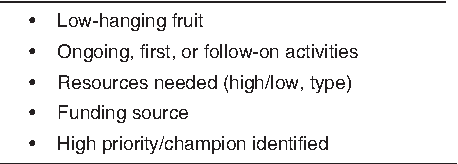
Criteria Used for Prioritization
Ease or difficulty was further examined to specify the level and type of human and material resources needed. If national resources are used, or if external resources must be generated to carry out an action, this was specified, and potential sources of support were identified. Finally, an estimate of the level of interest among key players, and the existence of a champion to promote the activity, were specified.
While the plan was envisioned as a 5-year development activity, implementation activities could only be realistically developed in detail for 2 years. Planning for years 3 to 5 would depend largely on results from the first 2 years. This differs from WHO's costing exercise, which attempted to estimate costs for the entire 5-year period.
Actions specified in the JEE were found to provide only limited guidance for implementation. Consultants referred to the WHO benchmark list, intended to bridge JEE recommended actions with actions at each capacity level needed to reach the next level. In fact, correspondence between JEE recommendations and the stepwise benchmarks was set as a goal from the Nigerian experience to assist other countries engaged in a similar process. This greatly assists in identifying practical activities for realistic program planning.
Incorporating Other Planning Efforts
In 2017 the World Bank Regional Disease Surveillance Systems Enhancement (REDISSE) program was initiated to strengthen disease surveillance and epidemic preparedness.
9
Nigeria was approved for US$90 million of support for strengthening:
surveillance and information systems; laboratory capacity; preparedness and emergency response; human resource management for effective disease surveillance and epidemic preparedness; and institutional capacity building, project management, coordination and advocacy.
Given the significant overlap among the objectives of the REDISSE loan and the NAPHS, both planning activities were coordinated by NCDC. This ensured that key activities for pandemic preparedness from the national action plan could be funded through REDISSE. Cost estimates for the plan had already been developed for REDISSE; this then assisted the creation of cost estimates for the wider national action plan.
Organizing the NAPHS
The NAPHS process led to a list of activities that was too detailed, and in too many technical areas, for any single person or group to populate adequately. A decision was taken to reactivate the initial groups that started the JEE self-evaluation process. They reviewed actions that were initially drafted, reduced overlap, and identified areas of joint work across topical areas. In the end, they were able to reduce the plan from 1,000 to 600 activities, using criteria of prioritization of importance, cost, and readiness to implement. Yet 600 activities were still far too many to implement effectively. Many activities thus remain in the written plan without specific implementation actions in the plan. 10
In February an orientation workshop was held, and groups began to work. Two other national workshops were held during the year to develop plans for activities and identify their costs. In December 2018, the NAPHS was launched by Nigeria's Ministry of Health. 11
Discussion
After 2 arduous years, Nigeria has reached the end of the beginning, with a plan to strengthen 19 technical areas of public health security. Institutional and organizational development to plan and implement these activities has been substantial. We can now look back at what we have achieved and forward to the many tasks ahead.
The process of preparing for and carrying out JEEs is well established and structured in a similar manner across countries. The NAPHS, by contrast, is still highly individualized by the planning processes of each country. The experience of Nigeria and other early-adapter countries should contribute to further standardizing the NAPHS process.
Looking back, we can see that the planning process could have been more effective and efficient. Wide participation characterized the JEE; it was assumed that the widest possible participation in planning for NAPHS was also needed. Indeed, validation needs wide agreement, but the process of planning can be done better with a core group of technical and political leaders. Because the process was long, and only started half a year after the JEE team left the country, momentum was lost, and personnel in technical groups changed repeatedly. Developing the NAPHS in Nigeria is believed to have consumed 2,800 person-hours over a year; a more effective multistage process could produce a more operative plan more rapidly.
More specific recommendations from the JEE support team, oriented toward implementation, and general costing guidelines would have helped to initiate a more practical and rapid planning process. When recommendations instead are too specific or too general to be applied, an additional step is imposed on the process.
The elaboration of detailed cost estimates and activity plans for all 5 years was not possible, and in our opinion not necessary, as many of these activities will only be addressed later, when more realistic and timely cost estimates will be possible. In practice, the plan mainly developed activities for the first 2 years and at the national level. Activities for later years, and for local implementation throughout the country, will have to come later. We intend to treat the NAPHS as a living document, to be reviewed every 6 months by the multisectoral Health Security Committee.
Looking forward, guidance on implementation will mainly be provided through reviews of activities undertaken in each prior year. After-action reviews following disease outbreaks, and periodic program reviews in geographic and topical areas, will provide guidance to periodically modify implementation plans.
The JEE began an intersectoral process, but sustained engagement in these new relations is challenging. Piggybacking on the World Bank's REDISSE project has made such collaboration more possible.
Management software and in-service training for project monitoring and supervision are now being developed to monitor global health security programs. We learned to use international assistance aggressively to strengthen planning and mentor national staff. Finally, a review of major disease outbreaks was used to prepare for upcoming challenges. Review and adaptation of this plan each year will be critical.
Many low-income countries are skilled especially at managing vertical disease control programs. This has been encouraged by global health organizations seeking progress in disease-specific programs. Balancing and combining the 19 core activities of a country's public health system is a more demanding challenge, as it requires both vertical programmatic and horizontal systems development activities. We believe this is the only way to make global health security programs work. Over the past 30 years, great progress has been made through targeted vertical programs. Our new challenge is to integrate vertical and horizontal programs to prevent, detect, and respond more effectively to global health threats.