




Abstract
Emergency service personnel who respond to terrorist attacks may experience persistent stress following the event. This occupational stress must be examined in order to develop occupation-specific response preparation and follow-up measures. An explorative pilot study examined the occupational stress-related effects of the 2016 terrorist attack on Breitscheidplatz in Berlin on emergency service personnel. The present study examines whether the results of the pilot study can be replicated and whether the effects changed after 2 years. The participants were 60 emergency personnel (including 11 police officers and 24 firefighters) who were deployed to the attack, and a control group of 60 personnel (including 37 police officers and 21 firefighters) who were not deployed. Data on stress, quality of life, and current mental state were gathered 3 to 4 months after the attack and 18 to 21 months after the first survey. The data showed that police officers who responded to the attack had significantly higher levels of aggression and hostility at both time points, and firefighters had significantly lower levels of environmental quality of life at both time points. Quality of life in terms of physical health for firefighters could not be replicated. Due to the different types of stress experienced by emergency service personnel, a differentiated approach is necessary. More specific preparation and follow-up measures are necessary to counteract persistent stress. Further research in this area could lead to specific predeployment and postdeployment training measures.
Introduction
Terrorist attacks and mass shootings are no longer unusual, nor are they limited to specific countries or regions. The psychological effects that such attacks have on emergency service personnel, victims, their families, and the general public are being investigated in various studies.1-4 It is generally recognized that the negative implications of terrorist attacks are worse compared with those of accidents and natural disasters. 5 Nevertheless, the rescue personnel concerned underestimate the need for self-care. 6
Firefighters have an 85% risk of experiencing a critical event over a 2-month period. Age, rank, years of service, and gender have no influence on the exposure rate. 7 Work-related traumatic events are also the most reported stressors among police officers and emergency service personnel. These events are associated with elevated rates of posttraumatic stress symptoms and distress. 8 For emergency service personnel, various reactions to potentially traumatic incidents have been described, ranging from increased hostility to somatic complaints and posttraumatic stress disorder.9,10 There are few systematic analyses of differences between genders or occupational groups,1,11 and the results are often inconsistent. For example, available data on whether the length of professional experience is a resilience factor 12 or a vulnerability factor 13 is controversial. Some studies reported that professionals were less susceptible to posttraumatic stress disorder than voluntary responders14,15; other studies, however, reported increased vulnerability. 16
To our knowledge, a comparative study that differentiates between occupational groups and incidents has yet to be carried out. There is much literature regarding the 9/11 responders in the United States,17-19 but only a few studies have examined the psychological reactions of emergency service personnel to terrorist attacks in Europe, and almost all of them focus on posttraumatic stress.2,20,21 One reason for this paucity is the difficulty of conducting prospective studies. To determine the true consequences of such incidents, a general screening would be required at the beginning of training, which would then need to be repeated at regular intervals, such as the global assessment tool of the US forces, 22 or the psychological fitness approach of the German armed forces. 23
On December 19, 2016, a truck was deliberately driven into the Christmas market at Breitscheidplatz in Berlin, leaving 12 people dead and 56 others injured. The authors conducted an exploratory pilot study after the attack to decide whether it was possible to differentiate between occupational groups and their reactions to the incident. The survey had 1 time point, included 37 emergency service personnel, and did not have a control group. The analysis revealed increased hostility and aggression among police officers and a lower quality of life among firefighters related to both their environment and physical health. 24 The purpose of the present study is to examine whether these results—elevated aggression and hostility among police officers, and lower quality of life (in terms of their environment and physical health) among firefighters—can be replicated. An additional goal is to examine whether these variables changed over a 2-year period compared with a control group not involved in the attack.
Methods
A total of 435 emergency service personnel were deployed after the 2016 terrorist attack at Breitscheidplatz in Berlin. Notably, this number did not include police officers, and this information was unavailable. All emergency service personnel of the fire brigade, the police, nongovernmental organizations, and the military and civilian rescue services who responded to the attack were given the opportunity to participate in this study. A control group was formed with service personnel from the same units and positions but who did not take part in the response, due to different shift hours. Recruiting took place after the various institutions gave consent. After the head officials were consulted, potential participants were invited to attend informational sessions to learn about the study. Participation in the informational sessions and the study was voluntary; participants were included in the study after they gave their written consent. The first survey was carried out 3 to 4 months after the terrorist attack. The second survey was 18 to 21 months later and included only those who participated in the first survey. Participants received the second questionnaire by mail.
A total of 120 emergency service personnel participated in the first questionnaire: 60 response personnel and 60 control group participants. Thirty-nine response personnel and 33 control group participants took part in the second questionnaire. Gender and occupational group affiliation of the participants are shown in Table 1.
Distribution of Personnel According to Gender, Occupation, and Deployment to the Terror Attack
Abbreviation: PSNV, Psychosocial Emergency and Crisis Network [Psychosoziale Notfallversorgung].
The survey consisted of a questionnaire with a biographical section and the following measurement instruments:
Quality of life was assessed using the World Health Organization Quality of Life (WHOQOL-BREF) questionnaire. This questionnaire comprises 26 items that are rated on a 5-point Likert scale. It is a disorder-independent instrument that focuses on the past 2 weeks. The 4 domains analyzed are physical health, psychological health, social relations, and environment. Together, these domains provide a global scale for quality of life. Internal consistency is acceptable to good, with a Cronbach alpha (α) between 0.77 and 0.87 for the subscales. The values were collected from a large German sample of 2,073 people.
25
Current mental state was assessed using the Brief Symptom Inventory. It comprises 53 items and assesses symptoms of psychiatric disorders and includes the following subscales: somatization, obsession-compulsion, interpersonal sensitivity, depression, anxiety, hostility, phobic anxiety, paranoid ideation, and psychoticism.
26
Statistical analysis was carried out using IBM SPSS Statistics for Windows version 21.0 (Armonk, NY, USA). We used the first-observation-carried-forward method to impute data for missing values for the second time point. To assess any influence that the participants who dropped out may have had on the sample, we compared relevant psychometrical and sociodemographic parameters of participants and dropouts using independent sample Student's t tests for metric and chi-square (χ 2 ) tests for categorical parameters. The same procedure was followed to test for differences between the deployed and nondeployed groups, excluding aggression and hostility, and environmental and physical quality of life. We used a linear regression analysis to test whether the results obtained by nonparametric tests in the previous study could be replicated, and whether these differences were also present in the control group. Explanatory variables were the occupational groups; the dependent variables were aggression and hostility (for police officers) or environmental and physical quality of life (for firefighters). For this purpose, occupational status was divided into dichotomous categories for police officers (police officers versus members of all other professional groups) and firefighters (firefighters versus members of all other professional groups). Due to the small sample size, the analyses for the study group and the control group were carried out separately.
Results
The study group and control group did not differ in age (T = 1.68; P = .10), rank (T = 0.83; P = .41), year of service (T = 0.52; P = .61), or gender χ2(1,n=119) = 0.83, P = .36). There were also no significant differences between the imputed and nonimputed data for the relevant categories at the first time point, as shown in Table 2.
Independence Sample Student's t Test with No Significant Differences Between Participants Who Completed the Study Versus Dropouts
Note: Differences in N are due to missing data.
Abbreviations: df, degree of freedom; N, sample size; SD, standard deviation.
The occupation-specific analysis of the response personnel showed increased hostility and aggression among police (F1,57 = 17.3; P < .001; R2 = .23). For the control group, this influence was not found (F1,58 = 2.3; P = .139), as shown in Figure 1.
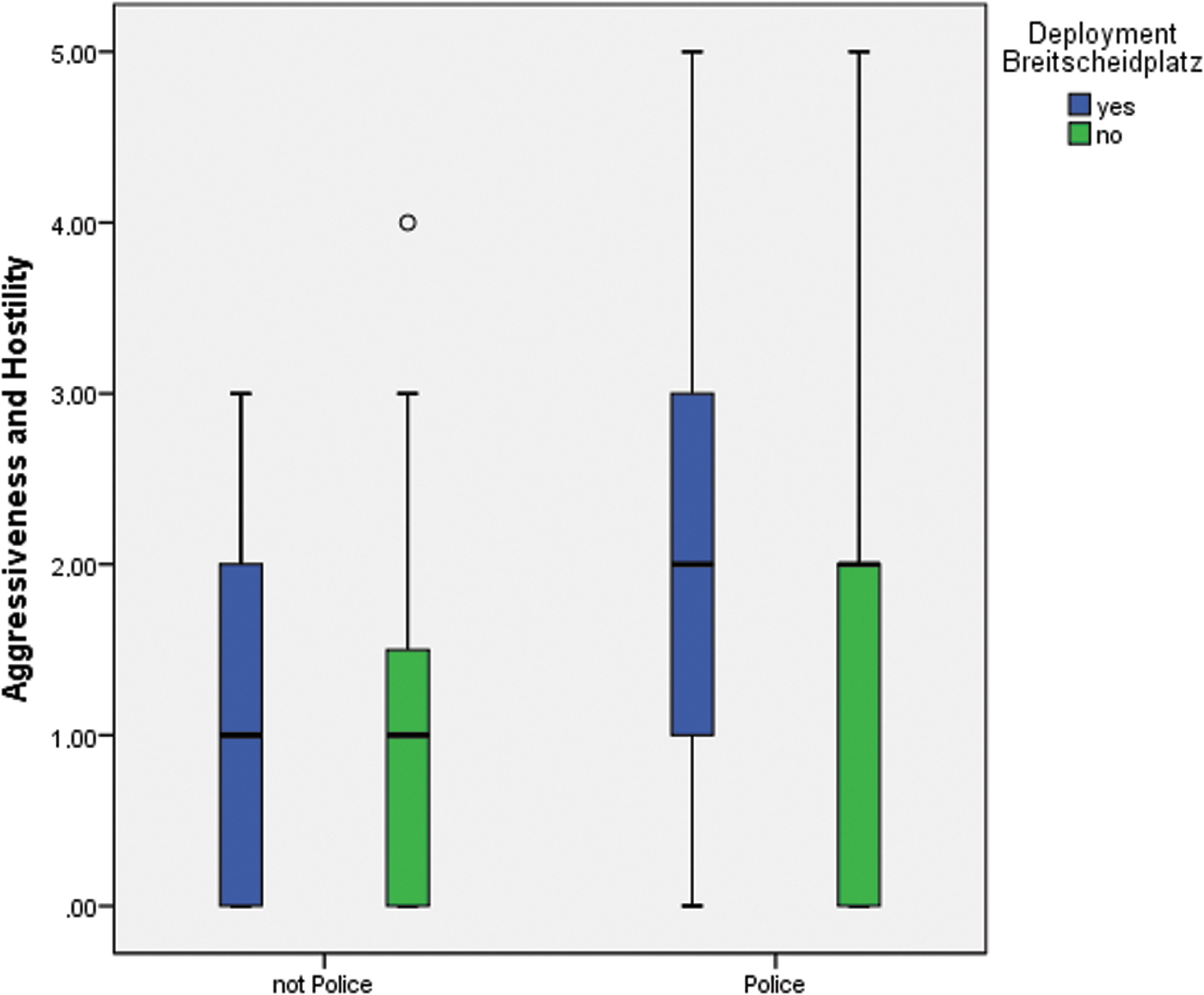
Box plot with significantly higher aggressiveness and hostility of exposed police forces 3 months after the terrorist attack on Breitscheidplatz Berlin 2016.
Firefighters, compared with other response personnel, had significantly lower levels of quality of life in the environment domain of the WHOQOL-Bref (F1,57 = 5.9; P = .018; R2 = .09). This was not the case in the control group (F1,58 = 1.3; P = .251). However, the influence of the occupation of firefighter on quality of life in terms of physical health could not be replicated (F1,58 = 1.7; P = .137). Table 3 shows these results in detail.
Linear Regression Analysis of Occupational Groups and Their Symptoms 3 to 4 Months After the Terrorist Attack
Abbreviations: CI, confidence interval; df C, counter degree of freedom; df D, denominator degree of freedom (differences may arise from incomplete questionnaires); RC B, regression coefficient B.
Finally, we tested whether the significant results at the first time point could still be seen 2 years after the attack (Table 4). The association between police in the study group and hostility and aggression was still present even 2 years after the attack (F1,57 = 6.8; P = .012; R2 = .11). This association was also not found in the control group at the second time point. Two years after the attack, firefighters in the response group still experienced lower levels of quality of life in the environment domain (F1,58 = 4.2; P = .045; R2 = .07). This was not the case in the control group (F1,58 = 2.1; P = .152).
Linear Regression Analysis of Occupational Groups and Their Symptoms 2 Years After the Terrorist Attack
Abbreviations: CI, confidence interval; df C, counter degree of freedom; df D, denominator degree of freedom (differences may arise from incomplete questionnaires); RC B, regression coefficient B.
Conclusion
The linear regression analyses largely confirmed the results of the previous study. The association between police personnel and increased hostility and aggression after a terrorist attack was replicated at both time points. Occupation explained 23% of the variance 3 to 4 months after the attack and 8% of the variance 2 years later, but not in the control group. For this reason, this result can likely be attributed to the response after the terrorist attack. Police officers are required to interact with perpetrators much more often than victims, which may influence their propensity for increased aggression following deliberate emergencies, such as terrorist attacks.
The association between firefighters and a lower quality of life in the environmental domain applied only to firefighters in the response group. This may be attributed to the fact that firefighters focus more strongly on aspects of their environment after a large-scale emergency that is deliberately caused.
These results could be due in part to the crisis intervention measures. For example, negative effects were found among participants in these measures after the terrorist attack in Berlin. 27
To our knowledge, this is the first study that addresses differences in the levels of psychological stress experienced by different groups of emergency service personnel who responded to a terrorist attack in Germany. Our study, however, has certain limitations. The size of the sample is extremely small for subgroup analyses, and some data had to be imputed for the second time point due to a high dropout rate. This particularly affects the results regarding the second time point and should therefore be interpreted carefully. There is also no baseline measurement, thus differences may have existed in responders before being deployed to Breitscheidplatz. Further, due to the small sample size, no direct comparison between the same occupational groups (deployed versus not deployed) was carried out. Recruiting participants was difficult as not all emergency service personnel could be contacted. Because there was no information on the nonresponders, no direct comparison could be made. A selection bias can therefore not be excluded. Despite these limitations, the replication of most results found in the pilot study provides evidence of specific stress outcomes experienced by different occupational groups. Based on the results, we believe there is an urgent necessity for more research in this area.