




Abstract
Engineering at microscopic scales has an immense effect on the modern bioeconomy. Microbes contribute to such disparate markets as chemical manufacturing, fuel production, crop optimization, and pharmaceutical synthesis, to name a few. Due to new and emerging synthetic biology technologies, and the sophistication and control afforded by them, we are on the brink of deploying engineered microbes to not only enhance traditional applications but also to introduce these microbes to sectors, contexts, and formats not previously attempted. In microbially managed medicine, microbial engineering holds promise for increasing efficacy, improving tissue penetration, and sustaining treatment. In the environment, the most effective areas for deployment are in the management of crops and protection of ecosystems. However, caution is warranted before introducing engineered organisms to new environments where they may proliferate without control and could cause unforeseen effects. We summarize ideas and data that can inform identification and assessment of the risks that these tools present to ensure that realistic hazards are described and unrealistic ones do not hinder advancement. Further, because modes of containment are crucial complements to deployment, we describe the state of the art in microbial biocontainment strategies, current gaps, and how these gaps might be addressed through technological advances in synthetic engineering. Collectively, this work highlights engineered microbes as a foundational and expanding facet of the bioeconomy, projects their utility in upcoming deployments outside the laboratory, and identifies knowns and unknowns that will be necessary considerations and points of focus in this endeavor.
Microbes contribute to such disparate markets as chemical manufacturing, fuel production, crop optimization, and pharmaceutical synthesis. This work highlights engineered microbes as a foundational and expanding facet of the bioeconomy, projects their utility in upcoming deployments outside the laboratory, and identifies knowns and unknowns that will be necessary considerations and points of focus in this endeavor.
Microbial Engineering, Synthetic Biology, and Bioeconomy
The definition of a modern bioeconomy varies,1-6 but it generally involves the economic activity related to industries associated with biology (eg, healthcare, agriculture, and consumer goods), biochemistry (eg, production of chemicals, materials, and fuels), and sustainability (eg, waste management, remediation, and alternative energy).1-6 Although estimates of the value that a bioeconomy adds to the national economy are not entirely consistent across studies, such estimates can provide useful reference points for understanding relative contributions. For example, the biobased economy (eg, industrial enzymes, chemicals, textiles, plastics, and agriculture) contributed US$459 billion to the US economy in 2016. 7 The total revenue from the biotechnology industry (eg, pharmaceuticals, agriculture food and feedstock, biochemicals, biofuels, and materials) contributed more than US$324 billion (at least 2% of gross domestic product [GDP]) and between 5.4% and 8.6% of total US GDP growth in 2012. 8 Indeed, the “US biotech sector revenue is estimated to have grown on average >10% each year over the past decade—much faster than the rest of the economy.” 8 Overall, the estimated contribution of the bioeconomy is 5% to 10% of the US GDP.6,9
Developments in microbial engineering have enabled the biotechnology sector to create new markets, leading to gains in the market share across various sectors of the economy. This is particularly true for the subfield of synthetic biology, in which biological engineering using recombinant DNA approaches and technological innovations in DNA synthesis and sequencing have accelerated advancements in microbial (and higher organism) engineering. Biotechnology companies are heavily investing in synthetic biology startup companies, 10 and private sources and federal agencies are also rapidly increasing their investments. Global venture capital funding for synthetic biology companies increased from US$200 million in 2009 to US$3.8 billion in 2018, a compound annual growth rate (CAGR) of 38.7%, and US federal agencies invested at least $211.2 million in synthetic biology research in 2017.11-13 The growth of this industry is only projected to increase—the global synthetic biology market is estimated to expand from US$5.3 billion in 2019 to US$18.9 billion by 2024 (CAGR 28.95%). 14 The scale of this growth has generated significant interest from national security experts not only in regard to biosecurity, regulation, and ethics but also in the economic security of the United States as a competitor in the field. 15 Thus, over the last 10 years federal agencies have invested significant resources to better understand the domestic and global bioeconomy and to remain at the leading edge of innovation.16-21
In this article, we highlight major sectors that have advanced innovation in synthetic biology of engineered microbes, due to the evolving role of microbes in a diverse array of bioeconomic activities. We explore emerging trends in the deployment of microbes in the forms of living therapeutics and environmental enhancements. In addition, we identify and briefly assess the risks associated with these technologies, review US governance relevant to the deployment of engineered microbes, and provide reasoning for continued ingenuity in security measures. This review is intended to inform subsequent discussions and case studies presented in the literature. We conclude by briefly discussing technology for biocontainment and surveillance of engineered microbes to mitigate deployment risks in new contexts.
Applications of Engineered Microbes
Agriculture
Genetically engineered crops are perhaps the most prominent example of the impact of synthetic biology on the economy. In 2012, the estimated revenue for these crops was US$128 billion from 69.5 million hectares grown in the United States, representing 40.8% of global growth. By 2018, global growth of genetically engineered crops had increased 176% to 191.7 million hectares.22,23 The effects of this technology include marked increases in crop yields (+22%) and farmer profits (+68%), and more environmentally sustainable farming through decreased use of chemical pesticides (-37%). 24
The deployment of engineered microbes can further optimize crop benefits. Microbes can allow crops to survive when environmental conditions are not ideal, by providing them with nutrients, pathogen and predator defense, environmental stress hardiness, flavor, development, and normal growth. 25 Natural microbes have been used to improve phosphorous availability, 26 increase biomass yields, 27 enhance plant development, 28 and reduce disease incidence, 29 among other uses. Expanding the use of these and other applications of engineered microbes is intriguing, and their contributions to the agricultural bioeconomy are likely to extend to domesticated organisms such as honeybees, cattle, and pigs. Engineering, selection, and microbiome modification in these crops and animals have the potential to increase efficiency, health, development, and productivity. 30
Healthcare
The production of natural, adapted, and engineered microbes to develop medicine and improve health is a longstanding staple of the bioeconomy. An early example is the fungal antibiotic penicillin for restriction of staphylococcal growth, which revolutionized medical science. 31 Nearly 90 years later, the global antibiotics market is estimated at US$46.23 billion and is expected to increase to US$63.34 billion by 2026 (CAGR 3.2%). 32 In addition to antibiotics, microbes produce other notable products, such as growth factors, hormones, and toxins (eg, Botox). 33 One transformative example is the facilitation of industrial-scale production of insulin for administration to diabetics by recombinant DNA technologies in E coli and S cerevisiae in the 1980s, which replaced previous methods that extracted insulins from the tissues of domesticated animals. 34 The impact of microbial production of medicinals extends to disparate applications, a selection of which, along with their market size, is presented in Table 1.
Examples of Health Products Derived from Microbes
Engineering of microbes is likely to further revolutionize the industrial production of medicinal biologics and to introduce avenues for the discovery of new ones. The implementation of microbes as vehicles for delivery of molecules to sites in vivo is an exciting possible outcome of such work and research in this field is already promising. For cancers, studies in mice have shown antitumor T cell activation in response to vaccination with yeast expressing carcinoma tumor antigens. 40 In virology, expression of HIV-neutralizing antibody fragments in lactobacilli could provide stable protection against HIV at the vaginal mucosa. 41 And, in the gut, perhaps the most sought-after site of therapeutic intervention, a commensal E coli strain 42 has shown utility in crowding out pathogens in the contexts of postantibiotic recovery 43 ; biofilm formation, 44 in local production of enzymes to treat metabolic disorders 45 ; and human growth factors to treat inflammatory disease. 46
Energy, Manufacturing, and Sustainability
Although microbes have been a popular subject of research on engineering new biofuels,47-51 implementing such applications has remained a challenge. Other renewable and clean energy strategies have well outpaced next-generation biofuels production. Currently, traditional biomass fuels represent 63.6% of global renewable energy use and another 33% is provided through a combination of hydropower, wind, and solar energy. 52 When considering global investment trends, it appears that these other renewable energy sources will continue to outcompete next-generation biofuels for years to come. In 2018, solar energy commanded 48.9% of new renewables investments, with wind energy close behind at 47.5%, whereas biobased energy represented only 2.7% of investments. 53
These data suggest that in the near term, the most effective contributions of engineered microbes toward energy, manufacturing, and sustainability may be through diverse, efficient, and environmentally friendly production of high-value compounds.33,54 Renewable chemicals appear to be especially promising, with a market value of US$49.22 billion in 2016, which is expected to increase to US$102.76 billion by 2022 (CAGR 13.05%). 55 Biobased chemicals are projected to make up 11% of the global chemical market in 2020, or about US$375 billion. 56 But, with this growth comes challenges—the chemicals industry has already maximally reduced fossil fuel consumption and greenhouse gas emissions by intensification and energy efficiency measures. 57 Thus, chemical innovation via engineered microbes in biofuels, electrification, carbon capture, and waste conversion is poised to contribute to the future growth of the bioeconomy. Examples of industrial products derived from microbes on the market today are presented in Table 2.
Examples of Industrial Products Derived from Microbes
Deployment of Engineered Microbes
Emerging Trends and Ramifications for Biosecurity
Although microbes naturally exist in our bodies and our surroundings, environmental release of genetically engineered microbes has typically been restricted to bioreactors. Release of engineered microbes in the United States is governed by a number of regulations (Table 3) but so far has been conducted primarily in agricultural settings. Between 1987 and 2011, 30 field tests of engineered microbes were conducted by agricultural companies on frost management, insecticide development, and other pesticide development. 65 During the last 20 years, the deliberate release of engineered microbes into contexts outside of bioreactors has been under even greater consideration and scrutiny given their potency for biomedical or environmental impact due to innovations in synthetic biotechnology (Figure 1). In 2018, the US National Academies of Sciences, Engineering, and Medicine identified modifications of existing bacteria to become more dangerous and in situ production of harmful biochemicals as their highest concerns in synthetic biology. 66 Many microbes are naturally pathogenic, but we will focus on the engineering of innocuous model microbes to perform functions that are intended to benefit humans. Living therapeutics and environmental remediation are 2 emerging and exemplary categories where environmental release of engineered microbes is likely. Both demonstrate a wide range of possible technologies and are trending in academic and commercial research, but they differ in the types of harms they could generate. We will, therefore, expand on the possible risks and the level of safeguarding required for these technologies. In regard to the commercial sector, we focus on the activities of startup companies, as information about their goals, products, and techniques is broadcast more publicly than larger corporations.
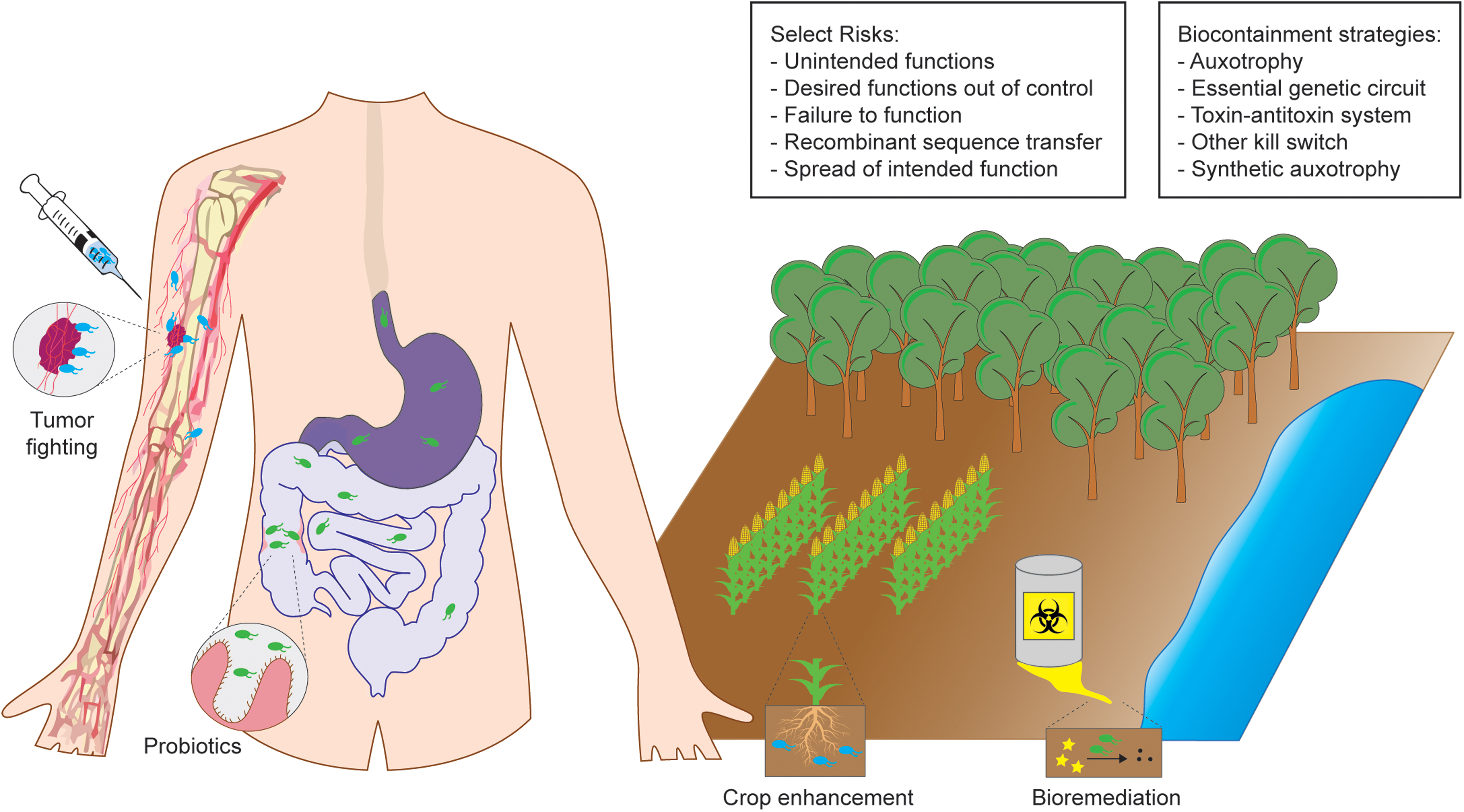
Select Risks and Biocontainment Strategies for Engineered Microbes. Color images are available online.
A Sample of Major US Regulatory Governance Relevant to Engineered Microbe Deployments
Abbreviations: CEQ, Council on Environmental Quality; EPA, Environmental Protection Agency; FDA, Food and Drug Administration; NOAA NMFS, National Oceanic and Atmospheric Administration National Marine Fisheries Service; USDA APHIS, United States Department of Agriculture Animal and Plant Health Inspection Service; USDA FSIS, United States Department of Agriculture Food Safety and Inspection Service; USFWS, United States Fish and Wildlife Service.
Engineered Microbes as Living Therapeutics
Engineered microbes are emerging as options for living therapeutics, called probiotics—a term more commonly applied to the subset of living therapeutics intended for the gut. 67 Probiotics are also used for animal health, 68 thus spanning the agricultural and medical sectors of the bioeconomy. In this article we focus on living therapies designed for humans as they are more likely to have direct human impact.
Microbial therapies can be categorized by their destination (eg, gut, skin, oral, vaginal, or tumor), administration route (eg, oral or intravenous), or target disease (eg, Crohn's disease, colitis, or cancer). Gut probiotics are the most active area of research. In addition to treatment of gastrointestinal disorders, gut probiotics have been shown to play major roles in mediating overall health and neurological health via the gut-blood barrier and the gut-brain axis.69,70 Probiotics can affect brain activity in rodents 71 and in small cohorts of human patients.72,73 Several biotechnology companies are working on developing cocktails of natural gut bacteria obtained from fecal samples of healthy individuals (Table 4).
Companies Developing Deployable Engineered Microbial Technologies
Data were derived from Crunchbase. Accessed January 2020. www.crunchbase.com
In many cases, natural gut bacteria possess insufficient therapeutic efficacy or do not contain the desired active therapeutic molecule(s). For these cases, administration of an engineered living microbe holds promise, but it also constitutes a form of environmental release that could be excreted, if it survives the journey.74-76 The first clinically administered genetically modified organism was a strain of Lactococcus lactis engineered to secrete murine or human interleukin-10, an anti-inflammatory cytokine, for treatment of colitis and Crohn's disease.77,78 The strain was engineered with a containment mechanism (a topic addressed in more detail later) based on thymidine auxotrophy. 79 L lactis has also been engineered to secrete antitumor necrosis factor (antiTNF) single-domain antibody fragments for treatment of chronic colitis in mice. 80 This technology was later commercialized by ActoGeniX, which was acquired by Intrexon (now Precigen, Inc.) for US$60 million in 2015 (Table 4).
Lactic acid bacteria such as L lactis are typically the first choice for engineered gut probiotics, but E coli Nissle 1917, a nonpathogenic patient isolate long used as a probiotic,81,82 was characterized as a safe carrier for targeted delivery of recombinant proteins to the intestinal mucosa in 2005. 42 This strain was also engineered to secrete antiviral peptides for protection against HIV infection 83 and proteins that promote insulin production in human cells. 84 In recent years, the startup Synlogic has continued to use E coli as a chassis for treating metabolic disorders such as phenylketonuria 85 and hyperammonemia. 86 Novome Biotechnologies is also developing therapies for metabolic disorders by engineering Bacteroides,87,88 the most abundant genus within the gut of US residents, to treat hyperoxaluria 89 (Table 4). Additionally, while Seres Therapeutics typically harnesses combinations of donor-derived microbes as gut therapeutics, one of the latest additions to their pipeline is a rationally designed, fermented microbiome candidate.
Other sites within the body have been targeted for engineering and pose variable levels of environmental exposure and risks. In the 1980s, the concept of replacement therapy emerged in the treatment and prevention of dental diseases. 90 Wild-type and laboratory strains of Streptococcus mutans, an oral bacterium, were found to provide lifelong resistance to dental caries following a single application in laboratory rats. This technology formed the basis of the company Oragenics. Microbes from the human oral microbiome have also been applied in other parts of the body. Over 20 years ago, researchers introduced recombinant strains of Streptococcus gordonii, a member of the human oral microbiome that can colonize the vaginal microbiome, into the vaginal microbiota of monkeys to serve as live vaccines by expressing HPV and HIV antigens.91,92 Later, S gordonii was engineered to function as a therapeutic rather than as a vaccine by secreting a microbiocidal single-chain antibody to treat experimental vaginitis caused by Candida albicans in rats. 93 Natural vaginal isolates of Lactobacillus jensenii have also been engineered to secrete various proteins that either bind or inhibit HIV.94,95 The latter strain generated a 63% reduction in HIV transmission when tested in macaques 96 and has been commercialized as MucoCept by Osel. The skin microbiome has also been engineered; the company Azitra engineers the natural commensal skin bacterium Staphylococcus epidermidis to address various skin diseases (Table 4).
A final category of microbial therapeutics that merits mention is bacterial cancer therapeutics because of their increased potency and reduced risk of excretion into the environment. Bacteria can be used as cancer therapies because they can penetrate and preferentially reside in tumor microenvironments that are inaccessible to most cancer therapeutics.97,98 Natural microbes have been used for cancer therapy for several decades, including Bacillus Calmette-Guérin therapy, 99 which urologists have developed into the most effective therapy currently available in the treatment of nonmuscle invasive bladder cancer. But in general, wild-type bacteria compete weakly against tumors and may seek out more hospitable environments. Thus, engineering can improve their potency and ability to respond 100 while also restricting them to certain tumor environments. 101 Common engineering approaches that have been used for bacterial cancer therapies are production of an enzyme that converts a prodrug into a drug (limited by the weak penetration of prodrugs into tumors)102-104 or production of factors that recruit the immune system to fight against tumor cells (limited by the elevated possibility of a cytokine storm).105,106 Very rarely have bacteria been engineered to secrete cytotoxic molecules, although bacterial toxins have had independent use in tumor treatment. 107
Application in the Environment
In food webs and elemental life cycles, bacteria and fungi are decomposers and scavengers that accelerate the breakdown of waste and recycle of nutrients. Microbial decomposition can also be used to treat manmade introductions of abiological chemicals as wide-ranging as petroleum to heavy metals. 108 Engineered microbes provide an opportunity to selectively deploy targeted cleanup agents that can detect and destroy environmental toxins,109,110 such as those for aromatic or chlorinated pollutants, as first reported in the 1980s. 111 Bacteria also serve wide-ranging roles as symbionts or commensals for plants, and these roles may be more economically attractive to engineer.
The application of engineered microbes in the field has greater value proposition and regulatory acceptance when the function required cannot be found in nature or occurs at an unacceptable timescale—important goals of bioremediation. The first field release of an engineered microbe for bioremediation was Pseudomonas fluorescens strain HK44, which was isolated from a chemical plant contaminated with polyaromatic hydrocarbons. 112 This strain was engineered to break down naphthalene and to luminesce upon doing so, enabling detection and tracking. 113 Although the subsequent years presented creative advances in engineered microbial technologies designed to address pesticide,114,115 heavy metal, 116 and radioactive waste contamination, 117 none of these technologies were ultimately deployed in the field. An alternative strategy is to use engineered microbes for enhancement of plant-based phytoremediation, as was done for toluene using engineered endophytic bacteria Burkholderia cepacia. This was tested in hydroponic cultivation and greenhouse settings, and plants grown from seeds exposed to the engineered microbe outperformed their counterparts in growth and detoxification. 118 As an enabler of the deployment of these technologies, polymer encapsulation techniques such as the use of alginate beads have been tested for strains capable of bioremediation.119,120 Alginate beads and related encapsulation techniques may help to address the major challenge of survival in the environment through improvement of the resilience of the microbe in toxic environments, 121 as some encapsulated microbes can survive for over 14 years. 122 Encapsulated engineered microbes can also be embedded within cartridges that interface with electronic devices, as used by the company FREDsense to detect water contaminants.
The emerging problem of microplastic accumulation, particularly in marine environments, presents a new potential opportunity to deploy engineered microbes for bioremediation.123-125 These plastic particles of less than 5 mm in diameter arise from slow physical disintegration of plastic waste. Microplastics have been found in the guts or stool of numerous organisms, with unknown health consequences and high likelihood of consumption by humans.126-128 Microbes and associated enzymes have been explored for the degradation of various plastics, with successful breakdown of polyesters achieved by leaf compost cutinases. 129 Recently, this field was reignited by the discovery of a natural microbe, Ideonella sakaiensis, that breaks down and grows on polyethylene terephthalate (PET) as a sole carbon source. 130 Given the slow kinetics of PET breakdown in I sakaiensis and its limited growth contexts, the diatom Phaeodactylum tricornutum was engineered to secrete recombinant PET hydrolase originally from I sakaiensis in marine contexts. 131 Such approaches may be promising for tackling distributed sources of amorphous PET from microplastics, drink bottles, and food packaging.
Unlike in medical research, the incentives and infrastructure to perform field-testing of engineered microbes for bioremediation is minimal, concerning to the public, and historically not encouraged by the US Environmental Protection Agency (EPA).132,133 Thus, very few engineered microbes have been applied outside the laboratory. 134 Some who propose changes to EPA policy lament the lack of application of engineered microbes designed to break down hydrocarbons 135 and suggest a more risk-based regulatory approach. 136 In contrast to the bioremediation sector, the agricultural sector has been an early and prolific proponent of the release of engineered microbes in field tests.137-139 Initial agricultural objectives for engineered microbes included frost protection, 137 pest protection, 140 and increased nitrogen uptake for growth enhancement. 141 However, even after several successful approvals such as for frost prevention, companies chose to pursue wild-type microbes that could perform similar functions. 138 As of 1997, only 1 type of living recombinant microbial product requiring environmental release had been commercialized 138 —an engineered strain of Bacillus thuringiensis that combined several insecticidal genes. 140 One detailed technopolicy analysis concluded that the primary reason for the lack of commercialization of engineered microbes has changed over time from regulatory hurdles to a lack of product efficacy and limited potential for profitability. 138
Enhancement of crops using engineered microbes has recently resurfaced as an area of commercial activity. Nitrogen fixation in agricultural crops is a particularly illustrative example, as microbes can be engineered for improved nitrogen uptake and/or to associate with cereals.142,143 Because plants rely on soil microbes for nitrogen fixation, nitrogen is often the limiting nutrient for growth. 144 Synthetic fertilizers pose challenges of cost and energy-intensity of production as well as environmental hazards from runoff.145,146 The company Pivot Bio was originally interested in using engineered microbes to enhance nitrogen uptake147,148; however, it is now working with native species to produce nitrogenase. In agriculture, there is some precedence for reawakening or modifying genes by using natural processes of mutagenesis (eg, ultraviolet light) and by selecting for traits. Such strategies lie on the continuum between conventional breeding and genetic engineering.149,150 On the other hand, Joyn Bio, a joint venture between Bayer and Ginkgo Bioworks, has chosen the path of engineering microbes to improve nitrogen fixation, to be introduced at the point of seed treatment 151 (Table 4).
In addition to their role in crop enhancement, microbes enhance agricultural processes as animal probiotics. Companies such as Danisco Animal Nutrition, a division of DuPont, have long provided silage probiotic solutions that contain Bacillus species, supporting gut balance and intestinal morphology. Pando Nutrition seeks to provide an antibiotic alternative to poultry producers by genetically engineering a probiotic-secreted enzyme. Advancement of biocontainment strategies may not only responsibly steward the introduction of engineered microbes into new contexts but may also alleviate public perception about such efforts.
Despite the exciting gains that can arise from engineering, the majority of field-deployed microbes so far are wild-type strains, typically natural isolates with unusual traits and a propensity for growth under target field conditions. But, because the introduction of natural or engineered microbes in large quantities to a sensitized ecosystem poses a risk of unanticipated changes, technologies to evaluate environmental health are necessary to ensure the safety of such approaches. Interestingly, microbes could meet this need themselves; the use of natural and engineered microbes as biosensors and bioindicators of environmental perturbance is an area of much interest and has been extensively studied, employed, and reviewed.152-155 These microbes can be useful in detecting substances of high relevance to sustainability and security (eg, pollutants, chemicals, hormones, pharmaceuticals, and pathogens) and assessing overall quality, indirect effects of perturbances, and to give temporal perspective to these measurements. 156 Biosensors and bioindicators will be crucial to the success and safety of future deployment programs, but the field will also require more tools for assessing and controlling the effects, effectiveness, and risks presented by these approaches.
Deployment Outside the Laboratory
Given the diverse rationale for judiciously introducing engineered microbes into new environments, an organized framework is needed for risk assessment. We encourage scrutinizing the introduction of engineered microbes for each of these 6 risk categories:
Unintended functions due to poor engineering design Desired functions for a target environment that are undesirable in other environments Failure to function in the target environment Engineered DNA sequence acquisition by other organisms Functional expression of sequences acquired by other organisms Unintended impacts on the food web due to deployed microbial growth
Speaking very generally, risk 1 is low because microbial engineering techniques are highly targeted and genes subject to heterologous expression are well-annotated in their function. Risks 2 and 3 are much more plausible. An example of risk 2 is a microbe that could perform too much of a desired function, or act on a broader set of environmental molecules that were not provided in the laboratory. Further, within a patient, excess expression of an immunomodulating protein or overcolonization could rapidly jeopardize patient health. These outcomes are more consequential than probable outcomes from risk 3, because a failure to act robustly or proliferate in a desired environment (because laboratory strains are generally believed to be less fit than native environmental strains) have little presumed detriment. Risks 4 and 5 relate to the possibility that engineered DNA sequences become acquired by other microbes, which, in principle, could have the broadest consequences on altering an ecosystem or patient microbiome. For example, bacteria engineered to possess genes encoding human therapeutics could share this genetic material with other gut commensals via horizontal gene transfer, leading to a formerly innocuous microbe gaining biomedical activity. Curiously, while horizontal gene transfer (HGT) is a common mode of DNA exchange in the environment, 157 genetically modified organisms (GMOs) have not been observed to pass on traits through HGT. For example, HGT of herbicide resistance from a GMO plant to bacteria was not detected in a field study. 158 While horizontal gene transfer from GMO plants to humans or the environment is of low probability, 159 the same may not be true of engineered microbes because microbes have elevated rates of gene exchange. 157 Such HGT events can be easily monitored by engineering strains to contain cassettes for expression of reporter proteins only when they are transferred to other organisms. 160 Additionally, technologies have been developed to prevent the potential spread of recombinant traits by HGT. 161 Risk 6 is a risk common to the introduction of natural or engineered microbes, as their presence may reshape the local ecology through competition for limited resources or by serving as prey for predators. The latter effects have been observed even in confined but open reactor contexts, such as the predation that occurs when lipid-rich algae are cultivated in open pond reactor systems.162-164 While this risk is important to acknowledge, we will not discuss it further here.
Perhaps the most salient reason for the need to continue investigation of biocontainment (discussed in more detail in the next section) can be drawn from the lessons of invasive species. In 2012, invasive species cost the US economy an estimated US$150 billion, or about 1% of the GDP. 8 In response, an “ecological restoration” market in the United States generates revenues of at least US$9.5 billion annually. 8 While not much is known about invasive microbes, what we know comes from studies of invasive plants. Introduction of nonnative plant species to a target region can have disruptive effects on its microbial community, including introduction and establishment of alien pathogens, perturbations to soil microbiome composition, and alteration of plant–microbe symbioses. 165 These changes could lead to rippling effects on the ecosystem including alteration of food chains, shifts in consumer behavior and range, increased waterway contamination and damage, and modified structural composition and decomposition dynamics of soils, all of which could change landscapes and their resident flora and fauna. It is possible that microbial dynamics could be similarly disruptive in higher organisms as well, with a tangible example being that of white-nose syndrome in hibernating bats in North America. 166
Opportunities for Technology Innovations
Biological Containment of Engineered Microbes
Because biological containment strategies have been reviewed extensively elsewhere,161,167,168 here we briefly discuss their limitations and opportunities for innovation to guide practitioners and policymakers. Biocontainment systems have classically featured 1 of 3 systems: (1) dependence of the organism on an essential nutrient or metabolic building block that is not easily found in the environment (auxotrophy) 169 ; (2) dependence of the organism on a nonbuilding block chemical for expression of essential genes (transcriptional control or gene circuit) 170 ; or (3) restriction of the organism to a limited environment where expression of a toxin or cell lysis mechanism is suppressed (toxin–antitoxin system or kill switch).171,172 To illustrate challenges and research opportunities associated with published biocontainment approaches, we will use as an example the technique of synthetic auxotrophy, where cells are engineered to rely on synthetic building blocks.173-177 We chose this biocontainment technique because in ideal settings it has outperformed novel biocontainment strategies in the important metric of escape frequency. Yet, like other recent approaches, it has limitations in its characterization and application that are worth examining.
Measurement of escape frequencies required for large-scale deployment poses a challenge for the advancement of biocontainment research from laboratory settings. The US National Institutes of Health biocontainment standard is defined as less than 1 escape within a population of 108 cells (or an escape rate of 10−8 escapees per colony forming unit [CFU]). 178 Measurement of escape frequency in batch experiments is limited by the size of liquid culture volumes that can be incubated and the surface area of solid media that can be used for plating. Several synthetic auxotrophs referenced earlier exhibit escape frequencies below the practical detection limits of 10−12 escapees/CFU during a multiday or even multiweek observation period. However, these observations do not imply that escape is impossible, and some escape may be tolerable depending on the application. For personalized therapeutics, escape rates below 10−8 escapees/CFU may be sufficient given smaller cell counts administered to patients.
Other challenges in the field of biocontainment research include the generalizability of these methods across different organisms, the compatibility of the containment conditions with the intended deployment environment, the compatibility of containment methods with one another, and the evaluation of these strategies over longer timescales. Despite the impressive escape rates obtained, synthetic auxotrophy has only been tested in E coli and requires availability of organism-specific tools for incorporation of synthetic amino acids. Although initially demonstrated in genomically recoded E coli, synthetic auxotrophy functions in nonrecoded hosts.175-177 Other biocontainment techniques, such as kill switches, generally also require organism-specific genetic elements for expression. In either case, if a biocontainment strategy requires introduction of a nonnative molecule into a new environment, then the properties of the nonnative molecule could have important ramifications and may need to be tested independently. Additionally, the introduction of a synthetic molecule, which is by definition required for synthetic auxotrophy but also a feature of some kill switches, adds cost to a process, creating another barrier to adoption. Another challenge is the compatibility of containment methods with one another. Due to the statistical rarity of escape mechanisms that must simultaneously occur, multilayered approaches may be the easiest and most effective way to implement robust containment.172,179-186 Finally, how these methods perform over time in the face of evolution is still relatively unknown. To date, most experiments have been in batch, and while applicable to biomanufacturing, the results may not be relevant for environmental deployments. In these situations, an organism may need to survive for weeks or months, timescales subject to significant evolution, and therefore testing of evolutionary stability is required. At least one recent effort to develop kill switches has examined their evolutionary stability. 184 Overall, there is a strong need for research on the development of more generalizable, compatible, and durable biocontainment strategies. An ideal outcome of such research would be the creation of multiple complementary off-the-shelf components that can be easily implemented together for multilayered biocontainment.
Alternative Containment Approaches
If the primary concern is HGT of engineered DNA sequences from engineered microbes to other microbes, then the biocontainment techniques described earlier do not prevent successful DNA exchange. A complementary set of technologies can address HGT through methods that result in destruction of recombinant biological macromolecules if present in the wrong environment (eg, a DNA destruction device 182 or a mutually dependent host-plasmid system 187 ), methods that overlap a gene of interest with a toxin gene, 188 or methods that use codes other than the universally conserved codon table for decoding of DNA sequence (eg, alternative genetic alphabets 189 or recoded sequences that have codons reassigned 190 ). Of these approaches, complete destruction of DNA or protein sequences has been difficult to achieve and can be obstructed by mutation. However, the use of alternative genetic alphabets within a protein coding sequence appears relatively foolproof for preventing functional expression if an HGT event were to occur. Challenges include the highly sophisticated level of engineering required to introduce machinery that can recognize synthetic bases. Additionally, while the organism is not necessarily dependent on supplementation of synthetic bases (and, therefore, not a synthetic auxotroph), synthetic bases must be provided to achieve the desired function, thus limiting the affordability of this technique and the context where it can be used.
Surveillance of Engineered Microbes
Given the roles of many natural microbes in infectious diseases, the topic of microbial surveillance techniques has also been reviewed extensively elsewhere. 191 In the increasingly likely event of deployment of engineered microbes, surveillance technologies will be needed to monitor release sites and beyond. In this section, we briefly describe recent developments in the use of informatics, next-generation sequencing, and mass spectrometry for surveillance. Although numerous techniques exist for screening at the stage of DNA synthesis, 192 they do not help with the identification of engineered microbes in the environment, where sequencing coupled with DNA amplification are critical. Recent approaches in DNA sequence screening have looked for signatures within large databases such as the Addgene plasmid repository. Engineered microbes can contain natural DNA from other organisms or transgenes produced by DNA synthesis. Because the common paradigm associated with DNA synthesis for heterologous expression is to adjust the codon usage of protein coding sequences, the codon usage of a gene relative to its natural sequence can serve as a signature of engineering from analysis of nucleotide sequences alone. 193 Deep learning methods have been developed to predict lab-of-origin of a DNA sequence when trained on appropriate datasets. 194 Machine learning has also been used to detect pathogenic sequences from next-generation sequencing reads.195,196
Identification of a microbe is most straightforward if it can be isolated and cultivated. However, this strategy is not reliable because many microbes defy cultivation under standard laboratory conditions. Approaches for microbial identification have differed across the epidemiological and agricultural communities, which largely search for pathogens or GMOs, respectively. Before the emergence of widely accessible next-generation sequencing techniques, the state of the art in pathogen identification was analysis of chromosomal DNA restriction patterns using pulsed-field gel electrophoresis. 197 Mass spectrometry on organismal proteomes198,199 or multilocus polymerase chain reaction (PCR) products200,201 emerged as alternatives for pathogen identification. However, much like sequencing of ribosomal RNA, these approaches are not well-suited to detecting changes in DNA engineered at other loci within a host. In contrast, most GMO screening approaches used in agriculture today are reliant on PCR-based classification methods that are inherently limited to specific transgene sequences.202-204 Because of the decreasing costs of sequencing, whole-genome DNA sequencing is emerging as a standard in open-view pathogen detection because of its unbiased nature relative to PCR. With this approach, one could search for synthetic DNA sequences within native loci. Moving forward, these approaches can be informed by detection strategies for pathogens,195,196 invasive species,205-207 or GMO crops, 208 as concepts from each of these categories can apply to engineered microbes (eg, entry into new environments, genetic modification, and smaller size/genomes).
Environmental sampling for engineered microbes is yet another challenge that can be informed by precedents in related fields and strengthened by advances in technologies such as mass spectrometry. Environmental applications and strain choice will likely dictate the best specific locations to search for environmental DNA. 209 Samples of environmental DNA have been successfully obtained from sources spanning lake waters 210 and sewage systems. 211 Sewage is an especially good place to sample for the potential presence of engineered probiotics that may survive in excretions, as sewage has been previously used for successful detection of poliovirus vaccine during a test release. 212
The detailed listing of microbial technologies that are likely to be deployed for biomedical or environmental applications can guide researchers in the field of surveillance to better determine where and what to search for. Responsible stewardship of engineered microbes to new contexts will require greater vetting of biocontainment technologies and monitoring frameworks that leverage next-generation sequencing capabilities.
Conclusions
Synthetic biology has afforded power to the field of microbiology for which its innovators have long yearned. The ability to write, rewrite, and unwrite nucleic acid sequences, and, thus, the very identity of organisms, will similarly alter myriad aspects of the bioeconomy. The resultant engineered microbial technologies throughout the bioeconomy have vast potential, but important innovations and considerations are necessary to ensure the proper protections are in place. As deployment of microbes into higher organisms or the larger environment becomes tangible and perhaps even commonplace, the successes and challenges the field faces along the way will be indelibly affected by the work of this new decade. As such, the security of economic markets, biological systems, and the organisms existing within them will be founded on our collective foresight about the topics presented in this work. Players in the bioeconomy must respond to the urgent need to develop innovative engineered microbial solutions for therapeutic, environmental, and energetic scientific problems—and they must design these solutions in ways that protect the world while exhibiting the propriety required of such power.
Footnotes
Acknowledgments
The authors would like to thank Dr. Neil Thompson for his helpful expertise, input, and perspective that contributed to the contents of this manuscript.