




Abstract
Biodiversity is being lost at an alarming rate around the world,1-3 and many more species are at risk of extinction in the near future. 4 Biodiversity is the measure of the variability of living organisms from genes to species to ecosystems and ecological complexes. One of the main causes of biodiversity loss is large-scale environmental changes, through processes such as land use change, 2 invasive species, 1 contaminants, 5 and climate change.2,6,7 Consequently, ecosystem services are being lost and ecosystem structures are rapidly changing.8-10 Changes in biodiversity and changes in land use are 2 important factors influencing the emergence of infectious diseases.3,11-14 Several different mechanisms are hypothesized to drive the effects of biodiversity on infectious disease risk.15-17
Human activities are altering ecological conditions and bringing species into contact in new or more frequent ways.13,14 Concurrently, globalization has resulted in an era of global connectivity through increased human movement and trade, and the spread of infectious diseases from localized areas are now threatening new regions. 18 Additionally, loss of biodiversity in plant species due to climate change or invasive species can lead to shifts in habitat, which then affect other species in that ecosystem. Understanding how changes in biodiversity result in infectious disease emergence will have a major impact on which mitigation strategies are likely to be effective at promoting global health security. 19 Human and domestic animal health systems have been prioritized for health security, but there has been limited attention to wildlife and environment sector contributions. 20 In this commentary, we discuss the importance of biodiversity in evaluating health security risk and informing actions to mitigate these risks globally. In doing so, we provide examples of how changes in biodiversity lead to increased emergence of infectious disease risk, noting that changes and interactions are not uniform in risk and often are mediated—for heightened or reduced risk—by multiple factors. We show how these relevant connections can be considered in the context of infectious disease prevention, detection, and response as well as in public health and medical practice at local scales to promote health security in communities and in a global context.
Environmental Impacts on Biodiversity
The United Nations Convention on Biological Diversity defines biodiversity as “the variability among living organisms from all sources including, inter alia, terrestrial, marine and other aquatic ecosystems and the ecological complexes of which they are part; this includes diversity within species, between species and of ecosystems.” 21 Within this definition, the most important word is “variability.” Diversity is important at all scales, from populations having high genetic diversity to communities having a more diverse assemblage of species. Diverse ecosystems may be more resistant to climate change, such as in grassland plant communities that have high species richness. 22
Almost all infectious diseases have been shown in one way or another to have mechanisms of emergence in relation to biodiversity through anthropogenic drivers. 23 Humans are altering environments and ecological systems at unprecedented rates. Changes in the environment can include land use change, 24 introduction of contaminants and pollutants, invasive species, 25 and increased urbanization (Figure 1). Political and social instability often results in environmental change and behavioral modifications (eg, seeking food or other resources) that may alter exposures. Environmental change can, in turn, cause further instability, including human population movement, 26 and has the potential to negatively impact flora and fauna, and thus the biodiversity of an area. The current rate of extinction is an unprecedented 1,000 times higher than natural background rates, with a recent intergovernmental report indicating the risk of losing 1 million species in the near future. 4 The timeline for the potential extinction of 1 million species bears repeating, because the near future is only a handful of years away. Loss of biodiversity and changes in the distribution of biodiversity negatively affect ecosystems through the loss of ecosystem services such as decomposition, soil productivity, pollination, and carbon sequestration.8-10 In line with the One Health concept, 27 the health of humans, animals, and the environment is key to health security and can benefit from integrated or coordinated approaches to prevent, detect, and respond to diseases.
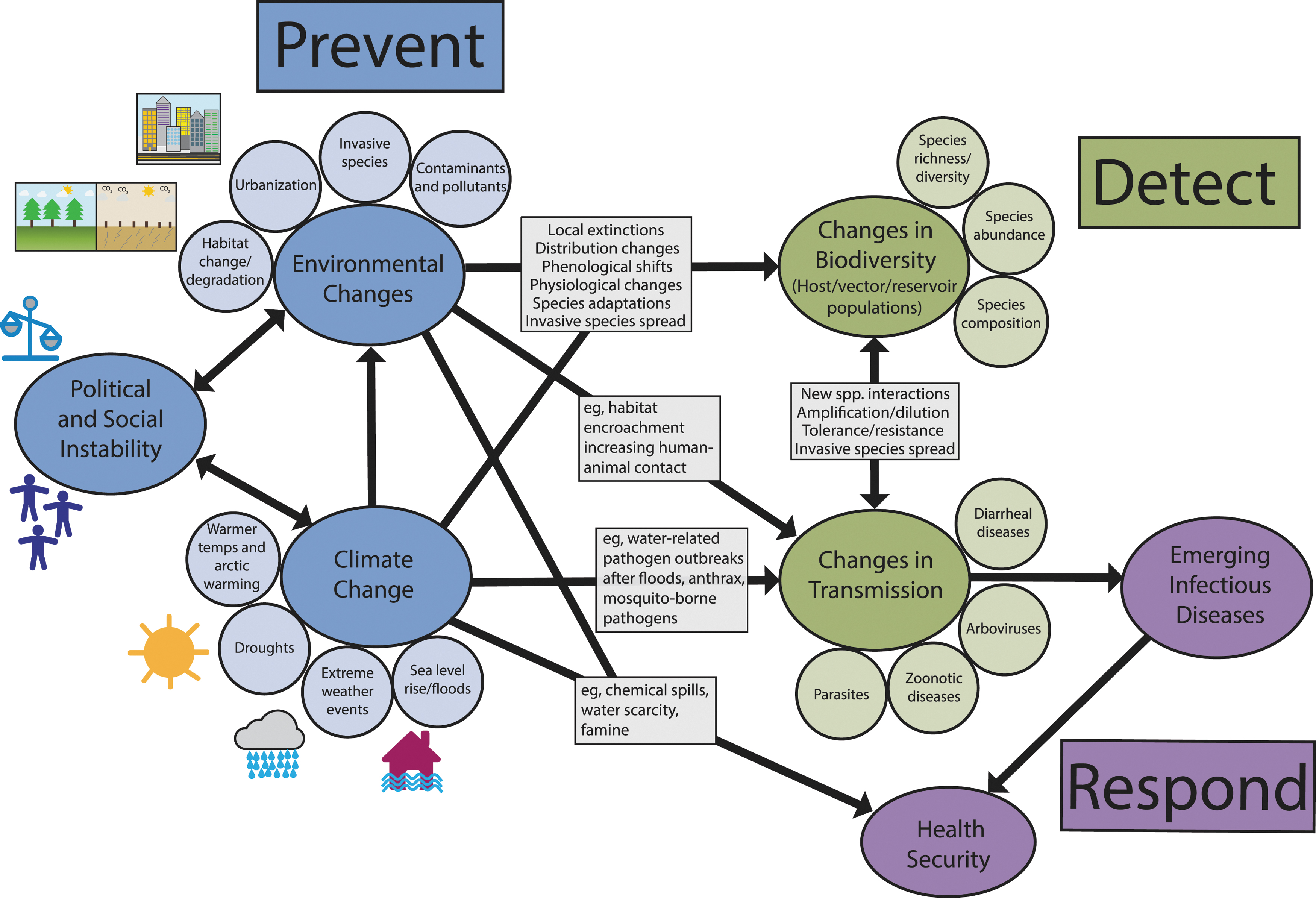
How biodiversity and environmental change affect health security. This diagram reflects net expected outcomes. In some cases (eg, unsuitable host range), risk will decrease but overall risk is expected to increase. Small circles are examples of specific changes within the larger ovals. Text between ovals are concepts, processes, or examples that can lead to changes in biodiversity, transmission and infection, and health security. The Prevent, Detect, and Respond boxes refer to the abilities required to reduce and mitigate infectious diseases globally as recognized under the Global Health Security Agenda, which we argue miss crucial inputs from the environment sector at present.
The diversity and role of wildlife disease hosts is dependent on the pathogen(s) in question. For example, West Nile virus has a different suite of hosts and vectors (birds and mosquitoes) than Lyme disease (mammals and ticks). Understanding changes to pathogen transmission in the future, and where to target sentinel monitoring and intervention strategies, requires knowledge of the entire ecology of the system. 19 Wildlife infectious disease hosts and reservoirs respond to changing environmental conditions in different ways. Phenological and physiological changes can change the timing of migration and dispersal, altering ecological processes and creating new species interactions. 28 Likewise, new species interactions are created when populations respond to changes in the environment through shifting, expanding, or contracting their ranges by tracking their preferred climatic niches through niche conservatism.29,30 Some species are able to adapt to changing conditions. 31 If species are not able to track their preferred climatic niches or cannot adapt, then they risk local extinction (extirpation) or global extinction. 32 Environmental change can also result in changes to biodiversity through species introductions and the expansion of invasive species ranges. 1 All of these changes can result in changes to species richness, abundance, and composition within a host community.
Changes in Biodiversity Drive Infectious Disease Emergence
It is important to emphasize that changes in biodiversity and changes in the ecology of hosts, vectors, and pathogens are correlated with the emergence of infectious diseases.12,19,33,34 Biodiversity is known to influence disease transmission in a variety of ways, and increases in biodiversity can buffer against or promote transmission. Hosts vary in their competence for contributing to transmission to other hosts or vectors, 35 potentially depending on whether those hosts can tolerate the pathogen (tolerance) or can limit pathogen burden (resistance). Two widely studied concepts regarding biodiversity and disease transmission are the dilution effect and the amplification effect. These concepts concern whether competent or incompetent hosts are lost or persist during changes in biodiversity. Competent hosts have the ability to transmit pathogens and maintain them in the environment. 36 Understanding which species are lost and which are likely to persist following environmental change—and whether they are competent or incompetent hosts—is critical to determining how pathogen transmission will be affected.
Loss of biodiversity could result in greater disease risk if incompetent hosts (ie, those that do not contribute to infection) are lost. When abundant, these incompetent hosts “dilute” the probability of transmission between vectors and more competent hosts. This dilution effect is the reduction in vectorborne pathogen transmission associated with the presence of diverse potential host species, some of which are incompetent. Some examples of increased biodiversity have been correlated with decreased rates of disease. The most studied system supporting the dilution effect is the bacterium that causes Lyme disease (Borrelia burgdorferi), their vector (black-legged ticks, Ixodes scapularis), and small mammal communities.11,37 The most competent host for the bacterium is the white-footed mouse (Peromyscus leucopus), which is resilient to environmental disturbance. The loss of other mammal species that are poor hosts for the bacterium (eg, Virginia Opossum [Didelphis virginiana], which coincidentally also preys on ticks, contributing to tick population control), increases the probability that black-legged ticks feed on white-footed mice and become infected. This results in a higher proportion of infected ticks than if other incompetent hosts were present to buffer infection. Two other documented examples include a reduction of small mammal diversity leading to higher rodentborne hantavirus infections 38 and avian diversity being related to West Nile virus. 39 Specifically, low bird diversity correlates with increased human infection of West Nile virus likely through differences in host competence, 39 although the pattern of increased infection with low diversity may not always be the case. 40 In some cases, as with West Nile virus, newly infected wild species may be susceptible and experience population declines. 35
On the other hand, the amplification effect is seen when increased host diversity leads to increased infection rates or seroprevalence. For example, Plasmodium prevalence is higher in chimpanzees at sites with high mammal species richness. 41 In both dilution or amplification, it is important to recognize that infectious diseases can both increase or decrease with species diversity depending on the situation and system and that they are complex and dynamic phenomena. 16 As discussed previously, West Nile virus has been shown to both increase and decrease in response to biodiversity loss.39,40 Species richness can be a determinant in the maintenance and spread of disease and potential for pathogen eradication, such as 1 or more reservoir species that are important sources of pathogens (eg, coronaviruses in bats). The changes in ecological dynamics can push naturally circulating disease in reservoir populations (ie, enzootic transmission) into epidemic transmission, with greater potential for spillover to other host species. There is concern about spillover of severe acute respiratory syndrome coronavirus 2 (SARS-CoV-2) from humans, the only epidemiologically significant source of major spread, into wild animal populations that could serve as a novel long-term reservoir host or themselves be susceptible. 42
Climate change results in environmental change—through droughts, warming temperatures, sea level rise and flooding, and more frequent extreme weather events (Figure 1)—and is predicted to increase prevalence of vectorborne diseases and change the distributions of host species.32,43,44 Climate change by itself is known to result in changes to transmission dynamics, resulting in outbreaks such as water-related disease (eg, cholera or leptospirosis after flooding events45,46) and anthrax outbreaks. 47 Severe anthrax outbreaks may be more likely to occur in hot, dry summers following wet spring conditions. 47 Furthermore, climate can be altered through El Niño-Southern Oscillation events, 48 which are strong drivers of weather and global climate variability. 49 Leading to drought in some regions and floods in others, 50 such events have been strongly tied to outbreaks around the world. 48 For instance, in Africa and North America, heavy rains increase rodent populations, resulting in increased human plague infections.51,52 Heavy rain and floods can also increase mosquito populations, and thereby increase vectorborne infections such as Rift Valley fever and malaria.53,54 Droughts may cause dengue fever outbreaks due to increased water storage areas, which are ideal for populations of Aedes aegypti and Ae albopictus mosquitoes. 55
With changes in climate, often with the help of trade and travel conduits, vectors and vectorborne pathogens are shifting and expanding their ranges to higher latitudes. 43 As areas become more ecologically suitable, vectors are spread or are introduced to these areas and bring with them the pathogens they harbor. Ae agypti and Ae albopictus are the 2 mosquito species that have shown the greatest range expansion globally.56,57 These 2 species can transmit dengue virus, West Nile virus, chikungunya virus, Zika virus, and yellow fever virus.
Change in land use (eg, conversion for agriculture, extractive industries, human settlements, reforestation) is a leading cause of the loss of biodiversity and increases in infectious diseases. 3 For example, in a recent analysis of the impacts of deforestation in the Amazon rainforest, MacDonald and Mordecai 58 found that a 10% increase in deforestation led to a 3.3% increase in human malaria incidence. Along with reducing biodiversity directly, land use changes can affect the habitats of mosquitoes and other disease vectors. In most cases, habitats for most known disease-carrying or epidemiologically important vectors are increased with habitat disturbance. 59 Importantly, human encroachment into wildlife habitats creates new species interactions and opportunities for pathogen transmission among species (Figure 1). Key examples of this include Nipah virus in Southeast Asia 60 and Ebola virus in Africa. 61 Both viruses are examples of a pathogen spillover when a viral agent jumps from an animal reservoir to humans and both are examples of threats to global health security. 62 Outbreaks of Nipah and Ebola viruses have also been linked to climate and habitat factors that affected reservoir hosts (ie, fruit bat populations) along with human behaviors (eg, blood-to-blood contact through hunting or butchering of animals shedding virus; ingestion of infected urine, saliva, or feces contaminated by bats; intensive livestock production that allowed for amplification in an intermediate host) that facilitated transmission, and thus disease emergence and spillover into humans.63,64
Application to Global Health Security
Global health security comprises “the activities required to minimize the danger and impact of acute public health events that endanger the collective health of populations living across geographical regions and international boundaries.” 65 Much of the health security efforts, especially after the SARS and the West Africa Ebola outbreaks, have focused on strengthening capacity to detect and respond to disease outbreaks to prevent large-scale spread in human populations. These efforts are reinforced through assessment and planning processes, surveillance and laboratory enhancements, and emergency readiness frameworks. Now, made even more urgent by the coronavirus disease 2019 (COVID-19) crisis, there is growing recognition that prevention at the source—in wildlife and domestic animals prior to spillover in humans—requires involving additional sectors and strengthening their capacities to assess and manage threats. 20 The One Health approach emphasizes the connections between the health of humans, animals, and the environment, thereby capturing the importance and essentiality of integrated strategies for risk reduction. One Health coordination mechanisms, such as those being formed through national platforms, provide possible entry points for integration of ministries of environment, academic institutions, and nongovernmental organizations to develop novel collaborations and solutions for pathogen and disease monitoring and prevention.
The Global Health Security Agenda—a partnership of 69 countries, international organizations, nongovernmental organizations, and private sector companies—is mobilizing attention and resources to prevent, detect, and respond to disease threats. Broadly, the environment sector has been identified as a key contributor to the Global Health Security Agenda, but no formal mechanism for genuine inclusion as an advisory member has been explored. 66 Similarly, no intergovernmental environment partner is included in the Food and Agriculture Organization of the United Nations, World Organisation for Animal Health, and World Health Organization “tripartite” collaboration, which oversees global guidance development and implementation tools related to risks at the human–animal–ecosystem interface. It is critical to have environment sector representation in health security initiatives to provide a more direct link to biodiversity and environment research, implementation, and policy (eg, via partnership with the United Nations Environment Programme or the Convention on Biological Diversity).
In addition to understanding and mitigating disease emergence and spread, we need to expand our thinking beyond the current emphasized scope of zoonotic, vectorborne, and antimicrobial-resistant threats to consider the role of climate and other environmental risks in health and security (eg, via food and nutrition supply) at different scales. For example, the focus on both mitigation of and adaptation to climate change allows for future scenarios and ecosystem-based solutions to promote resilience. 67 Preparing for disease threats similarly requires thinking ahead and considering the role of environmental and other forms of local and global change in new or increased pathogen exposure pathways, while also factoring in potential instability influences, such as the interacting role of naïve immunity, spread potential in high-density settings, low sanitation and healthcare infrastructure situations, and increased pressures on or degradation of natural resources that may be inherent in conflict or disaster situations. 68 The critical value of biodiversity-derived protections for health security are not sufficiently captured in ecosystem service assessments, which typically focus on direct contribution of biodiversity to resources (eg, in the form of food, fiber, and fuel). 69 The risk from ecosystem degradation warrants more direct and dedicated attention under environmental accounting frameworks (eg, the Intergovernmental Science-Policy Platform on Biodiversity and Ecosystem Services). National biodiversity strategies and action plans, national action plans for health security, and other planning frameworks (eg, climate, agricultural development, ecotourism) can consider key interfaces and determinants (Box 1) for health security at national and subnational levels to guide design and implementation of targeted efforts to prevent, detect, and respond to disease risk related to changing environmental conditions. Improving understanding and appreciation of these links, especially through greater emphasis of health security at more local (eg, community) levels where outbreaks begin, will address a key deficit in health security.
Box 1. Addressing Disease Risk at Specific Interfaces
The trends examined in this commentary show the relevance of biodiversity and ecosystem dynamics at the species or population level. They also shed light on dynamics at a more granular, time-limited scale, such as in the animal value chain (ie, hunting, handling, butchering, markets, consumption). Multiple species or populations may be forced into new interactions in these settings, often with limited biosecurity measures. Poor welfare conditions (eg, nutrition, hygiene, high-density housing) may affect immune status that promotes pathogen shedding or increases susceptibility to infection. Given the relevance of unsustainable wildlife trade as a driver of biodiversity loss, there are potential synergies in working together to identify high-risk species and practices, including via efficiencies for disease or pathogen monitoring and enhanced regulation and enforcement.
Certain aspects of changes in biodiversity may be important signatures for prediction of infectious diseases and outbreaks. For example, wildlife can serve as sentinels in the detection of infectious and chemical threats of potential consequence to humans, providing a baseline and more nuanced ability to detect routine pathogen circulation versus epidemic risks representing possible evolutionary, ecological, or epidemiological shifts.70-72 Just as human populations are facing elevated vulnerability to disease (eg, from poor nutrition status), disease events may also disproportionately manifest in wild species as ecological dynamics are altered. The latter could, for example, take the form of disruptions to food chains, restriction of habitat ranges, and changes to the flow of genetic diversity over migration corridors. These changes could also potentially affect human health status downstream by disrupting other natural ecological processes (eg, pollination). Trends (eg, seasonal) may be observed over time, helping to target risk reduction strategies. For disease specifically, biodiversity also provides important biological material for research into understanding host resistance and tolerance, potentially informing new therapeutics. While signatures may be nonuniform across taxa and disease systems, wildlife health and disease investigation and reporting represent an underutilized source of information for early warning systems as part of health security monitoring and threat reduction.
Recommendations—Think Locally
The scale of biodiversity loss globally and the potential consequences to global health and wellbeing are vast. At local levels, however, attention to changing ecosystems and risk factors allows for pragmatic solutions that can directly engage and benefit the health community. Examining ecological and epidemiological dynamics at this scale minimizes variability common at the global level and provides feasible entry points for implementation and decision making. For example, national biodiversity assessments and registries can provide a starting point for identifying present species, examining disease risk based on known reservoirs for pathogens or pathogen families, and identifying important interfaces or practices where risk is most pertinent. There may be practical efficiencies that can leverage existing systems or networks as part of monitoring and risk reduction efforts (eg, national park infrastructure, visitor policies, eyes on the ground).
From a clinical frame, practitioners can elevate attention to possible environmental and animal exposure factors affecting health to inform public health action. Identifying relevant exposures may help targeted screening for pathogens beyond the common diagnostic panels for infections to inform more precise differential diagnoses, particularly benefiting cases of undiagnosed or misdiagnosed disease and improving tracking of coinfections. 73 This approach can also be extended to broader epidemiological investigations to inform traceback efforts and elucidate important spillover and spread pathways.
Ecologists have high utility in helping to integrate a variety of information inputs to understand disease risk given the complexities of mechanisms, which may be closely linked to ecosystem food webs and other ecosystem dynamics. Certain related or complementary disciplines may also be highly relevant, such as plant ecologists, soil scientists, and entomologists who could examine the association between shrub height, vector habitat suitability, and malaria risk or the significance of normalized difference vegetation index and soil composition for monitoring outbreak risk for Rift Valley fever. Veterinarians and other animal health practitioners also play a key role in detection of disease in wild or domestic animals, including sentinel events that signal public health risk.
Identifying the key data needs and optimizing entry points for collection and use of diverse sources of information to guide and refine risk assessment and management decisions requires the type of systems approach that is fundamental to ecology.
In communities, One Health-sensitive messaging can promote coordinated and consistent messages across sectors to yield new synergies. Working in concert with trusted local leaders and stakeholders, risk communication can offer an opportunity to strengthen health literacy and empower communities, providing relevant guidance and space for questions and concerns. Recalling that biodiversity alone is not a risk, and may be protective as described above, care should be taken to convey the importance of specific risk factors and mitigation practices while considering ways to avoid possible unintended and harmful consequences (eg, killing wildlife, destroying habitats). For example, EcoHealth Alliance led the development of an illustrated publication, Living Safely with Bats, 74 that can be used as a visual tool for community outreach. Translated into 12 languages and adapted to regional contexts for relevance (specific risk interfaces and fauna and flora), it provides practical guidance for both reducing zoonotic disease risks—such as safely disposing of dead animals, rodent-proofing homes, and avoiding bat hunting and consumption—while conveying the important role of wildlife and ecosystems for health and livelihoods. Surveillance programs sampling in or around communities should share findings with communities to establish that local benefits are conferred, especially where trust and uptake of formal health systems is limited and frontline prevention of disease is vital. Similarly, community health workers as well as animal health, agricultural extension, and environmental health and sanitation officers are critical components of the workforce for generating a vigilant system of on-the-ground readiness and information channels for proactive and rapid notification of threats, ideally reinforced by direct links to strong national systems.
Practitioners have an opportunity to influence policy at individual, community, national, and global levels through evidence building and advocacy to tackle health risks. A key pathway is via involvement in national and subnational land use planning, ensuring that health is adequately considered, and valued in cost-benefit calculation, in pre- and post-project risk and impact assessments—specifically, environmental and social safeguard assessments used by governments and multilateral development banks. 75 Decisions on the placement of new shopping centers, roads, agricultural sites, and extractive industries, as well as the development and enforcement of regulations that help reduce disease exposures, are examples of potentially relevant opportunities to intervene. 19 In some cases, this may mean that ecosystems are preserved or adaptations are made to ensure safer development strategies (which may also generate cobenefits), but collectively will help to avoid the externality of epidemic and pandemic risk and consequence. 76 Past trends and lessons can help assess and predict future risks, taking into account several changing and interacting factors that should be monitored to rapidly identify changing risks.77,78 This can help mitigate acknowledged risks upstream as well as refine future predictive capabilities to avoid unanticipated negative outcomes. 79
Conclusions
We identify 3 key steps in limiting negative impacts on biodiversity for the purpose of health security. First, there must be recognition and investment in biodiversity and ecosystem protection at the local level and climate change awareness and mitigation at both local and global levels. Biodiversity is related to livelihoods, food security, and productivity in a wide variety of economic sectors, including tourism and agriculture. Infectious disease outbreaks can reduce, if not completely halt, tourism—as we have seen with the COVID-19 pandemic. Building alliances between the public health sector, environmental experts, policymakers, and economic development professions will be critical for bringing the conversation and prioritization of biodiversity protection to the table in a way that is targeted to achieve health security gains. This, in turn, can show the broader value of biodiversity to society and will likely drive action on root causes—which often occur far outside the scope of the conservation or health sectors—to curtail losses in biodiversity and disease risk. Second, public health and medical professionals should be given the tools to integrate information from the environment sector into monitoring and early warning/response systems as well as clinical case management. This can be aided by enhanced understanding of links between health and biodiversity and recognition of changing risk for emerging infectious diseases (eg, local trends for climate-sensitive diseases). Third, prioritization and planning processes should be conducted in line with a One Health approach—ensuring key sectors, risks, or benefits are not missed, with dedicated effort to ensure ministries of environment are empowered to contribute to health security efforts. These steps require collaboration and cooperation among many different groups, most of which have their own goals, agendas, and budget lines.
While any infectious disease system would be considered complex due to the multiple scales of interactions between humans, agricultural animals, wildlife, the environment, and climate, patterns can be discerned through in-depth research to understand the ecology of the disease system. Ecological research of hosts and pathogens in the wild has been the primary way that we gain a preliminary understanding of these systems and how to better detect and respond to outbreaks. 80 Developing capacity and channels to ensure findings feed into national health systems and decision making for human, animal, and environmental health will help bridge a gap between research and practice. In addition to ecologists, health practitioners can play an important role in actively participating in syndromic surveillance that has been proven to identify outbreaks faster and can help to more proactively link exposures and clinical suspicion. 50 Thus, ensuring the collaboration and coordination of the environment sector with the human and domestic animal health sectors is crucial to successfully reducing the threat of infectious diseases and enhancing global health security.