




Abstract
Gene drive is an experimental technique that may make it possible to alter the genetic traits of whole populations of a species through the genetic modification of a relatively small number of individuals. This technology is sufficiently new that literature on the understanding and views of stakeholders and the public regarding the use of gene drive organisms in agricultural pest management is just beginning to emerge. Our team conducted a 2-pronged engagement process with Texas gene drive agricultural stakeholders to ascertain their values, beliefs, and preferences about the efficacy, safety, and risk management considerations of gene drive technology as a potential tool for agricultural pest management. We found that a majority of stakeholders support gene drive research and its potential use for managing agricultural pests. Our work with stakeholders confirms both their willingness to be engaged and the importance they place on stakeholder and public engagement regarding these issues, as well as the need to address these issues before use of gene drive as a pest management mechanism will be accepted and trusted.
Introduction
Gene drive is an emerging technology in the early stages of laboratory research. This technology would use genetic engineering to drive a particular genetic trait into the population of a targeted species over the course of several generations. Gene drives bias inheritance through sexual reproduction such that the desired gene is passed down to most or all of an organism's offspring.1-6 This biased inheritance, intended to cause the spread and persistence of selected traits in a target population, distinguishes gene drives from other genetic pest management technologies.
Agricultural pests are becoming increasingly difficult to manage using current techniques. 7 Pest management can generate large annual costs for farmers, leading to possible yield loss if not achieved efficiently or effectively.8-11 Current management strategies rely heavily upon chemical tools like herbicides and insecticides. Increased resistance to these chemicals diminish their efficacy12,13 or necessitate the use of alternative chemicals that might have additional nontarget environmental impacts. Some research suggests increased use and misuse of pesticides can harm human health, the environment, and ecosystems.12,14 Gene drive management strategies may offer a way to mitigate pest-related stress. A gene drive might be used to reduce pest damage by suppressing the size of the targeted population or used for population replacement, a process that would alter specific traits of the pest so that it causes less harm.15-20 The degree to which pesticide usage changes, economic shifts occur, and environmental, ecological, and human health benefits accrue depends on the role of the targeted pest in the ecosystem and whether a population suppression, enhancement, or replacement gene drive is used. 21
The aspects of gene drive that theoretically make it potentially efficacious—precision, spread, and persistence—also raise important issues about its safety, given concerns about its potential to harm ecosystems, the environment, and human health and about offsetting risk management strategies that should be incorporated into its design. Current technological uncertainties concerning gene drive could result in harms through mutation of the gene drive, escape beyond the target area, or spread to nontarget species15,16,22-24 Any of these unintended consequences could negatively affect biodiversity, or harm beneficial or key species. Even if a gene drive manages the pest as intended, reductions or changes in target species may affect predator populations, reduce overall ecosystem functioning and services, or result in another detrimental species filling the vacated ecological niche. 21 Ecosystem changes in turn may impact pesticide usage and human health.
In addition to the scientific and technical aspects involved in the use of a gene drive for pest management, stakeholder and public acceptance of and trust in this technology and its regulation are necessary conditions for moving gene drive research applications forward and for enacting related policies and regulations. 16 Recognizing this necessity, some policymakers and scientists across multiple disciplines have emphasized the need to engage stakeholders and the public in the early development of gene drive research and field testing in order to identify their beliefs, values, concerns, and preferences so that these can be addressed by gene drive developers and policymakers.2,7,16,23,25-29
Defining and identifying appropriate gene drive stakeholders is itself an important step in engagement. In their review of engagement activities for novel vector control, Schairer et al 30 defined stakeholders as “any persons or organizations with an interest in the outcome of eventual technological deployment” and engagement as “any form of communication or collaboration between such stakeholders.” Stakeholders include individuals in decisionmaking or action roles as well as those affected by the decisions or policies. 31 Stakeholders in gene drives for pest management have been broadly defined as people and organizations with a personal interest in the use of new technologies and their outcomes. 16 Identifying stakeholders is complicated by both the geographical reach of gene drives and length of time it might take for various outcomes to materialize. 32
Several studies on public and stakeholder opinions regarding gene drives for pest management have been published. Some of these studies explored people's trust in regulators and other engagement partners, which as noted in a report published by the National Academies of Sciences, Engineering, and Medicine, 16 is essential to the engagement process. The US public rates US universities and the US Department of Agriculture (USDA) the most trustworthy and small and large companies the least trustworthy. 33 The people of Mali rank the national government, United Nations, and scientific organizations the most trusted institutions for biotechnology issues. 34 New Zealanders' levels of trust in science and in organizations vary with the degree to which they hold a scientific, humanitarian, pragmatic, or individualistic worldview. 29 Nigerian scientists place the most trust for conducting gene drive safety assessments in the World Health Organization, universities, and research institutes, and little to no trust in the government. 35
A crosscutting theme inherent to the cited literature is that effective engagement requires dialogue about science, risk assessment, and governance with a wide variety of stakeholders, the public, and regulators. Yet who do stakeholders and the public consider appropriate to be involved in decisions about gene drive technology? De Graeff et al 36 found that gene drive academic and policy experts support broad engagement efforts on the governance of gene drive organisms. New Zealanders think government agencies, citizen representatives, scientists and academics, along with other groups, should be involved in determining whether to use novel methods for managing invasive pests that threaten biodiversity. 37 Some Nigerians and Malians want to strengthen community participation in decisionmaking by educating people on gene drive mosquitoes and holding public and stakeholder discussions.34,35
When asked to consider adopting a new technology, people pay particular attention to what they perceive as its potential usefulness, benefits, and risks.38-41 Essentially, people are concerned with a new product's efficacy and safety. For gene drive organisms, product efficacy is fundamentally a matter of whether the gene drive affects the pest as intended in a cost-effective manner.16,42 People want to know about scientific evidence that proves gene drive will work.34,35,43 They think gene drives could be beneficial but are concerned that the technology will fail to address the pest concern.34,35,44 Some individuals worry about costs to the community and effect on the economy, yet others think gene drives may cost less than existing methods and lead to reductions in governmental and household costs.34,44 Furthermore, the economics behind developing gene drive technology for agricultural pests are different from those for preserving biodiversity and protecting people from mosquito-borne diseases. 33
Concerns about product safety related to gene drive coalesce around the importance placed on avoiding significant harms to the ecosystem, environment, and human health when a gene drive is used for pest management. 16 Studies show that people deem identifying the potential for these types of harms important factors regarding applications of gene drives.33,34,37,44 Humanitarians and individualists tend to have higher levels of environmental concern than scientific and pragmatic individuals, 29 and these worldviews significantly correlate with level of support for using gene drives as does one's perception of gene drive approaches being risky or safe. 43 Some people see potential for environmental benefits to accrue through reductions in pesticide use. 44 Conversely, human health might be harmed if gene drive mosquitoes end up vectoring other diseases, developing resistance to chemical control, or upsetting ecological balance.34,35,44
Risk management entails identifying key risk concerns and potential control measures that might be established to achieve product safety goals. 16 Primary risk concerns for stakeholders and the public are unknown consequences, uncertainty, and irreversible harms.43,44 People recognize that unknown consequences could occur if gene drive or other genetically modified organisms mate with other related species, the gene drive spreads to nontarget species, or through uncontrolled spread into nontarget areas.35,44 Some people stress the need for laboratory and field trials that show gene drives will achieve intended goals and not result in unintended consequences or harm human health or the environment. 34 Another approach to managing risks is establishing controllability mechanisms. The ability to control the spread of a gene drive, remove gene drives, or reverse a gene drive should problems occur are significant concerns people have about gene drive organisms.33,35,37
For our study, we defined stakeholders as people and organizations with professional or personal interests in gene drive and agriculture, who may or may not have geographic proximity to a potential release site. We conducted 2 broad engagement efforts using 2 established approaches.30,45 We based our surveys on the previously referenced literature to ascertain factors important to stakeholders' views about gene drives for agricultural pest management. Our study fills a gap in the literature by identifying the views of Texas stakeholders regarding the use of gene drives to manage agricultural pests. Existing studies conducted in other countries have either focused on stakeholder and public views regarding gene drive mosquitoes for malaria control34,35,44 or on pest management for biodiversity preservation.29,37,43 The US study on gene drives for agricultural pest management examined public views. 33
Methods
As part of a project funded by the USDA to engage Texas stakeholders in discussions about gene drive, we conducted 2 engagement activities that obtained stakeholders' opinions and preferences about hypothetical gene drive applications for agricultural pest management.
Texas Stakeholder Survey
We designed and implemented a Texas stakeholder survey. Stakeholders were identified from a broad spectrum of organizations and included people from federal and state governmental agencies and committees with clear legislative authority on agricultural issues and related topics, as well as people from private companies, trade organizations, and nonprofits that have, or might have, some interest in Texas agriculture and ranching. The sample pool included Texas-based academics knowledgeable about gene drive or agriculture along with out-of-state academic researchers with positions in US academic or professional societies relevant to gene drive research, or who represent the region that includes Texas or are board members or policy analysts. Our survey identified stakeholders' levels of trust in regulatory agencies, perceptions of benefits and harms, views about unacceptable or acceptable uses, attitudes toward engagement, and opposition or support for policies and continued research on gene drive technology. Given the novelty of gene drives, the stakeholder survey included a video that introduced respondents to gene drive technology, why it might be useful for managing agricultural pests, and potential downsides from using it. The stakeholder survey instrument and video are available at https://bush.tamu.edu/wp-content/uploads/2021/12/Stakeholder-Survey.pdf.
Contact information for specific individuals within such organizations was collected from publicly available databases from multiple websites. The online survey was fielded from August 25 to October 16, 2020, by the Texas A&M Public Policy Research Institute (PPRI) using Qualtrics online survey software (Qualtrics, Provo, UT). To encourage survey completion, PPRI sent 4 reminder emails, after which PPRI attempted up to 3 calls for individuals who had not completed or initiated the survey. Of the 2,996 individuals sent the survey, 369 responded (12.3% response rate). The resulting dataset included individuals from the following sectors: government or public (29.2%), private or business (13.9%), industry or business association (8.9%), nonprofit or nongovernmental organization (11.8%), and university research or education (36.3%). The median survey completion time was 27.1 minutes.
Posteducational Session Survey
We held 31 educational sessions with community and additional Texas stakeholder groups between December 4, 2019, and July 2, 2020 (27 in-person and 4 virtual). Opportunities for holding these sessions were identified and scheduled in several ways. Trained personnel from the Texas Integrated Pest Management and Entomology Extension Program used their outreach networks to hold talks with growers, producers, agricultural industry workers, pest applicators, extension agents, gardeners, naturalists, farmers, and ranchers. Members of the study team presented the gene drive materials as a solo presentation or as one of several given at annual meetings or conferences held by agriculture, ranching, and pest management organizations. They also presented the materials to several undergraduate and graduate student classes. Several public talks were held including at a public library, a chamber of commerce event, and virtually via Zoom after COVID-19 prevented in-person events. Educational sessions were advertised in multiple ways by the hosting organization or by Texas A&M AgriLife Extension using their websites, Facebook, and/or email lists.
The presenters met with 2 county extension organizations, 9 private sector and business organizations, 6 industry or business associations, 6 nonprofit or nongovernmental organizations, 3 university student classes, and 5 general public groups. The presenters used a standard set of materials about gene drive technology that covered the information in the video but in greater depth; they spent 15 to 25 minutes covering the concepts. Following this portion of the presentation, the audience learned how gene drives could hypothetically be used to manage 1 or 2 of the following agricultural pests: boll weevil, pigweed, Indian meal moth, or a species of mosquito that carries Rift Valley fever virus. Each case study covered information about the pest and the damage it causes, current management methods and their limitations, scenarios of how gene drives might be used to manage the pest, and potential outcomes associated with the use of gene drive technology. Each case study took about 5 to 10 minutes to present. Presenters selected the case studies they thought would be of most interest to the audience. Attendees had an opportunity to ask questions following the presentation.
After the presentations, attendees were asked to complete a voluntary, posteducational session survey that asked for their feedback on how much they thought they learned, whether gene drive research should be pursued or not, what factors matter in deciding this, and their level of trust in key regulatory agencies. The survey instrument is available at https://bush.tamu.edu/wp-content/uploads/2021/12/Posteducational-Session-Survey.pdf. A total of 1,060 surveys were collected.
In analyzing the data collected from our 2 engagement activities, we used descriptive statistics to highlight respondents' views on trust, roles in gene drive policy and decisionmaking, product efficacy and safety, risk management considerations, and level of support for gene drive research and policies. Figures 1 and 2 display results for the survey questions related to agency trust. The summary results for all other questions on the surveys are provided in Tables 1 and 2.

Stakeholder perceptions of competence of lead agencies to regulate gene drive in agricultural pest management. Abbreviations: EPA, Environmental Protection Agency; FDA, Food and Drug Administration; USDA, US Department of Agriculture.
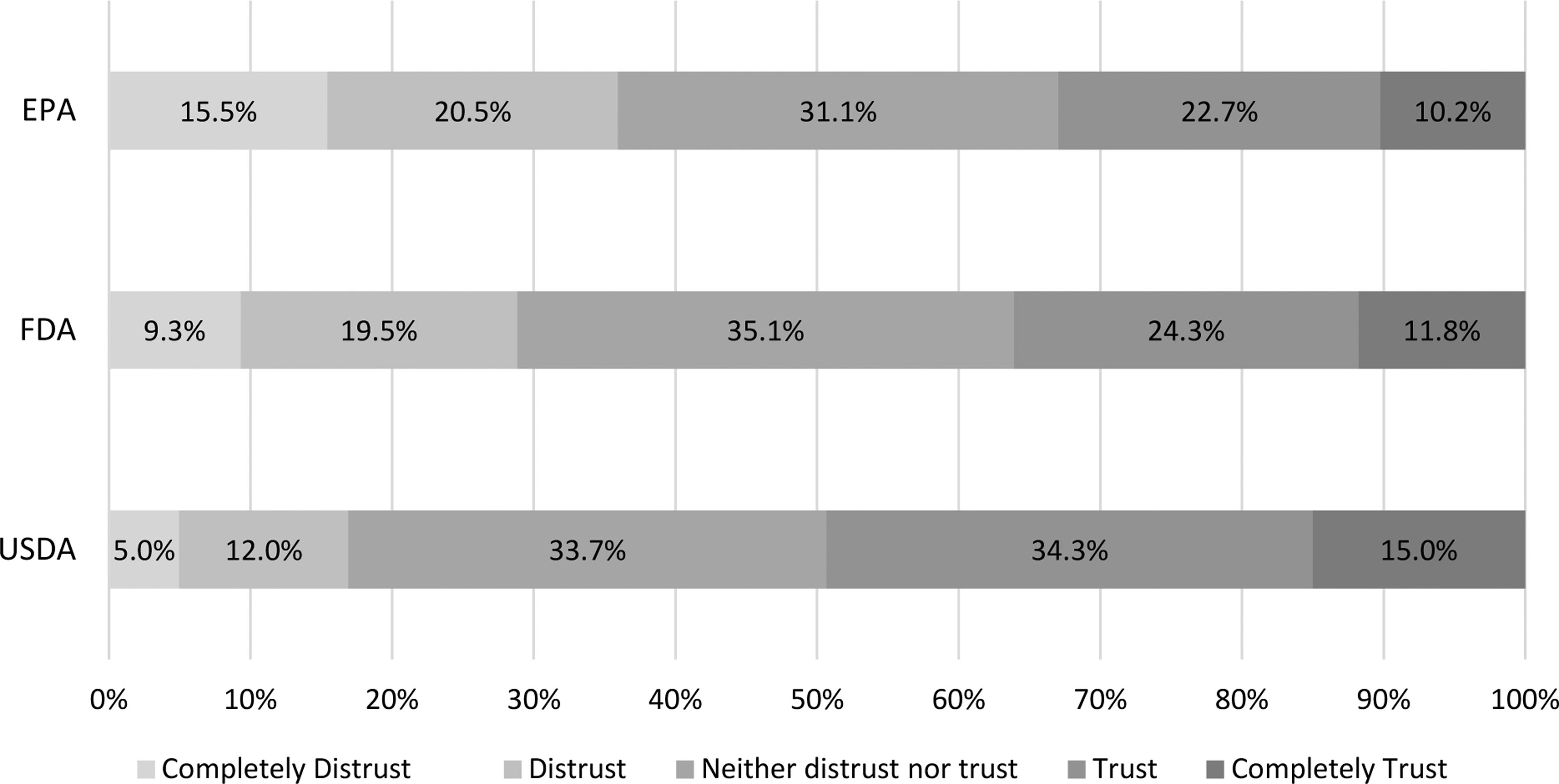
Educational session attendee perceptions of trust in lead agencies to make decisions about gene drive for agricultural pests. Abbreviations: EPA, Environmental Protection Agency; FDA, Food and Drug Administration; USDA, US Department of Agriculture.
Summary Results of Texas Stakeholder Survey (N = 369)
Scale used: 1 = not involved at all; 2 = not so involved; 3 = somewhat involved; 4 = very involved.
Scale used: 1 = not important at all; 2 = not so important; 3 = somewhat important; 4 = very important.
Scale used: 1 = strongly disagree; 2 = disagree; 3 = neither disagree nor agree; 4 = agree; 5 = strongly agree.
Scale used: 1 = a bad idea; 2 = not sure; 3 = a good idea.
Scale used: 1 = strongly oppose; 2 = oppose; 3 = neither oppose nor support; 4 = support; 5 = strongly support.
Summary Results of Posteducational Session Survey (N = 1,061)
Scale used: 1 = completely distrust to 5 = completely trust.
Scale used: 1 = extremely unimportant to 5 = extremely important.
Scale used: 1 = extremely unconcerned to 5 = extremely concerned.
Scale used: 1 = gene drive research should not be pursued; 2 = not sure; 3 = gene drive research should be pursued.
Results
Trust
In the stakeholder survey, we asked respondents who indicated being at least somewhat familiar with the USDA, the US Environmental Protection Agency (EPA), and the US Food and Drug Administration to rate how competent each of these agencies would be at developing guidelines and regulations for gene drive research and use in agricultural pest management. These federal agencies are expected to be the lead regulators of gene drive use in agriculture. Between 61% and 83% of stakeholder survey respondents rated the 3 agencies as somewhat competent or very competent (Figure 1). Overall, the USDA was seen as the most competent and the EPA as less so but still competent.
In the posteducational session survey, we asked about people's trust in the same 3 agencies to make decisions about gene drives for agricultural pest management. Nearly 33% to 50% of the respondents reported that they trust or completely trust these agencies (Figure 2). Respondents expressed more trust than distrust in each of the agencies; USDA was the most trusted agency and EPA the least trusted. These responses are similar to the equivalent competency question from the stakeholder survey.
Stakeholder and Public Roles in Gene Drive Policy and Decisionmaking
To ascertain support for engagement activities, in the stakeholder survey we asked to what extent different groups should be actively involved in informing policies for gene drive. As shown in Table 1, respondents' most favored groups for involvement in gene drive policies were state agricultural extension agents (mean = 3.64; SD = 0.64) and university scientists (mean = 3.68; SD = 0.57). On the other end of the spectrum, respondents saw little need to involve religious leaders (mean = 1.75; SD = 0.81) and animal rights groups (mean = 1.99; SD = 0.94).
The posteducational session survey queried people about their support for engagement activities by asking how much they distrust or trust a comparable list of groups to make decisions about gene drive for agricultural pests. As with the stakeholder survey, Table 2 shows that the most trusted group among the posteducational session survey respondents were extension agents and program specialists (mean = 3.77; SD = 1.00) and university scientists (mean = 3.62; SD = 1.06). Respondents assigned animal rights groups (mean = 1.91; SD = 1.11), voters (mean = 2.25; SD = 1.13), environmental groups (mean = 2.29; SD = 1.21), and religious leaders (mean = 2.27; SD = 1.26) overall low trust ratings.
Views on Gene Drive Product Efficacy and Safety
We measured stakeholder views on gene drive product efficacy using the importance they placed on relevant agricultural economic factors. Overall, stakeholder survey respondents expressed the importance of different agricultural economic factors. Among the economic factors, agricultural product quality had the highest mean score (mean = 3.66; SD = 0.67) and job displacement of agricultural workers had the lowest (mean = 3.09; SD = 0.79). Our posteducational session survey results also showed that economic factors are important when making decisions about developing gene drive for agricultural pest management. Managing pests in a more effective and less costly way had the highest mean score (mean = 3.81; SD = 0.97).
In the stakeholder survey, we measured views on product safety based on how important biodiversity, public health, and effects on pesticide usage should be when deciding whether a gene drive should be developed to manage a specific agricultural pest. Overall, respondents indicated that the following factors are important: public health (mean = 3.87; SD = 0.38), biodiversity (mean = 3.67; SD = 0.55), and pesticide usage (mean = 3.59; SD = 0.59). Respondents from our posteducational session survey reported on product safety based on the importance they assigned to overall effects on the environment (mean = 4.17; SD = 1.03), plants or animals (mean = 4.13; SD = 1.02), and agricultural workers' health (mean = 4.13; SD = 1.04).
Views on Gene Drive Risk Management Considerations
Our surveys included questions that address several risk management considerations noted in the literature. Stakeholder survey respondents overall reported that 4 technological factors related to controllability and scientific certainty are important when deciding whether a gene drive should be developed to manage a specific agricultural pest. We also asked whether they agree that a gene drive must be able to be undone and the effects reversed in case harmful, unintended consequences occur. Among those technological factors, the ability to shut it down after release had the highest average score (mean = 3.76; SD = 0.49). In the posteducational session survey, respondents reported overall concern about the potential for a gene drive to spread into other related species, possibly affecting beneficial insects and crop plants or affecting key species in the ecosystem (mean = 3.81; SD = 1.06). They also indicated the importance of the degree of scientific certainty that a gene drive will have the intended results (mean = 4.04; SD = 1.07).
Support for Gene Drive Research and Policies
Stakeholder survey respondents expressed high levels of support for using gene drive technology in agricultural pest management. In the survey, respondents were asked whether, overall, gene drives are a good idea for managing agricultural pests—65% supported the potential use of gene drives for managing agricultural pests, 12% opposed its use, and 23% were unsure. We found similar results in the posteducational session survey, where 65% of respondents reported that gene drive research should be pursued, about 7% did not support gene drive research, and just under 28% were not sure. We also gauged stakeholder views on different gene drive policies that would help build the knowledge base and structure for gene drive engagement. We found that respondents were generally supportive of federal policies to increase research funds for gene drive technology.
Discussion
The research we present here is an empirical approach to identifying perceptions and values of key stakeholders in the policy area of agricultural pest management and the utility of gene drive technologies. While we do not claim that our stakeholder samples are perfectly representative of key stakeholders in Texas or other states, we do believe the breadth and depth of our stakeholder samples reflect enough variety and representation to illuminate the following major points of importance.
A key organizing theme that emerged for stakeholders as they approached gene drive applications for pest management is trust, broadly conceived. In our stakeholder survey and posteducational session survey, we found that although most stakeholders trusted the USDA and US Food and Drug Administration, the posteducational session survey respondents were less trusting of either of these agencies. Stakeholder survey respondents also trusted the EPA, but posteducational session survey respondents were slightly more distrustful than trustful. The difference in ratings between the 2 survey groups may be partly attributed to the neutral response option in the posteducational session survey. Results from both surveys indicated that stakeholders trust agricultural extension personnel, university scientists, and industry in their evaluations of gene drive for pest management, given the stakeholders' willingness to engage with these groups. However, stakeholder survey respondents trusted environmental groups and the general public to be involved in gene drive evaluations, whereas the posteducational session survey respondents did not. Although stakeholders support engagement, we do not know whether their motivations for engagement align with the purposes noted in the literature.16,25 We can likely expect some variation among their motivations. 36 Commitment to engagement is, however, indicated by stakeholder survey respondents who generally supported policies to educate people about gene drive and to involve them and international groups in gene drive development.
In addition, stakeholders consider the importance of trusting product efficacy and safety claims, with risk management considerations centrally important to decisions and policies about use and deployment of gene drives. Overall, stakeholders rated these factors as somewhat to very important, although product efficacy received somewhat lower importance than the other 2 factors. Stakeholder survey respondents generally supported policies that focus on social factors as well as efficacy and safety factors of gene drive technology. Trust in those responsible for risk management is especially important for individuals with low levels of knowledge about a topic, which, given its novelty, is expected to be the case for many people for gene drive technology. 12 For individuals with little personal knowledge about a technology, evaluations of its benefits and risks are strongly correlated with their trust in those responsible for managing the related risks. 12
Without trust in regulatory agencies and other key participants, decisions will not be seen as either fair or transparent. 8 Trust can be measured along several dimensions: integrity, value similarity, care, fairness, motivations, and competence.13-15 Given the technological complexity of gene drive, we think that stakeholder and community members' views of decisionmakers' competence is the aspect of trust most pertinent to the process of using gene drives. 16
Conclusion
Stakeholders, decisionmakers, and the public are at the very early stages of considering gene drive technology as a possible way to combat costly, damaging agricultural pests. Stakeholders, decisionmakers, and the public are just now learning about gene drive applications, gathering information, and forming opinions about it. Whether or not such a technology should be developed and deployed was not the purpose of this study. We are interested in discovering how stakeholders approach such innovations and how they frame their interests and concerns before any potential use of gene drives in agriculture is publicly discussed. We learned that gene drive agricultural stakeholders pay close attention to issues of trust, efficacy, safety, and risk management and support joint decisionmaking as the only way to conduct the discussion of this innovative technology and make optimal decisions about it. We confirmed the importance of several issues raised in the literature—trust, broad engagement, efficacy, safety, and measures to respond to potential harms29,33-37,43,44—that will drive this important discussion and provided a framework for supporters and opponents to approach this discussion openly and productively. Future research can further elaborate useful approaches to a balanced discussion of the utility of this new technology for pest management. We recommend that future research on stakeholder and community engagement include further examination of (1) the reasons that motivate stakeholders to engage in this process, (2) appropriate and acceptable entities for initiating education and engagement activities, and (3) how partnerships on gene drive policy making might be formed across stakeholders and communities in an equitable manner that recognizes the value of stakeholder and community member participation.
Footnotes
Acknowledgments
The authors acknowledge Dr. Kent Portney, director in memoriam of the Institute for Science, Technology, and Public Policy and former principal investigator for the project upon which this article is based, for his vision, leadership, and expertise in the interdisciplinary design of the overall project and each of its components. We also express our sincere appreciation to personnel from Texas A&M AgriLife Extension Entomology and the Texas Integrate Pest Management Program for conducting stakeholder engagement sessions and surveys. This work is supported by Agriculture and Food Research Initiative Grant No. 2018-67023-27676/Accession No. 1015199 from the USDA National Institute of Food and Agriculture. Any opinions, findings, conclusions, or recommendations expressed in this publication are those of the author(s) and do not necessarily reflect the view of the USDA.