




Abstract
Firefighters are a critical component of the emergency response system and therefore a potential target for organizations seeking to disrupt this system. Terrorist organizations may deliberately attack firefighters to both increase the devastation of an attack and impair the affected community's ability to respond to an attack. We performed a focused search of the Global Terrorism Database to identify terrorist attacks against firefighters worldwide. The database includes incidents from 1970 through 2019, with a total of 201,183 entries. These entries were searched for incidents involving firefighters or fire trucks. We analyzed trends in the number of incidents occurring per year, regions of the world impacted, methods employed, and number of casualties inflicted. A total of 42 attacks involving firefighters were identified in the Global Terrorism Database resulting in 26 deaths and 95 wounded. Of the 42 attacks, 12 (28.6%) were secondary attacks, where firefighters responding to an initial attack were themselves targeted. The most common method for both primary and secondary attacks was the use of a bomb or explosive. Although attacks against firefighters are uncommon, they highlight both the strategic value and vulnerability of firefighters to terrorist attacks. Increased efforts must be made to protect firefighters from future terrorist attacks.
Introduction
The goal of a terrorist attack is to use violence and intimidation in pursuit of political aims. 1 Previous research has described the deliberate targeting of healthcare infrastructure and personnel.2-7 Firefighters are a crucial component of the emergency response, providing fire suppression, performing hazard mitigation, and conducting rescue operations. As first responders to the scene of a terrorist attack, they can also become targets themselves of a secondary attack. For this reason, first responders are trained extensively in establishing situational awareness and ensuring scene safety. 8
By targeting components of the initial emergency response, the effects of a terrorist attack can be drastically amplified. Incapacitation of fire service personnel can adversely impact the provision of lifesaving interventions to people who are injured or ill in times of emergency. The loss of life among firefighters may be further compounded by the preventable deaths of victims who could have been saved with timely rescue and emergency care. Finally, the targeting of firefighters can have a negative psychological effect on a community when highly respected public safety professionals are injured or killed. 9
In order to mitigate the risk and impact of terrorist attacks against firefighters and inform future preparedness, a better understanding of past attacks is necessary. This study characterizes terrorist attacks deliberately targeting firefighters spanning the last 50 years.
Methods
The Global Terrorism Database (GTD) is an open-source database maintained by the National Consortium for the Study of Terrorism and Responses to Terrorism (START) based in College Park, Maryland. 10 To be included in the GTD, an incident must be intentional, entail some level of violence or immediate threat of violence, and be perpetrated by subnational actors (not officially government-sponsored). Furthermore, an incident must meet at least 2 of the following 3 criteria: (1) the act must be aimed at attaining a political, economic, religious, or social goal; (2) there must be evidence of an intention to coerce, intimidate, or convey some other message to a larger audience than the immediate victims; and (3) the action must be outside the context of legitimate warfare activities.
We performed a search of the GTD using the Preferred Reporting Items for Systematic Reviews and Meta-Analyses (PRISMA) standard, which identified 201,183 terrorist attacks from 1970 through 2019. 11 Using the target/victim type and target subtype variable, we identified a smaller dataset of incidents involving “fire fighter/truck,” comprising 42 entries. To ensure that these entries accurately represented attacks against firefighters, 2 members of the research team performed a manual review of each entry to confirm appropriateness for inclusion in the analysis. This study was deemed to be exempt from review by the Washington University School of Medicine Human Research Protection Office.
Results
We identified 42 instances of terrorist attacks against firefighters in the GTD. These attacks claimed the lives of 26 individuals and wounded 95 more. Of these attacks, 12 (28.6%) were secondary attacks, where an initial attack was used to draw in firefighters who were then targeted by a subsequent attack. The Table provides information about attack characteristics including whether the attack was a primary or secondary attack, the region where the attack took place, the attack type, and weapons used.
In both primary and secondary attacks, bombs or explosives were used in over 40% (n = 18) of all attacks. However, terrorist organizations also used firearms and incendiary weapons and staged attacks against firefighter facilities and infrastructure, although these forms of attacks were less common.
Table. Characteristics of Attacks (N = 42)
Among secondary attacks, 10 of the 12 (83%) involved the detonation of an explosive device as the primary attack meant to lure firefighters and other emergency responders to an area. The other 2 secondary attacks used an incendiary device as the primary attack.
The Middle East and North Africa saw the most targeted violence against firefighters with 16 documented attacks. Three terrorist attacks against firefighters occurred in North America. Attacks against firefighters have occurred on all inhabited continents except Australia.
All but 2 attacks occurred after 2006. The highest number took place in 2015 with 8 (19%) documented, followed by 6 in 2016, and 5 in 2013. Figure 1 shows the full breakdown of attacks by year. Figure 2 shows the number of secondary attacks by year.
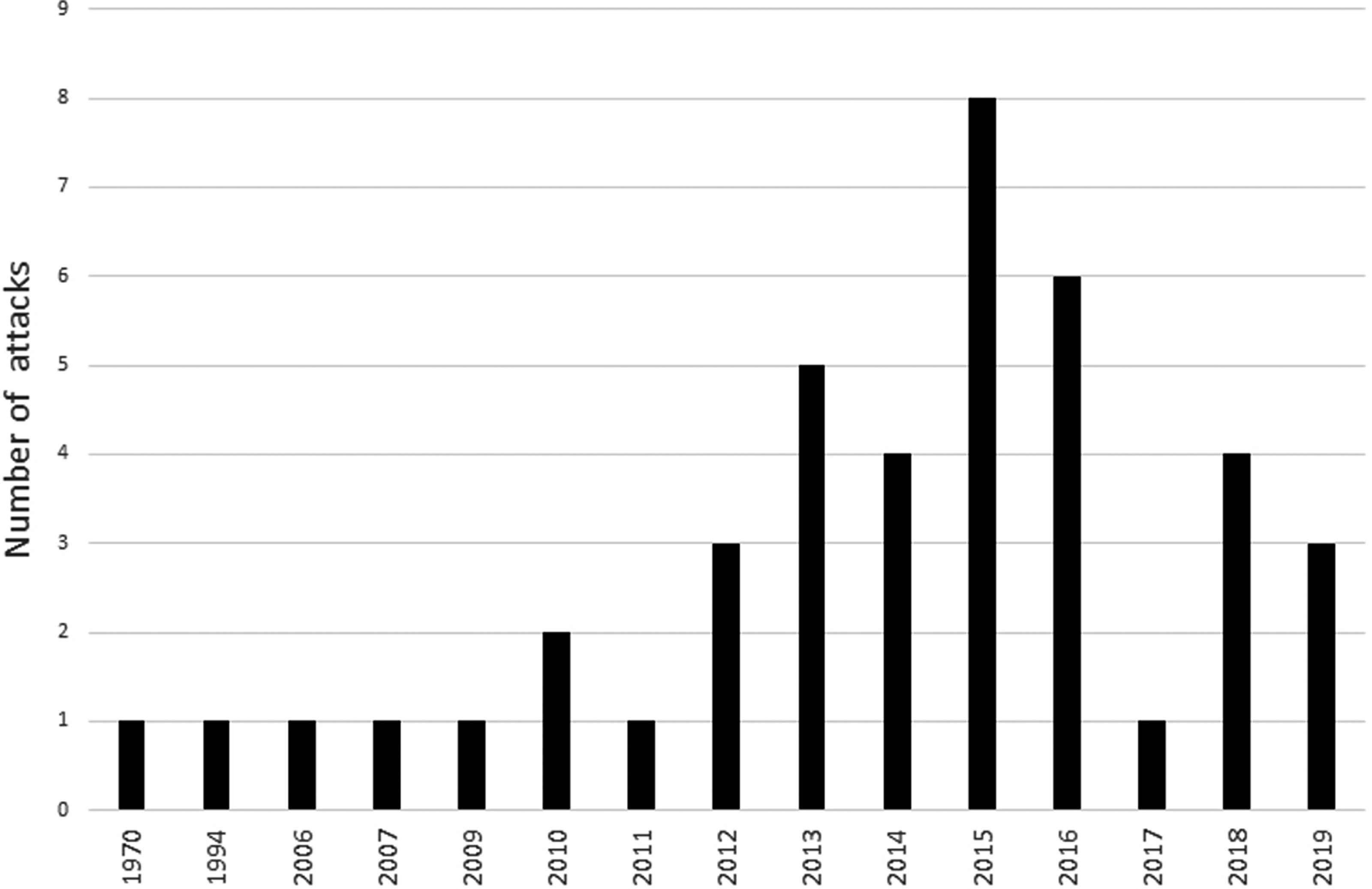
Number of terrorist attacks against firefighters by year, 1970 to 2019.
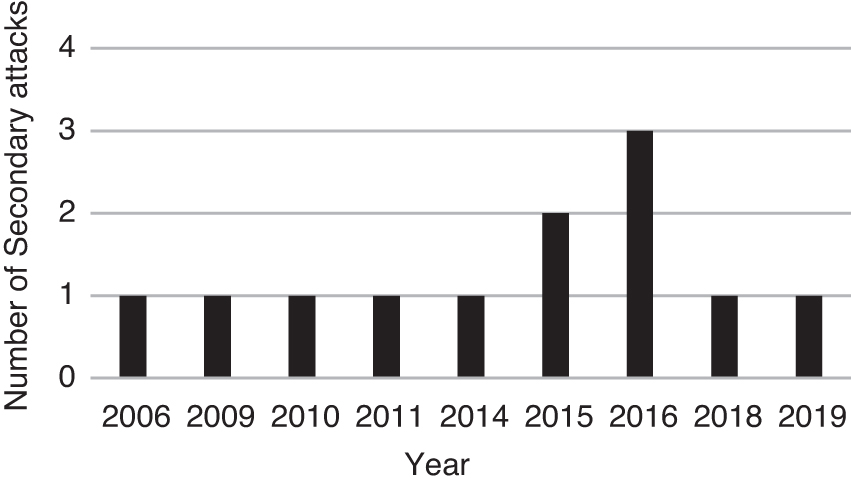
Number of secondary terrorist attacks against firefighters by year, 1970 to 2019.
Discussion
Firefighters are an integral part of any emergency response to a terrorist attack. Unfortunately, the highly visible role fulfilled by fire service personnel makes them vulnerable targets.
Firefighters deliver crucial prehospital emergency care. Fire departments often incorporate formal medical training (eg, emergency medical responder, emergency medical technician) into the fire suppression curriculum. In the aftermath of a disaster, firefighters contribute to rescue and salvage operations. Firefighters may be tasked with delivering first aid and transporting patients to definitive healthcare resources within the community. The intentional disruption of rescue operations can exacerbate the already devastating effects of a terrorist attack.
From 1970 through 2019, we identified 42 incidents in which firefighters were deliberately targeted by terrorist organizations. Of these, 12 were secondary attacks. In total, these attacks resulted in 26 deaths and 95 individuals wounded. However, the true death toll may be higher because incapacitation of firefighters called upon to rescue victims of an attack could lead to potentially preventable loss of life among responders and victims alike.
All but 2 of the recorded attacks against firefighters occurred during or after 2006. At least 1 attack against firefighters has been reported annually since 2009 with a peak in 2015. This trend is concerning because targeted violence against firefighters has the potential to result in not only significant loss of life but also hampering a community's emergency response. The consistent targeting of firefighters in attacks by terrorist organizations may indicate increased familiarity with means to disrupt emergency management and mitigation.
Secondary attacks demonstrated a similar trend, with all but 1 occurring during or after 2006. As with the attack pattern in general, secondary attacks are also becoming more common, with 5 occurring in 2015 and 2016. This is concerning for multiple reasons. First, secondary attacks are specifically designed to incapacitate emergency personnel responding to an event. They are also logistically more complex to carry out because 2 separate attacks—often using bombs or explosives—must occur in close proximity within a short amount of time. The increasing number of secondary attacks on firefighters is concerning because it suggests that terrorist organizations are becoming more comfortable both in targeting firefighters and in organizing more complex attacks to do so.
Terrorist organizations used a variety of methods to execute their attacks against firefighters. The most common method was the use of explosives. However, 9 attacks were carried out with firearms and 1 involved a melee (fight). Unlike explosives, both firearms and melee attacks require the perpetrator or perpetrators to be in close physical proximity to their victims. The fact that terrorists were able to accomplish this speaks to the imperatives of first responder safety and increased situational awareness.
Terrorist attacks have occurred on every inhabited continent except Australia. While the Middle East and North Africa accounted for 38.0% of all attacks recorded, Europe and Asia accounted for 47.5% of attacks (21.4% and 26.1%, respectively). Attacks have also occurred in North and South America (7.1% and 2.4%, respectively) and Sub-Saharan Africa (4.8%), although with much less frequency than in other continents.
Overall, our study points to the need for firefighters to be trained to respond to the aftermath of a terrorist attack and to avoid becoming victims themselves. Some urban fire departments within the continental United States have incorporated specific counterterrorism education and personnel into daily operations.12-14
Another key component of emergency response is the ability to gain rapid access to attack victims to begin rendering lifesaving care. The need to quickly reach victims, however, must be balanced against security and safety concerns for first responders. In the United States, a potential solution that has begun to be incorporated in rescue planning is the “rescue task force.” A rescue task force combines police and firefighter elements to enable firefighters and emergency medical service providers to operate in warm zones, where threats may not have been entirely neutralized. The purpose is to rescue victims faster and initiate potentially lifesaving treatment sooner.15,16 Other countries are beginning to adopt this model as well. The United Kingdom recently announced that both London and Manchester would have firefighters trained and equipped to respond to marauding terrorist attacks, 17 which are defined as “fast-moving, violent incidents where assailants move through a location aiming to find and kill or injure as many people as possible.” 18 However, moving firefighters closer to threats may increase the risk posed to them. On-scene situational awareness and a robust unified command structure focused on safety will help mitigate possible hazards. Initial and ongoing firefighter education should incorporate lessons learned from threat analysis and explore strategies for the preservation of personal and professional safety.
Schmeitz et al 5 previously examined 184 attacks directed against emergency medical service providers. Attacks against firefighters were not included in that analysis. Given the differentiation between fire and emergency medical service providers with respect to mission profiles and training standards, a focused analysis on attacks against firefighters can help inform stakeholders as to their vulnerability.
Previous studies examining the impact of terrorism on firefighters have largely focused on the long-term physical and mental health effects of responding to attacks.19,20 There is a paucity of literature exploring specific educational or preparedness initiatives for firefighting personnel. A 2002 study by Beaton 21 suggests that a validated survey instrument can be used to gauge the baseline level of domestic preparedness. The Domestic Preparedness Questionnaire showed adequate “validity” and inter-test “reliability” as an assessment of training effectiveness. 20 Another study from Norway highlights the importance of “role clarity” among firefighters and other first responders in the aftermath of a disaster. 22
Many agencies, both domestically and internationally, may be tasked with gathering intelligence on impending terrorist threats. It is imperative that the fire service communicates with relevant intelligence and law enforcement agencies to ensure adequate awareness of impending threats. Maintaining and facilitating these interagency communications should be a high priority. Knowledge of potential attacks can afford firefighters invaluable time to prepare for and maximize their safety. Similarly, during an attack, the ability to interface quickly with security and intelligence assets is vital to maintaining accurate situational awareness of ongoing threats.
This study analyzed a preexisting retrospective, university-sponsored, government-funded database of unclassified terrorist attacks drawing upon government, private, and media sources. There is a limited means to confirm this data or know the extent of underreporting. Additionally, the database itself does not include foiled or failed plots, attacks in which violence is threatened as a means of coercion, nor incidents reported from lower-quality sources. Limited high-quality sources in certain geographic areas may result in conservative documentation of attacks. There is also a gap in data collection from 1993 because handwritten report cards were lost; however, some data were recovered. 10 Of the 201,183 GTD entries, 11,454 were missing target subtype variables, which could lead to underreporting of the target type. All of these factors may mean that the true incidence of attacks against firefighters is underreported or misreported in this analysis. Additionally, due to the retrospective nature, no statements of causality can be made.
Conclusion
Targeting of fire service professionals by terrorist organizations can drastically impact a community's emergency response capabilities. Although uncommon, terrorists have increased their attacks against firefighters in recent years. This increase highlights both the strategic value and vulnerability of firefighters. Developing strategies to protect firefighters will require multidisciplinary collaboration between stakeholders in the medical, security, and intelligence community.