




Abstract
The US Centers for Disease Control and Prevention Division of Select Agents and Toxins (DSAT) regulates laboratories that possess, use, or transfer select agents and toxins within United States as part of the Federal Select Agent Program. DSAT also mitigates biosafety risks through the review of “restricted experiments,” which under the select agent regulations are experiments that pose heightened biosafety risks. In a previous study, we evaluated restricted experimental requests submitted to DSAT for review between 2006 and 2013. The purpose of this study is to provide an updated analysis of requests to conduct potential restricted experiments submitted to DSAT between 2014 and 2021. This article describes the trends and characteristics of the data associated with restricted experimental requests involving select agents and toxins that have an impact on public health and safety (US Department of Health and Human Services agents only) or both public health and safety and animal health or products (overlap agents). From January 2014 to December 2021, DSAT received 113 requests to conduct potential restricted experiments; however, 82% (n=93) of those requests were determined not to meet the regulatory definition of a restricted experiment. Of the 20 requests that met the definition of a restricted experiment, 8 were denied because the experiments had the potential to compromise disease control in humans. DSAT continues to encourage entities to practice due diligence and request a review of research that could potentially meet the regulatory definition of a restricted experiment out of an abundance of caution to protect public health and safety and prevent any potential compliance action.
Introduction
The US Centers for Disease Control and Prevention Division of Select Agents and Toxins (DSAT) manages the possession, use, and transfer of biological select agents and toxins, which have the potential to pose a severe threat to public health and safety. Certain provisions in the select agent regulations require entities to request permission from the program before conducting a subset of high-risk experiments that have the potential to be directly misapplied by others or accidently released in the environment, posing a severe threat to public health. 1 These experiments are therefore “restricted” until permission is granted by DSAT. Regulatory oversight for conducting restricted experiments was included in the 2005 publication of the final rule governing the possession, use, and transfer of select agents and toxins (42 CFR 73) 1 and was adopted from the major actions under Section III-A-1 of the NIH Guidelines for Research Involving Recombinant or Synthetic Nucleic Acid Molecules. 2
Currently, 3 types of experiments meet the regulatory definition of a restricted experiment (42 CFR 73.13). 1
Experiments that involve the deliberate transfer of, or selection for, a drug (or chemical) resistance trait to select agents that are not known to acquire the trait naturally, if such acquisition could compromise the control of disease agents in humans, veterinary medicine, or agriculture (ie, the transfer of drug-resistant traits into select agents).
Experiments involving the deliberate formation of synthetic or recombinant DNA containing genes for the biosynthesis of select toxins lethal for vertebrates at an LD50 <100 ng/kg body weight (ie, nucleic acids that encode select toxins).
Experiments involving the creation of SARS-CoV/SARS-CoV-2 chimeric viruses resulting from any deliberate manipulation of SARS-CoV-2 to incorporate nucleic acids coding for SARS-CoV virulence factors or vice versa. *
In our previous article, 3 we evaluated restricted experimental requests submitted to DSAT between 2006 and 2013. This article presents an updated analysis characterizing restricted experiment requests submitted to DSAT between January 1, 2014, and December 31, 2021. The information presented is intended to continue to promote awareness among the research community regarding the types of experiments that meet the regulatory definition of a restricted experiment and the technical review process.
Methods
Definition: Potential Restricted Experiment Requests
Potential restricted experiment requests submitted to DSAT from January 2014 to December 2021 were used in this analysis. The definition of a “potential restricted experiment” is an experiment involving the transfer of a drug resistance trait into a select agent (eg, introduction of kanamycin resistance into Francisella tularensis) or an experiment involving the formation of nucleic acids that encode for select toxins (eg, experiments using synthetic or recombinant nucleic acids for the biosynthesis of botulinum neurotoxin). A technical review was conducted to determine whether the request met the regulatory definition of a restricted experiment.
Technical Review
DSAT requested the following information from entities to conduct a technical review or risk assessment of each potential restricted experiment request:
Synopsis of the proposed experiment(s) and the intended objective(s) Description of the nucleic acid insert (complete sequence information is not required) and biological characteristics of the recombinant or synthetic product Description of the cloning/expression vector, if applicable Biosafety level, including a description of facility containment, equipment, and special practices to be used for the proposed experiment(s) Identification and characteristics of the host organism used for molecular cloning Scientific references or supporting documentation, particularly with respect to the therapeutic usefulness of the proposed antibiotic used for selection purposes and biosafety aspects of the proposed experimental product Synopsis of any planned animal or plant experiments (if applicable) or other relevant animal or plant work Description of the methods used for selection (eg, plasmid-mediated or passive selection) to include all potential drug-resistant products, including intermediate variants (if applicable) Availability of alternative antibiotic marker genes that could be used to avoid the acquisition of drug resistance that could compromise the use of the drug to control disease agents in humans Description of the mechanism and specificity of antimicrobial resistance (antibiotic, antifungal, and antiviral resistance) conferred to include any cross-resistance to other therapeutically useful antimicrobials (if applicable) Estimated amount of toxin (recombinant or synthetic) to be produced (if applicable)
In addition, DSAT considers the additional information presented by the entity when determining the following:
If gradient selection experiments (in vitro or in vivo) meet the definition of a restricted experiment, or
If drug efficacy experiments (in vitro or in vivo) to evaluate any resistant strains that result from failed therapy with drugs that control disease agents in humans meet the definition of a restricted experiment
Whether the isolates are less susceptible to drugs that control disease agents in humans will be retained
Whether drugs that control disease agents in humans can be used at therapeutic doses to limit the growth of a less susceptible population
Whether the experimental model will exert pressure to create resistant strains
Whether agar plates or broth media will be supplemented with drugs that control disease agents in humans to determine if resistant isolates are generated
Whether purposeful selection for resistant strains will be conducted
All potential restricted experiment requests that involved the deliberate introduction of a drug resistance trait were reviewed to determine if the drug resistance being introduced into the select agent was against a drug that is used therapeutically for the treatment of select agent infections. If the drug resistance trait could compromise disease control, other information was considered (eg, Are other drugs available to treat select infections? If the drug is not used for treatment United States, is it used therapeutically outside the United States?). In addition, experiments with specific select agent strains that have naturally acquired resistance to the drugs used to treat the disease were not considered restricted experiments.
If a request required a technical review, DSAT convened the Intragovernmental Select Agent and Toxin Technical Advisory Committee (ISATTAC) to provide recommendations as described in a previous publication. 3 ISATTAC's recommendations were submitted to the DSAT director to render a final decision. Some requests did not require a technical review because the request was not unique or it was previously reviewed by ISATTAC; in these situations the DSAT director rendered a final decision based on precedence.
During the decisionmaking process, DSAT considers a biosafety review of the restricted experiment request. In addition, security plans, personnel security risk assessments, and incident response plans were considered before a final determination was provided to the entity. Restricted experimental decisions are a result of careful consideration of the entity, principal investigator, and biosafety factors, and cannot be transferred to another entity or principal investigator planning similar work. If approved, adherence to specific conditions, such as biosafety level containment, is required to conduct a restricted experiment.
Data Analysis
The following variables were extracted from the DSAT-restricted experiment request database during the study period:
Entity type submitting the request (eg, academic, government, private/commercial)
Select agent or toxin identified in the experiment
Type of experiment proposed (9 CFR §121.13 (a)(1) or (a)(2)) 4
Drug resistance trait transferred (if applicable)
Final determination of the request (eg, restricted experiment approved, restricted experiment denied, experiment does not meet the regulatory definition of a restricted experiment)
Incomplete submissions or requests withdrawn by the requestor were excluded from analysis.
Results
Requests Received by DSAT for Technical Review
From 2014 to 2021, DSAT received and reviewed 113 requests for potentially restricted experiments (Figure 1). The number of requests received each year ranged from 1 to 54 during the study period, declining 5-fold from 2014 to 2021 (Figure 2). For the study period, 82% (n=93) of all potential restricted experiment requests did not meet the definition of a restricted experiment. However, 20 requests (18%) met the regulatory definition of a restricted experiment, of which 12 experiments were approved and 8 experiments were not approved (Figure 1).

Types of requests included in the study analysis. All requests to conduct potential restricted experiments were analyzed and characterized by the number of requests that met the definition of a restricted experiment vs those that did not meet the definition, as well as the types of restricted experiments that were approved or denied.

Restricted experiment status following DSAT review of requests submitted for determination of restricted experiment status. Requests were analyzed to determine the number of requests that met the regulatory definition of a restricted experiment or experiments that did not meet the regulatory definition of a restricted experiment. Abbreviation: DSAT, Division of Select Agents and Toxins.
Entity Types Submitting Restricted Experiment Requests
From 2014 to 2021, an average of 276 entities were registered with DSAT each year. However, only 9 entities accounted for the submission of the 20 requests that met the regulatory definition of a restricted experiment: 2 were federal entities and 7 were academic institutions (data not shown).
Requests by Select Agent
Requests to conduct potential restricted experiments with Burkholderia pseudomallei (n=37, 33%), Burkholderia mallei (n=14, 12%), and botulinum neurotoxins (n=13, 12%) were the top 3 selected agents and toxin experiments submitted for review (Figure 3). Collectively, these top 3 agents represented 57% of all requests reviewed. However, 11 out of 20 (55%) of the requests that met the definition of a restricted experiment involved the deliberate formation of synthetic or recombinant DNA containing genes for the biosynthesis of botulinum neurotoxin.
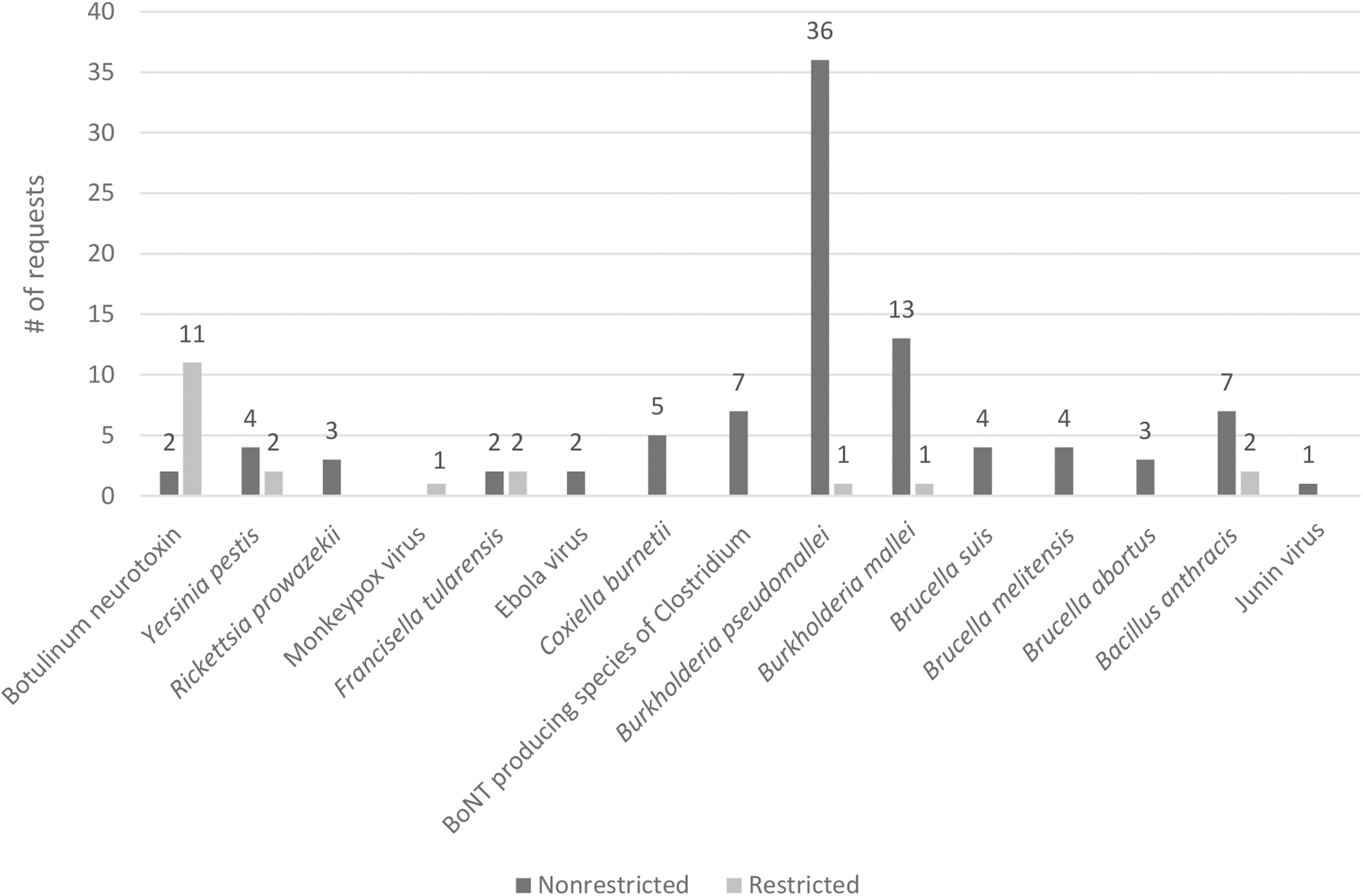
Restricted and nonrestricted requests by select agent or toxin. Requests were examined to identify the most common select agents or nucleic acids encoding for select toxins requested to review. The requests were also categorized into restricted or nonrestricted experiments. Abbreviation: BoNT, botulinum neurotoxin.
Restricted Experiment Violations
During the study period, DSAT did not observe any restricted experimental departures. As such, there were no referrals to the US Department of Health and Human Services Office of Inspector General to report potential restricted experiment violations. 5
Discussion
From 2014 to 2021, DSAT reviewed 20 requests to conduct restricted experiments from 9 academic or federal government laboratories, suggesting that restricted experimental research with select agents and toxins is being proposed or conducted by a very small subset (n=9, 3%) of the total 276 of entities that are registered with the select agent program. These observed trends are consistent with the types of entities submitting proposals to conduct potentially restricted experiments in our previous study. 3
Eighty-two percent (n=93) of the 113 reviewed requests did not meet the regulatory definition of a restricted experiment because the requests were to select toxins that had an LD50 greater than 100 ng/kg body weight or the transfer of the drug resistance trait into a select agent did not compromise the control of disease in humans. These data suggest that although entities continue to submit requests to DSAT for experiments that do not meet the definition of a restricted experiment, the total number of these types of requests is decreasing over time. DSAT continues to encourage entities to practice due diligence and request a review of research that could potentially meet the regulatory definition of a restricted experiment out of an abundance of caution to ensure public health and safety and prevent any potential compliance action. The information presented in this article, coupled with the information in the Restricted Experiments Guidance 6 and outreach activities at national scientific conferences, is intended to promote awareness among the research community of the types of experiments that meet the regulatory definition of a restricted experiment and to provide a greater understanding of the restricted experimental review process.
The overall total number of potential restricted experiment requests submitted to DSAT for review declined between 2014 and 2021 and remained consistently low. The overall decline in potential restricted experiment requests submitted to DSAT is consistent with the trend seen in our previous study 3 where the total number of requests received declined substantially between the years 2010 and 2013 and continued to decline during the current study period. This decline could be attributed to the regulated community becoming more aware of the types of experiments that require prior review from the select agent program, thereby reducing the number of overall requests to review experiments that do not meet the regulatory definition of a restricted experiment.
The number of requests that met the definition of a restricted experiment declined from 31 approved restricted experiments to 12 approved restricted experiments between the 2 study periods, suggesting that the regulated community is conducting less restricted experimental work overall. However, requests to conduct restricted experiments with nucleic acids that encode for select toxins continued to be the most consistent type of request approved during the 2 study periods, while requests to conduct restricted experiments by transferring drug-resistant traits into select agents continued to be the most consistent type of request that was denied during the 2 study periods.
During the current study period, 11 requests to conduct restricted experiments that involved the deliberate formation of synthetic or recombinant DNA containing genes for the biosynthesis of botulinum neurotoxin requests and 1 request to characterize monkeypox isolates resistant to tecovirimat (investigational drug ST-246 at the time of the request review) were approved to conduct in this study period because
the biosafety conditions met the minimum safety guidelines prescribed in the Biosafety in Microbiological and Biomedical Laboratories 6th ed. 7 ;
the experiments did not compromise the control of the disease in humans;
conditions were prescribed to mitigate the risk of the experiments to public health (eg, the entity required to destroy research strains at the conclusion of the study) and safety; and
the benefit of validating the efficacy of a new antiviral to treat a select agent infection with limited existing medical countermeasures outweighs the potential safety and security risks.
The remaining restricted experiment requests (n=8) were for experiments that introduced drug resistance traits that could compromise the control of disease and were excluded because either the biosafety approach or the experimental procedures proposed did not adequately mitigate the public health risks associated with the deliberate or accidental release of products derived from these experiments. The accidental release of these products and the risks to public health were so severe that the knowledge gained by conducting the experiment in the strictest biosafety and security conditions was not commensurate with the risk to public health and safety.
As we previously reported, 3 B pseudomallei and B mallei continued to be the top selected agents submitted for review, although 36 of 37 requests for B pseudomallei and 13 of 14 requests for B mallei did not meet the definition of a restricted experiment. One explanation for why entities are disproportionally submitting requests to review Burkholderia spp experiments is because the organism is inherently resistant to several classes of antibiotics. 8 As such, entities may be practicing due diligence to determine if the introduction of specific antibiotic resistance genes into B pseudomallei and B mallei meet the definition of a restricted experiment. However, experiments do not meet the regulatory definition of a restricted experiment if the selected agent is known to naturally acquire drug resistance traits.
Finally, no restricted experiment violations were referred to the US Department of Health and Human Services Office of Inspector General between 2014 and 2021, whereas 4 restricted experiment violations were referred in our previous study 3 between 2003 and 2013 and civil money penalties were imposed.
This finding indicates that entities were more compliant with the restricted experiment provisions of the selected agent regulations during the current study period, which could be associated with increased Federal Select Agent Program outreach and training efforts related to restricted experiments to select agent stakeholders through annual meetings, workshops, and webinars; the Restricted Experiments Guidance 6 ; and related presentations and outreach at national scientific conferences. Additionally, a combination of onsite inspections and virtual inspections during the COVID-19 pandemic (March 2020 through December 2021) did not notably impact DSAT's operations to ensure comprehensive compliance with the federal select agent regulations for all registered laboratories.
One limitation of this study is the absence of restricted experimental data from the US Department of Agriculture (USDA), Division of Agricultural Select Agents and Toxins (DASAT) to observe trends across the Federal Select Agent Program from 2013 to 2014. However, beginning in 2015, the Federal Select Agent Program began to publish annual data characterizing the number and type of restricted experiments received by DSAT and DASAT in the annual report of the Federal Select Agent Program released on the selected agent website. 9 DASAT did not receive any requests to conduct restricted experiments for USDA Veterinary Services or Plant Protection and Quarantine Select Agents between 2015 and 2021. In addition, predictive statistical analyses were not conducted to identify statistically significant relationships between the frequency and types of restricted experiment requests submitted over time among entity types because of the low sample size (n=20) of requests that met the regulatory definition of a restricted experiment, which may reduce the chance of detecting a true effect.
Conclusion
The Federal Select Agent Program greatly enhances the nation's oversight of the safety and security of select agents and toxins through the review of restricted experiments.
Footnotes
Acknowledgments
The findings and conclusions in this report are those of the authors and do not necessarily represent the official position of the US Centers for Disease Control and Prevention.