




Abstract
The application of geospatial data often allows the tracing of people who are involved in activities of an illegal nature. In June 2021, we estimated the true magnitude of the spread of COVID-19 within the networks of escort-karaoke bars in Seoul, Republic of Korea, using geographic information system (GIS)-based contact tracing that was applied to our epidemiological investigation. Our joint rapid response team, composed of epidemic investigation officers and police personnel, identified 19 paper-traced cases and 158 GIS-traced cases from 5,692 confirmed cases in Seoul during the study period (June to July 2021). Our findings suggest that collaboration with law enforcement agencies and the use of overlaid satellite imagery in outbreak investigations enhances high vigilance and reduces the risk of potential breaches of human rights in the process.
Background
During the early phase of the COVID-19 pandemic, contact tracing was the key strategy for interrupting the chains of transmission of SARS-CoV-2. 1 However, conventional contact tracing requires a sizable, well-trained workforce to conduct face-to-face interviews, which is difficult in general, but even more so when investigating illegal activity or stigmatized places such as escort-karaoke bars. 2 Because of the illegal nature of visiting or working at such places and the associated social judgment, employees and visitors to escort-karaoke bars are often unwilling to disclose their identity and visit history, which may result in further spread of the virus into the community.
A geographic information system (GIS) provides a comprehensive way to collect and analyze data when an epidemiological investigation is related to spatial dimensions. It has been used to track polio vaccination, 3 Ebola contact tracing, 4 and the measles epidemic. 5 In the United States, smart thermometers have been used to track the geospatial distribution of influenza-like symptoms, and smartphone location tracking has been used to measure population mobility despite public health restrictions. 6 Given the high burden of case detection and management during the surge of the COVID-19 outbreak, GIS can be useful for real-time reporting of new chains of SARS-CoV-2 transmission and reversing the growing outbreak.
In June 2021, the Seoul Metropolitan Government (SMG) detected a surge in COVID-19 cases among people who were allegedly associated with escort-karaoke bars. An escort-karaoke bar is a type of room salon where female employees cater to groups of men seeking drinks and attentive conversation in a closed space with poor ventilation. In this study, we estimated the true magnitude of the spread of COVID-19 within the networks of escort-karaoke bars using GIS-based contact tracing methods in an epidemiological investigation in Seoul in 2021.
Methods
The COVID-19 surveillance system of the SMG detected a surge of COVID-19 cases clustered in a district in Seoul in June 2021. Most of the cases were young adults aged 20 to 39 with unknown origin of infection; however, these cases were reportedly associated with escort-karaoke bars, which triggered the investigation. It was estimated that the number of confirmed cases from escort-karaoke bar clusters who did not disclose the route of infection increased because the social distancing stage prohibited private gatherings at nightclubs or escort-karaoke bars. At the beginning of the epidemic in Gangnam District, one of the busiest urban areas of Seoul, we established a joint rapid response team to tackle the surge of unknown infection routes in collaboration with law enforcement. The team comprised members of the Korea Disease Control and Prevention Agency, SMG, Korean National Police Agency, and Gangnam Health Center. An epidemiological field investigation was conducted focusing on surveillance and contact during the period of July 1 to 14, 2021.
To begin with, we conducted forward contact tracing using conventional paper-based tracing, which is the main method used to interrupt transmission of SARS-CoV-2, by identifying and quarantining close contacts of infected cases. 7 According to protocol by the Korea Disease Control and Prevention Agency, all COVID-19 confirmed cases are subject to epidemiological investigations, which include their name, gender, age, medical records, mobile phone-based location information, records of credit card usage, as well as the origin and route of infection—in accordance with Article 18 (Epidemiological Investigations) of the Infectious Disease Control and Prevention Act. The epidemiological investigation officer at the local health authority conducted in-depth interviews with patients and developed case epidemiological investigation forms, checked closed-circuit television (CCTV) footage, and reviewed credit card usage to determine the exposure events and close contacts, as well as GPS inquiry to send a text message to the exposed person. A personally traced case was defined as a laboratory-confirmed COVID-19 case who worked at or visited escort-karaoke bars in the Gangnam District, as determined by conventional epidemiological investigation methods, namely in-depth interviews with patients using standardized epidemiological investigation forms. These forms were completed for 5,692 cases between June 15, 2021, and July 6, 2021. As a result, we identified 12 escort-karaoke bar employees, 4 visitors, and 3 family members of visitors through the analysis of epidemiological investigation forms, CCTV footage, and credit card usage.
This traditional method of contact tracing is understandably laborious and influenced by recall bias, especially if patients are unwilling to reveal the infected person with whom they have come into close contact. To fill the gaps in conventional contact tracing, our joint response team supplemented personally traced cases with digital technologies. Using GPS data, we can locate the exact position of GPS-enabled smartphones, enabling new levels of geospatial data collection and analysis.
3
In accordance with Article 18 of the Infectious Disease Control and Prevention Act,
7
an epidemiological investigation officer is authorized to conduct an epidemiological investigation. To initiate the GPS search, the officer obtains the confirmed patient's name, date of symptom onset, date of collection, and mobile phone number. In the case of symptomatic patients, GPS information can be obtained up to 14 days prior to the date of symptom onset and 14 days prior to the date of sample collection for asymptomatic patients, considering the incubation period for COVID-19. We conducted forward contact tracing using conventional paper-based tracing by identifying and quarantining close contacts of infected cases.
8
The GIS-based tracing method tracked the infection route of unknown cases and then measured the magnitude of the outbreak by targeting the escort-karaoke bars where exposure to COVID-19 most likely occurred. We defined GIS-traced cases as those that were laboratory confirmed and stayed more than 3 hours within 150 meters of 12 personally traced cases from escort-karaoke bars between midnight and 6
In accordance with Article 76-2 (Request for Provision of Information and Verification of the Information) of the Infectious Disease Control and Prevention Act, 7 we received GPS data on the confirmed patients and suspected patients from a telecommunications business. Based on this mandate and authority, the KCDA registered the information about infected individuals with the epidemiological investigation support system immediately after GPS data were collected from the telecommunication businesses and police on a near real-time basis. Our joint rapid response team ensured appropriate privacy protection for the source of the contact tracing system location information and scrutiny of the transparency of the process, as there are strong legislative protections against misuse. 9 The encrypted location data were transmitted through telecommunication companies and police internal networks. Information such as location tracking could only be analyzed by the police officer in charge and the results were shared only with other investigation team members.
We identified a total of 5,692 confirmed cases in Seoul from June 15 to July 6, 2021. In collaboration with law enforcement, GPS tracking data were loaded into ArcGIS Pro version 2.8.7 (Esri, Redlands, CA) and open street maps.
In addition, we conducted a social network analysis—a quantitative method of examining how social groups operate in particular ways—to assess epidemiological significance and interactions. This analysis characterizes networked structures in terms of nodes and links that connect them. 10 IBM i2 Analyst's Notebook version 9 (IBM, Armonk, NY) software was used to automatically calculate the number of connected nodes, distribution of nodes and density, and the location of each node for network visualization.
Lastly, we illustrated heatmaps covering the vicinity of 659 escort-karaoke bars in Gangnam District using the mobile phone GPS data for location tracking of personally traced cases and GIS-traced cases (Figure 1). We created a grid of infected people who stayed for more than 10 minutes at an escort-karaoke bar within the 150 meter radius between midnight and 6
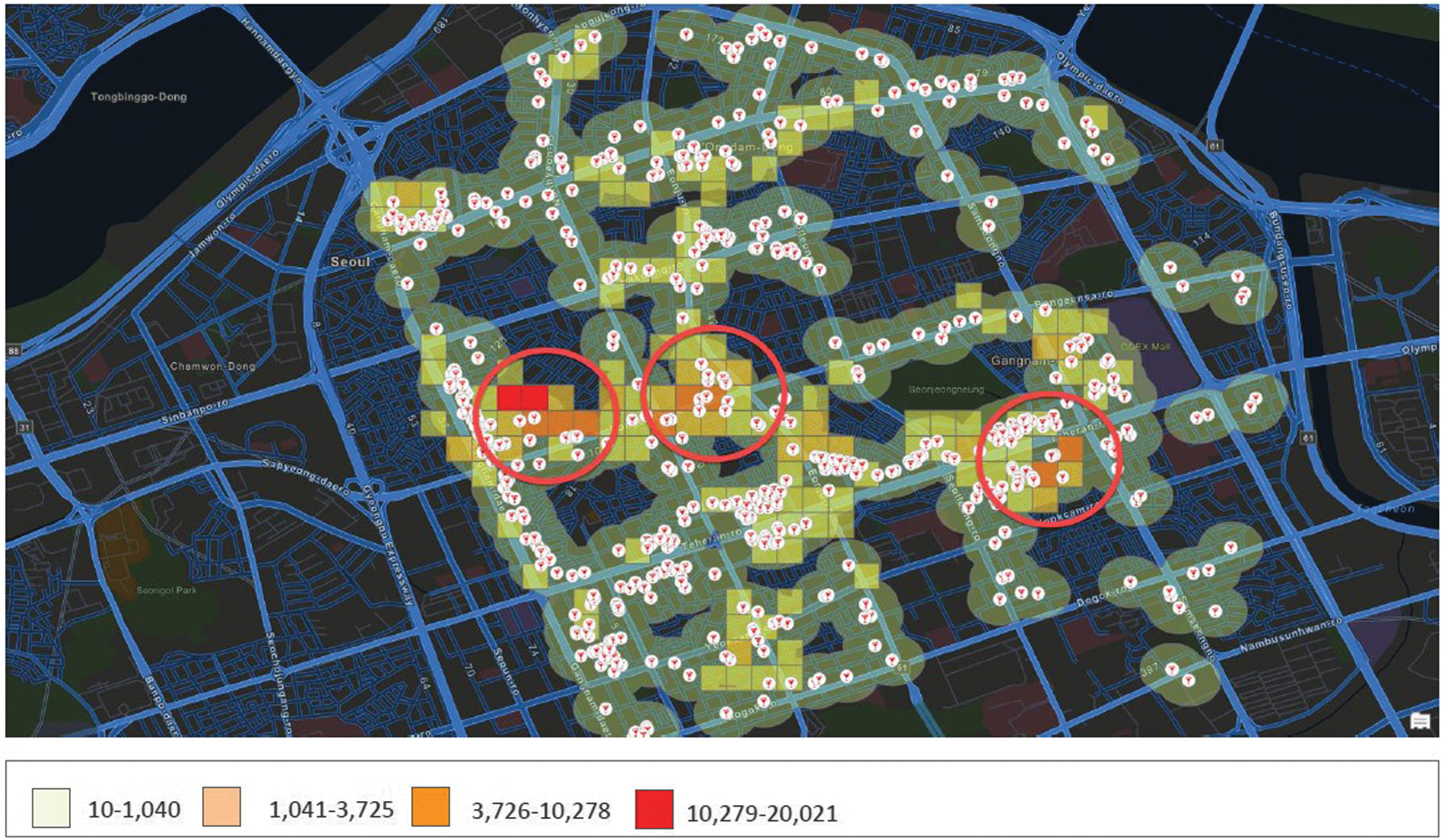
Heatmap illustrating the distribution of COVID-19 escort-karaoke bar clusters. The legend from yellow to red represents the least dense to most dense, using mobile phone GPS location data, Seoul, Korea, 2021. Abbreviation: GPS, global positioning system.
To be specific, we created digital maps for location tracking using the mobile phone GPS of patients. The digital maps illustrated the distribution of cumulative stay time in escort-karaoke bars with a color-coded legend: yellow (10 to 1,040 minutes), orange (1,041 to 3,725 minutes), red orange (3,726 to 10,278 minutes), and red (10,279 to 20,021 minutes). The red orange and red hotspots included 3 hotspots where our joint team carried out onsite field study and where there was a second wave of transmission to a family of the escort-karaoke bar visitors.
Results
Of the 5,692 confirmed cases identified in Seoul between June 15 and July 6, 2021, we identified 19 paper-traced cases. Of these 19 patients, 12 (63.2%) confirmed patients were working at escort-karaoke bars, 4 (21.1%) were visitors, and 3 (15.7%) were family members of visitors. Of 19 patients for whom demographic information was available, 12 (63.2%) were women, the mean age was 32.7 years (range 4 to 57 years), and 11 (57.9%) were symptomatic.
In addition, we identified 158 patients who worked at or visited escort-karaoke bars between June 15 and July 6, 2021. Of these 158 patients, 80 (50.6%) were women, the mean age was 32.5 years (range 15 to 64 years), and 119 (75.3%) were symptomatic. Similar to personally traced cases, the average age of GIS-traced cases was higher for men (34.0 years) compared to women (31.1 years). In the GIS-traced group, 27.5% of men and 17.9% of women were aged 50 years or older (Table).
Table. General Characteristics of Personally Traced Cases and GIS-Traced Cases From the Gangnam Hostess-Related Cluster in June and July 2021 in Seoul, Korea
Symptoms include fever, myalgia, headache, cough, and hyposmia at the time of diagnosis.
Abbreviation: GIS, geographic information system.
Potential routes of infection were determined by conducting social network analyses on personally traced cases and GIS-traced cases (Figure 2). The relationship between personally traced cases and GIS-traced cases showed that cases were connected through 9 clusters and 11 central cases, except for 1 cluster. Female employees tend to work at multiple escort-karaoke bars. One patient employee who played the role of intermediary within a red hotspot had a greater amount of influence over transmission and acted as a gatekeeper to control the flow between parts of the network. The connectivity of the intermediary was 63.4%, showing a high level of strength.
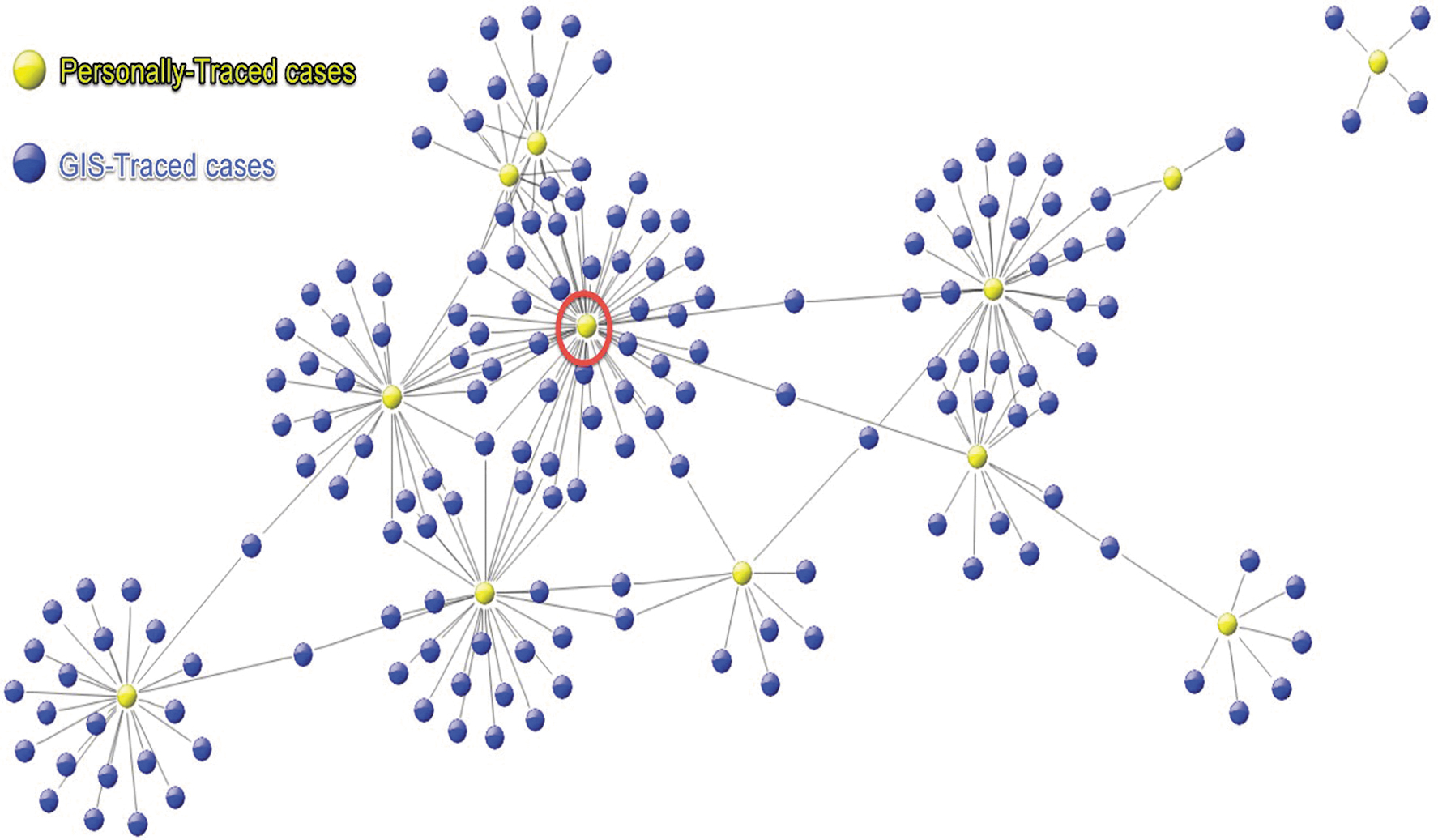
Social network of COVID-2019 escort-karaoke bar clusters generated using personally traced cases indicated in yellow and GIS-traced cases indicated in blue, Seoul, Korea, 2021. Abbreviation: GIS, geographic information system.
Based on this analysis, we identified a total of 177 patients who worked at or visited escort-karaoke bars between June 15 and July 6, 2021, including 19 patients who were personally traced and 158 patients who were GIS traced. Figure 3 shows the epidemic curve as a series of successively larger peaks, which were separated according to incubation period, indicating that 1 or more of the people infected during the initial wave infected a group of people who represented the second wave of infection.
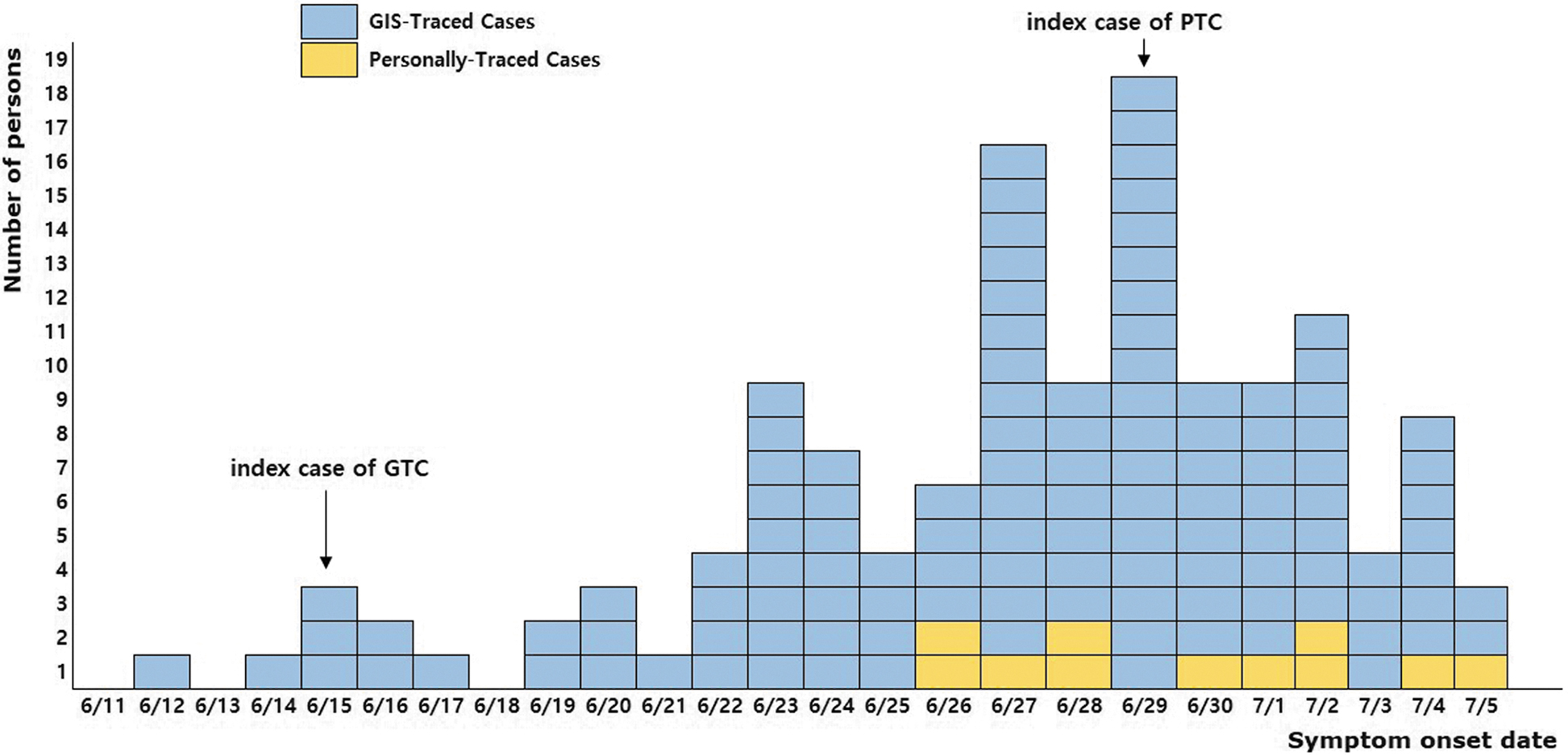
Epidemic curve of COVID-19 escort-karaoke bar clusters using personally traced and GIS-traced cases, Seoul, Korea, 2021. Asymptomatic cases are excluded. Abbreviations: GIS, geographic information system; GTC, GIS-traced case; PTC, personally traced case.
Discussion
Our study demonstrated that backward contact tracing using geospatial data, together with conventional forward contact tracing, could identify more associated cases and, thereby, interrupt further transmission by identifying locations at risk and enabling effective intervention measures to implement. A study from 2014 comparing traditional contact tracing paper-based methods of data collection with advanced digital methods showed that advanced digital methods can overcome the limitations of paper-based contact tracing. 3 In a modeling study from 2021, backward contact tracing in addition to forward contact tracing resulted in the identification of 2 to 3 times more cases than forward contact tracing alone. 11 Our study demonstrated that the advantages of supplementing a personally traced method with a GIS-traced method included a more accurate magnitude of COVID-19 transmission, security, and real-time reporting, especially for cases involving a stigmatized place such as an escort-karaoke bar.
In the early stages of the COVID-19 pandemic in South Korea, there were occasions when some patients experienced unwanted privacy invasion with the release of highly detailed information in the media. 12 Our study illustrates a method that can overcome the challenges of privacy and ethical issues associated with conducting contact tracing. Location-based contact tracing using aggregated geospatial data, rather than individual-level data, was much more secure for tracing specific groups that were not tracked due to social stigma. In fact, it was possible to describe the COVID-19 epidemic trajectory and magnitude while minimizing the social effects. However, the use of GPS location data of confirmed cases still has the potential to expose personal privacy. Therefore, when conducting an epidemiological investigation of a confirmed case, it is necessary to notify the Korea Disease Control and Prevention Agency and obtain consent to conduct an epidemiological investigation including the case's GPS data. The use of collected information is limited to the purpose of containing and preventing the spread of infectious disease, in strict compliance with the Personal Information Protection Act 13 and to the extent permitted by the relevant public health law.
Another benefit of location-based tracing is its relatively low cost compared with tracing using in-person interviews. With a proper level of accuracy, location-based tracing can identify more cases within a short time period, especially if a large number of people have been potentially exposed. One of the main purposes of contact tracing is to collect information on cases to identify infection sources and transmission patterns so that appropriate preventive measures can be implemented promptly. We recommend minimizing the use of conventional contact tracing methods that could lead to social stigma and, instead, focusing on GIS-based tracing efforts that facilitate a prompt response to infectious disease outbreaks. Location-based tracing provides an opportunity to explore less labor-intensive methods than conventional contact tracing based on in-person interviews. The results are applicable to other low-income countries facing similar geographical and infrastructural conditions. 14
Using GIS to visualize the spatial distribution of cases and undertake a hotspot analysis to measure the magnitude of the outbreak enabled the joint response team to implement timely interventions and allocate resources accordingly to mitigate the spread of COVID-19 in Seoul. 15 Specifically, we provided preemptive testing once a week for employees at various bars, regardless of symptoms. For widespread testing to identify carriers who did not want to reveal their visiting history but had come in close contact with an infected person, an additional screening testing station was installed in a Gangnam subway station with dense foot traffic near the 3 hotspots. Rather than reveal the precise locations of an infected individual to the general public, we can disclose aggregated data, which has a more powerful effect on tracking and quarantine. Furthermore, it took 24 days to identify 12 confirmed cases through traditional contact tracing methods using epidemiological investigation forms and checking CCTV footage and credit card usage, whereas it took 20 days to find 158 confirmed cases through advanced digital methods using GPS and heatmaps based on oral interviews. This method also makes it easier to quickly recognize where the outbreak has occurred.
In an outbreak investigation, collaboration between municipal governments, local health centers, and law enforcement agencies can be pivotal in a pandemic response because tracing confirmed cases often involves working with large sets of spatial data on mobility and other relevant place-based data that may be useful in understanding the epidemiology of the disease. 16 This investigation was made possible by legislation that permits the collection and sharing of location data pertaining to infected patients, or those suspected of being infected, during an outbreak of a serious infectious disease and addresses the protection of personal information and public health. 17 Our investigation may serve as a proof of concept that interagency collaboration should be actively sought when there is a need for administrative support from both the epidemiological investigation authorities and law enforcement. To enable collaboration in a timely manner, we recommend developing a formal agreement for interministerial cooperation.
One limitation of this study is that the parameter setting of the GIS maps was too conservative, so the actual number of potential infections that we predicted may have been much larger. Due to the nature of escort-karaoke bars, cases were GIS-traced for 3 hours or more, but the numbers could be underestimated because people who stayed for 1 or 2 hours were omitted. Moreover, the use of GIS-based contact tracing may have been hindered by another technological impediment—because tracking was performed using the GPS of modern smartphones, it was difficult to know who may have turned off their smartphones when in escort-karaoke bars. However, if the variable is set too loosely, there is a risk of overestimation due to an increase in false-positive cases.
Conclusion
In this study of a cluster of COVID-19 cases in an escort-karaoke district in Seoul, contact tracing using geographic visual data was useful for tracing and mitigating transmission, as well as reducing social stigma and disclosure of private information. These findings suggest that in the current and future pandemics, collaboration between infectious disease control authorities and law enforcement agencies is an effective approach to outbreak investigation, especially when tracing individuals involved in illegal or stigmatized activities. To promote the application of this approach to investigating outbreaks in the future, public health agencies may need to establish a legal foundation that allows for effective collaboration with law enforcement agencies. Both parties should maintain high vigilance for potential breaches of human rights during the process.
Footnotes
Acknowledgments
We thank relevant ministries, including the Ministry of Interior and Safety, Si/Do and Si/Gun/Gu, medical staff in health centers, and medical facilities for their efforts in responding to the COVID-19 outbreak. The opinions expressed by authors contributing to this article do not necessarily reflect the opinions of the institutions with which the authors are affiliated. YJ Choe received a grant from the Information and Communications Promotion Fund through the National IT Industry Promotion Agency, funded by the Ministry of Science and ICT, Republic of Korea.