Abstract

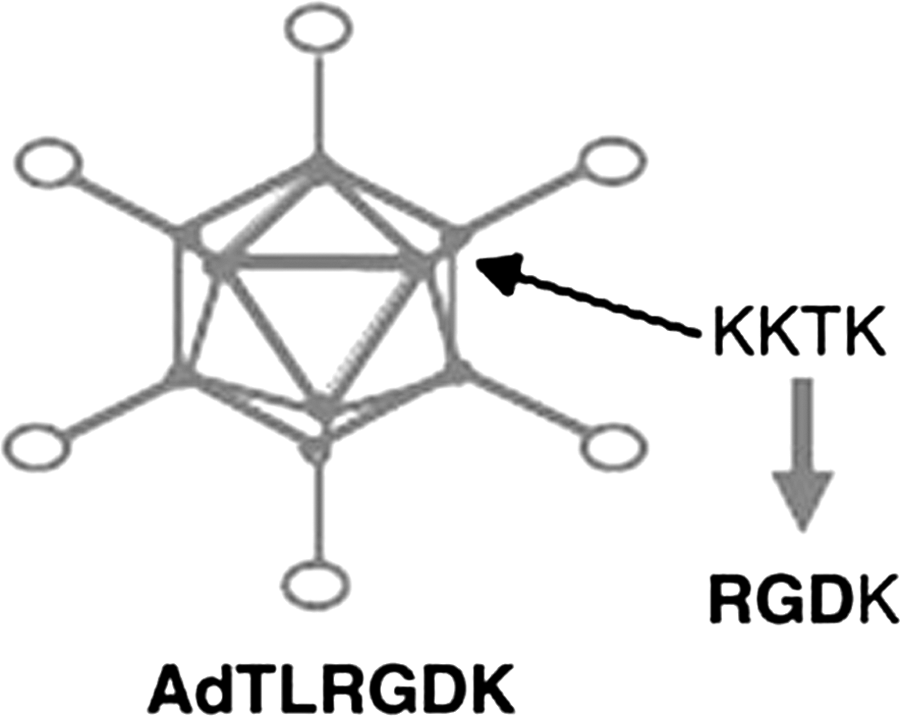
Adenovirus Gets the Shaft
page: 1214
Successful tumor gene therapy with systemically delivered adenovirus-based vectors will require ablation of the virus's natural tropism for the liver. In this issue, the group led by Dr. Ramon Alemany generates novel replacement mutants and analyzes their liver-detargeting and tumor-targeting transduction properties.
The authors generate adenoviral particles in which a small heparan sulfate proteoglycan-binding motif in the shaft of the Ad fiber protein is replaced by an RGD motif-carrying ligand. The authors demonstrate that these vectors exhibit more efficient transduction of a subcutaneous tumor after intravenous vector delivery when compared with wild-type vectors. Liver transduction, however, was only marginally reduced and considered not significantly different from the control. This indeed increased the tumor-to-liver ratio but failed to deliver significant levels of liver detargeting.
The Weak Link in Lentiviral Vector Preparations
page: 1168

Lentiviral vectors are notorious for their limited stability at ambient and physiological temperatures. This thermosensitivity affects the yields and biological potency of the vector during production and storage and is also an important consideration during experimental or clinical administration of the vector. Understanding the kinetics of this decay and the mechanistic basis of this phenomenon will likely impact practice in the laboratory and the clinic and may ultimately lead to more stable lentiviral vector systems.
Researchers from the Instituto de Biologia Experimental e Tecnológica in Portugal, led by Dr. Pedro Estilita Cruz , investigated the thermostability of lentiviral vectors and their components as well as the effect of pseudotyping. In line with their previous work on gammaretroviral vectors, reverse transcriptase (RT) activity was identified as the main determinant of stability. The authors also show that vector inactivation does not affect viral entry but impacts the postentry stages that require RT activity.
In these studies, Carmo et al. provide a potential solution by demonstrating that a modified feline endogenous virus RD114 envelope stabilizes RT's biological activity better in comparison with the less stable amphotropic envelope. This opens the door to further development of improved, more stable lentiviral vectors for gene therapy. (lv)
Decorating against Cardiac Fibrosis
page: 1190

For many complex, acquired, progressive disorders it is often difficult to identify cause and effect when evaluating the role of a single protein player. Here, in an elegant mechanistic study from the Huazhong University of Science and Technology in China,
Dr. Dao Wen Wang
and his team studied the role of decorin in a spontaneous rat model of hypertension and in doing so make a case for its therapeutic use in cardioprotection against fibrosis in hypertension.
Decorin, a proteoglycan present in the serum, is a known antagonist of transforming growth factor (TGF)-β. By neutralizing extracellular TGF-β, it antagonizes the profibrotic effects of this cytokine, likely due to reduced collagen expression. Here, the authors overexpress decorin from a systemically administered AAV. A well-established spontaneously hypertensive rat model was injected at a stage with existing cardiac fibrosis. AAV8 resulted in decorin overexpression in vessels, heart, kidney, and liver, which resulted into a 4- to 5-fold increase in plasma levels of the naturally occurring protein. At 16 weeks after vector administration several clinical effects were seen: hemodynamics and cardiac hypertrophy were improved, as was collagen deposition and fibrosis in the heart. In addition, the albumin level in urine were decreased significantly, which builds further on the existing data that decorin alleviates renal dysfunction.
The study was terminated 16 weeks after vector infusion and therefore was not equipped to evaluate the long-term effects of decorin overexpression in the circulation. The study warrants consideration of AAV-mediated expression of decorin for the treatment of cardiac and renal fibrosis in hypertensive populations but will require long-term toxicity testing of supraphysiological expression of decorin and may benefit from regulated expression systems or more tissue-specific expression before clinical translation. Nonetheless,
“The results of the paper strengthen the notion that gene therapy represents an important and realistic therapeutic tool to combat heart failure. In this respect, the molecular mechanisms of this disease offer a number of possible targets for intervention,” says Dr. Giacca. “Targeting pathological remodeling and fibrosis using decorin can now be added to the list of the possible therapeutic options. This paper perhaps further underlines the outstanding efficacy of AAV vectors for cardiac gene transfer.”
Science wire
Novel Approach Provides Promise for Mitochondrial Gene Therapy

All eukaryotic cells carry in their mitochondria a genome (mitochondrial DNA or mtDNA), which is derived almost exclusively from the maternal egg. Mutations in mtDNA contribute to a diverse range of currently incurable human diseases and disorders; approximately 1 in 3500–6000 people have either mitochondrial disease or are at risk for development of mitochondrial-based disorders. A number of obstacles hinder the successful application of mtDNA gene therapy for the treatment of these diseases.
Using microsurgery, the authors were able to transfer the spindle–chromosomal complex from one nonhuman primate (Macaca mulatta) egg to an enucleated mitochondrial-replete egg. The reconstructed oocytes were fused with sperm and implanted. The authors show that the reconstituted oocytes were able to support normal fertilization and embryo development; the procedure resulted in the birth of three offspring. Genetic characterization of the nuclear DNA of the offspring demonstrated that it had indeed originated from the spindle donors whereas the mtDNA came from the cytoplast donors. The authors note that “this approach may offer a reproductive option to prevent mtDNA disease transmission in affected families.”
“Tachibana et al. are to be congratulated on a substantial accomplishment of great potential,” states
For example, “how will we know that the cytoplast-donating ova are free of mtDNA mutations?” says Bennett. “Ova from older donors have more impaired mitochondria, so young donors are best. But mitochondria also segregate into primordial ova early in embryogenesis and may be genetically different from those of somatic cells, yielding the paradox of a phenotypically normal mother with low somatic cell mtDNA mutational burden having a child with high mtDNA mutational burden and clinical disease. To be safe, the mtDNAs of the cytoplasts would need some type of high-throughput sequencing or at least screening for heteroplasmic mtDNA mutations and deletions.”
Second, notes Bennett, “if mutated mtDNAs truly have a replicative advantage, then small amounts of mtDNA carried over in the karyoplasts, or low-abundance heteroplasmic mutations in the cytoplast host, could achieve dominance over time. This is always a risk, particularly early in cell division where a mitochondrial “bottleneck” arises when mitochondrial replication does not keep up with cell division.”
Nonetheless, remarks Bennett, “these problems can be addressed, particularly if one is trying to produce a fertilized ovum free of a serious pathogenic mtDNA mutation that has likely already devastated a child. Tachibana et al. provide real hope for families afflicted with mitochondrial disorders.” (sk)
Regulatory wire
New Database Reveals a Decrease in NIH-Funded Gene Therapy Research

The National Institutes of Health (NIH) has a new system for providing funding information about research projects conducted at universities, hospitals, and other research institutions. The Research Portfolio Online Reporting Tool (RePORT) website and the RePORTER query tool can be found at http://report.nih.gov. According to the website it provides “reports, data and analyses of NIH research activities.” It retains all the features of the previous CRISP database while providing (1) additional query fields, (2) information about funding for every NIH-supported project (expenditures), (3) the publications and patents that have acknowledged support from each project (results), (4) application success rates for budget and grant activity categories, and (5) information about NIH-supported investigators and trainees, including demographic information. Unlike CRISP, RePORTER will also provide links to PubMed Central, PubMed, and the U.S. Patent and Trademark Office's (USPTO) Text and Image Database.
According to
The site includes funding information related to NIH grants funded by the American Recovery and Reinvestment Act of 2009. Funding queries can be designed to yield a geographical distribution of the grantee's location via Google Maps or per congressional district. Online tables contain clickable content and can be exported conveniently to your local desktop. The options in RePORT are numerous and allow searching for historical funding trends per research field, per institution, and per grant type or permutations thereof.
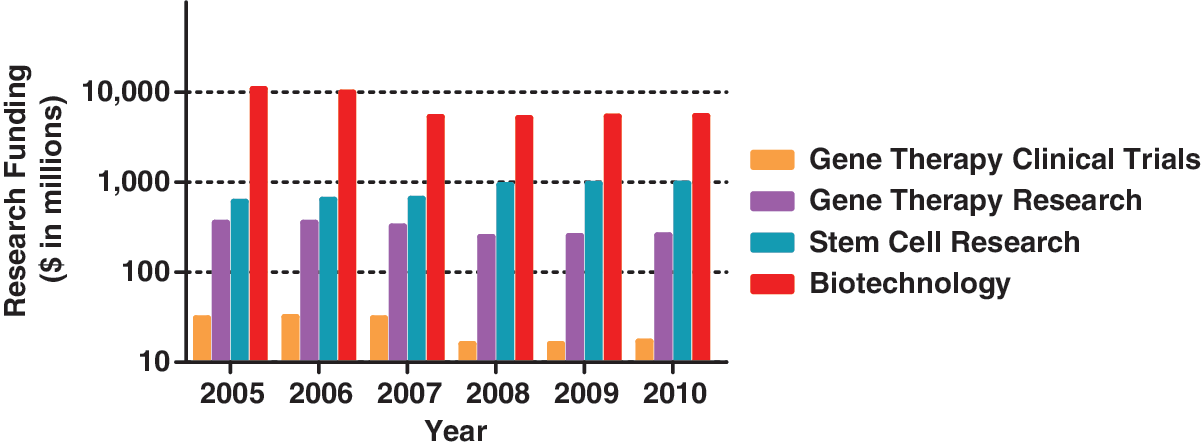
One of the new features of RePORTER is a section called the Research, Condition, and Disease Categorization (RCDC) system that lists detailed funding information for 215 major areas, including gene therapy and stem cell research, from the year 2005 to 2010. RCDC data indicate that whereas support for gene therapy research has progressively decreased from $355 million in 2005 to a projected $259 million in 2010, stem cell research has increased from $609 million in 2005 to a projected $977 million in 2010. NIH funding for gene therapy clinical trials has also decreased over the 5-year span from $31 million in 2005 to $17 million in 2010 (Fig. 1). (sk&lv)
Industry wire