




Abstract

Studies on the molecular virology of a Parvoviridae family member called adeno-associated virus (AAV), conducted in the 1980s by a small group of virologists, established the scientific foundation for the development of this virus as a vector for gene therapy. AAV vectors have emerged as the technology of choice for many applications of in vivo gene delivery. It became clear from the first gene transfer studies in mice that this class of vectors has attractive properties such as efficient transduction of nondividing cells and a peculiar aversion to host immune responses. Progression of this technology into large animals and humans, however, was slow because of challenges in the production of sufficient quantities of high-quality vector. Tremendous progress has been made to overcome these barriers. A series of reviews summarizing the current state of AAV manufacturing is scheduled for publication in Human Gene Therapy, the first two of which are included in this issue.
The simplicity of the AAV genome, which encodes only two sets of viral open reading frames spanning a limited 4.7 kb of single-stranded DNA, belies the complicated network of steps involved in its replication. This helper-dependent virus is a parasite to other viruses, such as adenoviruses, that have more complicated genomes. A graphic representation of this parasitic relationship is shown in Fig. 1, which depicts the colocalization of viral gene products in cells transfected with both AAV (Rep protein in green) and adenovirus (DNA-binding protein in red). AAV establishes residence in cellular domains that harbor foci of adenovirus replication, eventually directing this activity toward its own benefit of self-replication. Superimposed on this interface of two viruses is a complex network of cell–virus interactions. The stoichiometric, temporal, and spatial requirements of this ménage à trois (i.e., AAV, adenovirus, and the cell) have made it difficult to engineer a system for efficient production of replication-defective versions of AAV. For AAV vectors to realize their true potential in the clinic, they must be manufactured in a scalable, cost-effective way that yields products that are homogeneous and devoid of confounding and potentially toxic contaminants.
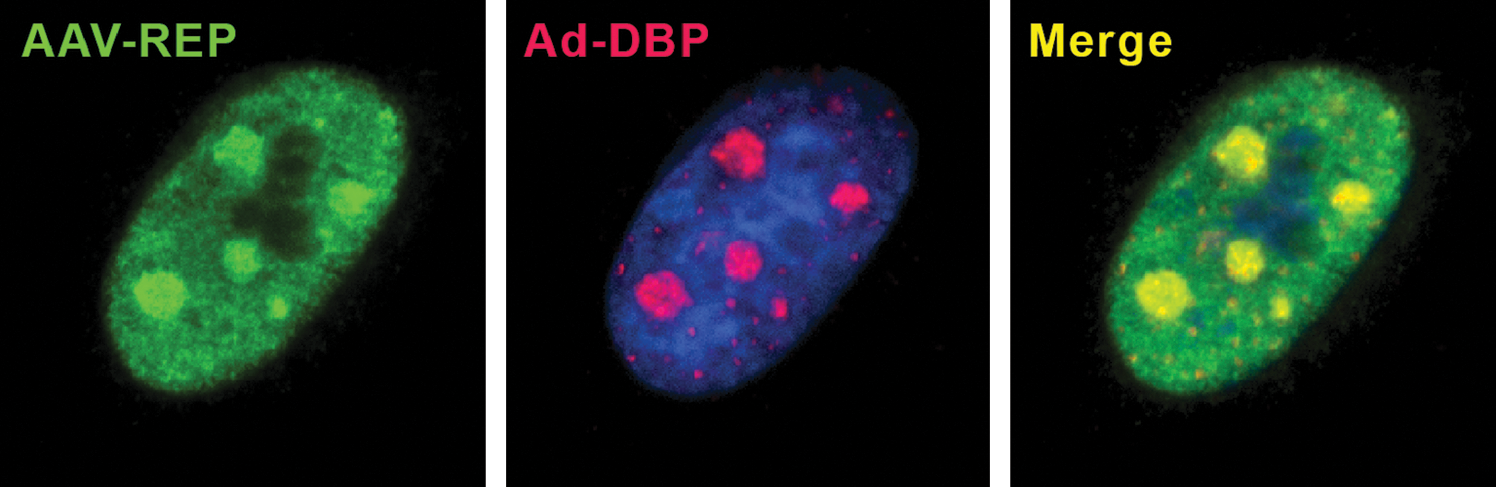
HeLa cells were transfected with a plasmid containing the wild type AAV genome together with an expression vector for the adenovirus Ad-DBP helper protein. Cells were subsequently fixed and stained for Rep protein from AAV (left – green) and DNA binding protein (DBP) of adenovirus (center – red) using immuno-histochemical techniques, and the right panel is a superimposed image of the Rep and DBP signals. Images provided courtesy of Dr. Matthew Weitzman, The Salk Institute, La Jolla, CA.
This issue of Human Gene Therapy contains reviews by J. Fraser Wright from Children's Hospital of Philadelphia and Richard Peluso and colleagues from Targeted Genetics, on the use of transfection and cell line-based approaches, respectively, to produce AAV vectors. Subsequent issues of the Journal will review the use of chimeric–heterologous viruses to constitute the replication of AAV vectors using herpesvirus (Barry Byrne and colleagues from the University of Florida), baculovirus (Rob Kotin and colleagues from the National Institutes of Health), and adenovirus (Guangping Gao and colleagues from the University of Massachusetts and the University of Pennsylvania). These important technical advances will go a long way in bringing AAV gene therapy closer to successful commercialization.