




Abstract
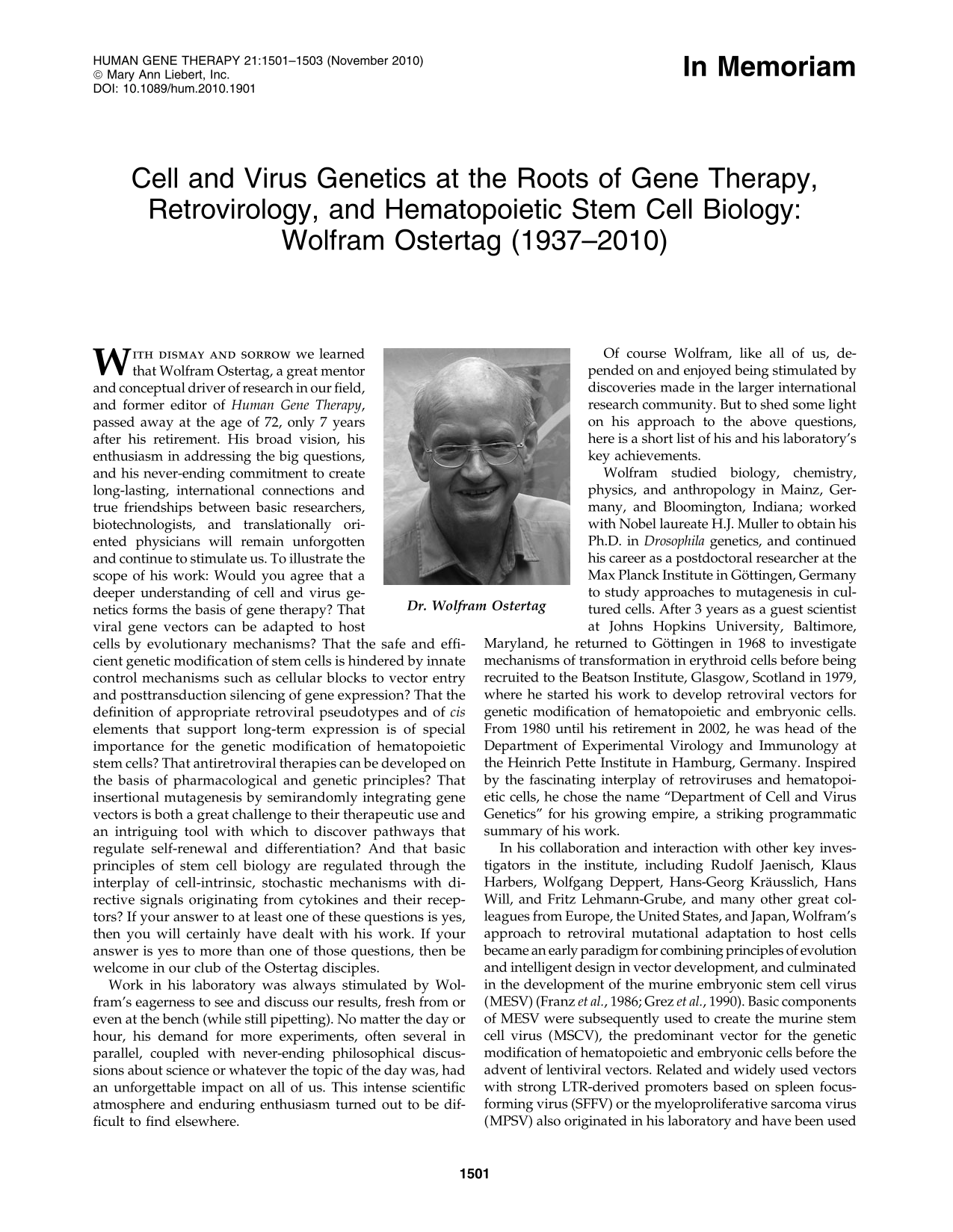

Work in his laboratory was always stimulated by Wolfram's eagerness to see and discuss our results, fresh from or even at the bench (while still pipetting). No matter the day or hour, his demand for more experiments, often several in parallel, coupled with never-ending philosophical discussions about science or whatever the topic of the day was, had an unforgettable impact on all of us. This intense scientific atmosphere and enduring enthusiasm turned out to be difficult to find elsewhere.
Of course Wolfram, like all of us, depended on and enjoyed being stimulated by discoveries made in the larger international research community. But to shed some light on his approach to the above questions, here is a short list of his and his laboratory's key achievements.
Wolfram studied biology, chemistry, physics, and anthropology in Mainz, Germany, and Bloomington, Indiana; worked with Nobel laureate H.J. Muller to obtain his Ph.D. in Drosophila genetics, and continued his career as a postdoctoral researcher at the Max Planck Institute in Göttingen, Germany to study approaches to mutagenesis in cultured cells. After 3 years as a guest scientist at Johns Hopkins University, Baltimore, Maryland, he returned to Göttingen in 1968 to investigate mechanisms of transformation in erythroid cells before being recruited to the Beatson Institute, Glasgow, Scotland in 1979, where he started his work to develop retroviral vectors for genetic modification of hematopoietic and embryonic cells. From 1980 until his retirement in 2002, he was head of the Department of Experimental Virology and Immunology at the Heinrich Pette Institute in Hamburg, Germany. Inspired by the fascinating interplay of retroviruses and hematopoietic cells, he chose the name “Department of Cell and Virus Genetics” for his growing empire, a striking programmatic summary of his work.
In his collaboration and interaction with other key investigators in the institute, including Rudolf Jaenisch, Klaus Harbers, Wolfgang Deppert, Hans-Georg Kräusslich, Hans Will, and Fritz Lehmann-Grube, and many other great colleagues from Europe, the United States, and Japan, Wolfram's approach to retroviral mutational adaptation to host cells became an early paradigm for combining principles of evolution and intelligent design in vector development, and culminated in the development of the murine embryonic stem cell virus (MESV) (Franz et al., 1986; Grez et al., 1990). Basic components of MESV were subsequently used to create the murine stem cell virus (MSCV), the predominant vector for the genetic modification of hematopoietic and embryonic cells before the advent of lentiviral vectors. Related and widely used vectors with strong LTR-derived promoters based on spleen focus-forming virus (SFFV) or the myeloproliferative sarcoma virus (MPSV) also originated in his laboratory and have been used in several clinical trials (Kollek et al., 1984; Stocking et al., 1985; Ahlers et al., 1994; Baum et al., 1995; Hildinger et al., 1999; Fehse et al., 2004; Gaspar et al., 2006; Ott et al., 2006; van Lunzen et al., 2007). It may also be of interest to note that the MND promoter, recently used in the first successful clinical trial to treat a metabolic disease by lentiviral gene transfer into hematopoietic stem cells (Cartier et al., 2009), is a derivative of the MPSV control elements (Challita et al., 1995).
On the basis of work performed in the FDC-P cell lines developed by Mike Dexter's laboratory, Wolfram demonstrated that the genetic modifications of stem cells is hindered not only by epigenetic control (Baum et al., 1995), but also by blocks to vector entry (Beck-Engeser et al., 1991). This triggered research into defining appropriate retroviral pseudotypes, and although he didn't find the best port of entry into hematopoietic stem cells, his laboratory introduced retroviral pseudotypes displaying the glycoprotein of the lymphocytic choriomeningitis virus (LCMV), subsequently shown to be of special interest for the preferential transduction of malignant glioma cells (Miletic et al., 1999).
Almost forgotten but highly remarkable is his important role in the discovery of the antiretroviral activity of azidothymidine (AZT) (Ostertag et al., 1974; Dube and Ostertag, 1991). Back in 1974, he found that AZT inhibits the replication of murine leukemia virus, his preferred genetic tool since the early 1970s. From an economic perspective, it may have been his greatest mistake not to have patented this discovery, which occurred many years before HIV emerged as a new plague of human existence. Work started in his department has led to the development of highly efficient genetic principles to block the entry of HIV into cells (Hildinger et al., 2001).
Wolfram also was one of the first to exploit the potential of replicating retroviruses, and later also replication-deficient retroviral vectors, as tools for the identification of growth-regulatory genes in cultured cells (Stocking et al., 1988, 1993). This work started in the mid-1980s, long before genome sequencing projects were even envisaged, illustrating the substantial technological challenge associated with these projects in the “old days.” The first risk calculations of the frequency of growth-promoting insertions and the discovery of genes participating in growth-factor signaling emerged from this work. This profound background in experimental approaches to retroviral insertional mutagenesis may also explain why the first discovery of leukemia induction by a replication-deficient retroviral vector originated from work initiated in his laboratory (Li et al., 2002).
Although Wolfram always has been a great supporter of the translational development of retroviral gene transfer for medical use, including biotechnological approaches to vector production, he was driven mostly by his deep interest in understanding the principles of hematopoietic differentiation. With one important arm of his research program investigating the interactions of hematopoietic cells with their stromal layers (Nibbs et al., 1993; Itoh et al., 1996), a highlight in the great series of his papers addressing the fundamental question of hematopoietic lineage diversity was work published in 1991, arguing that signals originating from cytokines and their receptors play an important role in directing cell fate decisions (Just et al., 1991). Using elegant cell-tracking studies, this work was only recently confirmed by one of his scientific grandchildren (Rieger et al., 2009). Wolfram's “hybrid model” of self-renewal and differentiation harmonized the epigenetic endogenous program of a cell and instructive cytokine actions (Just et al., 1991).
The scope of Wolfram's personality was much broader than indicated by this summary. A deep love for arts, music, architecture, gardens, and his family always balanced his rich scientific activities. Although the list of his contributions could easily have been extended, his life reached an unexpectedly sudden end. It is with a deep sense of gratitude to note how many of his ideas and achievements continue to live in quite a few of us.
Carol Stocking, Manuel Grez, Boris Fehse, Dorothee von Laer, Katsuhiko Itoh, Vladimir Prassolov, Joachim Nowock, Klaus Kühlcke, Ursula Just, Timm Schröder, Hannes Klump, Bernhard Schiedlmeier, Elke Grassman, Johann Meyer, Zhixiong Li, Axel Schambach, Ute Modlich, Olga Kustikova, Melanie Galla, Jürgen Bode, Axel Zander, Christopher Baum