




Abstract
Gene therapy research is advancing rapidly, and hopes of treating a large number of brain disorders exist alongside ethical concerns. Most surveys of public attitudes toward these ethical issues are already dated and the content of these surveys has been researcher-driven. To examine current public perceptions, we developed an online instrument that is responsive and relevant to the latest research about ethics, gene therapy, and the brain. The 16-question survey was launched with the platform Amazon Mechanical Turk and was made available to residents of Canada and the United States. The survey was divided into six themes: (1) demographic information, (2) general opinions about gene therapy, (3) medical applications of gene therapy, (4) identity and moral/belief systems, (5) enhancement, and (6) risks. We received and analyzed responses from a total of 467 participants. Our results show that a majority of respondents (>90%) accept gene therapy as a treatment for severe illnesses such as Alzheimer disease, but this receptivity decreases for conditions perceived as less severe such as attention deficit hyperactivity disorder (79%), and for nontherapeutic applications (47%). The greatest area of concern for the application of gene therapy to brain conditions is the fear of not receiving sufficient information before undergoing the treatment. The main ethical concerns with enhancement were the potential for disparities in resource allocation, access to the procedure, and discrimination. When comparing these data with those from the 1990s, our findings suggest that the acceptability of gene therapy is increasing and that this trend is occurring despite lingering concerns over ethical issues. Providing the public and patients with up-to-date information and opportunities to engage in the discourse about areas of research in gene therapy is a priority.
Introduction
G
As research into gene therapy progresses and new clinical applications become available, it is critical to assess public opinion and to ensure that all stakeholders, including prospective patients and the broader public, are part of the conversation about moving forward with this therapeutic tool.
There is a large body of literature on public opinions and attitudes toward new medical developments and a number of studies have measured public perception specifically about genetic engineering and gene therapy over the past 20 years (Macer, 1992; Macer et al., 1995; Singer et al., 1998; Bates et al., 2005). These studies vary widely in geographic location, time, survey method, and population queried. As previous work has found that background knowledge of genetics and degree of religious belief influence attitudes toward genetics research and applications, most survey studies on gene therapy have attempted to measure these two factors in their surveyed population (Singer et al., 1998). Overall, results show that acceptability for genetic treatments such as gene therapy is high for applications that involve a cure for fatal or very severe genetic illnesses in children or adults (Singer et al., 1998).
In contrast with previous survey studies that were structured around fixed questions, more recent work harnessed online social media to capture emergent opinions and public-driven concerns about gene therapy (Robillard et al., 2013). The online Q&A website on which users can contribute both questions and answers provided access to freely initiated opinions and attitudes toward gene therapy without a prompt from the research community. Through a content analysis of questions and answers contributed onto the online platform Yahoo! Answers, Robillard and colleagues found that online users express high expectations for gene therapy as well as fears about the impact of gene therapy on self and society (Robillard et al., 2013). More specifically, the main ethics themes discussed in questions were changes to society, effects on self, religion, resource allocation and discrimination and equity (Robillard et al., 2013). Whereas some of these themes overlap with the concerns that ethicists have been articulating about gene therapy and with previous survey work, others contribute new insights into public views and attitudes toward clinical and nontherapeutic applications of this therapeutic innovation.
New developments in medicine such as gene therapy interact with public opinion through mechanisms such as funding bodies, patient advocacy organizations, and lobbying and debate, all of which can impact policy (Bucchi, 2007; Rose, 2010). Thus, establishing and understanding public perceptions of the current state of scientific research and medicine is crucial to gain a broader understanding of the social context in which biomedicine moves forward. In addition, awareness of public perceptions can inform effective science communication, which relies on a multidirectional input of knowledge, expertise, and attitudes (Gregory and Miller, 2000; Wilsdon and Willis, 2004).
The present work builds directly on the study by Robillard and colleagues (2013) to explore in depth public perceptions of the ethics of gene therapy in the context of the current, freely contributed discourse on the topic.
Materials and Methods
Approval was obtained from the University of British Columbia's Behavioural Research Ethics Board to administer the survey online on Amazon's Mechanical Turk platform. All respondents gave informed consent to participate in the survey and for their data to be used for the purpose of the research.
Survey instrument
The survey was based on findings from a previous study on information-seeking about gene therapy in online social media (Robillard et al., 2013) and was divided into eight sections: (1) demographics (age, gender, education, children, religion); (2) a short introduction to gene therapy, provided for informational purposes; (3) general questions about the benefits and harms of gene therapy; (4) questions about the acceptability of gene therapy for various applications, both established and hypothetical; (5) questions about the impact of gene therapy on identity; (6) questions about the acceptability of gene therapy for nontherapeutic applications; (7) questions about the greatest area of concern when it comes to gene therapy; and (8) a comprehension check.
With the exception of a set of questions in the fourth section, all questions were asked of all participants. In Section 4, we used the contrastive vignette technique with a between-subjects design to investigate participants' views on the acceptability of gene therapy for different applications. Minimally contrastive versions of a template scenario were presented to participants: gene therapy for Alzheimer disease, for attention deficit hyperactivity disorder, and for memory enhancement. Each participant was randomly assigned to a single scenario and was unaware that other scenarios existed. All participants then answered an identical question regarding the acceptability of gene therapy for the scenario.
The survey was hosted on the online platform FluidSurvey, a Canadian company based in Ottawa, Ontario providing services to a wide range of Canadian universities. The company reports that “FluidSurveys is compliant with Canadian privacy (all data resides on Canadian servers) and accessibility standards (W3C).”
Recruitment and sample
The sample of respondents was recruited through Amazon Mechanical Turk (AMT), a crowdsourcing Internet marketplace. AMT allows for large participant samples and an efficient survey distribution. Participants recruited through AMT were required to click a link, redirecting them to the online survey. A small, token incentive of $0.25 offered for completion of the survey corresponds to standard rates for similar tasks on AMT. To ensure the validity of responses, we included a simple comprehension check at the end of the survey. This method, recommended by Kittur and colleagues, filters out respondents who click through the survey inattentively (Kittur et al., 2008). Several studies suggest that the representativeness of the subject pool provided through this platform for a North American population is similar to that of traditional subject pools (Ipeirotis, 2010; Paolacci et al., 2010).
Analysis
Descriptive statistics were generated for the responses to every question. In addition, to test for the role of demographic variables as predictors of attitudes toward gene therapy, we conducted canonical correlation and linear regressions on subsets of the data.
Results
Demographics
A total of N=560 responses to the survey were obtained. Of these, 60 responses (11%) were incomplete and were removed from the sample; 29 (5%) responses were removed because of failure of the participant to correctly answer the comprehension check question; 4 responses (1%) were removed because of failure to complete the consent form. The remaining responses, n=467, were complete and valid surveys retained for analysis. To summarize the demographic characteristics of the respondent pool, we calculated percentages based on the responses to questions about country of residence, age, gender, education level, religion, and religiosity (Table 1).
Demographic characteristics (country, gender, age, education, religion) of study participants (n=467).
Benefits and risks of gene therapy
Participants were asked to express their agreement with a series of statements about gene therapy, using a seven-point Likert scale (1, Strongly disagree; 7, Strongly agree) (Fig. 1). A majority of participants were in agreement (combined percentages for scale items 6 and 7) that gene therapy will have a positive impact on society (75%), that gene therapy will provide a possible cure for a large number of diseases (74%), and, to a lesser extent, that the benefits of gene therapy will be greater than the harms (54%). With regard to the statement “Interfering with genes should not be allowed because it defies nature,” a majority of participants were in disagreement (67%). Participants (57%) also disagreed with the statement “It is always wrong to change genes before people are born.” Responses to the question about whether it is too risky to change people's genes were mixed and captured the greatest number of neutral responses (9% agreement, 43% disagreement, 48% neutral).
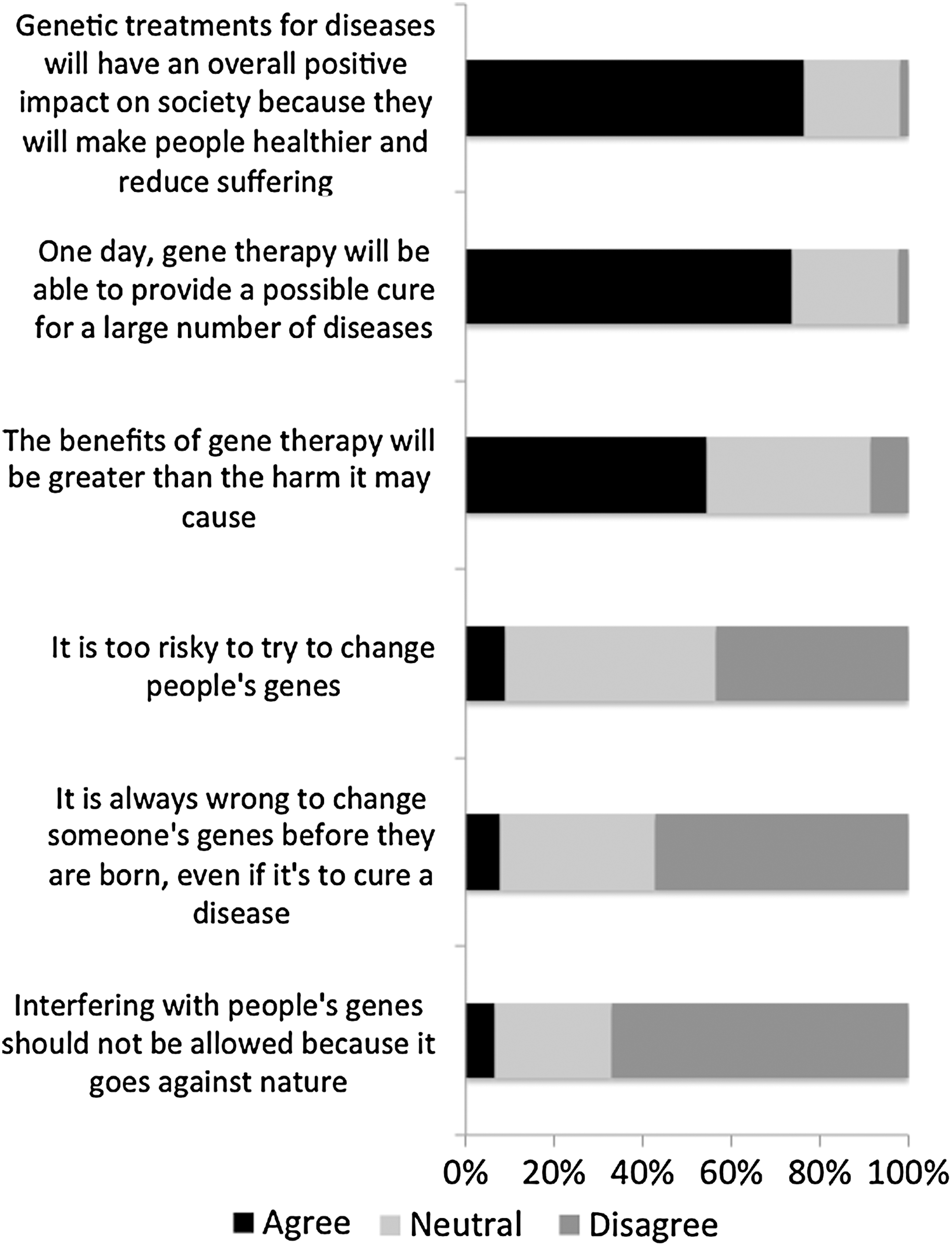
Agreement with general statements about gene therapy. Percentage distribution of participants based on their agreement with six general statements about the risks and benefits of gene therapy.
We conducted a regression analysis to determine whether demographic characteristics predicted participants' answer to the first and most general statement: “Genetic treatments for diseases will have an overall positive impact on society because they will make people healthier and reduce suffering.” We found a significant but irrelevant relationship between religiosity and agreement with the statement: participants who considered themselves to be more religious were more likely to disagree with the statement. However, the R 2 value for the overall model was 0.063 of common variance, so this model explains a significant relationship for only 6% of the variance in our results.
Gene therapy for real and hypothetical scenarios
Participants read a short scenario in which gene therapy is used to treat Leber's congenital amaurosis (LCA), and were asked whether they thought gene therapy for this condition should be allowed. A large majority of participants (93%) responded that this application should definitely be allowed (62%) or should probably be allowed (31%); a small proportion of participants answered that it probably should not be allowed (4%), and an even smaller percentage that it definitely should not be allowed (2%). To determine whether demographic variables predicted participants' answer to this question, we conducted a regression analysis and again found that greater self-reported religiosity significantly but minimally predicted attitudes against the use of gene therapy in this scenario (R 2=0.054).
In the following set of questions, respondents were asked to indicate whether gene therapy would be acceptable for one of three randomly assigned conditions using minimally contrastive scenarios: to treat Alzheimer disease (n=155), to treat attention deficit hyperactivity disorder (ADHD) (n=145), or to enhance normal memory (n=164).
As shown in Fig. 2, acceptance for gene therapy is highest for conditions perceived as more severe (Alzheimer disease) and lowest for enhancing normal function (memory), although 77% of respondents felt gene therapy was probably or definitely acceptable for enhancing normal memory.
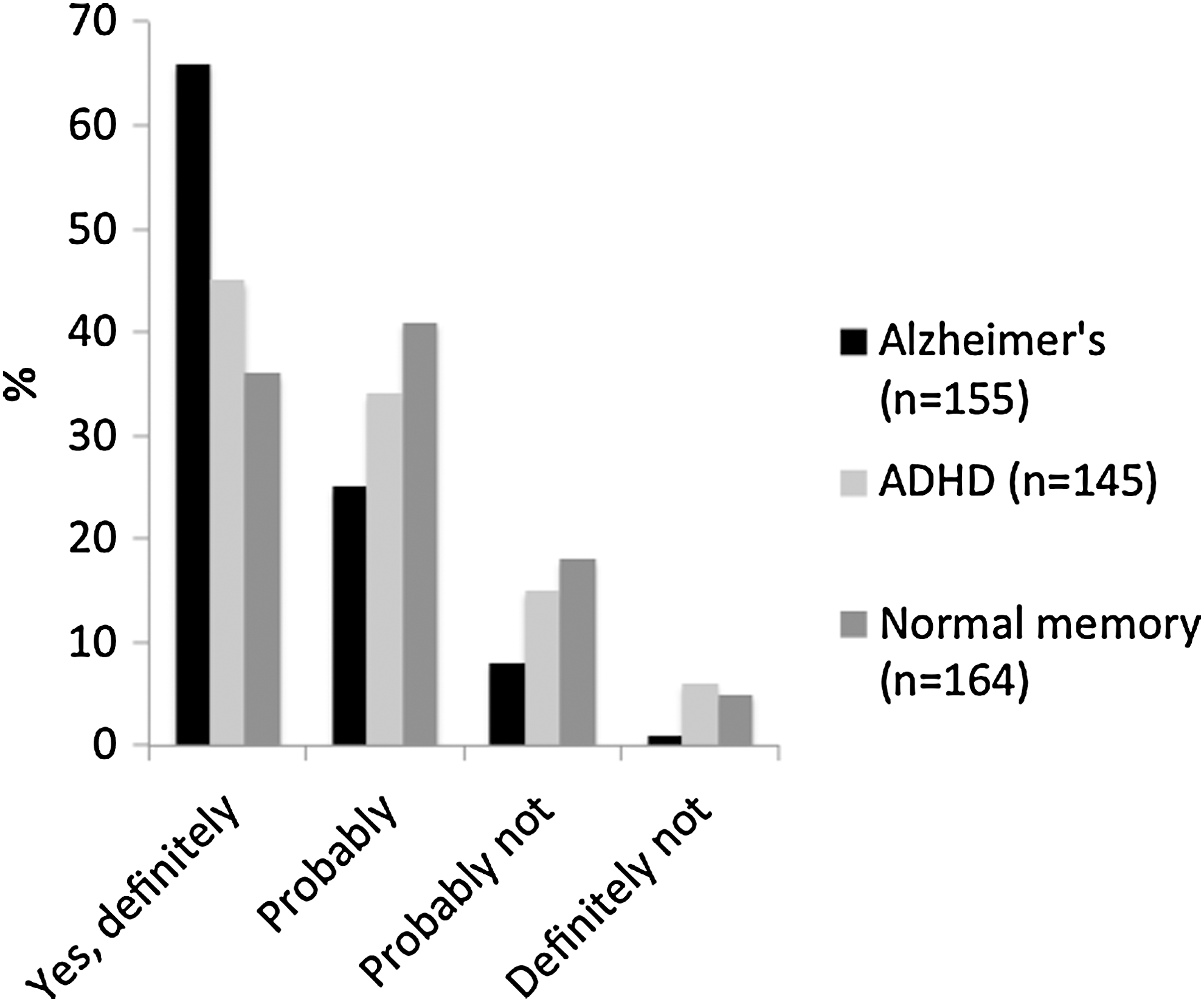
Acceptability of gene therapy for different applications. Percentage distribution of participants based on how they rate acceptability of gene therapy for one of three conditions: Alzheimer disease, attention deficit hyperactivity disorder (ADHD), and enhancement of normal memory.
Gene therapy and identity
Participants' views about whether gene therapy for brain illnesses changes individual identity were divided: 29% of participants answered yes, 30% of participants answered no, and the remainder (41%) answered “I don't know.” Participants were then invited to comment on their choice. Participants who answered “yes” commented on the brain's role in personality, conceived to be a component of identity:
“If it's a fixed part of your brain that controlled your personality then yes it would [change one's identity]”
as well as on identity as a function of brain processes:
“It [gene therapy] would change the way you think and how you perceive situations therefore changing your overall identity”
“The brain is basically who you are.”
Conversely, participants who answered “no” commented on extracorporeal sources of identity:
“My identity is based on my spirit and my spirit does not depend on genes”
“I don't believe we are walking meat: I think there is something much higher about ourselves that has nothing to do with flesh and science”
on the attributes of personality being unaffected by gene therapy:
“[Gene therapy] would affect the genes for the illness, not the genes that make up your personality”
“I think that the genes involved typically have nothing to do with personality and behavior”
and on gene therapy as a disease treatment like any other:
“Fixing an illness doesn't affect your identity. That would be like saying antibiotics could change your personality.”
Gene therapy and religion
Although we asked participants about their adherence to religion in the demographics section of the survey, we were interested in assessing the impact of religion on participants' views about gene therapy in greater depth. When asked whether on balance, their faith or moral belief system supports gene therapy, 37% of participants answered that it does, 17% answered that it opposes gene therapy, and 21% answered that their faith or moral belief system is not concerned with gene therapy. The remaining 26% of participants answered that they do not identify with a particular belief system. When asked whether their faith or moral belief system affects how they feel personally about gene therapy, 26% of participants agreed or strongly agreed, 47% disagreed or strongly disagreed, and 6% were neutral.
Gene therapy for enhancement
We next assessed our participants' views on gene therapy for enhancement purposes. When asked in a forced-choice question whether scientists should research applications of gene therapy aimed at improving the traits and abilities of healthy individuals as well as focusing on therapies that help sick people get better, 47% of participants answered “yes.” Participants who answered “yes” were then prompted to select which forms of enhancement were acceptable (Fig. 3A). The most acceptable forms of enhancement according to participants were increasing life span (41%), improving intelligence (39%), and improving strength and fitness (38%). All participants, whether they answered yes or no to the initial question about the acceptability of enhancement as a whole, were asked to select what they thought were potential issues with gene therapy for enhancement (Fig. 3B). The distribution of these issues varies slightly depending on the participants' answer to the initial question. Participants who answered “no” to gene therapy for enhancement were more concerned that this application would take away from research on diseases and would lead to different classes of human beings.

Main area of concern with undergoing gene therapy
The final question of the survey involved a short scenario in which participants were asked to imagine that they would be receiving gene therapy for a brain-related illness. Participants then had to rank each of nine areas of concern from least concerning to most concerning (Fig. 4). We found that participants were most concerned about not receiving all the appropriate information regarding the treatment and least concerned about gene therapy being contrary to personal beliefs.

Areas of concern for a medical application of gene therapy. Percentage distribution of participants based on their ratings of issues related to gene therapy as being concerning.
A canonical correlation analysis was conducted to evaluate the multivariate shared relationship between the four demographic variables (variable set 1: age, gender, education, religiosity) and the responses to the nine concerns about undergoing gene therapy for the brain (variable set 2). The analysis yielded four functions with squared canonical correlations of 0.5740, 0.2696, 0.1563, and 0.1418. Collectively, the full model across all functions was statistically significant using the Wilks's λ=0.594 criterion, F(36, 1658.12)=6.859, p<0.001. The first correlation (0.5740) was defined mainly on the demographic side by religiosity, and on the concern side by “Going against my religious beliefs.” The second correlation (0.2696) was defined mainly on the demographic side by the female gender and a lower level of education, and on the concern side by “Changes to one aspect of my personality” and “Passing on genetic material to my offspring.” The third correlation (0.1563) was defined on the demographic side by the male gender and a lower level of education, and was distributed over most concerns. The fourth correlation (0.1418) was defined on the demographic side by the male gender and a higher level of education, and also distributed over most concerns.
Discussion
The results from this online study provide new insights into public attitudes toward the ethics of gene therapy. Findings show that (1) a majority of participants are accepting of gene therapy; (2) while acceptability is highest for therapeutic purposes, nearly half of respondents express that it is also acceptable for enhancement purposes; (3) faced with the possibility of undergoing gene therapy, receiving insufficient information about the treatment is a main concern; and (4) attitudes about the ethics of gene therapy cannot be reliably predicted by demographic information.
A significant trend that appears across studies measuring public attitudes toward gene therapy is a high acceptance of this technique for life-threatening medical issues (Macer, 1992; Macer et al., 1995; Saba et al., 1998; Hampel et al., 2000; Siegrist, 2000; Savadori et al., 2004; Calnan et al., 2005; Hui et al., 2009, 2012; Hudson and Orviska, 2011), when the therapy can “save a life” and “drastically increase quality of life.” This acceptance typically decreases as the severity of the illness treated decreases. For example, treatment for serious conditions such as heart disease or Alzheimer disease met with the highest amount of support (Calnan et al., 2005; Condit, 2010), whereas gene therapy for disorders seen to not as drastically affect quality of life, such as ADHD, met with less support (Condit, 2010).
Studies have found that acceptance is lowest for nontherapeutic applications (Macer, 1992; Macer et al., 1995; Siegrist, 2000; Calnan et al., 2005; Hui et al., 2009, 2012; Condit, 2010). Previous work identifies two main drivers for the rejection of nontherapeutic applications. The first driver is opposition to the technology itself (e.g., genetic manipulation amounts to “playing God,” or crosses an ethical line), in which case participants would also oppose gene therapy for medical applications. The second driver is a rejection of the goal to improve on the human condition. This contrast between drivers of attitudes toward gene therapy for enhancement is illustrated by a study that compared attitudes toward genetic technologies between the United Kingdom and Italy (Saba et al., 1998). A majority of participants from both geographic regions expressed support for the use of genetic engineering for the treatment of serious diseases. However, when asked about enhancement, participants from Italy tended to cite serious ethical concerns such as going against nature, whereas those in the United Kingdom cited more social risks such as genetic discrimination (Saba et al., 1998).
Regarding acceptability overall, we observed a similar trend in the present study, in which participants were more accepting of gene therapy for more severe medical conditions. However, we still found a high acceptance for enhancement applications (47%). When examining specific drivers of these attitudes, we found that a minority of participants expressed concerns with the technology itself, and instead identified concerns with the societal implications of enhancement, such as issues with discrimination and equity.
A popular theory in the scientific literature regarding public perceptions of emerging biotechnologies is that personal factors such as level of knowledge and/or alliance to the tenets of a particular religion or deontological belief system drastically impact attitudes. To measure this effect, survey participants can be asked to rate their level of understanding about the biotechnology in question, or their religiosity, on a scale. Alternatively, participants may be asked to answer factual questions about the relevant specific area of science (e.g., Identical twins have the same genes Y/N/I don't know) before answering questions about attitudes (Macer et al., 1995). As online tasks benefit from being succinct, we favored the first approach in the design of the present survey. However, in contrast with previous work showing that religion is a main factor in people's acceptance of genetic engineering (Hampel et al., 2000), we found that religiosity only accounted for a significant but negligible portion of the variance in our results about general acceptance of gene therapy.
Although we did not find gender to be a key predictor of attitudes, multiple studies found a significant difference between the attitudes of men and women toward gene therapy. In almost all cases men were found to be more accepting and to perceive fewer risks then women (Hampel et al., 2000; Calnan et al., 2005). However, this is not a completely robust trend as one study found men had a higher assessment of negative reproductive implications (Hui et al., 2012).
Some evidence suggests that the distribution of these attitudes has changed over time. Gallup polls found that people in the United Kingdom and in Japan were slightly more supportive of gene therapy as time went on in the early nineties. Macer and colleagues suggest that this may be due to the increased media attention around gene therapy at the time (Macer, 1992; Macer et al., 1995). However, a similar increase in media coverage occurred in the United States surrounding the first gene therapy clinical trials with no similar change in attitudes (Macer et al., 1995). Attitude changes over time and in response to the media discourse on gene therapy may have contributed to the different results we obtained in the present work. Follow-up studies will be needed to establish how the attitudes presented here change over time.
Despite the usefulness and potential scope of Internet-based surveys, we also appreciate the limitations of this study. Surveys and questionnaires allow only a brief and shallow glimpse at how a society as a whole feels about any particular issue. They do, however, offer a good indication of current public sentiment, and this information is crucial to inform the development of relevant policy.
Another limitation relates to our sample: it derives from a single recruitment strategy. Despite the many practical advantages of using Amazon's Mechanical Turk, such as subject anonymity, subject identifiability and prescreening, and cultural diversity, concerns have been expressed about the validity and generalizability of data acquired through this platform. However, Mechanical Turk participants have been shown to be at least as representative of the U.S. population as traditional subject pools in social science experiments (Paolacci et al., 2010). Although this representativeness applies to Mechanical Turk participants as a whole, it may not specifically reflect the pool of participants who responded to this survey. In the sample, the 19–29 age group is overrepresented while the 40–49 and 50–59 age groups are underrepresented relative to the population in the United States.
A benefit of Mechanical Turk is that nonresponse error is less of a concern that it is for Internet samples recruited through other means (Paolacci et al., 2010). Mechanical Turk also allows the experimenter to circumvent the potential issue of inattentive participants—for example, we used a comprehension check question at the end of our survey to ensure we collected responses only from participants who read each question thoroughly.
As it can be difficult to gauge the reasoning behind specific attitudes when the testing tool is in the form of a questionnaire, follow-up work using qualitative methods such as interviews and focus groups will be needed to explore the drivers of public attitudes toward the ethics of gene therapy in greater depth.
Overall, we find that the public perceptions of the ethics of gene therapy differ from the concerns expressed by the ethics communities. Our finding that the main concern of participants when faced with a gene therapy scenario is “Not receiving all the information” strongly highlights the need to deliver effective, evidence-based communication on this topic. Further, engaging the research and medical communities as well as the diverse publics in a conversation about the ethics of gene therapy and other emerging gene-based therapies is a priority.
Footnotes
Acknowledgments
The authors thank Nick Dragojlovic for insightful comments during survey development. The authors also thank the members of the mTurk community for their interest and participation in the survey. J.I. is Canada Research Chair in Neuroethics. Support for this work was generously provided by Genome British Columbia AGCP-CanEuCre-01, CIHR CNE #85117, the British Columbia Knowledge Development Fund, the Canadian Foundation for Innovation, and the Vancouver Coastal Health Research Institute.
Author Disclosure Statement
No competing financial interests exist.