




Abstract

P
Because MSCs can be induced to produce anticancer molecules, such as tumor necrosis factor (TNF)-related apoptosis-inducing ligand (TRAIL) (Grisendi et al., 2010), we here show the impact of gene-modified human MSCs producing TRAIL against PDAC.
The BxPC3 cell line (Fig. 1, left) was selected on the basis of its high expression of functional TRAIL receptors associated with recombinant human TRAIL sensitivity confirmed in a dose–response assay (data not shown).
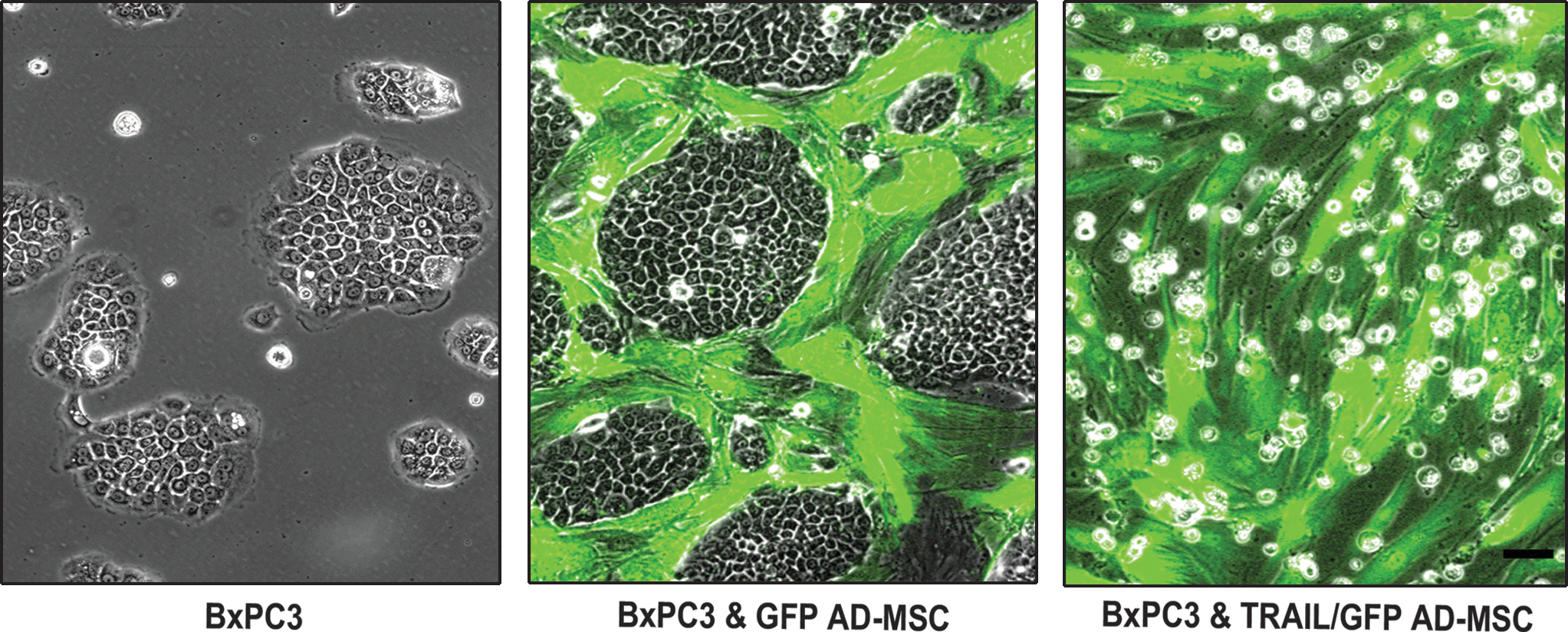
Pancreatic adenocarcinoma cell line BxPC3 interplays with adipose-derived mesenchymal stem cells expressing green fluorescent protein (GFP AD-MSCs) only or tumor necrosis factor-related apoptosis-inducing ligand (TRAIL/GFP AD-MSCs). Scale bar, 50 μm.
Microscopic examination of cocultures (Fig. 1, middle) of BxPC3 cells with adipose-derived MSCs expressing green fluorescent protein (GFP AD-MSCs), as control, revealed a peculiar interaction between MSCs and tumor cells, with BxPC3 cells arranged as islets surrounded by green AD-MSC bundles, in parallel to what is described for the PDAC-associated desmoplastic reaction in vivo (Chu et al., 2007).
Having proved the interaction between GFP AD-MSCs and BxPC3 cells, coculture experiments were then performed for both 24 and 48 hr, testing various target-to-effector (T:E) ratios (1:1, 1:2, and 1:5), using TRAIL/GFP AD-MSCs. Tumor cell death was detected in all tested conditions. The interplay between TRAIL/GFP AD-MSCs and BxPC3 cells was followed by a breakdown of tumor islets together with the disruption of adherent BxPC3 cells, resulting in clusters of dead floating elements in culture medium above an established layer of TRAIL/GFP AD-MSCs (Fig. 1, right; T:E ratio, 1:2 at 48 hr; scale bar, 50 μm).
These morphological findings were quantified by flow cytometric detection (data not shown) of apoptotic propidium iodide-positive cells, reaching 69±3% (average±SD) for TRAIL/GFP AD-MSCs versus 14±1% for GFP AD-MSCs (p=0.001 by two-tailed t test). Similar features were observed in cocultures of TRAIL/GFP AD-MSCs and an additional PDAC cell line (MIA PaCa-2 cells; data not shown).
Depicting the strong interaction with genetically modified AD-MSCs and PDAC lines, we here suggest MSCs as suitable vectors for anticancer agent delivery, opening novel therapeutic opportunities for this still incurable cancer.
Footnotes
Acknowledgments
This work was supported in part by Associazione Italiana Ricerca Cancro (AIRC) IG 2012 grant no. 12755 (M.D.), Ministero Italiano Istruzione Università e Ricerca PRIN 2008WECX78 (M.D.), and Ministero della Salute Bando GR-2008-1145964 (M.D.). In the inspiring memory of A.M. and L.P.
Author Disclosure Statement
No competing financial interests exist.