




Abstract

A
Down syndrome (DS), or trisomy 21, constitutes the most common chromosomal abnormality (around 1 in 800 live births) worldwide and is associated with numerous hematological, neurological, and cardiovascular complications. DS adults demonstrate a significantly increased risk of AD-related dementia at an early age and therefore provide a unique opportunity for gaining insights into the etiology of this complex disorder. Trisomy 21–induced pluripotent stem cells (iPSCs) from amniotic fluid stem (AFS) cells would enhance our understanding of neuropathological consequences of trisomy 21, as it has been recently demonstrated that analysis of secreted amyloidβ-42 and tau peptides (pathogenic peptides implicated in AD) from short-term in vitro cultures of cortical neurons derived from trisomy 21–iPS can potentially provide a translational platform for drug targeting and toxicity screening (Biancotti et al., 2010; Lu et al., 2013).
In this study, amniotic fluid–derived trisomy 21 cells obtained from routine amniocentesis were reprogrammed to induced pluripotent stem cells (AFiPSCs) and subjected to a protocol for neuronal differentiation. Mature iPSC clusters were passaged en bloc on Matrigel and switched from the embryonic stem cell medium (which favors self-renewal) to the neural differentiation medium 24 hr after seeding. After 6 days in a differentiation medium, immunostaining revealed that both control (euploid) and trisomy 21-AFiPSCs are positive for the expression of nestin and Pax-6. Further treatment in the retinoic acid–supplemented medium for 8 days gave rise to neural stem and progenitor cells that stained positive for neuronal differentiation marker beta-tubulin III (Tuj1) in addition to nestin.
Figure 1 shows the emergence of neuronal progenitors with well-defined neurites and cell body from two closely situated trisomy 21-AFiPSC colonies stained with fluorescent-tagged antibodies against nestin and Tuj1 and counterstained with DAPI (top panels). Selected areas (indicated by boxes) are magnified in the middle panels. In the bottom panels, images have been merged to provide an overview of the immunophenotype of the emerging cells.
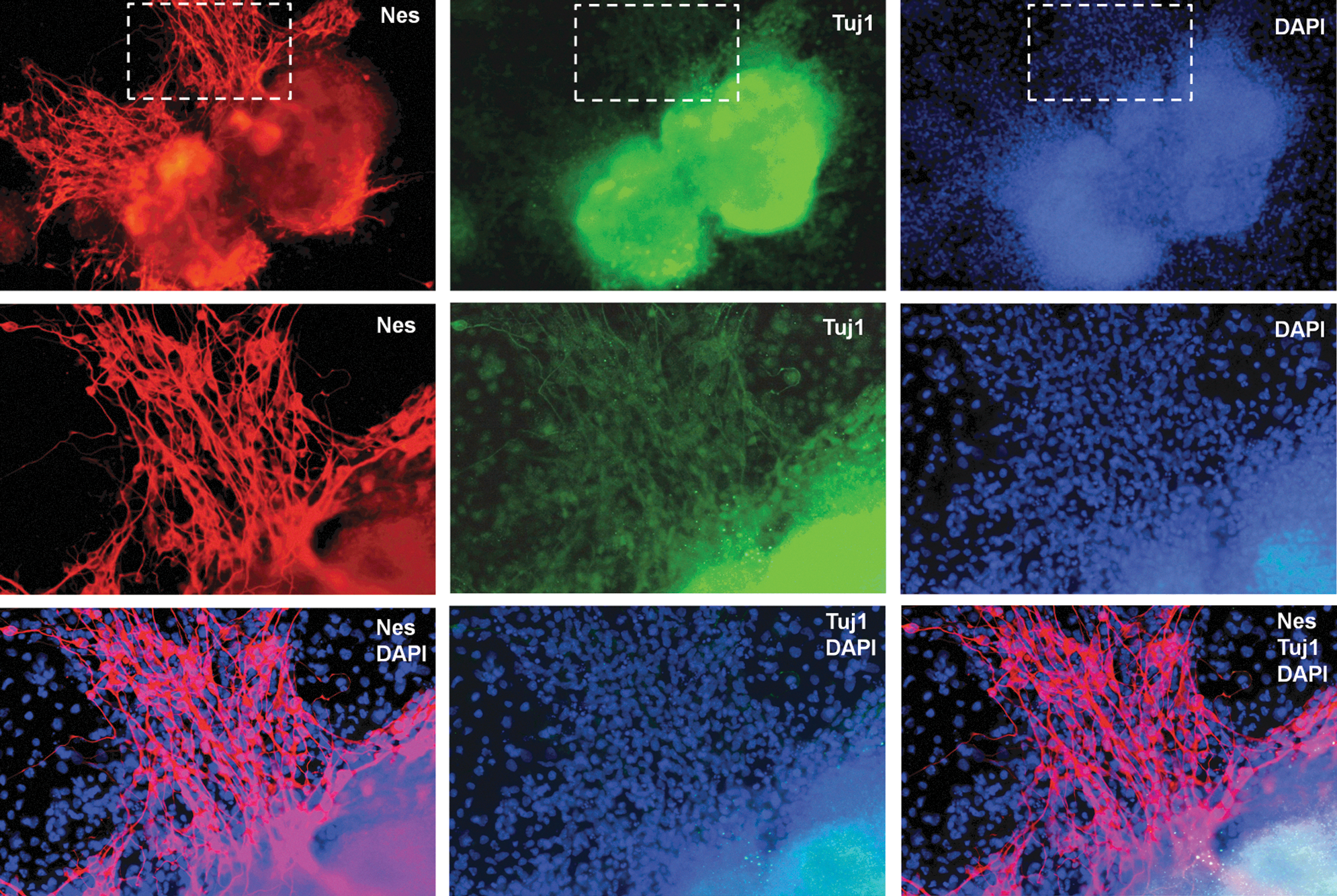
Immunophenotypic characterization of neuronal precursors and progenitors emerging out of trisomy 21 amniotic fluid–derived induced pluripotent stem cells (iPSCs). Nes, nestin; Tuj1, tubulin beta-III.
Footnotes
Acknowledgments
A.J.T. and P.D.C. are supported by the Great Ormond Street Hospital Children's Charity. A.D. receives funding from University College London Hospitals/University College London via the Department of Health's National Institute for Health Research (NIHR) Biomedical Research Centres funding scheme and an NIHR Clinical Senior Lectureship.
Author Disclosure Statement
No competing financial interests exist.