




Abstract
CRISPR/Cas9 genome editing platforms are widely applied as powerful tools in basic research and potential therapeutics for genome regulation. The appropriate alternative of delivery system is critical if genome editing systems are to be effectively performed in the targeted cells or organisms. To date, the in vivo delivery of the Cas9 system remains challenging. Both physical methods and viral vectors are adopted in the delivery of the Cas9-based gene editing platform. However, physical methods are more applicable for in vitro delivery, while viral vectors are generally concerned with safety issues, limited packing capacities, and so on. With the robust development of nonviral drug delivery systems, lipid- or polymer-based nanocarriers might be potent vectors for the delivery of CRISPR/Cas9 systems. In this review, we look back at the delivery approaches that have been used for the delivery of the Cas9 system and outline the recent development of nonviral vectors that might be potential carriers for the genome editing platform in the future. The efforts in optimizing cationic nanocarriers with structural modification are described and promising nonviral vectors under clinical investigations are highlighted.
Introduction
T
CRISPR systems are adaptable immune mechanisms used by many bacteria to protect themselves from foreign nucleic acids, such as viruses or plasmids. 1 –4 Different CRISPR/Cas system types (I, II, and III) vary in the molecular mechanisms to achieve nucleic acid recognition. The type II CRISPR/Cas system relies on only a single protein for specific DNA recognition and cleavage guided by RNA, which was an adaptive property for genome editing application. 5,6 Also, the Cas9 protein was identified as a multifunctional protein essential for defense against viral invasion. 7 In 2013, the targeted genome editing accomplished by the type II CRISPR system from Streptococcus pyogenes was reported. 8 –13 Since then, CRISPR/Cas9-based systems has been an emerging field for genome engineering and genome regulation.
Two critical components must be introduced for the application of the CRISPR/Cas9 system, including the Cas9 nuclease and a guide RNA (gRNA) that consists of a fusion of a crRNA and a constant tracrRNA. Cas9 uses gRNA to form base pairs with site-specific DNA sequences and introduces a DSB. Thus, Cas9 nuclease could be directed to a specific site simply by altering the first 20 nts of the gRNA. Because of its versatility, simplicity, high specificity, and efficiency, the type II CRISPR/Cas systems have recently shown great potential for RNA-guided precise genome editing in various cell types such as mouse embryonic stem cells and mouse spermatogonial stem cells. In addition, this CRISPR/Cas gene editing tool has been used to induce mutation of cancer genes in adult mouse livers, and target integrated HIV-1 proviral DNA allowing for elimination of the integrated latent provirus. 14,15
Current Delivery Approaches for Crispr/Cas9 System
The CRISPR/Cas system has been applied to genome engineering in a variety of cell lines and organisms, but in vivo delivery of genome editing platforms remains challenging. 16 The appropriate choice of delivery system is critical if genome editing systems are to be effectively performed in the targeted cells or organisms. The delivery of CRISPR/Cas9-based therapeutics could be achieved by introducing the plasmid encoding nuclease and designed gRNA sequence into the cell nuclei, or by a direct delivery of mRNA or protein. A wide variety of possible delivery methods have been already developed for gene editing therapeutics.
In cultured cells, electroporation, nucleofection, and lipofectamine-mediated transfection have been used to deliver plasmid DNA encoding Cas9-gRNA complexes through cell membranes. 17 –19 These methods are welcomed in the in vitro experiment because of their simplicity, high reproducibility, and enhanced gene expression. However, when it comes to the application in vivo, physical delivery methods meet more challenges because of the variable physiological and pathological conditions. Recently, hydrodynamic injection, which can accommodate the large transgene size of Cas9, has been employed to achieve Cas9-mediated genome editing in the mouse liver in vivo. 20 However, this method was associated with considerable liver damage and disruption of cardiovascular function in mice, and its further application in large animals is not clear. 21
Viral vectors, including adenoviral, adeno-associated viral (AAV), and lentiviral vectors, have also been widely used for the delivery of Cas9 system-encoding cassettes to targeted cells in vivo. 22 –24 Ran et al. packaged SaCas9 and its sgRNA expressing cassette into an AAV vector and targeted the cholesterol regulatory gene Pcsk9 in mouse liver, which induced significant reductions in serum Pcsk9 level and total cholesterol level. 25 Heckl et al. successfully generated mouse models of myeloid malignancy using the CRISPR/Cas9 system delivered with lentiviral vectors. 26
Although viral carriers exhibited high efficiency in gene delivery and expression, viral delivery systems are generally concerned with their potential in carcinogenesis and immunogenicity. Safety issues have been the major concern in any animal studies for viral vectors. In addition, limited DNA packaging capacity of viral vectors might be a roadblock for the delivery of the genome editing system. For example, the current packaging capacity of AAV is not sufficient for the versatile applications of larger enzymes such as TALENs or CRISPRs. Moreover, limitations in the infected cell types and difficulties of large-scale vector production might also be considered during the application of viral delivery for the genome editing system. 27 –31
Potential Nonviral Vectors for Crispr/Cas9 Delivery
Delivery alternatives are essential for the therapeutic application of the CRISPR/Cas9 system. Recently, advances in nonviral delivery systems have been made with the development of a vast range of nano-/microcarriers with diversities in targeting property modifications. Compared with viral vectors, nonviral ones have advantages such as low immunogenecity and absence of endogenous virus recombination, which might minimize the chance of short-term and long-term adverse effects. 32 –35 Also, nonviral vectors have less limitations in delivering larger genetic payloads and are generally easier to synthesize and produce in large scale than the viral ones.
Low delivery efficiency has been a barrier in the application of nonviral delivery systems; however, with the development of material sciences, new polymer- and lipid-based delivery systems with optimal properties efficient transport of their payloads past the multiple barriers under physiological conditions can be achieved. The emerging field of nanotechnology provides more options such as the nanosized carriers, which may have diverse potentials in targeted delivery of drugs to particular sites by designing the physicochemical properties or surface modification. Among them, cationic nanocarriers, formed by positively charged lipids or polymers, are most commonly used in gene delivery as nonviral vectors, including cationic liposomes, polymers, dendrimers, and peptides. Because of the positively charged surface, cationic nanocarriers could load and condense nucleic acids simply by electrical interaction. To date, various cationic nanocarriers have already entered the clinical trials.
There are few publications dealing with the genome editing systems and nonviral vectors for delivery. Given the advantages and robust development of the nonviral drug delivery system, the delivery of the CRISPR/Cas system with nonviral vectors, such as cationic nanocarriers, should be further explored. Here, we highlighted the commonly used nonviral vectors in gene delivery, which might also be potential delivery systems for CRISPR/Cas therapeutics in the future.
Lipid-based vectors
Lipid-mediated gene transfer was one of the earliest strategies in gene therapy. The term “lipofection” has been coined to describe lipid-based gene transfection since 1987. 36 Cationic lipids such as 1,2-dioleoyl-3-trimethylammoniumpropane (DOTAP), 37 N-[1-(2,3-dioleyloxy)propyl]-N,N,N-trimethyl-ammonium chloride (DOTMA), 38 2,3-dioleyloxy-N-[2(sperminecarboxamido)ethyl]-N,N-dimethyl-1-propanaminium trifluoroacetate (DOSPA), 39 and 1,2-dimyristyloxypropyl-3-dimethyl-hydroxyethyl ammonium bromide (DMRIE) 40 are commercially available (Fig. 1).

Chemical structures of commonly used cationic lipids. DOTAP, 1,2-dioleoyl-3-trimethylammoniumpropane; DOTMA, N-[1-(2,3-dioleyloxy)propyl]-N,N,N-trimethylammonium chloride; DMRIE, 1,2-dimyristyloxypropyl-3-dimethyl-hydroxyethyl ammonium bromide; DOSPA, 2,3-dioleyloxy-N-[2(sperminecarboxamido)ethyl]-N,N-dimethyl-1-propanaminium trifluoroacetate.
Cationic lipids are characterized structurally by three domains: a cationic head group, a hydrophobic tail, and a linker between these two domains. 41 Most commonly used cationic lipid-based vectors include liposomes and solid lipid nanoparticles (SLN). Liposomes are small artificial vesicles with spherical shape formed by amphiphilic phospholipids and cholesterol that self-assembled into one or more bilayers enclosing an aqueous core. Cationic liposomes have emerged as one of the most attractive gene vectors owing to their enhanced pharmacokinetic properties and relatively low immunogenicity. SLN are basically composed of high-melting-point lipids that consist of a solid core and are covered by surfactants. Cationic SLN are promising nonviral gene delivery carriers suitable for systemic administration. Advantages to SLN include good storage stability, and its suitability for steam sterilization and lyophilization, which make them widely used nonviral vectors. As the most classical nonviral gene vectors, cationic liposomes are the first nonviral delivery vectors used in clinical trials. To date, many cationic liposome-based gene delivery systems have entered clinical trials for the treatment of melanoma, cancer, and AIDS.
However, the drawbacks of cationic lipid-based nanocarriers such as poor stability, low transfection efficacy, as well as the generation of inflammatory responses have limited their further application. 42,43 Many groups have carried out further investigations in order to increase gene transfection efficiency and reduce the toxicity of cationic lipid-based nanocarriers mainly by structural modification of the lipids. Stekar et al. have attempted to reduce the toxicity of cationic lipids by replacing the ammonium groups of edelfosine and miltefosine with phosphonium and arsonium functionalities, which resulted in a significantly reduced toxicity of drug delivery systems while maintaining the antitumor activity. 44 In addition to replacing the existing ammonium group of cationic lipids, the chemical modification of the amine moiety can also improve the transfection efficiency; for instance, the hydroxyethyl derivatives of DOTAP, 45 DC-Chol, 46 and DOTMA 47 all showed enhanced transfection efficiencies. Despite the manipulation of cationic head group, varying the lengths and types of hydrophobic tail group have also been used to promote gene transfer. Cholesterol derivatives and diacetylene-based lipids showed enhanced gene transfer efficiencies. 48,49 Cleavable linkers such as pH-sensitive, redox-reactive, and enzymatically degradable groups have also been introduced into cationic lipids for optimal properties. 50 –53
Several cases of liposome-based gene therapy have advanced to the clinical stage. In a phase I study, DC-Chol/DOPE cationic liposomes were employed to deliver the human HLA-A2, HLA-B13, and the murine H-2K genes to patients with different cancer types. A strong immune response was generated locally following in situ gene therapy but no significant side effects were seen. Two out of eight patients showed the complete regression in cutaneous nodules after HLA-A2-DNA liposome treatment. 54 Other liposomal formulations under clinical investigation include GL67A–DOPE–DMPE–PEG, DOTAP–cholesterol, and GAP-DMORIE–DPyPE (NCT01621867; NCT00059605; NCT01502358). 55 –57
Polymeric vectors
Cationic polymers such as polyethylenimine (PEI), poly(L-lysine) (PLL), poly[2-(dimethylamino) ethyl methacrylate] (PDMAEMA), and polyamidoamine (PAMAM) dendrimers have gained significant attention in gene therapy for their lower immunogenicities and easier large-scale production and functionalization.
Polyethylenimine
Polyethylenimine (PEI) is one of the most studied and commonly used polymeric vectors for gene delivery (Fig. 2). Since the first successful transfection carried out using PEI by Boussif et al. in 1995, PEI has been considered as a gold standard in the investigation of polymer-based gene carriers owing to its high transfection efficacy. 58 PEI is divided into linear PEI (l-PEI) and branched PEI (b-PEI) groups according to the molecular structures. ExGen500 and jetPEI, both of which are derivatives of l-PEI with a molecular weight of 22 kDa (Mn), have been made commercially available. 59 High gene transfer efficiency of PEI is generally due to its high charge density and “proton sponge” nature. 60
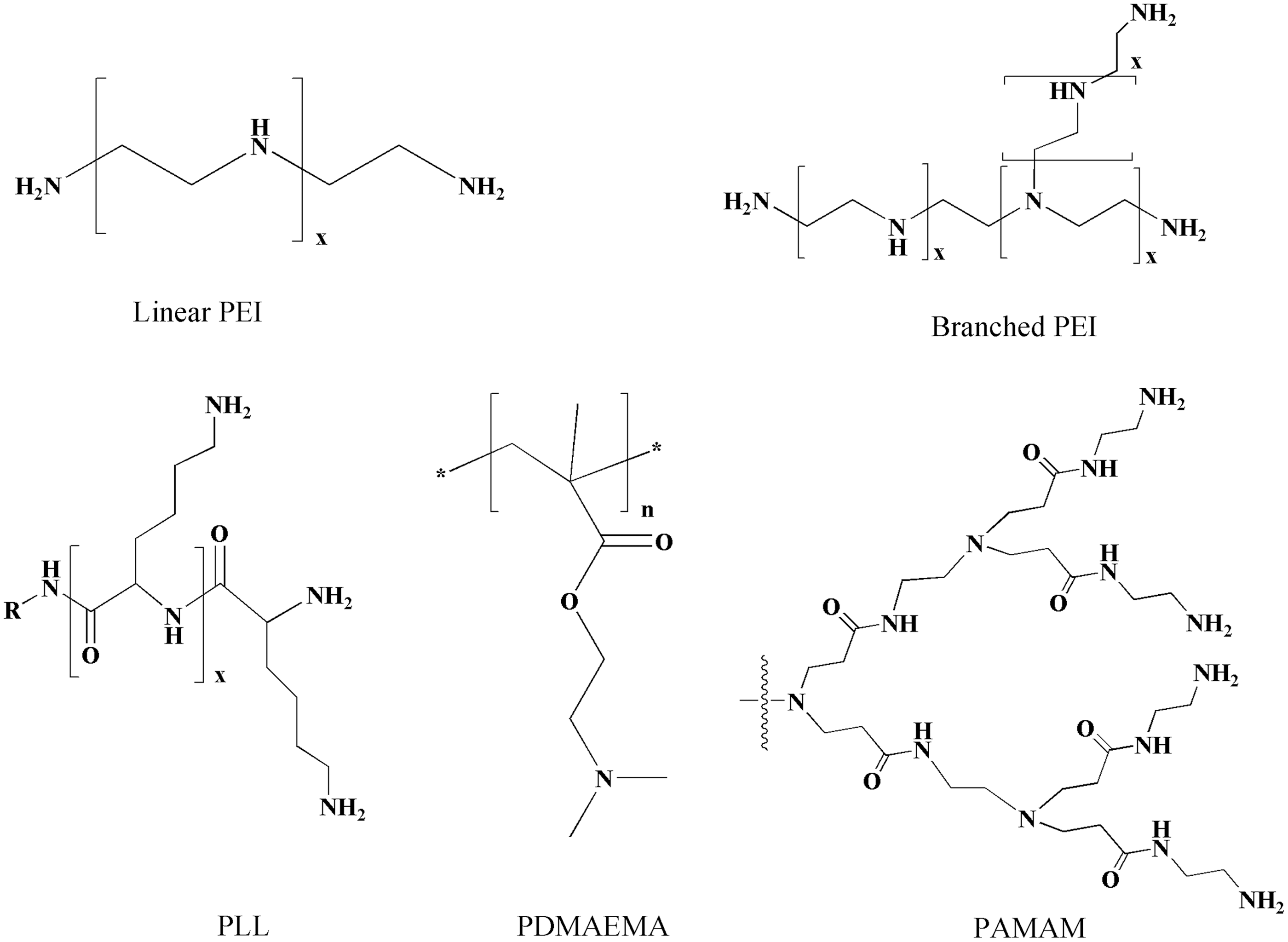
Chemical structures of polymeric vectors. PEI, polyethylenimine; PLL, poly(L-lysine); PDMAEMA, poly[2-(dimethylamino) ethyl methacrylate]; PAMAM, polyamidoamine.
The molecular weight and the degree of branching of PEI have been proven to affect the formation and stability of the PEI/DNA complexes. In the meantime, transfection efficacy and toxicity is also strongly correlated with the molecular weight and structures (branched or linear) of PEI. 61 PEI with a higher molar mass, higher cationic charge, and higher degree of branching is generally considered to have stronger electrostatic interactions with nucleic acids, resulting in the formation of small and enzymatically stable polyplexes. However, this is also accompanied with significant increase in cytotoxicity while PEI of lower molecular weight is less cytotoxic, but less efficient. 62 –64 Thus, maintaining the balance between high transfection efficiency and low cytotoxicity of PEI has been the major concern during the design and preparation of PEI-based vectors.
Various modifications of PEI have been employed to improve the transfection efficiency while decreasing its cytotoxicity. PEGylation is one of the most commonly used methods. 65 Ideally, PEGylation creates a hydrophilic shell for PEI, which might help to avoid the exposure of positive surface charge of PEI and also stabilize the resultant polyplexes in physiological condition by reducing nonspecific interactions with serum proteins. 59 However, it was revealed that the lengths and densities of PEG chains conjugated to PEI affect both transfection efficiencies and carrier toxicities; therefore, PEGylation of PEI must be characterized and optimized in detailed experiment for different applications. When it comes to the targeted delivery of genes to cells and tissues, targeting moiety, such as folate, Arg–Gly–Asp (RGD) peptide, and galactose, could be introduced into PEG-PEI copolymer to improve the cellular internalization. 66,67 Zhan et al. conjugated c(RGDyK) to PEG-PEI to form a targeted gene carrier, which exhibited higher transfection efficiency compared with the one without RGD decoration. 68
Besides PEGylation, several other modifications have also been made to improve the transfection efficiency of PEI. One such approach is the modification of PEI with hydrophobic moieties, such as cholesterol and stearic acid, which promotes additional hydrophobic interaction between polyplexes and cell membranes. 69 –72 Zheng et al. modified a low-molecular-weight PEI (PEI 1.8 kDa) with lipoic acid (LA) to form PEI-LA conjugate, which mediated a nontoxic and highly potent gene transfection. 73 Moreover, Kim et al. modified branched PEI (1.8 kDa) with cholesteryl chloroformate, which showed higher transfection efficiency compared with that of PEI 25 kDa. 70
In addition to hydrophobic modification, receptor-mediated endocytosis was achieved by chemical modification of the PEI backbone with ligands, such as antibodies, sugars, and peptides. Lee et al. functionalized PEI with trastuzumab (herceptin, an HER2-specific monoclonal antibody), which showed significantly higher transfection efficacies up to 20-fold than the nonmodified PEI-based polyplexes in Sk-Br-3 cells overexpressing HER2. 74
Additionally, nonbiodegradability is one of the major limitations of high-molecular-weight PEI. 75,76 Cross-linked low-molecular-weight PEI with stimuli-responsive linkages is an alternative method, involving the incorporation of reducible disulfide linkages or ester conjugation. Breunig et al. designed a carrier system based on disulfide cross-linked LMW l-PEI, which achieved high transfection efficiency while maintaining cell viability. 77 Pack et al. synthesized a degradable PEI derivative through the addition of PEI (800 Da) to diacrylate cross-linkers, the DNA-binding properties of which are similar to the commercially available 25 kDa PEI, but with more efficient gene expression and much less cytotoxicity. 78
Recently, PEI has been used in several clinical trials for the treatment of bladder cancer (NCT00595088), pancreatic ductal adenocarcinoma (NCT01274455), and multiple myeloma (NCT01435720). A phase II trial of intraperitoneal treatment with EGEN-001, an IL-12 plasmid formulated with PEG–PEI–cholesterol lipopolymer in the treatment of persistent or recurrent epithelial ovarian, fallopian tube, or primary peritoneal cancer, is under clinical investigation (NCT01489371; NCT01118052; NCT01300858). 79
Poly(L-lysine)
Poly(L-lysine) (PLL) is a synthetic polypeptide with good biocompatibility and biodegradability 80 (Fig. 2). PLL possesses a high charge density essential for effective plasmid DNA complexation and condensation. 81 In general, PLL exhibits relatively low transfection efficiency owing to lack of buffering capacity to aid in endosomal escape. 59 In order to promote the gene transfer of PLL, many PLL derivatives have been investigated. To improve cellular uptake, hydrophobic moieties were incorporated into the carriers. Incani et al. synthesized palmitic acid-modified PLL (PLL-PA), and the transfection efficiency was significantly increased to levels higher than native PLL and the commercial transfection agent Lipofectamine2000. 82,83
High-molecular-weight PLL causes relatively high cytotoxicity because of its interactions with serum proteins, resulting in rapid clearance of the complexes from the blood stream, which significantly hinders its systemic application. 84 Synthesis of PLL-PEG copolymer overcomes these limitations and augments its lifetime in blood. 85,86 In vitro and in vivo studies both demonstrated successful gene transfer using a PLL-PEG copolymer. PLL-PEG was investigated as a gene vector carrying the cystic fibrosis transmembrane regulator-encoding gene to treat cystic fibrosis (CF) in 2004, and PEG-PLL/DNA nanoparticles can be safely administered to the nares of CF subjects, with evidence of vector gene transfer and partial basal nasal potential difference correction. 87,88
Poly[2-(dimethylamino) ethyl methacrylate]
Poly[2-(dimethylamino) ethyl methacrylate] (PDMAEMA), a water-soluble cationic polymer, has been widely utilized as a nonviral gene carrier (Fig. 2). Synthesis of PDMAEMA could be achieved by atom transfer radical polymerization (ATRP) of 2-(dimethylamino) ethyl methacrylate initiated by ammonium peroxydisulphate. 89 The successful gene transfer by PDMAEMA polyplexes is attributed to its positive charge for DNA condensation, its ability to facilitate a proton-sponge effect, as well as easy dissociation of DNA once delivered into the cytosol. 90 –92
Numerous modifications of PDMAEMA were carried out to further improve its transfection efficiency while decreasing the toxicity. Xu et al. prepared biodegradable comb-shaped gene vectors consisting of degradable poly(N-3-hydroxypropyl)aspartamide-based PMAMA backbones and disulfide-linked cationic PDMAEMA side chains via ATRP, which exhibited good plasmid condensation ability, enhanced gene transfection efficiency, and low cytotoxicity. 93 Furthermore, grafting of PEG onto PDMAEMA polymer can enhance the circulation time.
Recently, polysaccharide-modified PDMAEMAs have exhibited significant potential in gene delivery. Polysaccharide based gene carriers and the biocleavable comb shaped gene carriers constructed from dextran backbones and PDMAEMA via ATRP exhibit higher gene transfection efficiency with much lower cytotoxicity compared with the higher-molecular weight PDMAEMA homopolymer. 94 Additionally, Wang et al. developed a copolymer based on PDMAEMA and methacrylated chondroitin sulfate with optimized properties. 95
To improve the cellular uptake of PDMAEMA/DNA complexes in specific cell lines or tissues, incorporating a targeting moiety onto PDMAEMA is available. Folate-targeted PDMAEMA-based polyplexes showed markedly improved transfection efficiency as compared with unconjugated derivatives. 96 Galactose and lactose were also conjugated to the terminus of PEG-PDMAEMA copolymer for hepatocyte targeting, and both exhibited improved transfection efficiencies in HepG2 cells. 97,98
Polyamidoamine dendrimers
Polyamidoamine (PAMAM) dendrimers are the most utilized dendrimer-based vectors for gene transfer and are commercially available (Fig. 2). Synthesis of these compounds involves repeating the Michael addition of a nucleophilic core (e.g., ethylene diamine or ammonia) to methyl acrylate followed by an amidation of the resulting ester. 99 PAMAM was first synthesized by Tomalia using a divergent synthetic strategy. 99,100 The first gene transfer study using PAMAM was conducted by Haensler and Szoka in 1993. 101 The primary amines on periphery of PAMAM are easily protonated, thus interacting with anionic DNA molecules to form nano-sized complexes. Additionally, the tertiary amines in the interior can provide good endosome buffering capacity and enhance endosome escape. 102,103
Generally, PAMAM dendrimers possess generation-dependent properties; low-generation (G0–G3) PAMAM dendrimers exhibit poor gene transfection efficiencies and less cytotoxicities, but high-generation (G4–G8) PAMAM show slightly better gene transfection efficiencies and certain cytotoxicities. 104 Various alterations to the basic PAMAM dendrimer structure have been investigated in an effort to improve transfection efficiency and reduce cytotoxicity. Hydrophobic modification is one of the most effective approaches.
In initial studies, Yu et al. synthesized a kind of lipid/dendrimer hybrid bearing a hydrophobic long alkyl chain and a low-generation hydrophilic PAMAM dendron. The hybrid displayed the advantageous delivery features of both lipid and polymer vectors and successfully delivered siRNA that produced a potent gene-silencing effect in vitro and in vivo. 105 In another study, Park et al. modified the surface of PAMAM with L-arginine, which significantly improved gene transfection owing to improved complex formation. 106,107 Meanwhile, efforts have focused on incorporating cell-targeting agents with PAMAM. Jiang et al. conjugated PEG-PAMAM with a transferrin receptor-specific peptide T7. T7-modified vectors showed higher efficiency in cellular uptake, gene expression, and accumulation at tumor sites in vivo than unmodified ones in Bel-7402 cells. 108
Chitosan
Chitosan has become one of the most prominent, naturally derived nonviral vectors for gene transfer because of its biodegradability and good biocompatibility (Fig. 3). Chitosan is a polysaccharide consisting of glucosamine and N-acetylglucosamine and can be derived from the partial deacetylation of chitin. Mumper et al. were the first to describe the potential of chitosan as a gene carrier in the mid-1990s. 109 Its potential as a gene delivery carrier is based on its cationic property. 110 Molecular weight, degree of deacetylation (DD), N/P ratio, pH, cell type, and the like, significantly affect the transfection efficiency of chitosan. 111 –114 However, its application in gene delivery is significantly limited by low transfection efficiency. 5β-Cholanic acid, deoxycholic acid, stearic acid, and alkyl chains have been conjugated to chitosan to improve the interaction with cell surface. 115 –117 Kwon et al. prepared 5β-cholanic acid-modified glycol chitosan for gene delivery and these complexes showed increasing transfection efficiencies in vitro and in vivo. 118,119 To promote the endosomal escape, low-molecular-weight PEI was grafted to chitosan, and its transfection efficiency rivaled that of PEI (25 kDa) with reduced cytotoxicity. 120 In addition, several strategies were used to improve the cationic property and buffering capacity of chitosan. The quaternization of chitosan has been investigated by several research groups. 121,122 Increase in positive charge density has been achieved by grafting PLL to chitosan, which exhibit improved DNA-binding ability, increased transfection efficiency, and reduced cytotoxicity. 123 The delivery of chitosan complexes to specific cell types was achieved by conjugating chitosan to various cell-targeting ligands. Cho et al. prepared galactosylated chitosan and it exhibited high transfection efficiency in HepG2 with asialoglycoprotein receptors (ASGP-R). 124
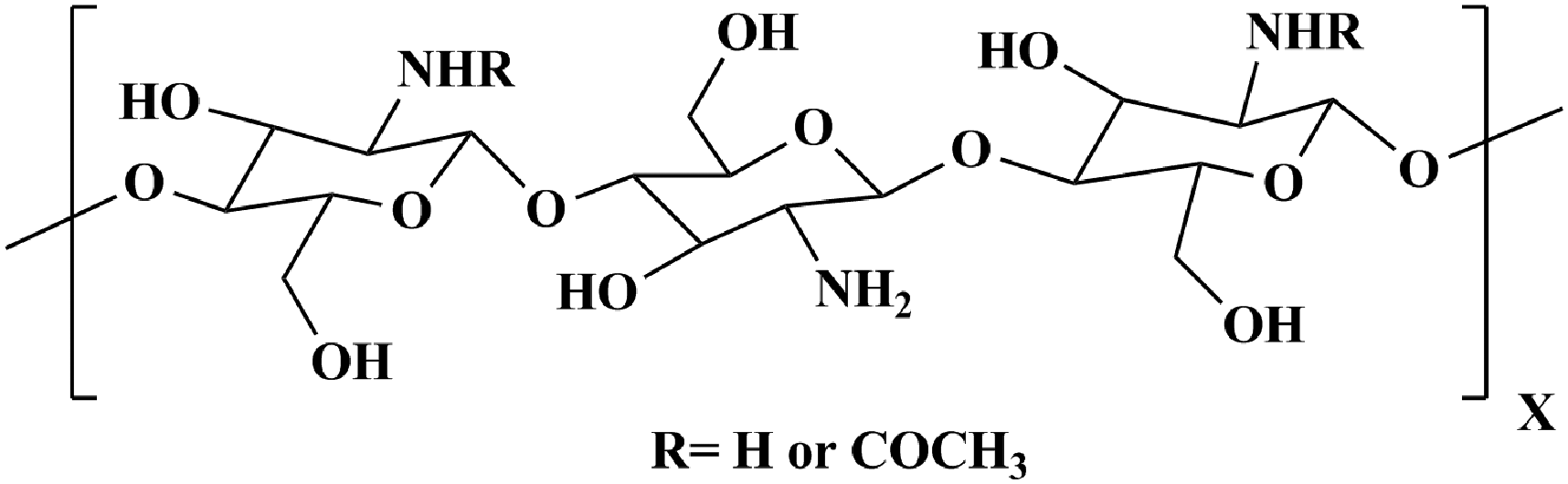
Chemical structure of chitosan.
Others
Other gene vectors are currently being evaluated preclinically for DNA delivery, including poly(β-amino ester)s, poly(amidoamine)s, and various carbohydrate-based polymers and dendrimers. 125 –127 Recently, Cheng et al. induced a peptide with a low pH-induced transmembrane structure (pHLIP) to the peptide nucleic acid anti-miRs, which targets the acidic tumor microenvironment. The novel anti-miR delivery platform effectively inhibited the miR-155 oncomiR in a mouse model of lymphoma. 128 Won et al. characterized a novel adipocyte-targeting fusion-oligopeptide gene carrier consisting of an adipocyte-targeting moiety and 9-arginine (ATS–9R) that selectively transfects mature adipocytes by binding prohibitin. 129 Additionally, Liang et al. have successfully developed CH6 aptamer-functionalized lipid nanoparticles that deliver siRNAs targeting osteoblast-specific genes for in vitro and in vivo gene silencing. 130
Most recently, a formulation comprising nonionic poloxamer CRL1005 and cationic surfactant benzalkonium chloride has reached clinical investigation. This formulation is being evaluated in a phase II/III study as a genetic vaccine to prevent CMV infection in patients who are undergoing allogeneic hematopoietic cell transplant (NCT01877655; NCT01903928; NCT00285259). 131,132
Future Considerations
A vast range of nanocarriers have already been applied as nonviral delivery systems in human gene therapy. The improvement in material science and nanotechnology allows the emerging of synthetic vectors with optimal physicochemical properties and tissue-/cell-targeting capabilities. Recently, an interesting study concerned with the delivery of the Cas9-based genome editing system with nonviral nanoparticles was carried out using “7C1 nanoparticles.” 133 7C1 was synthesized by mixing C15 epoxide-terminated lipids to low-molecular-weight (MW=600) PEI, and was then mixed with C14 PEG2000 and sgRNAs to form particles. They generated Cre-dependent and constitutive Cas9-expressing mice and proved the efficiency of mutating genes in pulmonary and cardiovascular endothelium using nanoparticle-mediated sgRNA delivery. The authors also raised concerns about the limitations of commonly used delivery methods for Cas9 and sgRNA, including viral delivery and hydrodynamic injection. They suggested that a versatile delivery system such as nonviral vectors might be efficient in facilitating genome editing in vivo.
The direct delivery approaches of protein or in vitro-transcribed mRNA of the Cas9 system were also investigated for their advantages such as avoiding insertional mutagenesis risks and lowering off-target effects. When it comes to the delivery of protein, nonviral vectors are also workable as they have less limitation with the payloads. Recently, Cre recombinase, Cas9-based transcription activators, and Cas9–sgRNA nuclease complexes were delivered by a cationic lipid formation into human cells in vitro and into the mouse model in vivo, suggesting that cationic lipid formation could work as a potent vector for protein delivery in genome editing therapeutics. 134 Another investigation on the cell-penetrating peptide (CPP)-based nanoparticles was also carried out. 135 The Cas9 protein was conjugated to CPP via a thioether bond and the gRNA was complexed with CPP, forming condensed nanoparticles, which led to efficient gene disruptions in several human cell lines in vitro with reduced off-target mutations relative to plasmid transfections.
The simplicity and versatility of the CRISPR/Cas9 system not only makes it powerful for biological basic research, but also improved the ease of gene regulation, paving the way for future gene therapy. How to efficiently deliver the CRISPR/Cas9 components to the tissue or cell type of interest in vivo might be a challenge in genome-editing-mediated therapeutics in the future. Nonviral vectors might provide more possibilities by versatile variations in their physicochemical properties (size, surface charge, solubility, etc.) and specific modifications with targeting ligands. For instance, folate-linked lipoplexes for targeted delivery of shRNA in ovarian cancer has been well characterized in our lab, and now we are working on the delivery of the CRISPR/Cas9 system in vivo using the same drug delivery system. 136 Meanwhile, another targeted polymer-based gene delivery system named RRHF (R8-RGD [RRRRRRRR-c(RGDfK)] peptide targeted fluorinated synthetic materials), which targets both tumor cells and vascular endothelial cells and tumor, has also been successfully developed by our team recently. RRHF shows excellent serum resistance and exhibits high gene transfection efficiency even in culture medium containing 30% FBS (Fig. 4). Moreover, RRHF can transfect a number of cell lines efficiently, including HEK293 (a human embryonic kidney cell line, ATCC), SK-OV-3 (a human ovarian cancer cell line), HCT 116 (a human colon cancer cell line), SW480 (a human colon cancer cell line), NCI-H-460 cells (human lung cancer cells), and HeLa (a human cervical carcinoma cell line, ATCC). Most recently, we intend to apply this vector to deliver the CRISPR/Cas9 system in vivo.
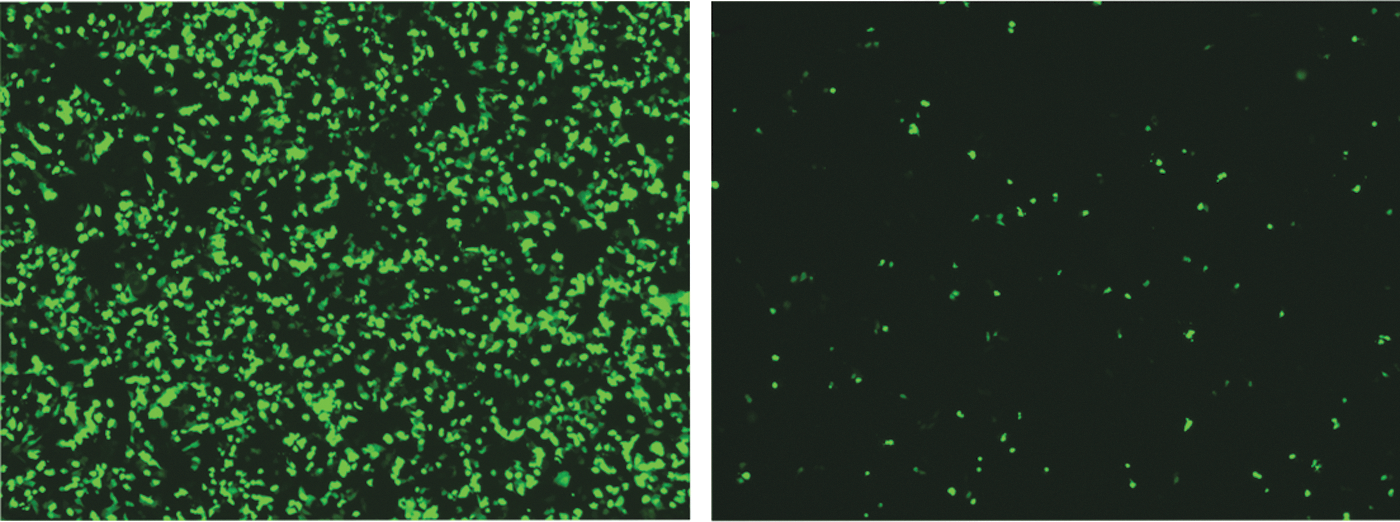
EGFP gene transfection efficacies in HCT 116 cells after 24 hr in culture medium containing 20% FBS. Left: Targeted polymer-based gene delivery system, RRHF, developed by our team. Right: Branched PEI 25K at its optimal N/P ratio (10) as positive control.
The CRISPR/Cas9 system has revolutionized the way of genome editing and genome regulation. Although in vivo applications of Cas9 remain challenging because of the limitations of current delivery approaches, it is likely that future development of optimal delivery formulation will further improve the performance of the CRISPR/Cas9 system.
Footnotes
Author Disclosure
The authors have no conflicts of interest to disclose.