




Abstract
Gene therapy is becoming an important treatment modality for gravely ill patients, and today's medical students and postgraduates are both potential consumers and future providers of gene therapy. Therefore, their attitudes and concerns about gene therapy may directly influence its long-term development and implementation in the clinic. We performed a cross-sectional survey of medical students and postgraduates at West China Medical School of Sichuan University. A custom-designed questionnaire was distributed to 600 students, and 579 were valid (96.98% response). Most respondents (84.46%) indicated little prior knowledge about gene therapy. The proportion of respondents considering gene therapy as acceptable ranged from 63.73% for serious illness to 17.72% for genetic enhancement. Adverse side effects were the most frequent concern among respondents when asked to imagine that they would receive gene therapy to treat a severe brain-related illness. These results suggest that medical students in China consider gene therapy's acceptability to be rather low, and are most concerned about its adverse side effects.
Introduction
G
At the same time, the growing availability of gene therapy techniques around the world is raising a range of serious ethical, legal, and social concerns. 7 One significant ethical concern for using gene therapy in severely ill patients is how to balance the risks and benefits of the treatment. An important question about using gene therapy methods in healthy people is how to balance the potential to enhance the genome against the risk of unwanted germline changes. 8 A key determinant of the development and implementation of gene therapy is likely to be the attitudes and ethical concerns of several stakeholders, including patient advocacy organizations, clinicians, and research funding bodies. 9 Therefore, it is important to understand the attitudes and concerns of as many of these stakeholders as possible.
Numerous studies in this regard have been carried out among clinicians and the general public, but they have been confined to developed Western countries such as Australia, Switzerland, Canada, and the United States. 1,10 –17 Few studies have examined attitudes in Asian countries among the general public or specifically among medical students and postgraduates, who are potential consumers and future providers of gene therapy and who are therefore likely to be better informed than the general population. 18 A study of nonmedical university students in Hong Kong indicated a negative attitude toward human genetic enhancement and worries about genetic discrimination and misuse of genetic information. 16
Here we performed a cross-sectional survey of medical students from various years at West China Medical School of Sichuan University and from postgraduates at the same institution who are active in the biomedical field. West China Medical School is ranked among the best five medical schools in the country and draws highly qualified students from all over the mainland. The survey was designed to understand their attitudes and concerns related to gene therapy.
Methods
Study design, sample selection, and data collection
This cross-sectional survey about attitudes among medical students and postgraduates toward gene therapy was launched in October 2014. Medical students from various years of the 5-year program and postgraduate students at West China Medical School of Sichuan University were recruited, regardless of medical specialty. The inclusion criteria were that subjects be able to read and understand the questionnaire on their own, and that they give informed consent to participate in the study. There were no exclusion criteria. Specially trained research staff distributed the paper-based questionnaires to participants, who completed them on their own and returned them to staff.
Survey instrument
The questionnaire was designed specifically for the present study and it was based on the literature, 1,19 including the authors' own work on attitudes of the public toward gene therapy in China. The survey was divided into seven sections asking for seven types of information: (1) demographic characteristics (gender, age, ethnicity, marital status, education, specialty, religion), (2) general attitudes toward gene therapy, (3) attitudes toward gene therapy if used to treat diseases of different severities or if used for genetic enhancement, (4) influence of religious beliefs on attitudes toward gene therapy, (5) main areas of concern with respect to the use of gene therapy to treat brain-related illness, (6) trade-offs to balance the benefits and risks of gene therapy, and (7) other ethical concerns related to gene therapy.
Analytical procedure
The questionnaire probed attitudes toward gene therapy by measuring agreement with statements of the type, “The benefits of gene therapy will be greater than the harm it may cause.” Respondents indicated a response of “definitely agree,” “probably agree,” “neutral,” “probably not agree,” and “definitely not agree.” To make the figures more readable, we aggregated the responses “definitely agree” and “probably agree” into a single response of “agree.” For the same reason, we aggregated the responses “probably not agree” and “definitely not agree” into the single response “don't agree.” When we performed statistical analyses to compare frequencies of different responses in different groups (e.g., poor or better prior knowledge about gene therapy, gender, ethnicity, education, religion, or medical specialty), we kept the responses separate and assigned them scores of 1 (“definitely not agree”) to 5 (“definitely agree”).
The questionnaire asked participants to rank each of seven areas related to gene therapy from 1 (of least concern) to 7 (of most concern). An average score was calculated for each area by multiplying the total score for the given area by the number of participants reporting that score, and then dividing by the total number of participants. Higher average score indicates greater concern.
Data management and statistical analysis
Data were managed in Epidata 3.1 and analyzed using SPSS 21.0 (IBM, Chicago, IL). Descriptive statistical analyses were performed; response rates were calculated as percentages on every item related to categorical variables. Potential associations between demographic characteristics of participants and their attitudes or ethical concerns about gene therapy were assessed using Mann–Whitney U-tests. p < 0.05 was defined as the threshold of significance for all tests.
Results
Demographic characteristics of respondents
A total of 600 questionnaires were distributed and 597 questionnaires were recovered, corresponding to a recovery rate of 99.50%. Of the returned questionnaires, 15 were excluded because the responses contained logical errors and another 3 were excluded because they were incomplete. The remaining 579 questionnaires were accepted as valid and used in the final analysis, corresponding to an effective response rate of 96.98% (579/597).
The median age of all respondents was 22.00 years (range, 16–39 years). Postgraduates had graduated a median of 2 years (range, 0–17 years) before completing the survey. Nearly all respondents (532, 91.88%) were Han Chinese, while 47 (8.12%) belonged to ethnic minorities, including Dong, Manchu, Gelao, Tujia, Hui, Tibetan, Zhuang, and Mongolian. Nearly half of the respondents worked in clinical medicine (241, 41.62%), while the remainder (58.38%) worked in other areas such as preventive medicine or stomatology (Table 1).
Demographic characteristics of respondents
Including Dong, Manchu, Gelao, Tujia, Hui, Tibetan, Zhuang, and Mongolian.
Including preventive medicine, stomatology, pharmacy, basic medical science, and evidence-based medicine.
General attitudes toward gene therapy
Among the 579 respondents, most (84.46%) had either never heard of gene therapy or had only heard about it, while 15.54% reported having learned about it in detail. In subsequent analyses, these two subgroups were defined to have “poor knowledge” or “better knowledge” about gene therapy and compared with each other. The diseases that respondents knew could be treated using gene therapy included sickle anemia, hemophilia, phenylketonuria, Down's syndrome, Alzheimer's disease, albinism, cystic fibrosis, immune deficiency syndrome, and cancer.
When asked whether they would be willing to undergo gene therapy themselves if it were necessary to treat disease, 39.55% said that they would be, while 34.89% said that they would not be. The remaining 25.56% indicated that they were undecided. The most frequent reasons for not accepting gene therapy were fears of adverse effects (58.54%), high cost (22.32%), and a belief that such therapy went against nature (19.14%). Among participants with poor knowledge, 38.85% accepted gene therapy, 25.36% did not accept it, and 35.79% were “undecided.” The corresponding response rates among those with better knowledge were similar at 43.33%, 26.67%, and 30.00% (Z =−0.409, p = 0.682).
Differences in general attitudes toward gene therapy according to differences in demographic characteristics are shown in Table 2. Respondents were significantly more likely to accept gene therapy for themselves if they were men rather than women (Z = −1.990, p = 0.047), and if they came from an ethnic minority rather than from the Han majority (Z = −1.966, p = 0.049). Other demographic characteristics, including marital status, education, specialty, and religion, did not significantly affect general attitudes toward gene therapy (p > 0.05).
Comparison between respondents' demographic characteristics and general attitudes toward gene therapy
Mann–Whitney U-test.
Attitudes toward gene therapy for different purposes
The acceptability of gene therapy among respondents varied substantially with the purpose of the treatment (Fig. 1). Most respondents accepted gene therapy for the more complex and severe diseases of breast cancer (63.73%) and congenital heart disease (60.28%). Acceptability decreased with decreasing disease severity, falling to 40.59% for attention-deficit/hyperactivity disorder and 44.38% for hypertension. Lower proportions of respondents were in favor of using gene therapy to improve memory (17.72% for vs. 54.40% against) or to extend lifespan (20.37% for vs. 46.81% against).
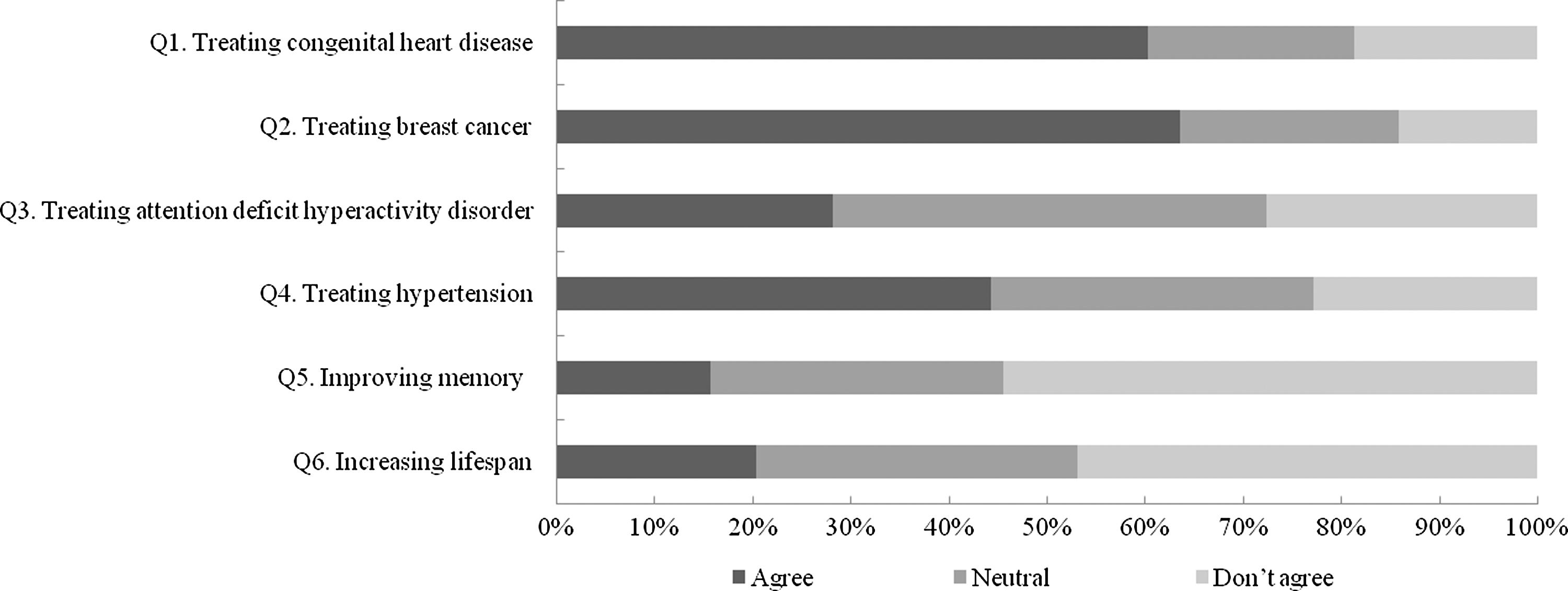
Proportions of respondents indicating whether they agreed with the use of gene therapy to treat specific conditions of varying severity, or to achieve genetic enhancement for improving memory or extending lifespan.
Associations between attitudes toward gene therapy for different purposes and sociodemographic characteristics, based on Mann–Whitney U-test Z scores and p-values, are shown in Table 3. Men were significantly more likely than women to accept gene therapy for treating congenital heart disease (p = 0.019) and treating attention-deficit/hyperactivity disorder (p = 0.033), as well as for extending lifespan (p = 0.001). Han Chinese respondents were significantly more likely to accept gene therapy for hypertension than minority respondents (p = 0.045). Students from nonclinical specialties were more likely than those from clinical specialties to accept gene therapy for treating congenital heart disease (p = 0.001).
Associations between attitudes toward gene therapy and sociodemographic characteristics
Boldfaced p-values indicate significant associations.
Z = Mann–Whitney U-test.
Influence of religious beliefs on attitudes toward gene therapy
While the largest proportion of respondents (47.31%) indicated that their religious belief system did not take a position for or against gene therapy, sizeable proportions indicated that their belief system disagreed with gene therapy (29.03%) or supported it (23.66%). Just over half of respondents (53.76%) gave a neutral response to the question of whether their religious beliefs affected their attitudes toward gene therapy. A smaller proportion (32.26%) indicated that religious beliefs had no influence, while the smallest proportion (13.98%) indicated that religious beliefs did have an influence. Self-reported religious students were more likely to agree with the statement, “It is always wrong to change someone's genes before they are born, even if it is to cure a disease” (p = 0.017; Table 3).
Main areas of concern about gene therapy
Respondents were asked to imagine that they were to receive gene therapy to treat a severe brain-related illness. They were asked to rank each of seven areas of concern from 1 (of least concern) to 7 (of greatest concern) (Fig. 2). The area of greatest concern was “adverse side effects related to the treatment” (average score, 5.59), followed by “it goes against my beliefs” (5.04); the area of least concern was “having the same genes as others” (2.35).
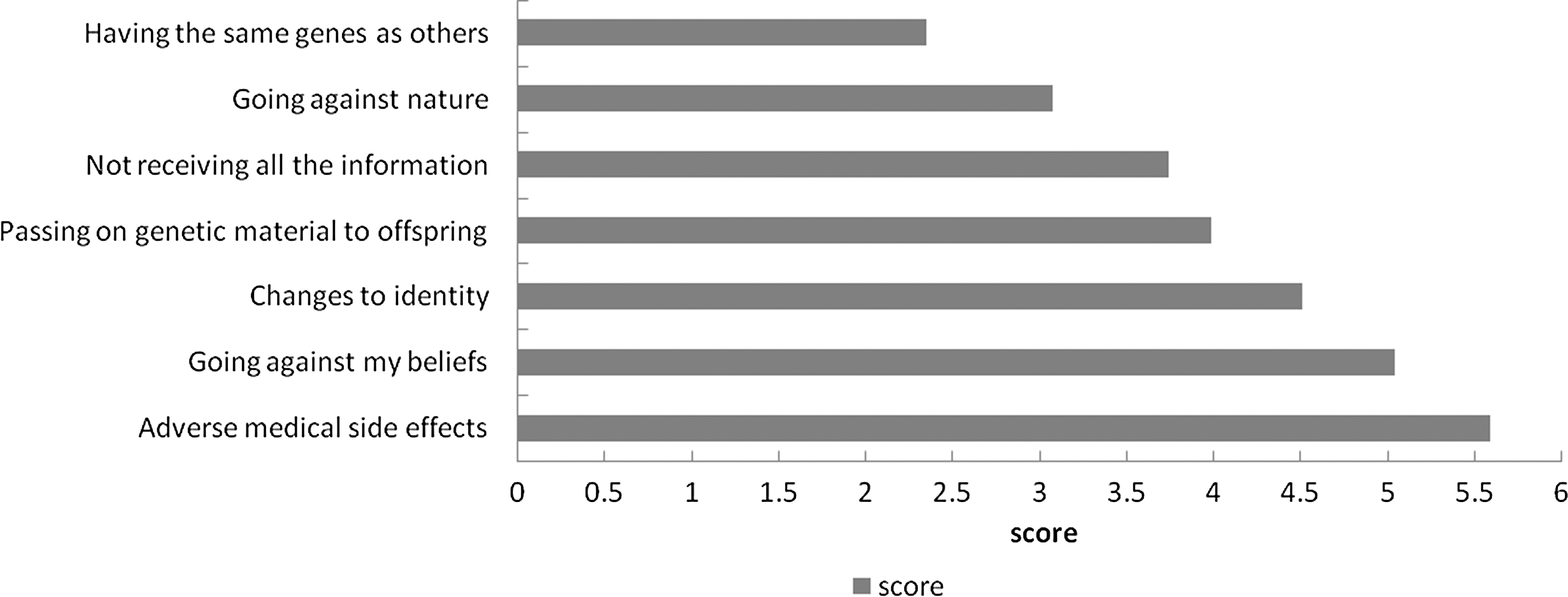
Ranking of different areas of concern over the use of gene therapy to treat a severe brain-related illness. Respondents were asked to imagine that they were to receive the gene therapy themselves. Higher score indicates greater concern.
Balance between the benefits and risks of gene therapy
When asked whether they agreed with the statement, “The benefits of gene therapy will be greater than the harm it may cause,” only 31.43% of respondents agreed, with more than 50% giving a neutral response (Fig. 3). Additional questions asked about specific potential benefits and harms of gene therapy. Some respondents (24.53%) agreed with the statement that genetic treatment of disease will have an overall positive impact on society because the treatment will make people healthier and will reduce suffering. Nearly half of respondents (40.93%) agreed with the statement that “One day, gene therapy will be able to provide a possible cure for a large number of diseases.” A similar proportion (41.97%) disagreed with the statement, “It is too risky to try to change people's genes,” while 40.58% gave a neutral response. Similar or higher proportions of respondents disagreed with the statements that “It is always wrong to change someone's genes before they are born, even if it is to cure a disease” (41.97%) and “Interfering with people's genes should not be allowed because it goes against nature” (44.21%). Most of these questions featured a significant proportion of neutral responses (range, 30.74–51.30%).
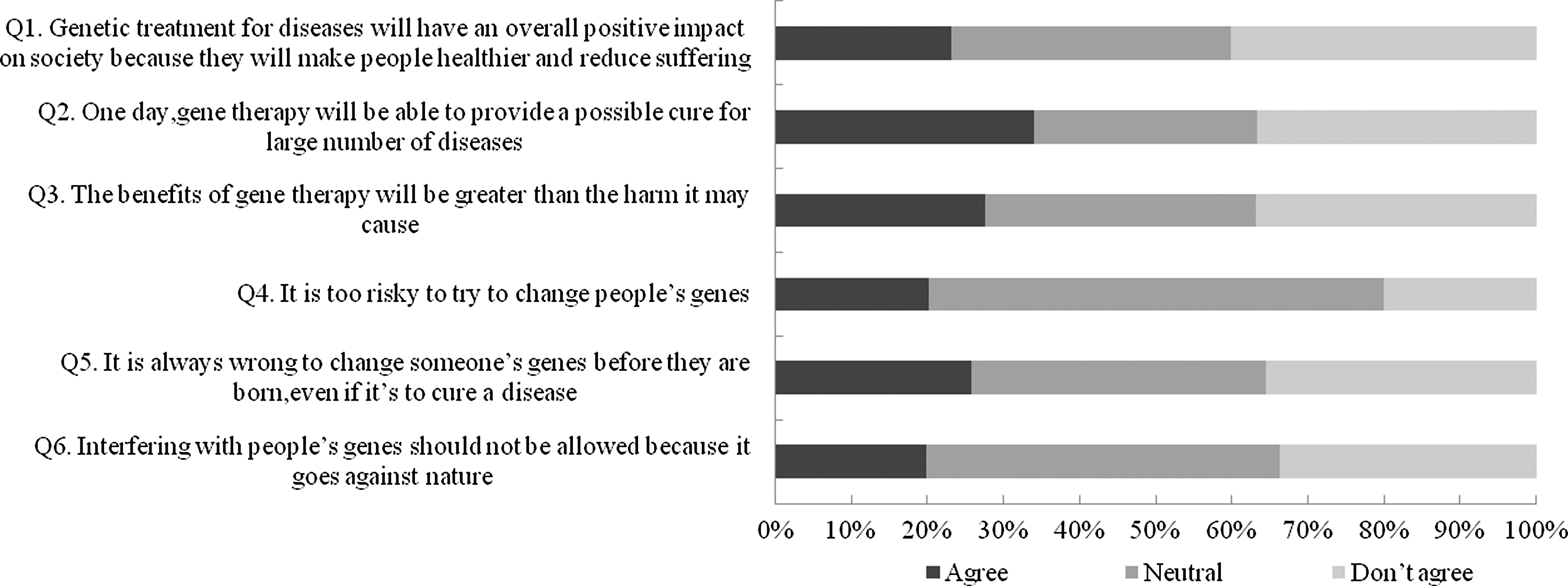
Proportions of respondents indicating whether they agreed with specific statements about the benefits and harms of gene therapy.
Associations between the benefits and risks of gene therapy and sociodemographic characteristics, based on Mann–Whitney U-test Z scores and p-values, are shown in Table 3. Respondents with poor knowledge were more likely than those with better knowledge to agree with the statement, “It is too risky to try to change people's genes” (p = 0.043). Men were significantly more likely than women to agree with the statement, “The benefits of gene therapy will be greater than the harm it may cause” (p = 0.007). Conversely, women were significantly more likely than men to agree with the statements, “It is too risky to try to change people's genes” (p = 0.005). Postgraduates responded more positively than medical students to certain statements, such as, “Gene therapy will have an overall positive impact on society” (p < 0.001).
Other ethical concerns related to gene therapy
Most respondents believe that gene therapy may change the human condition (68.57%), including living conditions and requirements for survival; reduce personal privacy (67.35%); lead to genetic discrimination (66.15%); and cause population aging (58.04%) and serious side effects (57.52%) (Fig. 4). Only 33.34% of participants agreed that gene therapy is a privilege for wealthy or powerful people, and 35.23% agreed that gene therapy went against the laws of nature on human life and death.

Proportions of respondents indicating whether they agreed with specific ethical concerns about gene therapy.
Associations between other ethical concerns related to gene therapy and sociodemographic characteristics, based on Mann–Whitney U-test Z scores and p-values, are shown in Table 3. Women were significantly more likely than men to agree with the statements, “Gene therapy goes against the laws of nature on human life and death” (p = 0.006), and “Gene therapy carries strong risk of exposing people's privacy” (p = 0.019). Postgraduates showed less agreement than medical students with statements that gene therapy “will cause some serious problems of population aging” (p = 0.022), “will cause genetic discrimination” (p = 0.016), and “carries strong risk of exposing people's privacy” (p = 0.036). Students from nonclinical specialties were more likely than those from clinical specialties to agree that gene therapy “will cause some serious problems of population aging” (p = 0.039), “will cause serious side effects” (p = 0.021), and “carries strong risk of exposing people's privacy” (p = 0.035), as well as agree that it is “the privilege of wealthy or powerful people” (p = 0.003).
Discussion
This is one of the first surveys regarding attitudes and concerns related to genetic therapy among medical students and postgraduates in Asia. The results indicate that among medical students and postgraduates from various years at a top-ranked medical school in China, most (84.46%) reported having poor knowledge about gene therapy, and only 15.54% reported having learned about it in detail. Medical students and postgraduates are likely to have more access to, and greater ability to understand, information about gene therapy than the general public, and so our results highlight the need to disseminate such information more in China, especially among university students.
Only 39.55% of our participants said that they would accept gene therapy for themselves if it were necessary to treat disease, but more than 60% said that they would accept it for themselves to treat cancer or brain-related illness. These acceptance rates are slightly lower than those in a 2011 survey of oncology physicians and nurses in China, 11 which found that 85.06% would accept gene therapy for themselves if they were diagnosed with advanced cancer and 63.11% if diagnosed with early-stage cancer. The higher rate of acceptance in the 2011 study may reflect greater knowledge of gene therapy among experienced clinical staff than among the medical students and postgraduates in our study.
Our acceptance rates are also lower than those reported in developed countries, although direct comparisons are difficult because the types of diseases described in each study differed. In Japan in 1992, Macer 10 found that 54% of the general public, 65% of high school biology teachers, and 54% of scientists were willing to use gene therapy to treat “serious or fatal genetic diseases”; the corresponding rates for those willing to use gene therapy on their own children were 66%, 73%, and 62%. In the United States and Canada in 2014, Robillard and colleagues 1 found that >90% of the general public considered gene therapy acceptable for treating “severe illnesses such as Alzheimer's disease.” The apparently greater acceptance of gene therapy in developed countries than in our Chinese study likely reflects a culture of science and technological advancement and of (largely optimistic) media coverage of that advancement. 20
The higher acceptance of gene therapy in the 2014 study in Canada than in the 1990 study in Japan may mean that people in developed countries have become more supportive about gene therapy over time. This hypothesis, however, is not supported in our study, where acceptance of gene therapy was similar between those with poor knowledge (38.85%) and those with better knowledge (43.33%); in addition, a similar proportion of respondents in the two groups were “undecided” about the acceptability of gene therapy (35.79% vs. 30.00%). Nevertheless, this statistical similarity may mask differences that would become apparent only with larger sample sizes. For example, respondents with poor knowledge were more likely than those with better knowledge to agree with the statement, “It is too risky to try to change people's genes” (Z = −2.026, p = 0.043). Larger studies are therefore needed to examine whether acceptance of gene therapy among Chinese increases with increasing knowledge.
Several researchers have suggested that public perceptions of gene therapy are influenced by demographic characteristics such as gender and religious beliefs. 21,22 This position is partly, but not entirely, supported by evidence from developed areas. 1,16 We found that most demographic characteristics did not appear to significantly influence Chinese respondents' attitudes about gene therapy in general, though there were some differences of detail. Men were significantly more likely than women to accept gene therapy for treating congenital heart disease or attention-deficit/hyperactivity disorder as well as for increasing lifespan. They were also significantly more likely than women to agree with the statement, “The benefits of gene therapy will be greater than the harm it may cause.” Conversely, women were significantly more likely than men to agree with the statements, “It is too risky to try to change people's genes,” “Gene therapy goes against the laws of nature on human life and death,” and “Gene therapy carries great risk of exposing people's privacy.” This finding is consistent with a similar study among the general public in England and Wales, where men were found to perceive fewer risks than women. 23 Similarly to gender, religion did not seem to affect overall attitude to gene therapy, but self-reported religious students were more likely to agree with the statement, “It is always wrong to change someone's genes before they are born, even if it is to cure a disease.”
Respondents were more likely to accept gene therapy in general and for most specific contexts if they came from ethnic minorities than from the majority Han population. The one exception was hypertension, for which Han Chinese respondents were significantly more likely to accept gene therapy than minority respondents. Our finding of greater acceptance of gene therapy by minority groups is somewhat surprising, given that the focus on traditional culture in many Chinese ethnic groups seems likely to lead to conservative attitudes. This result may merely reflect small sample size in our study, and so it should be verified and extended in future work.
We found that education and medical specialty may affect students' attitudes. Postgraduates responded more positively than medical students to certain statements, such as, “Genetic treatment for diseases will have an overall positive impact on society because it will make people healthier and reduce suffering.” On the other hand, postgraduates showed less agreement than medical students with statements that gene therapy “will cause some serious problems of population aging,” “will cause genetic discrimination,” and “carries strong risk of exposing people's privacy.” Students from nonclinical specialties were more likely than those from clinical specialties to agree that gene therapy “will cause some serious problems of population aging,” “will cause serious side effects,” and “carries strong risk of exposing people's privacy”; they were also more likely to agree that gene therapy is “the privilege of wealthy or powerful people.”
Numerous studies in developed countries suggest that the public's acceptance of gene therapy is proportional to the severity of the disease in question, 10,13,15,16,24 –27 with greater acceptance rates for the treatment of life-threatening diseases and of diseases that substantially decrease quality of life, including Alzheimer's disease and heart disease. 23 In previous studies, acceptance rates were lower for diseases that were considered not to substantially affect quality of life, such as attention-deficit/hyperactivity disorder. 27 Our results are similar to that previous work, suggesting that the views of medical students and postgraduates in Asia largely align with those of other stakeholder groups in developed countries.
We found that acceptance rates of gene therapy among medical students and postgraduates dropped substantially when the therapy was directed toward genetic enhancement rather than the treatment of disease. More than 50% of respondents rejected such use of gene therapy even if it meant that they themselves could gain a genetic advantage over others or live a longer life. This high rate of rejection is similar to that reported in a survey of the general public and of nonmedical university students in Hong Kong. 15,16 These results may reflect a predominant Chinese worldview that there is a “natural order” ordained by heaven with which humans should not tamper. Studies in Western countries have also reported high rejection rates of gene therapy for genetic enhancement. In one such study, UK respondents cited the main reason to be social risks such as genetic discrimination, while Italian respondents cited concerns about acting against nature. 13
We found that when respondents were asked to imagine that they were to receive gene therapy to treat a severe brain-related illness, their greatest concern was adverse side effects. This contrasts with a survey of the general public in the United States and Canada, who indicated that their greatest concern was not receiving all the appropriate information. 1 One possible explanation for this difference is that the medical students in our study, as a result of their medical training, are more aware than the general public of the side effects caused by gene therapies. Another possible explanation is that Chinese show greater concern than Westerners about gene therapy technology, perhaps stemming from a lack of understanding and media coverage in the country. This lack of awareness and understanding of gene therapy may help explain why such large proportions of respondents gave neutral responses to questions regarding trade-offs between the benefits and risks of gene therapy. Future studies should examine whether this neutral stance reflects an ongoing struggle to balance the benefits and risks, or indecision because of lack of information.
These findings in China suggest that gene therapy has a long way to go before gaining widespread acceptance among medical students. Since this population is likely to be better informed about gene therapy than the general population, 18 our findings imply even lower acceptance by the general public in China. We are unaware of studies assessing attitudes and concerns among Chinese in general, and so this is an urgent area for future research. Assuming that such studies verify the relatively low acceptance in our study, it is likely that several measures will be necessary to increase it, such as greater media dissemination; coverage in higher education programs, including medical schools; and government regulations to control the use of gene therapy. These communication and regulatory efforts should carefully address the various ethical, social, and legal concerns that medical students and the general public share toward gene therapy.
Conclusions
This study provides one of the first analyses of attitudes toward gene therapy among medical students and postgraduates in China. Most respondents possess poor knowledge about gene therapy, and many of them do not accept gene therapy for treating disease—far more than groups in developed countries. In fact, many medical students and postgraduates in China do not accept gene therapy for themselves, citing possible side effects as their area of greatest concern.
Footnotes
Acknowledgments
We thank all those who participated in this study. We are grateful for valuable comments from peer reviewers.
Author Disclosure
No competing financial interests exist.