




Abstract

T
In the gene drive design, sequences for the Cas enzyme and the short guide RNAs (sgRNAs) are flanked by the genomic sequences targeted for editing, between which is also inserted a functional gene of interest (GOI) (Fig. 1). These constructs are known as gene drives because when they are introduced into a population by breeding, they spread exponentially through an inheritance pattern known as the “mutagenic chain reaction” (MCR). 2,3 The design of these constructs enables an initial event in which the familiar homology-dependent repair (HDR) occurs. Because the Cas gene, sgRNA coding, and GOI sequences “ride along” with the transposition of the target sequences, the gene drive allele becomes homozygous shortly after the “carrier” mates with a wild-type organism. Instead of being diluted in the general population, the gene drive alleles rapidly increase in frequency, effectively taking over in the matter of a few generations.
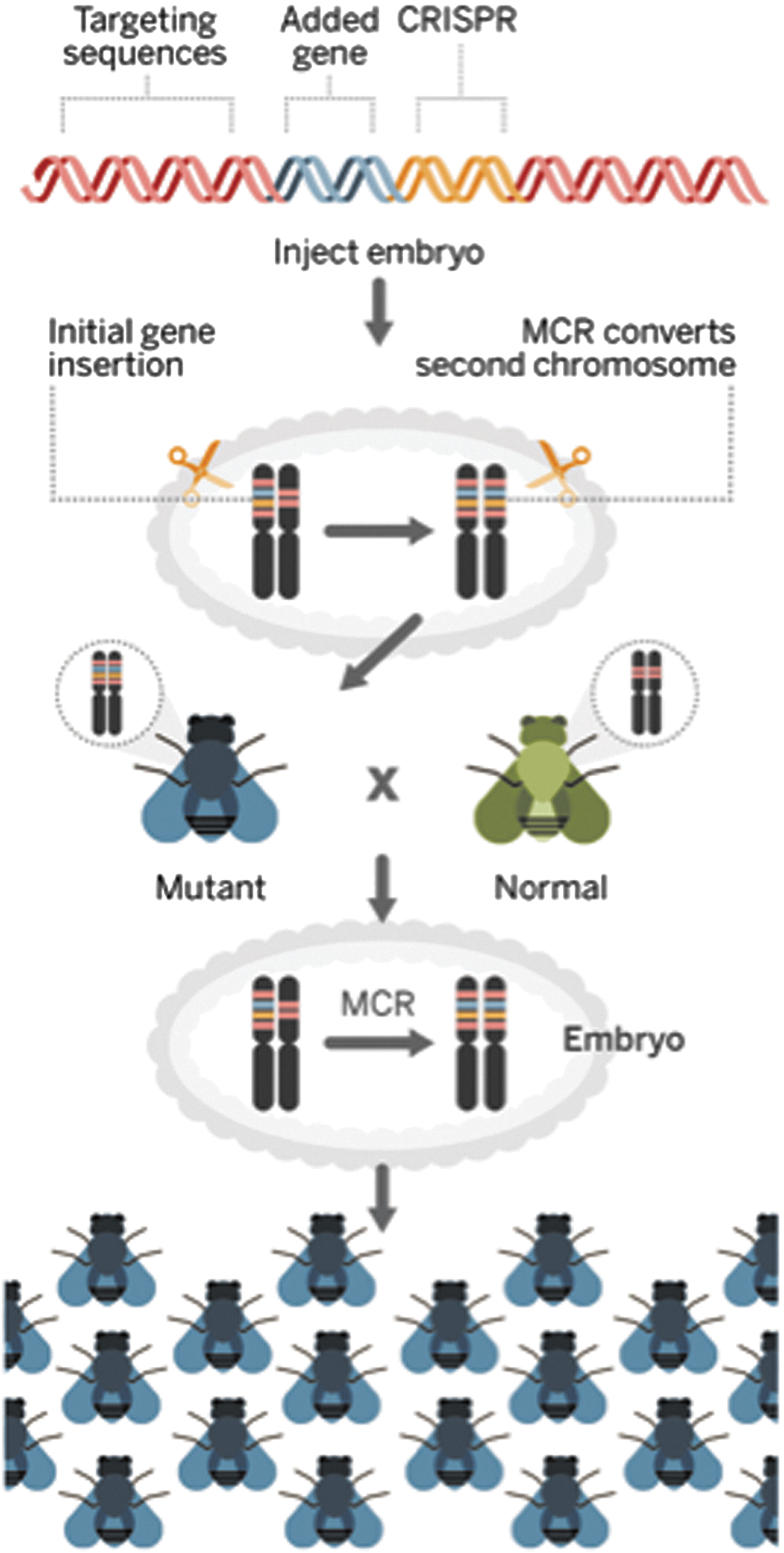
Schematic of gene drive construct propagating through an insect population by a mutagenic chain reaction (MCR). Adapted with permission from Bohannan. 2
The specific applications of gene drives include public health initiatives, ecological conservation measures, agricultural applications, and laboratory-based animal modeling. 4 The global problem of arthropod-borne human diseases makes public health applications the most compelling from an ethical perspective. The burden of mortality from arthropod-borne illnesses remains oppressive, with World Health Organization (WHO) estimates ranging up to 1 million deaths annually. 5 Malaria and dengue virus remain the most deadly of the arthropod-borne diseases, even as emerging pathogens, such as Zika virus and chikungunya virus have garnered increasing attention. While such mosquito-borne infections disproportionally affect developing nations, other arthropod-borne illnesses, such as West Nile encephalitis, Eastern equine encephalitis, Lyme disease, and Rocky Mountain spotted fever, are seasonally and regionally prevalent in the United States. A gene drive-based approach to such illnesses would seek to genetically alter arthropod vector populations in order to disable their ability to serve as effective vectors for infecting humans.
Given the potential power of gene drive technology to alter the genetic makeup of entire populations, safety considerations are critical. Approaches to safety in experimental applications of gene drives have been published by laboratories active in the field and summarized in a special report by the National Academies of Science, Medicine, and Engineering. 3 The overarching conclusion of the National Academies report was that although there are currently insufficient data to support general release of gene drive-modified organisms, there is a good rationale to proceed with limited field testing. Thus, it seems likely that in the near future such organisms will be released, most likely in a phased approach beginning with confined environments, such as isolated oceanic islands.
What is the relevance of these events to the gene therapy community? At first pass, these developments may seem to be limited to fields that only barely intersect with gene therapy research. However, because the basic tools of gene editing are rapidly being refined by gene therapy scientists, it may well be important to have dynamic interaction with those using these same tools in an ecological context. Additionally, those studying gene drives have begun to focus on the possibility of “horizontal” transfer of gene drives. This refers to a situation in which, after release into the field, the gene drive “jumps” into species beyond that into which it was initially introduced. 6 One illustration of horizontal gene transfer is the method commonly used to create genetically modified plants, which involves transfer of genes from the prokaryote, Agrobacterium tumefaciens, to eukaryotic plants of agricultural importance. Horizontal gene transfer appears less likely in the context of gene drive-modified mosquitoes, for example, but this possibility must be evaluated before exposure of the environment to such prolific organisms, which may mate with related insect species and prey on a fairly wide range of hosts as an ectoparasite. Understanding the risks associated with using gene drives in public health settings could be particularly illustrative as a point of comparison with the rather modest risks incurred by using similar tools to treat specific human diseases in affected individuals. Gene therapy scientists could be particularly useful to the broader scientific community and to society as a whole when contemplating the various risks associated with the “gene modification footprint” of human activity in our world.