




Abstract
Genetic vaccines based on replication-incompetent adenoviral (AdV) vectors are currently in clinical development. Monovalent AdV vectors express one antigen from an expression cassette placed in most cases in the E1 region. For many vaccines, inclusion of several antigens is necessary in order to raise protective immunity and/or target more than one pathogen or pathogen strain. On the basis of the current technology, a mix of several monovalent vectors can be employed. However, a mix of the standard monovalent AdV vectors may not be optimal with respect to manufacturing costs and the final dose per vector in humans. Alternatively, a variety of bivalent recombinant AdV vector approaches is described in the literature. It remains unclear whether all strategies are equally suitable for clinical development while preserving all the beneficial properties of the monovalent AdV (e.g., immunogenic potency). Therefore, a thorough assessment of different bivalent AdV strategies was performed in a head-to-head fashion compared with the monovalent benchmark. The vectors were tested for rescue efficiency, genetic stability, transgene expression, and potency to induce transgene-specific immune responses. We report that the vector expressing multiple antigens from a bidirectional expression cassette in E1 shows a better genetic stability profile and a potent transgene-specific immune response compared with the other tested bivalent vectors.
Introduction
R
Interestingly, a multitude of different approaches for expression of more than one protein from a recombinant AdV vector is described (Supplementary Table S1; supplementary data are available online at
In this study we identified an optimal method for bivalent AdV vector production by testing various bivalent AdV designs in a head-to-head comparison, using the respective monovalent AdV as a benchmark. Rather than the typically used human adenovirus 5 (HAdV5)-derived vector, we used the low-seroprevalence vectors human adenovirus 35 and 26 (HAdV35 and HAdV26). HAdV5 has the limitation that high levels of preexisting immunity in the human population can negatively affect immunogenicity. 42,43 Low-seroprevalence vectors such as HAdV35 and HAdV26 are not faced with this drawback. 44 –46 HAdV35 and HAdV26 vaccine vectors have shown promising results in clinical trials of malaria, HIV, and Ebola virus vaccines. 47 –49 Induction of T-cell and B-cell responses, as well as favorable innate cytokine responses, 44 by these low-seroprevalence vectors supports their advancement in vaccine development.
For bivalent vectors, rescue efficiency, the genetic stability profile, transgene protein expression, and immunogenicity were used as selection criteria. Major differences were found among the various bivalent designs. However, a bidirectional mouse cytomegalovirus (CMV) promoter cassette in the E1 region performed better than the other tested strategies by combining good rescue efficiency, high genetic stability, and induction of a potent immune response, thereby providing an attractive new vaccine vector design.
Materials and Methods
Vector generation and cell culture
HAdV26 and HAdV35 vectors were generated as previously described by Vogels and colleagues. 17 In short, the monovalent E1, bivalent E1-E3 (inverted), E1-E1 tandem, E1-2A, and E1 bidirectional promoter-containing vectors were generated by inserting the expression cassettes in either the E1, and if applicable, the E3 position. The expression cassettes in E1-E3 contain identical human CMV (hCMV) immediate-early promoters; however, they differ in the polyadenylation signal sequences derived either from simian virus 40 (SV40) or bovine growth hormone (BGH), 17 respectively. The vectors containing the expression cassettes in tandem in the E1 region were designed as such to reduce the sequence homology 29,30 and contain heterologous promoters; the hCAG 50 promoter modified to contain a mouse CMV enhancer (mCAG), and hCMV, and SV40- and BGH-derived polyadenylation signals, separated by a stop codon. In the E1-2A vectors a foot-and-mouth disease virus-derived 2A self-cleavage site (NFDLLKLAGDVESNPGP) 51,52 was placed between two transgenes expressed under the control of an hCMV promoter and SV40-derived polyadenylation signal sequences. In the E1-bidirectional promoter vectors two genes were placed up- and downstream of the bidirectional mCMV promoter containing heterologous polyadenylation signal sequences derived from SV40 and BGH. The inserted genes filovirus Marburg Angola (MARV), Ebola Zaire (EBOV), Ebola Côte d'Ivoire (CIEBOV)/Tai Forest virus (TAFV), and Ebola Sudan Gulu (SEBOV) glycoproteins (GPs) were codon-optimized for human expression, and for EBOV and SEBOV to reduce the homologous sequence stretches where necessary, by GeneArt (Thermo Fisher Scientific, Waltham, MA). The reporter genes encoding firefly luciferase and enhanced green fluorescent protein (eGFP) were also codon-optimized for human expression by GeneArt (Thermo Fisher Scientific). The transgenes were cloned into the pAdapt35 or pAdapt26 plasmid. 17 A Kozak sequence (5′-GCCACC-3′) was included directly in front of the ATG start codon, and two stop codons (5′-TGATAA-3′) were added at the end of the coding sequences.
The HAdV35 and HAdV26 vectors were generated by a two-plasmid system by transfection into PER.C6 cells, using Invitrogen Lipofectamine (Thermo Fisher Scientific) according to the manufacturer's recommendations. The homologous sequences in the HAdV genome plasmids allowed for homologous recombination in PER.C6 cells, giving rise to full-length HAdV vectors. The vectors were subsequently plaque purified and further propagated on adherent PER.C6 cells at 37°C/10% CO2 in Dulbecco's modified Eagle's medium supplemented with 10% fetal bovine serum (Life Technologies, Carlsbad, CA) and 10 mM MgCl2. Virus was purified by standard two-step CsCl gradient and dialyzed in formulation buffer (10 mM Tris [pH 7.4], 1 mM MgCl2, 75 mM NaCl, 5% sucrose, 0.02% PS-80, 0.1 mM EDTA, 10 mM histidine, 0.5% ethyl alcohol). The final viral particle (VP) concentration was determined by optical density (OD) in the presence of sodium dodecyl sulfate (SDS) and the viral infectious unit (IU) titers by median tissue culture infective dose (TCID50) assay. The corresponding VP/IU ratio, as well as the productivity (VP/cm2), were calculated. Transgene expression and vector identity were tested for all purified vectors, followed by sequencing of the transgene expression cassette plus flanking regions (BaseClear, Leiden, the Netherlands). Before the testing in vivo bioburden (MicroSafe; Millipore, Bedford, MA) and endotoxin (MicroSafe; Millipore) were determined for all purified vectors.
Genetic stability
The genetic stability of the expression cassettes was determined by passaging five different plaques serially up to and beyond passage 13 (p13) (representative of three viral passages beyond the bulk drug substance), on adherent PER.C6 cells in T25 flasks (3.5 × 10⁶ cells/flask). After infection, predetermined amounts of virus were added that give rise to full cytopathic effect (CPE) 2 days postinfection. On the basis of previous observations, for optimal batch quality the recombinant vectors were harvested either 2 days (HAdV35) or 1 day (HAdV26) after full CPE. Viral DNA was isolated at viral passage number (VPN) 2, 5, 10, and 13 or 15. PCR analysis was performed to test for the presence of the expression cassette both in E1 and E3 with primers flanking these regions. At VPN 13 the expression cassette PCR fragments were confirmed by sequencing. E3 and E4 region PCRs were performed for all vectors as an additional readout for general genome identity. For HAdV35 E1 Fw (ID 2271) 5′-GGAGGTTCGATTACCGT-3′, Rv (ID 2272) 5′-CCTCGATCTCGATATCATCA-3′, E3 Fw (ID 1985) 5′-GCTGCTTTGCCCGGGAACTTATTG-3′, Rv (ID 1986) 5′-CAAGTTCGTAAGAGAGGCGATGG-3′, E4 Fw (ID 478) 5′-GGGTAGAGTCATAATCGTGCATCA-3′, Rv (ID 479) 5′-CATGACACTACGACCAACACGATCTCG-3′ and HAdV26 E1 Fw (ID 2741) 5′-TGGCGCGAAAACTGAATGAG-3′, Rv (ID 2742) 5′-GCAGGCGGGTTGTCAAATAAG-3′, E3 Fw (ID 669) 5′-GAGTCTCACCTGGTCAGGTTC-3′, Rv (ID 670) 5′-GCTGAACAACTACACCAGAGAC-3′, and E4 Fw (ID 671) 5′-TTACACCAGCACGGGTAGTCAG-3′, Rv (ID 672) 5′-CGGAAGTTGAGTCACGAAATCG-3′ primer sequences were used.
Transgene expression
Transgene expression of Ebola and Marburg GP was analyzed both by Western blot (WB) and fluorescence-activated cell sorting (FACS) in transduced A549 cells. For WB analysis cells were transduced with predefined VP/cell ratios, namely for HAdV35 vectors 1000, 2500, and 5000, or for HAdV26 vectors 10,000, 20,000, and 50,000. Cells were harvested 48–72 hr posttransduction and lysed. The protein in cell lysates was separated on precast Invitrogen 4–12% Bis/Tris NuPAGE gels (Thermo Fisher Scientific) in Invitrogen MOPS buffer (Thermo Fisher Scientific) at 175 V, 500 mA. Protein was subsequently transferred to a nitrocellulose membrane according to the manufacturer's recommendations, using iBlot transfer stacks (Invitrogen iBlot system; Thermo Fisher Scientific). Immune staining was performed for 1 hr with filovirus GP-specific antibodies (noncommercial monoclonal and polyclonal antibodies) in 5% nonfat dry milk (Bio-Rad)/Tris-buffered saline–Tween 20 (Invitrogen/Thermo Fisher Scientific). Visualization of the protein of interest was performed by staining with fluorescently labeled secondary antibody IRDye 800CW goat anti-mouse/rabbit (diluted 1:10,000) and recorded on Odyssey (LI-COR, Lincoln, NE). The surface display of various GPs was determined by transducing A549 cells with increasing amounts of virus. Surface staining of the GPs was completed 48 hr posttransduction as recommended by the manufacturer, with mouse serum raised against the respective GPs and anti-mouse APC-coupled secondary antibody to facilitate detection of the positive cells (%) by FACS (BD FACSCanto II; BD Biosciences, San Jose, CA). The geometric mean of the positive cell fraction was determined and plotted relative to the single monovalent benchmark (ratio [candidate/benchmark]).
Animal experiments
The animal experiments were approved by the institutional review board and the national ethics committee for animal experiments. BALB/c mice were immunized intramuscularly with a total of 2 × 10⁹ or 1 × 10⁹ VP per HAdV35 vector. Intramuscular immunization with the bidirectional promoter-containing HAdV26 vector was performed with two different concentrations: 2 × 10⁹ VP, 1 × 10⁹ VP per vector and 2 × 10¹⁰ VP, 1 × 10¹⁰ VP per vector. The HAdV double-insert vectors were supplemented with the HAdV.E1 Empty vector to compensate for the HAdV monovalent control mix of 1 × 10⁹ VP per vector. Either 2 or 8 weeks (with biweekly bleedings) postimmunization, mice were sacrificed, after which spleen or sera were isolated and further analyzed. The spleens were prepared as previously described. 53 Filovirus-specific T-cell responses were detected in an interferon (IFN)-γ enzyme-linked immunospot (ELISPOT) assay. 54 In brief, the relative number of GP protein-specific, IFN-γ-secreting T cells in the spleen was determined by stimulating the cells with three different 15-mer peptide pools per filovirus antigen to cover the whole filovirus GP. As a result, the numbers of spot-forming units (SFU) per 106 cells were determined and calculated. The serum B-cell response in mice was determined by measuring the GP-specific antibody titers in an Ebola and Marburg GP-specific ELISA (ELISA units [EU]/ml) as previously described. 14 Briefly, lectin-coated ELISA Nunc MaxiSorp plates (Thermo Fisher Scientific) were blocked for 2 hr before coating with the phosphate-buffered saline (PBS)-diluted filovirus GP-containing HEK293 supernatant. After washing, the diluted reference standard serum and the test serum were added (in duplicate) to the plates with sample buffer and incubated at room temperature for 1 hr. Naive mouse serum was used as a negative control. After secondary antibody treatment with horseradish peroxidase-labeled IgG, the plates were developed with o-phenylenediamine dihydrochloride (Sigma-Aldrich, St. Louis, MO) according to the manufacturer's recommendations. After stopping the enzymatic reaction with 1 M H2SO4 the OD was measured at 492 nm, using an ELISA plate reader. All the analyses were performed with Gen5 software (BioTek, Winooski, VT).
Intracellular cytokine staining was performed by flow cytometry, using the BD Biosciences FACSCanto. Cells were stained with antibodies against CD4, CD8, IFN-γ, tumor necrosis factor (TNF)-α, and interleukin (IL)-2 prepared in BD CompBead (BD Biosciences) according to the manufacturer's recommendations. In the FACSCanto, data collection was stopped after 1.2 × 10⁵ events in the lymphocyte gate, and the final analyses were performed using FlowJo software (FlowJo, Ashland, OR).
Statistical analysis
The T-cell responses were compared between vectors, using analysis of variance with log10 SFU/million splenocytes as the response variable. p values were adjusted for multiple testing, using a Dunnett correction.
The B-cell responses were compared between vectors by analysis of variance for potentially censored values (Tobit model), using log10 ELISA units per milliliter as the response variable. p values were adjusted for multiple testing, using a Bonferroni correction. In both analyses, the monovalent group was compared with the double-insert groups. Adjusted p values less than 0.05 were considered statistically significant. All analyses were performed with SAS 9.2 software (SAS Institute, Cary, NC).
Results
Design and selection criteria for bivalent vectors
To identify the most favorable bivalent AdV design among those currently described in the literature, we selected a panel of bivalent designs and generated the respective HAdV35 vectors encoding two heterologous transgenes. First, vectors encoding transgenes in E1 and E3 (E1-E3) were designed and generated. Then, three different strategies based on the E1 insertion site were tested: E1-based bivalent vectors with two expression cassettes in tandem (E1-E1), the transgenes separated by the self-cleavable 2A sequence (E1-2A), and a bidirectional promoter-containing cassette (E1-bidirectional) (Fig. 1A).

Bivalent vector designs and poor genetic stability profile of E1-E3 vectors.
The main selection criteria for identification of the optimal bivalent vector design included producibility and induction of potent immune responses. These criteria were evaluated for the bivalent vectors, using the following: (1) rescue efficiency in the producer cell line, (2) genetic stability by extended passaging of several viral clones (plaques) followed by PCR amplification and sequencing 17 (Supplementary Fig. S1A), (3) successful generation of a small-scale vector preparation, (4) transgene protein production in a noncomplementing cell line (i.e., A549), and (5) transgene-specific humoral and cellular immune responses in the mouse model. All assays were performed with the respective monovalent vector as a benchmark control.
To establish the benchmark, individual test criteria were evaluated for three HAdV35 monovalent vectors and one HAdV26 monovalent vector encoding different filovirus GP proteins in the E1 region. All four monovalent vectors were successfully rescued and expanded. Using a genetic stability by extended passaging assay, all the tested monovalent vectors were found to be genetically stable up to viral passage 13 (p13) (Supplementary Fig. S1B). After upscaling and small-scale vector preparations, the monovalent vectors were also found to be genetically stable (data not shown). The physical titer (range, 2–3.5 × 10¹² VP/ml), infectious titer (range, 1–9 × 10¹¹ IU/ml), VP/IU ratio (range, 4–19), and productivity (range, 1–5 × 10⁹ VP/cm2) were not impaired, regardless of the type of vector and/or the encoded transgene.
A large panel of bivalent E1-E3 vectors is genetically unstable
Because E1-E3 bivalent vectors were previously described for HAdV35 vectors,
17
we chose E1-E3 bivalent vectors as a first strategy to evaluate. The transgene expression cassettes were placed in the E3 region in an inverted orientation compared with that described by Vogels and colleagues.
17
To test the E1-E3 strategy, an HAdV35 vector encoding two different Ebola strain GPs, E1.EBOV and
All four HAdV35.E1-E3 vectors encoding two filovirus GP proteins, two vectors encoding one filovirus GP protein, and one reporter gene were successfully rescued and expanded. All six HAdV35.E1-E3 vectors showed deletions in the transgene expression cassettes, mainly in the E3 region (Supplementary Table S2). The two HAdV26.E1-E3 vectors were rescued, yet proved to be difficult to expand and were genetically unstable. In light of the poor genetic stability of transgene expression cassettes placed in the E3 region, this bivalent strategy was not pursued any further. In the tested setup, the combination of E1 and E3 insertion sites is detrimental for genetic stability of the bivalent vectors. On the basis of these genetic stability results we hypothesized that bivalent vector designs in which both transgenes are expressed from the E1 region may have a better genetic stability profile. Therefore, further efforts focused on the E1-based bivalent designs.
Expression of a fusion gene separated by the 2A sequence from the E1 region of HAdV35 vectors results in an acceptable genetic stability profile, but poor transgene expression
E1-2A vectors were generated as the first of three different E1-based bivalent vector designs. In these vectors, two antigens are expressed from one expression cassette, separated by a 2A site that allows separation of the two proteins by ribosome skipping (Fig. 1A).
51,52
The three vectors

Genetic stability assessment and transgene expression of the bivalent E1-2A vector; in vitro characterization of the bivalent HAdV35.E1-2A vector.
HAdV35 vector with two expression cassettes in tandem in the E1 region yields vectors with an improved genetic stability profile and potent transgene expression
As a second E1 insertion site-based bivalent strategy, we tested vectors with two expression cassettes in tandem under the control of heterologous regulatory sequences (Fig. 1A): mCAG and human CMV promoters. Individual testing of the two promotors showed that they have similar transgene expression potency (data not shown). Two vectors,
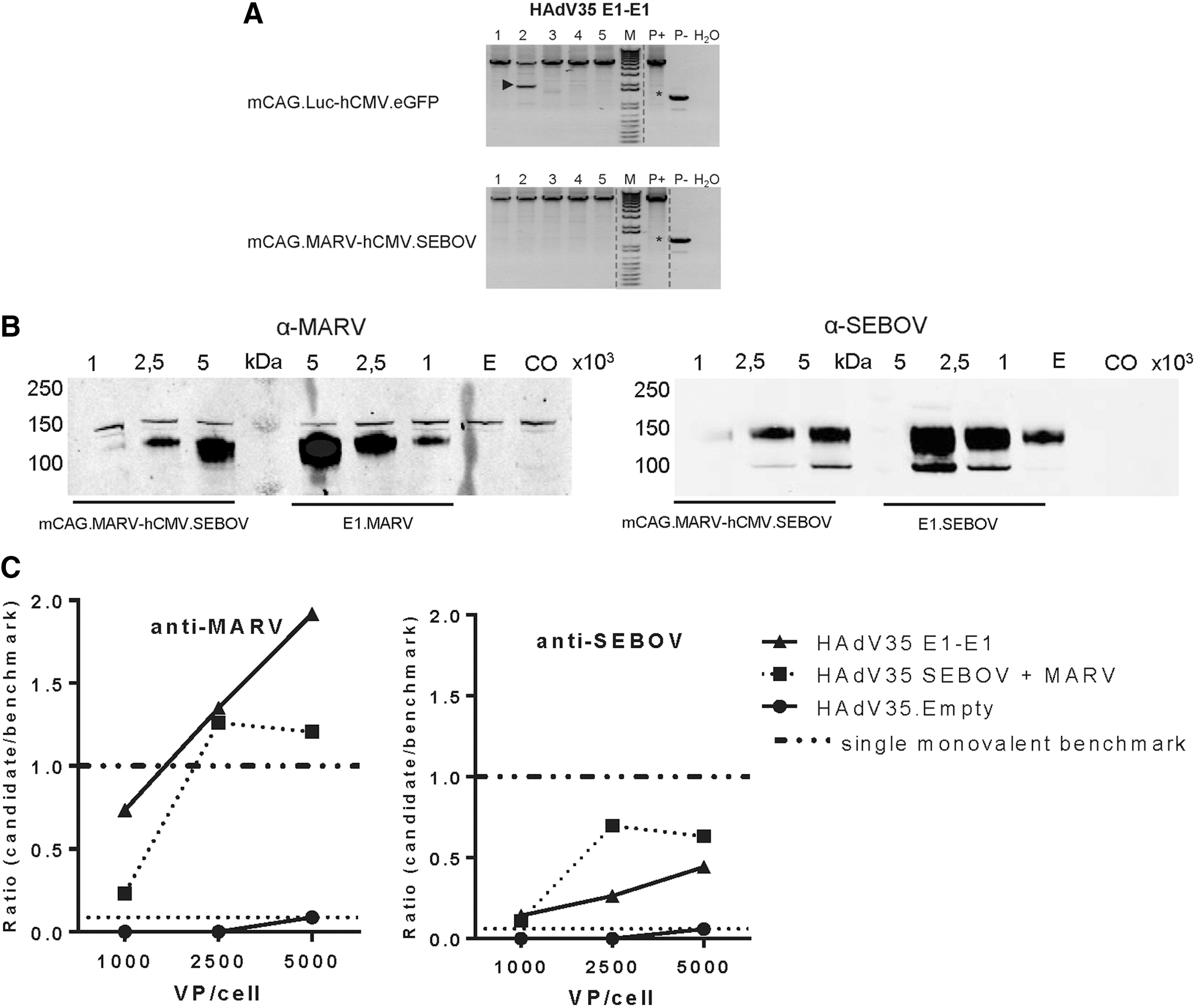
Genetic stability assessment and transgene expression of the bivalent E1-E1 vector; in vitro characterization of the bivalent HAdV35.E1-E1 vector.
HAdV35 vectors with an mCMV bidirectional promoter expression cassette in E1 show a good genetic stability profile and transgene expression in the range of the monovalent benchmark vectors
Vectors with a bidirectional mouse CMV promoter expression cassette (Fig. 1A) were tested as the third E1 insertion site-based bivalent strategy. Three vectors,

HAdV35 E1 bidirectional promoter-containing vectors; in vitro characterization of the bivalent HAdV35.E1 bidirectional promoter-containing vector.
Immune responses induced by the HAdV35 vector containing the bidirectional promoter cassette in E1 is comparable to the monovalent benchmark and performs better than other E1-based strategies
The E1-E3 bivalent strategy was deselected for immune response evaluation, based on a poor genetic stability profile. The E1 insertion site-based bivalent vectors showed similar genetic stability profiles, but differed in their transgene protein expression. Potent transgene expression is considered a prerequisite (although not predictive) for inducing potent immune responses. Because immunogenicity is considered a key outcome, all three bivalent vectors,
Compared with the monovalent mix, the

Filovirus-specific B- and T-cell responses in mice. Filovirus-specific B- and T-cell responses were measured in mice 8 weeks postimmunization after confirming correct vaccination by vector (hexon)-induced T-cell responses. The dots represent individual mice.
At week 2, all of the vectors induced functional helper CD4+ (IL-2, IFN-γ, and TNF-α) T cells. However, only the
HAdV26 vector containing an E1 mCMV bidirectional promoter cassette shows a good genetic stability profile and potent immunogenicity in mice
To assess whether the bidirectional approach for bivalent vectors can be applied in AdV vectors derived from different types, HAdV26 vectors encoding two transgenes in E1 driven by the bidirectional promoter were designed. The

Bivalent E1-bidirectional design in HAdV26 vector. An HAdV26 vector containing an E1-bidirectional cassette expressing filovirus transgenes MARV and SEBOV
To determine MARV- and SEBOV-specific immune responses, mice were immunized with
In addition to the
Discussion
Current AdV technology allows induction of protective immunity against more than one antigen if several monovalent vectors are mixed. To establish an alternative to the monovalent vector mixing approach we thoroughly characterized available bivalent vector designs, and established their rescue efficiency, producibility, genetic stability profile, 55 and immunogenicity compared with their monovalent counterparts.
We first focused on the E1-E3 bivalent vector design because this bivalent strategy is commonly used in the literature, and HAdV35 E1-E3 vectors were successfully generated in previous reports (Supplementary Table S1). The observed marked genetic instability of the E1-E3 vectors in this study, which was preceded by poor rescue efficiency of some of the vectors, was therefore surprising. In general, events of AdV genetic instability are most probably caused by homologous recombination as a consequence of sequence homology between the expression cassettes, transgenes, regulatory sequences, and the orientation in the AdV genome. 17,24,29,30,56 To generate a successful E1-E3 vector a systematic assessment of E3 function and the consequences of its deletions (e.g., effects on the fiber expression) might be necessary, 24,57 which limits its further development.
Unlike the E3 region, the E1 insertion region in the E1-E3 bivalent vectors remained genetically stable. We hypothesized that E1-based bivalent vectors would remain genetically stable and focused on generating designs that would allow placing two transgenes in the E1 region.
In these designs, the close proximity of homologous sequences in the E1-based bivalent vectors can pose a risk for deletion events during vector generation. 56 Nevertheless, all E1-based strategies showed a superior genetic stability profile after extended passaging and E1-PCR analysis compared with E1-E3 bivalent vectors and allowed selection of stable clones. In addition, batch viral genomes were further analyzed by E3/E4-PCR (data not shown) and multiple restriction enzyme digestions as shown for StuI enzyme in Supplementary Fig. S2. However, in the E1-2A vectors transgene expression levels and transgene-specific immunogenicity were poor. In light of successful reports using the 2A sequence for transgene separation in the literature, 37,39 the poor protein expression and immunogenicity observed in this study (Thosea asigna virus-2A gave similar results; data not shown) leaves room for improved design.
Analysis of the transgene expression levels and immunogenicity of the E1-E1 vectors, using mCAG and hCMV promoters, clearly showed higher levels of the gene inserted in the mCAG-driven 5′ expression cassette as opposed to the hCMV-driven transgene expression in the 3′ expression cassette. This observation was unexpected considering that the hCMV promoter drives robust transgene expression in monovalent benchmark vectors. Presumably the close proximity of the highly potent promoters influences their function, an effect previously termed promoter “interference.” 58,59 Possibly, the left ITR and the E1a enhancer might boost expression from the more proximal mCAG promoter. 60,61 Nevertheless, the E1-E1 strategy in which different regulatory sequences are used to prevent genetic instability can be regarded as a viable bivalent vector design for further development. If balanced expression is desired with this strategy, insertion of (small) insulator sequences between the cassettes may be worthy of further investigation. 62,63
In this study, the E1-bidirectional design HAdV35 vectors showed a favorable genetic stability profile, and potent antigen expression and immunogenicity, comparable to the tested mix of monovalent vectors. Therefore the E1-bidirectional design using a mCMV bidirectional promoter was chosen as the best tested design, and feasibility to transfer the design to another human AdV serotype was tested. Transfer of the E1-bidirectional design to HAd26 vectors was successful, yielding genetically stable vectors with potent transgene expression and immunogenicity. However, interestingly, transgene expression of the two filovirus GPs was shown to be more imbalanced than observed in the context of HAdV35 vectors.
This imbalance seems to be AdV type specific, suggesting some (unknown) effect of the AdV backbone on the 5′ reverse-oriented transgenes, such as the described adenovirus group and/or cell line-specific ITR influences on the proximal promoters. 64 –66 Rethinking the surrounding sequences, for instance by placing insulators, 62 using an alternative insertion site, 67 or changing the bidirectional promoter, may tailor the bidirectional vector design for other AdV serotypes. It should be noted that in all instances the humoral immune responses of the HAdV35 bivalent vectors closely followed the GP surface expression in A549 cells and may have been predictive for the HAdV26 bidirectional vector.
Although the E1-bidirectional strategy was shown to be better than other tested designs in this study, bivalent vectors in which one expression cassette each is placed at the left end of the AdV genome (E1) and at the right end of the AdV genome (between E4 and the right ITR) might offer a viable alternative and remain to be explored in HAdV35 and HAdV26 vectors (Supplementary Table S1).
Our data highlight the importance of meticulous screening and systematic assessment of various vector characteristics before their employment in further clinical development to ensure selection of the optimal (bivalent) vector design. As a result of this study E1-bidirectional vectors using an mCMV bidirectional promoter are proposed as alternatives to the mix of monovalent vectors for further development.
Footnotes
Acknowledgments
This project has been funded in whole or in part with federal funds from the National Institute of Allergy and Infectious Diseases, National Institutes of Health, Department of Health and Human Services, under Contract No. HHSN272200800056C.
Author Disclosure
The authors are employees of Janssen Vaccines and Prevention, Janssen Pharmaceutical Companies of Johnson & Johnson.
References
Supplementary Material
Please find the following supplemental material available below.
For Open Access articles published under a Creative Commons License, all supplemental material carries the same license as the article it is associated with.
For non-Open Access articles published, all supplemental material carries a non-exclusive license, and permission requests for re-use of supplemental material or any part of supplemental material shall be sent directly to the copyright owner as specified in the copyright notice associated with the article.
