




Abstract
Vectored delivery of the ZMapp antibody cocktail (c2G4, c4G7, and c13C6) by using recombinant adeno-associated viruses (rAAVs) could be useful for preventive immunization against Ebola virus infections because rAAVs can generate long-term antibody expression. Three rAAVs (serotype 9) encoding chimeric ZMapp antibodies were produced by triple-plasmid transfection up to 10 L-scale in WAVE bioreactors using HEK293 cells grown in suspension/serum-free conditions. Efficacy of AAV-c2G4 via intravenous (i.v.), intramuscular (i.m.), and intranasal (i.n.) routes of administration was evaluated in mice with two different doses of 2.7 × 10¹⁰ and 13.0 × 10¹⁰ vector genomes (vg). The best protective efficacies after Ebola challenge were obtained with the i.v. and i.m. routes. Serum concentrations of ZMapp antibodies positively correlated with survivability. Efficacy of the rAAV-ZMapp cocktail was then evaluated at a higher dose of 30.0 × 10¹⁰ vg. It conferred a more robust protection (90% i.v. and 60% i.m.) than rAAV-c4G7 (30%) and rAAV-c13C6 (70%), both administered separately at the same dose. Delivery of rAAV-c2G4 alone achieved up to 100% protection (100% i.v. and 90% i.m.) at the same dose. In conclusion, the preventive treatment was effective in mice. However, no advantage was observed for using the rAAV-ZMapp cocktail in comparison to the utilization of the single rAAV-c2G4.
Introduction
T
Recombinant adeno-associated virus (rAAV) is one of the promising vectors for gene therapy. It is currently being evaluated in clinical trials to deliver a gene encoding a therapeutic protein to treat rare genetic diseases, for examples Factor IX and RPE65 deficiencies. rAAV treatment for lipoprotein lipase deficiency (i.e., Alipogene tiparvovec, Glybera®) has been approved for commercialization in Europe. 9,10 rAAV is generally well tolerated, despite some immune responses reported against the capsid and the transgene. 11 –15 The utilization of rAAV for antibody therapy could therefore be useful to treat various chronic and infectious diseases. The main advantage for antibody therapy is that rAAVs can achieve high-level, long-term, and sustainable antibody expression, as shown by a number of studies in different animal models (reviewed in Robert et al. 16 ). rAAV-mediated expression of antibodies was successful with a variety of infectious agents such as EBOV, influenza virus, hepatitis virus C, HIV-1, prions, parasites, and so on. 16 However, one drawback of this approach is that rAAV needs several days to weeks to build-up a high level of expression, and thus the treatment should be administered in advance to confer maximal protection. 16 In contrast to a typical vaccine, severely immunocompromised patients, as well as healthy people such as first-line health workers and military personnel, can benefit from rAAV-mediated antibody therapy because stimulation of the immune system is not needed to produce a protective humoral response. Another advantage of rAAV is its long-term stability after lyophilization. It is stable for at least 5 months at 25°C under this form. 17 In Africa, transportation logistics can be complicated, and thus handling and transportation of rAAV would be facilitated by its lyophilization.
In Ebola survivors, the sequelae are numerous, including long-term neurological problems. 18 Viral RNA was detected several months after blood clearance in the semen and ocular and cerebrospinal fluids, thus providing evidence of viral replication reservoirs. 19 –23 rAAV serotype 9 (rAAV9) has a wide tropism that could be exploited to reach those reservoirs. Central nervous systems (CNS) cells can be transduced by intravenous (i.v.) injection because rAAV9 can cross the blood–brain-barrier and could thus allow mAbs produced to neutralize EBOV in the CNS. 24 –27 Alternatively, rAAV9 can efficiently transduce muscle fibers following intramuscular (i.m.) injection. 24,26,28 –30 This less invasive procedure, usually preferred to i.v. administration, 31 could thus be used to deliver antibody genes into a tissue that would subsequently turn it into a tissue factory for the production and secretion of neutralizing antibodies in the systemic circulation. Transduction of airways after intranasal (i.n.) administration also results in efficient antibody expression capable of preventing influenza virus infections and, more recently, EBOV infections. 32 –34
In previous mouse studies, only individual purified mAbs were tested for protective efficacy against the Ebola virus challenge. When administered as a bolus (100 μg/mice) into the peritoneal cavity 2 days post Ebola virus (also intraperitoneally [i.p.] administered) challenge, 2G4 and 4G7 achieved a maximal protection of up to 70% and 100%, respectively. 35 In a different study, 13C6 could protect up to 100% of the mice at the same dose. 36 Interestingly, protective levels were decreased if the ZMapp antibody was administered too early before challenge or too late post challenge within a window of 3 days.
The goal of the present study was to investigate in further detail the therapeutic potential of rAAV-mediated ZMapp antibody gene transfer in immunocompetent mice. Three rAAV9 vectors were designed, each containing a single gene coding for a mouse/human chimeric antibody belonging to the ZMapp cocktail. The rAAV manufacturing process included triple transfection and was scaled up to 10 L in shake flasks and WAVE bioreactors using HEK293 cells growing in suspension and without serum. The process was scaled up such that it would be amenable for current Good Manufacturing Practice applications. The i.m. and i.n. routes were re-examined, 34 and an additional route of administration, i.v., was evaluated to achieve body-wide rAAV-mediated antibody expression. The rAAV-expressing components of ZMapp were delivered either separately or in a cocktail to determine the efficacy of protection in a mouse model of Ebola virus infection. The minimal effective rAAV dose and ZMapp antibody concentration were determined for c2G4, c13C6, and the cocktail, but not for c4G7 because too few mice survived and because of the variability in serum concentration of antibodies. Altogether, the results confirm that rAAV-mediated ZMapp antibody gene transfer is very effective in preventing EVD in mice and provided additional information about this approach.
Materials and Methods
Vector design and cloning
rAAV was constructed based on the prAAV-MCS promoter-less backbone with inverted terminal repeats (ITR) from rAAV2 and the human growth hormone polyadenylation site (Cell Biolabs, San Diego, CA). The CAG promoter was chosen to drive the expression of the antibodies. pCBLacZ 37 was first digested by SalI and blunted, then digested by EcoRI to isolate a fragment containing the CMV enhancer, chicken β-actin promoter including exon 1 and intron 1, and splice acceptor from intron 2 of the rabbit β-globin gene. The fragment was then cloned in prAAV-MCS promoter less in the blunted-ClaI and EcoRI sites. Chimeric mouse/human antibody sequences (variable region sequences were provided by Dr. Larry Zeitlin from Mapp Biopharmaceutical, Inc., San Diego, CA), the foot-and-mouth disease virus self-cleaving peptide, and the optimized furin cleavage site 38 were synthesized and codon-optimized for human expression at Genscript, Inc. (Morrisville, NC). The antibody sequences were constructed by fusing the variable regions of murine heavy and light chains (HC and LC) (protein data bank: c2G4 5KEL_H [HC], 5KEL_L [LC]; c4G7 5KEN_N [HC], 5KEN_O [LC]; c13C6 5KEL_C [HC], 5KEL_D [LC]) 39 to their respective human constant regions of γ HC (CH1 domain) and κ LC (CL domain) of immunoglobulin G1 (IgG1). The codon for the lysine at the end of the HC constant region sequences was removed to prevent any interference at the protein level with the optimized furin cleavage site. 38 The entire sequences were cloned in the EcoRI and BamHI site of the vector construct to give rise to prAAV-c2G4, -c4G7, and -c13C6 constructs. For negative control, the c2G4 antibody gene sequence was cloned using the same enzymes, except the fragment was blunted and cloned in the reverse orientation in the same site to give the prAAV-c2G4_INV construct. Helper sequences for E1A, E1B, E4, and E2A proteins and VA RNAs were provided separately using pXX6-80 (Dr. Jude Samulski's Lab at UNC Gene Therapy Center, Chapel Hill, NC). For serotype, the capsid proteins were expressed using another plasmid (pRep2Cap9), containing Rep from serotype 2 and capsid from serotype 9 (NCBI AY530579.1). 40 pXX6-80 and pRep2Cap9 plasmid were used by the authors before. 41 The Rep2CapDJ plasmid was purchased at Cell Biolabs. The plasmid pVQAdCuROEBOZbGHpA contains the sequence of EBOV glycoprotein from the Zaire strain (UniProtKB/Swiss-Prot: P87666.1) in between KpnI and NotI sites. Expression was controlled by a CMV promoter/enhancer, and the gene contained a bovine growth hormone polyadenylation signal.
Cell culture and rAAV production
HEK293SF-3F6 cell line was maintained in serum-free SFM4Transfx-293 medium™ (HyClone, Logan, UT) supplemented with 6 mM of L-glutamine (HyClone), in vented-cap shake flasks (Corning, Corning, NY) at 37°C at 125 rpm agitation and under an atmosphere of 5% CO2. 42,43 For rAAV productions in disposable WAVE bioreactors (GE Healthcare, Mississauga, Canada), the cells were seeded at 2.5 × 10⁵ cells/mL 3 days before transfection. For the productions in shake flasks, the cells were diluted the day before transfection at 5 × 10⁵ cells/mL. Production of rAAV-c2G4_INV and -c13C6 in 1.3 L and 2 L format was performed in 2 L shake flasks with a cell culture volume of 660 mL each. Plasmids used for transfection were amplified in one shot TOP10™ (Invitrogen, Burlington, Canada) and purified using endotoxin-free kits (Qiagen, Toronto, Canada). The transfection was performed at ∼1 million cells/mL, as indicated in Table 1, by using 1 μg of total DNA and 2 μg of PEIpro® (Polyplus-transfection) per mL of culture mixed in 10% of the total cell culture volume. Equal amount of each of the three plasmids were used for the transfection (ratio 1:1:1 for pRep2Cap9:pHelper:prAAV-c2G4/c4G7/c13C6). rAAV was harvested 3 days post transfection. rAAV-producing cells were centrifuged at 300 g then re-suspended in 1/10 of the starting volume with lysis buffer (2 mM of MgCl2, 0.1% Triton X-100 in 25 mM of Tris-buffered solution, pH 7.5). In the 10 L rAAV-c2G4 production, the cells were lysed directly in the WAVE bioreactor by an addition of 1 L of 10 × lysis buffer. Benzonase (EMD Millipore, Etobicoke, Canada) was added to digest DNA and RNA at 5 IU/mL of starting cell culture volume, and incubated for 1.5 h at 37°C under agitation. Concentrated MgSO4 was added to obtain 37.5 mM to reduce rAAV aggregation or to 75 mM to prevent further aggregation. Cellular debris were pelleted at 2,600 g for 30 min at room temperature, and the supernatant containing soluble rAAV was recovered. 41,42,44 The rAAV lysate was then concentrated/diafiltered by tangential flow filtration to a volume corresponding to 10–12 mL of lysate/L of starting cell culture volume. Hollow fiber units (70–100 kDa MWCO; Spectrum Laboratories, Rancho Dominguez, CA) were used for tangential flow filtration (TFF). Before purification on an iodixanol-step purification, 41 the lysate was dead-end filtered using 0.8/0.45 μm filters, and 10 mL was loaded per Optiseal ultracentrifuge tube (Beckman and Coulter, Brea, CA). To reduce aggregation, a final concentration of 1.5 M of NaCl was added to the 3 L production of rAAV-c4G7 (Table 1) and in each layer of this iodixanol-step gradient (Optiprep™; Sigma–Aldrich, Oakville, Canada). 45,46 rAAV in the 40% iodixanol layer was recovered in 5 mL per tube and pooled together. The iodixanol was removed by TFF and was replaced by 99.9% of the storage/injection buffer (phosphate-buffered saline [PBS] 2 mM of MgCl2, 5% sucrose). The sample was further concentrated to the desired concentration by TFF. The number of rAAV vector genome (vg) copies was determined by real-time quantitative polymerase chain reaction (qRT-PCR), as described before, except a Mastercycler® ep realplex (Eppendorf, Mississauga, Canada) instrument was used. 41 The primers and the probe were located in the CMV enhancer of the CAG promoter, having the following sequences: 5′-ACGTCAATGGGTGGAGTATTT-3′, 5′-AAGGTCATGTACTGGGCATAAT-3′, and 5′-TGCCCACTTGGCAGTACATCAAGT-3′, respectively.
Summary of rAAV productions (purified product) in WAVE bioreactors and shake flasks
Quantification of vector genome copies was performed by real-time quantitative polymerase chain reaction (qPCR).
Yields were 2.6-fold higher in the WAVE bioreactor in comparison to the shake flasks.
Values on the day of transfection.
Quantification was performed on the final product.
CV is calculated as the standard deviation of independent titrations of the same production (N = number of independent titrations) divided by the average total production (vg) × 100.
rAAV, recombinant adeno-associated virus; vg, vector genomes; CV, coefficient of variation.
Analysis of rAAV productions by SDS-PAGE and Western blot
The capsid proteins (serotypes 9 and DJ 41,47 ) of the two 200 mL scale rAAV productions were separated by SDS-PAGE using a NuPAGE 4–12% polyacrylamide gradient gel (Thermo Fisher Scientific, Carlsbad, CA) with approximately 2.0 × 10¹⁰ vg/well then analyzed by Western blot using a specific monoclonal antibody (Clone B1) against the C-Terminal amino acids of VP1/2/3 (American Research Products, Waltham, MA) and a goat α-mouse IgG conjugated to HRP (GE Healthcare). The signal was captured and digitalized by using ImageQuant™ LAS 4000 mini biomolecular imager (GE Healthcare).
Production and characterization of the c2G4 ZMapp antibody produced in CHO cells after rAAV transduction
Twenty milliliters of Chinese Hamster Ovary (CHO) cell culture at a cell density of 1 × 10⁶ cells/mL was transduced using a multiplicity of infection (MOI) of 9,200 vg/cell of rAAV-c2G4 serotype DJ (produced as described above at 200 mL scale). One day after transduction, the cells (maintained in PowerCHO medium; Lonza) were grown for 7 days at 32°C instead of 37°C, as done previously, under an atmosphere of 5% CO2 with 0.5 μM etoposide (Sigma–Aldrich), a topoisomerase inhibitor that can facilitate synthesis of the complementary strand for rAAV. 48 For c2G4 purification, a protein A MabSelect SuRe column (GE Healthcare) was used according to the manufacturer's instructions. The protein concentration was determined using a Nanodrop (optical density 280 nm) instrument. To separate the HC and LC of c2G4, SDS-PAGE was performed using a Bis-Tris NuPAGE 4–12% polyacrylamide gradient gel and a BLUelf Prestained Protein Ladder (Froggabio, Toronto, Canada). The gel was stained with a 0.5% Coomassie Blue G-250, 50% methanol/10% acetic acid staining solution, and then the bands corresponding to each chain were excised and sent to the Proteomic platform of CHU of Quebec Research Center (Quebec, Canada) for liquid chromatography/tandem mass spectrometry (LC-MS/MS). The peptide sequences were blasted against the human and mouse genomes, and against the foot-and-mouth disease virus genome. The function of the purified c2G4 antibody was assessed below by confocal imagery.
Production of ZMapp antibodies in HEK293SF-3F6 cells after rAAV transduction
rAAV-c2G4/c4G7/c13C6 cells were produced using the DJ serotype in HEK293SF-3F6 in six-well plates using the standard transfection conditions described above. Three days later, the cells were pelleted and re-suspended in 100 μL of cell medium and freeze/thawed three times. A fraction (15 μL) was then used to transduce 5 × 10⁵ HEK293SF-3F6 cells in 350 μL in a 24-well plate under agitation (125 rpm). The cells were co-transduced at a MOI of 2 with a first-generation adenovirus expressing luciferase titered by a standard plaque assay. 49 After 48 h, the cells were pelleted by centrifugation at 500 g for 1 min, and the supernatant containing the ZMapp antibodies was recovered. The function of ZMapp antibodies was then assessed by flow cytometry analysis.
Confocal imagery and flow cytometry for assessing the function of ZMapp antibodies
The protocol used for cell staining was identical for confocal imagery and flow cytometry. HEK293SF-3F6 cells were seeded at 1 × 10⁶ cells/mL in a six-well plate in 2 mL of medium. They were then transfected with a plasmid expressing the Zaire Ebola glycoprotein (EboGP, pVQAdCuROEBOZbGHpA). Three days after transfection, one third of the cells were centrifuged at 400 g. The cells were re-suspended in PBS 3% bovine serum albumin (BSA) on ice for blocking. Either 2 μg of purified c2G4 produced in CHO cells or 70 μL of unpurified ZMapp antibody supernatants (one fifth of 350 μL) produced in HEK293SF-3F6 cells was incubated with the cells on ice for 1.5 h. A donkey anti-human secondary antibody conjugated with Alexa Fluor® 488 nm AffiniPure F(ab′)2 Fcγ specific (Jackson Laboratories, West Grove, PA) was then incubated 1 h on ice. The cells were then fixed with 2% ρ-formaldehyde. Confocal images were taken, as done previously, with purified c2G4. 50 Labelled cells with unpurified 2G4/c4G7/c13C6 ZMapp antibodies were analyzed using a BD LSRII flow cytometer (BD Biosciences, Mississauga, Canada).
rAAV treatment and EBOV trial
All mouse experiments were performed using rAAV9. Juvenile BALB/c mice, 4–6 weeks of age, were treated using three different routes—i.v., i.m., and i.n.—as described before. 32,34 Fifty microliters of rAAV was administered at different doses (2.7 × 10¹⁰, 7.5 × 10¹⁰, 13.0 × 10¹⁰, and 30.0 × 10¹⁰ vg). The cocktail consists of a mixture of three rAAVs, each representing 33% of the total amount of AAV cocktail. After 21 days, a dose equal to 1,000-fold the lethal dose 50 (1,000 LD50) of mouse-adapted EBOV (Zaire strain, Mayinga) was injected i.p. The weight of each mouse was measured daily. Determination of individual clinical scores was based on the severity of EBOV signs of infection. The ranks allowed for one observation were: 0 = no signs; 1 = ruffled fur, slower activity, and loss of body condition; 2 = labored breathing or hunched posture; 3 = ≥25% weight loss or no movement/unresponsive/paralysis; 4 = found dead. A score of 3 resulted in immediate euthanasia. Cumulative clinical scores were calculated daily by the addition of individual scores within each group. The mouse experiments were approved by the Animal Care Committee at the Canadian Science Center for Human and Animal Health in accordance with the guidelines outlined by the Canadian Council on Animal Care. Experiments were conducted according to regulatory standards at National Microbiology Laboratory in BSL-4.
Enzyme-linked immunosorbent assays for detection of ZMapp and anti-ZMapp antibodies
For sandwich enzyme-linked immunosorbent assay (ELISA) detection of ZMapp antibodies, a dilution of 2 μg/mL in PBS of a whole goat anti-human IgG (H + L; Jackson Laboratories) was used to coat COSTAR flat-bottom high-binding 96-well plates (Corning). The purified standard (c2G4 antibody) was produced by a CHO stable clone generated at the National Research Council, Canada. The standard or serum samples were then deposited on the plates and incubated 2 h. The serum samples were diluted 1:100 in PBS 1% BSA. A secondary goat anti-human IgG (H + L) antibody conjugated to alkaline phosphatase (Jackson Laboratories) was used in combination with ρ-nitrophenylphosphate (Sigma–Aldrich), with the reading performed at 405 nm using a SpectraMax 340PC384 reader (Molecular Devices, Sunnyvale, CA). For detection of anti-ZMapp antibodies, the plates were coated with 2 μg/mL of c2G4. Serum samples dilutions of 1:100 were deposited on the plates, and a secondary goat anti-mouse IgG (Fc fragment) conjugated to alkaline phosphatase (Sigma–Aldrich) was used for detection.
Statistics
For statistical analyzes, one- or two-tailed Student's t-tests were used when appropriate for comparisons to verify the significance of the differences between each group. Means are presented with the standard error of the mean (SEM) as error bars or ± values. Log-rank (Mantel–Cox) tests were performed to assess the significance of survival differences between rAAV-treated groups.
Results
AAV design and characterization of ZMapp antibodies
Design of rAAV for the expression of ZMapp antibodies (rAAV-c2G4, -c4G7, and -c13C6) combines the expression of both the HC and LC under the same expression cassette controlled by the strong ubiquitous promoter CAG (Fig. 1A). The sequence coding for the foot-and-mouth disease self-cleaving 2A peptide (F2A) was placed in between the HC and LC genes, allowing ribosome skipping and the translation of both antibody subunits from a single transcript. To obtain a blunt cleavage between HC and LC, which was associated with higher antibody stability in vivo, an optimized furin-specific cleavage site was inserted just before the F2A sequence in the rAAV genome (Fig. 1A). 38,51 A previously established triple plasmid transfection method was used to produce rAAVs. HEK293SF-3F6 cells were transfected in suspension in serum-free conditions. Three days later, the rAAVs produced were recovered by chemical cell lysis and purified by a iodixanol-step gradient. 41,44,52 Two different rAAV preparations (serotypes 9 and DJ) were analyzed by Western blot to verify the presence of the capsid proteins. Three bands of a proper molecular weight were observed, thus confirming the presence of VP1, VP2, and VP3 capsid proteins at 87, 72, and 62 kDa, respectively (Fig. 1B). The 62 kDa band was most intense because it is more abundant in the virion (VP1:VP2:VP3 = 5:5:50).

Characterization of adeno-associated virus serotype 9 (AAV9) and ZMapp neutralizing antibodies expressed by AAV.
To produce high antibody titers for characterization, CHO cells were transduced with a rAAV-DJ encoding the c2G4 antibody sequence. CHO cells are frequently used in the industry because they can produce high quantities of active antibodies during several days in culture. The serotype DJ was chosen because of its better transduction efficacy than serotype 9 for CHO cells. 47 Secreted c2G4 antibodies from the supernatant of CHO cells were purified by a protein A column and then analyzed by SDS-PAGE under reducing conditions. After Coomassie blue staining, two bands corresponding to HC and LC were observed at the predicted molecular weights of 52 and 26 kDa, respectively (Fig. 1C). In addition, the amino acid sequences of the HC and LC were confirmed by LC-MS/MS. The presence of F2A-derived amino acids was not detected, suggesting a proper self-cleavage of LC and HC.
The function of all three ZMapp antibodies was assessed by fluorescence microscopy and flow cytometry. HEK293 cells expressing EBOV glycoprotein (EBOgp) after transient transfection of the gene were incubated with c2G4, c4G7, and c13C6 antibodies from the supernatant of AAV-transduced HEK293SF-3F6 cells. A secondary antibody recognizing the human Fc of the chimeric antibodies and conjugated to Alexa Fluor 488 nm was used to stain the cells. Positive staining was characterized by a fluorescent ring at the cell surface because the EBOgp is a transmembrane protein, as shown for the c2G4 antibody (Fig. 1D). By flow cytometry, positive staining was observed in approximately 50% of EBOgp-transfected cells but not in untransfected cells, indicating that the ZMapp antibodies produced by rAAV were specific and functional. rAAV-c2G4_INV was used as a negative control because it is unable to express c2G4 (Fig. 1E).
Scale-up of rAAV production and purification for mouse experiments
To obtain enough quantity of rAAV for in vivo experiments, the triple transfection method was scaled up to 10 L in shake flasks and WAVE bioreactors. Quantitative real-time PCR, a standard method for rAAV titration, was performed on end-purified material to determine the final rAAV titer. For this, a primer/probe set binding in the CMV enhancer of the CAG promoter was used, giving a % CV <24% (Table 1). Up to 1.3 × 10¹⁴ vg of purified rAAV material was obtained from 10 L of cell culture (Table 1). Overall, an average of 4.7 × 10¹² vg was obtained from 1 L of cell culture, with rAAV cell-specific production ranging from 6.36 × 10² to 1.34 × 10⁴ vg/cell.
c2G4 gene transfer protects against Ebola infections in vivo
The objectives of the following experiment were first to evaluate the efficacy of the i.v. route in addition to the i.m. and i.n. routes examined in vivo elsewhere
34
for the vector delivery of ZMapp antibodies, and to determine a therapeutic dose. For simplicity, only the rAAV encoding c2G4 was administered because it has been previously demonstrated that the murine version (2G4) was able (after its direct injection) to confer protection against an EBOV challenge in mice.
51
Thus, rAAV-c2G4 was administered at doses of 2.7 × 10¹⁰ and 13.0 × 10¹⁰ vg via the i.v. route, and the i.m. and i.n. routes were also re-examined following the protocol depicted in Fig. 2A. The maximal dose (13.0 × 10¹⁰ vg) was selected because a dose in the range of 10.0 × 10¹⁰ vg was safely and successfully tested in mice in previous publications using the i.n., i.v., and i.m. routes of injection.
33,34,53
–55
The lower dose (2.7 × 10¹⁰ vg) used is also comparable to the one used (3.0 × 10¹⁰ vg) in a previous study.
28
A period of 20 days was allowed for expression of antibody c2G4, and its serum concentration was measured. Expression of antibodies at 20 days post rAAV administration was significantly higher than the expression at 10 days. This was also the case with c4G7 and c13C6 ZMapp antibodies (Supplementary Fig. S1 and statistics in Supplementary Table S1; Supplementary Data are available online at

Gene transfer of the c2G4 antibody mediated by AAV protects against Ebola infections in a mouse model.
Signs of EVD were significantly attenuated in comparison to negative control (2G4_INV) after the treatment for the following groups: i.v.Hi, i.m.Hi, and i.v.Lo. The i.v. administration of rAAV-c2G4 at a high dose fully prevented weight loss, while in other groups the weight loss was significantly reduced (day 6, Fig. 2C). Group cumulative clinical scores consisting in the sum of individual scores within each group were improved in comparison to the negative control between 3 and 9 days post challenge, the period in which the mouse's physical condition deteriorated (p < 0.05; Fig. 2D). A log-rank test on Kaplan–Meier plotted values supported an increased survivability for the i.v.Hi group (p < 0.05; Fig. 2E and statistics in Supplementary Table S2). For the first time, it was shown that a treatment with a single rAAV (rAAV-c2G4) could effectively suppress signs of EVD in mice.
Vectored ZMapp antibody delivery with a rAAV-ZMapp cocktail in vivo
The rAAV-ZMapp cocktail containing three rAAVs expressing the ZMapp antibodies (c2G4, c4G7, and c13C6) was evaluated in mice to determine its protective efficacy. rAAVs from the cocktail were also administered separately to determine the protective efficacy they provide individually and for comparison with the cocktail (Fig. 3A). As mentioned before, the cocktail consists of a mixture of three rAAVs, each representing 33% of total amount of AAV cocktail. For this experiment, only the i.m. and i.v. routes were employed because the i.n. route failed to protect the mice. The dose administered was also increased to 30.0 × 10¹⁰ vg to obtain a higher protective efficacy. Furthermore, the same maximal dose was used in a previous study with rAAV-ZMapp cocktail. 34 A lower dose (7.5 × 10¹⁰ vg) in comparison to 13.0 1010 vg (Fig. 2) was also administrated to study the treatment response following the dose used. Robust protective efficacies of 90% and 60% were obtained with the cocktail after i.v. and i.m. administration, respectively, at the highest dose administered (Fig. 3B). Reducing the dose resulted in less protection, thus indicating that the dose is an important factor for protective efficacy (Fig. 3B). After i.v. administration, the cocktail at the highest dose was more effective than single rAAV-c4G7 (70%) and rAAV-c13C6 (30%), but not rAAV-c2G4. Administration of rAAV-c2G4 by the i.v. and i.m. routes achieved complete protection (100% efficacy) and 90% protective efficacy, respectively (Fig. 3B).
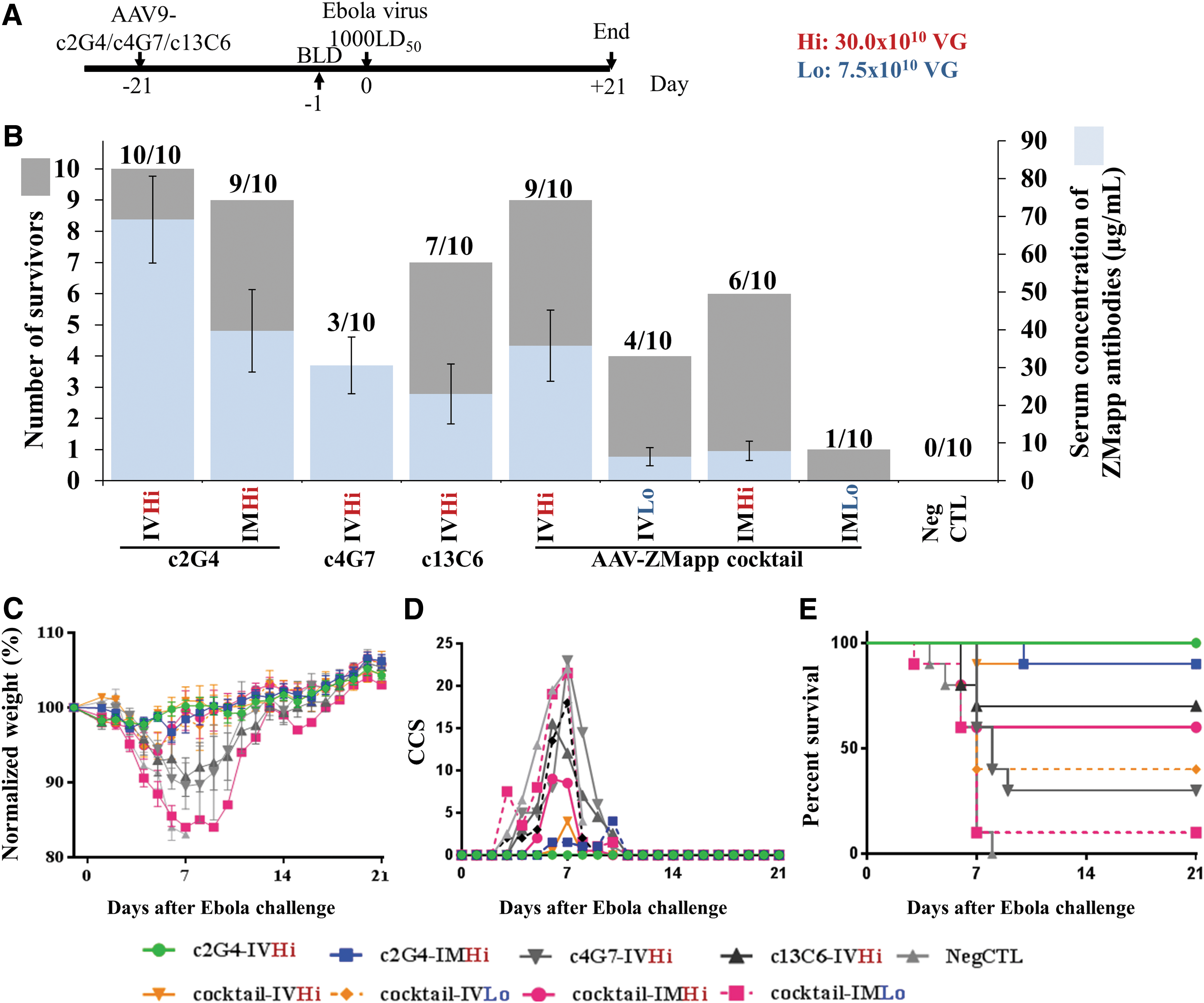
ZMapp antibody gene transfer mediated by AAV protects against Ebola infections in a mouse model.
Protective efficacies obtained after rAAV treatments correlated positively (Spearman's correlation, r = 0.88, p < 0.01) with the serum concentrations of ZMapp antibodies in samples collected 1 day before the EBOV challenge. The minimal effective concentration for each ZMapp antibody was thus determined based on a protective efficacy of 90%. Minimum effective concentrations were estimated to 6 μg/mL for the rAAV-ZMapp cocktail, 1.8 μg/mL for the c2G4 antibody, and 33.3 μg/mL for the c13C6 antibody. The minimal concentration could not be determined for c4G7 because the number of survivors was too low (n = 3) and because the variability in the data set was too high. Effective rAAV doses determined above and concentration of ZMapp antibodies could be used to establish initial conditions for testing in larger animal models.
The rAAV treatment was again well tolerated, despite the 2.2-fold higher dose administered. In challenged mice, weight loss was fully prevented, irrespective of the dose and route of administration, by using rAAV-ZMapp cocktail and rAAV-c2G4, except for the low dose i.m. with the cocktail (an average weight loss of 15% was observed at day 6; Fig. 3C). In addition, the treatments with rAAV-c4G7 and rAAV-c13C6 partially prevented weight loss in comparison to the negative control (Fig. 3C). The clinical score was steadily maintained at zero for the mice treated i.v. at the highest dose with rAAV-c2G4, indicating that the treatment completely prevented the appearance of EVD clinical signs (Fig. 3D). The clinical scores between 3 and 8 days post challenge, a period accounting for the highest scores, was significantly lower than the negative control group in all groups except for c4G7 and cocktail injected i.m. at 2.7 × 10¹⁰ vg. Survivability was also increased in all treated mice, except for the cocktail at low i.m. dose (Fig. 3E). In summary, the results show that the rAAV treatments suppress signs of EVD. Statistics for Fig. 3B and E can be found in Supplementary Tables S1 and S2.
Induction of an antibody-specific humoral response
As observed above, i.n. administration of rAAV-c2G4 conferred no protection because the quantity of c2G4 antibody in the mouse's system was insufficient (Fig. 2B). One possible explanation for this is provided by the analysis of the immune response generated against the chimeric antibody. Chimeric antibodies were used for these experiments because (1) they can easily be monitored by ELISA in serum, and (2) they are more likely to be used as an active drug in humans in comparison to more immunogenic murine antibodies. Despite these advantages, neoepitopes harbored by non-native therapeutic proteins have been held responsible for triggering a deleterious immune responses that can reduce the efficacy of treatment. 15,34,56 –59 To investigate this, the presence of a humoral response against the chimeric antibodies was monitored in mouse sera 1 day before the challenge (i.e., 20 days after rAAV administration; Fig. 4A). Interestingly, at a dose of 13.0 × 10¹⁰ vg, the humoral response was stronger in the i.n. group in comparison to the i.v. and i.m. groups (p < 0.001), but the difference was no more significant at a lower dose (2.7 × 10¹⁰ vg). The presence of anti-c2G4 antibodies in the i.n. group demonstrated that c2G4 was expressed at some point in these animals. This was also confirmed by ELISA 10 days after rAAV administration, although the c2G4 antibody was detected at a low concentration (∼200 ng/mL; Supplementary Fig. S1).
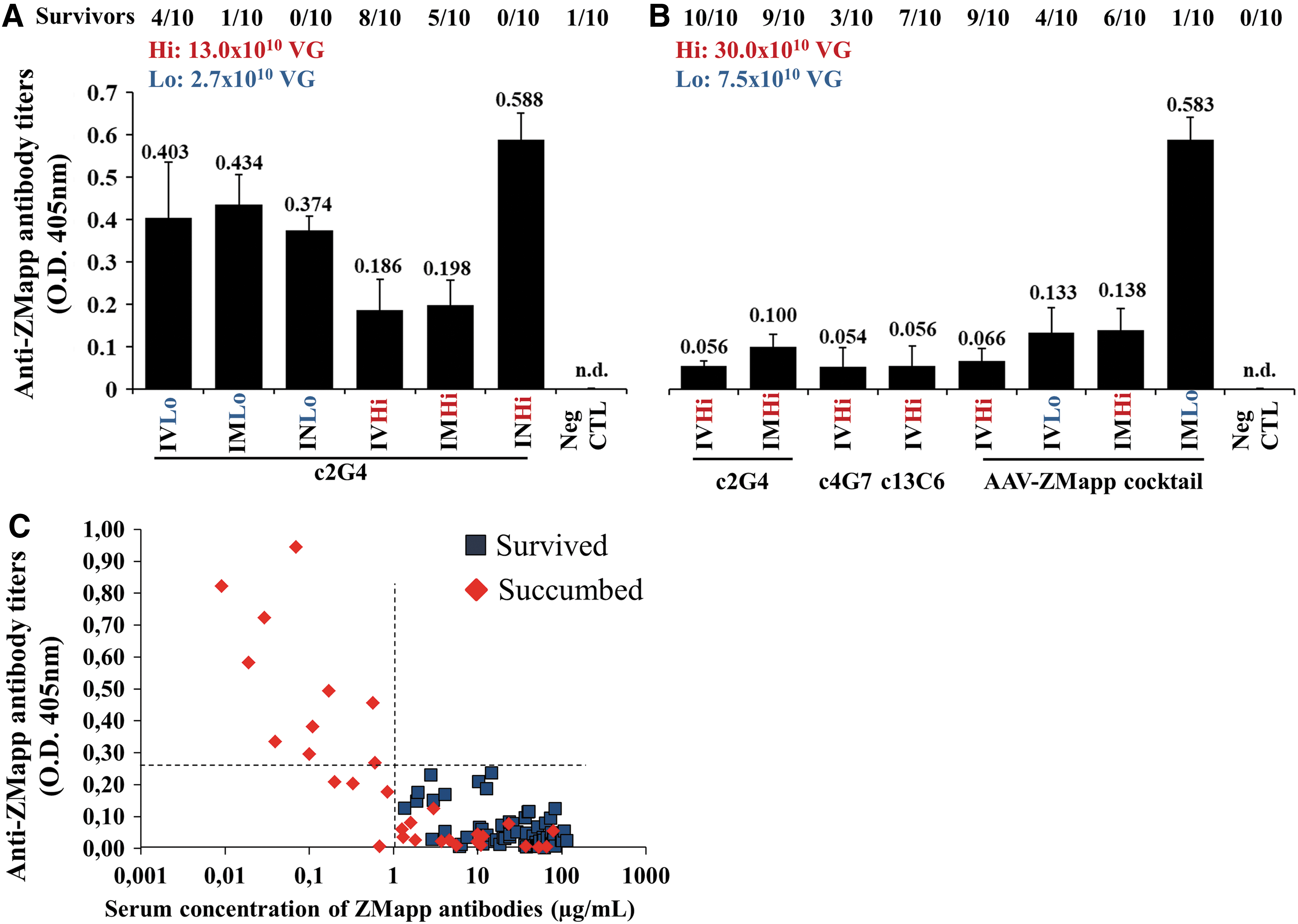
Induction of a humoral response reduces the efficacy of AAV-ZMapp treatment.
The humoral response was then evaluated in mice injected with the rAAV-ZMapp cocktail and single rAAVs, although it was not significantly different between the groups, except for the negative control 2G4_INV (i.e., not detected) and the mice treated i.m. with the low dose of rAAV-ZMapp cocktail (Fig. 4B). Statistics for Fig. 4 can be found in Supplementary Table S3.
ZMapp antibodies and anti-ZMapp antibody concentrations from both in vivo experiments (Figs. 2 and 3) excluding those from the i.n. and 2G4_INV groups were then plotted to determine whether there was a correlation (Fig. 4C). A very strong negative correlation (Spearman's ρ = −0.75, p < 0.00001, n = 120) was found between the concentration of ZMapp antibodies and anti-ZMapp antibodies, indicating an inverse proportional relationship. For example, a low concentration of anti-ZMapp antibodies generally corresponds to a high concentration of ZMapp antibodies and thus to better survival, as shown above (Figs. 2B and 3B). Furthermore, the higher the expression of ZMapp antibodies was, the higher was the rate of survival. All of the survivors had >1 μg/mL of ZMapp antibodies circulating in their serum. An anti-ZMapp antibody titer <0.24 O.D. was another characteristic of survivors. Together, the data agree with previous studies demonstrating that neoepitopes harbored by non-native therapeutic proteins may trigger a deleterious immune response that can reduce the therapeutic efficacy. 15,34,56 –59
In the experimental set-up, all groups contained the same number of males and females. Thus, any gender effect was mitigated by averaging the data for comparison. Interestingly, it was found that, irrespective of the groups analyzed, the concentration of antibodies was always higher in males (fivefold, p = 0.0019, except in i.n. groups where no expression was detected) and anti-antibody titers were always higher in females (twofold, p = 0.00061). Therefore, it is possible that females have developed a stronger humoral response that could have prevented the treatment of been effective by suppressing the expression of therapeutic antibodies.
Discussion
In the current study, rAAVs were produced in shake flasks and WAVE bioreactors up to 10 L scale and administered to mice to prevent EBOV infection. A summary of the outcomes of the two in vivo experiments is presented in Table 2. The difference in protective efficacy was modest between i.v. and i.m. administration, that is, only 10% at the dose of 3 × 10¹¹ vg for the single rAAV-c2G4 (100% vs. 90%) and 30% with the rAAV-ZMapp cocktail at the same dose (90% vs. 60%), respectively. Because protective efficacies were comparable in the best conditions, the i.m. route should be considered. Administration i.m. is simpler because it can be performed relatively quickly by a doctor/nurse, thus avoiding the installation of a catheter and potential risks of bacterial contamination of the line. In comparison to single rAAVs administrated separately, the protective efficacy of rAAV-ZMapp cocktail was superior to rAAV-c4G7 and rAAV-c13C6, but it was less effective than the rAAV-c2G4. In previous mice experiments using purified antibodies, the efficacy of the ZMapp cocktail was not compared to the treatment using single purified antibody. 35,36,60 When tested, the purified 2G4 and 4G7 were injected as a bolus (100 μg/mice) in the peritoneal cavity, and they were shown to protect mice when injected at 2 days post challenge with the EBOV virus. In contrast to the current study, the 4G7 was more efficient than the 2G4 antibody at protecting mice. Importantly, the purified antibodies were more efficient when mice were treated at 1–2 days post challenge in comparison to treatment before challenge. This suggests the antibody was absorbed relatively rapidly by the mouse tissues. It is therefore difficult to compare the data with previous mice data obtained using purified antibody because, in present the case, (1) the AAV was delivered using different routes of injection (i.m., i.v., and i.n.), (2) the EBOLA virus challenges was done 3 weeks later, and (3) antibodies were continuously expressed.
Outcomes of the ZMapp immunoprotection mediated by rAAVs
SEM, standard error of the mean; i.v., intravenous; i.m., intramuscular; i.n., intranasal.
One point to consider in the comparison of single rAAV and the rAAV-ZMapp cocktail is that the conditions of the rAAV-ZMapp cocktail were not optimized in this study. For example, the fact that the c2G4 antibody was produced more efficiently compared to c4G7 and c13C6 suggests that after injection of the cocktail, which consists of an equal mixture of the three AAVs, the c2G4 antibody was produced at higher level and/or was more stable. Its RNA might be also more stable, processed, or translated more efficiently. The efficacy of the cocktail could be improved by optimizing the ratio of the three AAVs to have equimolar expression of the three antibodies (as in the case of the ZMapp antibody cocktail). Due to its high efficacy, a preventive immunization strategy using the single rAAV-c2G4 should be considered. Optimizing this strategy could be done by the design of a single-chain antibody 61 and testing in self-complementary rAAVs, as they allow higher and quicker kinetic of expression. 62 –66 However, it can be argued that a single agent (rAAV-c2G4) would be sufficient, but it is unclear if that would carry through to other isolates of the virus.
Another potential limiting factor for the cocktail is the transduction of one cell by multiple rAAVs that could produce non-functional antibodies formed by the assembly of HC and LC from different antibodies. 16 The results show that this phenomenon did not abolish antibody expression in vivo. However, it would be possible that the effective concentration of neutralizing antibodies is reduced with the rAAV-ZMapp cocktail, which could explain the lower protective efficacy observed. To reduce potential consequences of antibody mis-assembly, design and delivery of a rAAV-ZMapp cocktail could be optimized by (1) the administration of rAAVs in different sites/routes and/or according to a timely sequence, (2) utilization of different serotypes with exclusive biodistribution, and (3) utilization of single-chain antibodies requiring no assembly. 16,67
In contrast to a previous study, 34 the present study has demonstrated a high protective efficacy in immunocompetent mice by i.m. administration of a rAAV-ZMapp cocktail. Some differences between the two studies could explain this. A different promoter was used to drive the expression of the antibody genes. The CAG promoter, which contains additional regulatory sequences, was used instead of the CB7 promoter. Accordingly, these promoters were shown to have different strengths in the same tissues, 68,69 and thus it is possible that the CAG promoter was stronger, therefore resulting in increased expression of ZMapp antibodies. In the current study, EBOV challenge was also performed 21 days post immunization, 7 days later than the previous study, which could allow for increased expression of the chimeric antibodies. It is also possible that higher doses were administered in the present study due to the variability of real-time qPCR titration. 70 In this study, the i.m. administration of rAAV-c2G4 at a dose of 2.7 × 10¹⁰ vg produced 250 ng/mL of c2G4 in the serum, while in the previous study, no 2G4 was detected at a dose of 3.0 × 10¹⁰ vg. Unfortunately, the results at higher doses cannot be compared because antibody concentrations were not determined after i.m. administration in the previous study.
Twenty days after the administration of ZMapp rAAVs, the humoral response produced by the chimeric antibodies was evaluated. Mice treated i.n. had a higher anti-c2G4 antibody titer than that produced by the other routes of administration, which could explain why the i.n. route failed to provide any protection. These results contrasted with a previous study where 100% protection was achieved with an i.n. route of immunization. 34 In the cocktail tested previously, the two antibodies expressed were non-immunogenic murine antibodies (2G4 and 4G7), and thus this could explain the protective effect observed. In addition, the rAAV-ZMapp cocktail was evaluated at a higher dose (3 × 10¹¹ vg), whereas in the current study, only one rAAV (rAAV-c2G4) was administered i.n. and at a lower dose of 13.0 1010 vg. Another difference was the administration of EBOV through the same i.n. route as rAAV and not i.p., as performed in the current study. This could facilitate the inactivation of EBOV. High concentrations of ZMapp antibodies in the airways would neutralize EBOV more effectively at the very early steps of the infection cycle. Together, the reasons provided could explain the present results.
The study suggests the existence of a gender-specific humoral response triggered by non-species related antibodies after rAAV9 delivery. A gender difference in the transduction tropism of AAV9 has been reported previously, but transgene immunity was not evaluated. 71 Therefore, a link between gender specificity of the tropism of rAAV9 and the humoral response must still be established. The results must also be validated in other models.
Bioprocess scale-up is critical to obtain the yields required for large animal studies, clinical trials, and commercialization. In this study, the production was scaled up to 10 L cell culture in WAVE bioreactors. An average production of 4.7 × 10¹² vg of purified material was obtained from 1 L of cell culture harvest. The highest dose of 30.0 × 10¹⁰ vg used in mice (M weight = 22 g, day −1) is equivalent to 1.36 × 10¹³ vg/kg body weight. If the same dose was used in humans, 2.90 L of cell culture/kg body weight would be required to treat one patient. Although this seems a large quantity, production of rAAVs using HEK293SF-3F6 in suspension and serum-free conditions can be scaled relatively easily to larger bioreactors (stirred-tank bioreactors and WAVE bioreactors). Although WAVE bioreactors are commercially available up to 500 L scale, rAAV manufacturing above this scale would require the use of a stirred-tank bioreactor. A number of teams, including the authors', have shown that rAAV yields can be improved by controlling different factors such as the cell density, the cell medium, plasmid ratio, and alimentation mode such as perfusion mode (reviewed in Robert et al. 72 ). Cell engineering to create packaging/producer cell lines and the addition of chemical compounds are other strategies that can also be used to improve the yields (also reviewed in Robert et al. 72 ). Other mammalian or insect cell systems/platforms could be used and optimized similarly to produce rAAVs to get high yields. 72 Cell-free and semi-synthetic systems are also interesting concepts to explore for the future of rAAV manufacturing. 73 –76 Improvement in vector design and various strategies could also be used to improve the therapeutic effect and to reduce the dose administered. The selection of tissue-specific promoters, such as powerful muscle-specific promoters, could be useful to express the ZMapp antibodies if the i.m. route is used because this will reduce expression in professional antigen-presenting cells and induce strong expression in the transduced tissue. 77 It has been demonstrated that the self-complimentary rAAV (scAAV) allows quicker expression kinetics and higher levels of expression. 62 –66 One pitfall to this vector is that it is limited by the genome packaging capacity. However, a single-chain variable fragment (scFV) can fit easily in the scAAV genome. Promising EBOV-specific scFVs (including 13C6) have been generated but have never been tested in vivo with scAAV. 61,78
Preventive immunization allowed robust protection by i.v. and i.m. routes but not by the i.n. route because of higher immunogenicity. The i.m. route is particularly interesting because it is more convenient than i.v. administration. Promising results were obtained after i.v. administration of the rAAV-ZMapp cocktail, with 90% protective efficacy at the highest dose, while 100% protection was obtained with rAAV-c2G4. Optimization of the cocktail could certainly improve its efficacy, as a dose reduction would result in a reduction of treatment costs. The yields of the rAAV manufacturing process could also be improved to test this promising approach eventually in larger animal models. For applications in humans, rAAV-antibody therapy could be used alone in immunocompromised patients and in combination with vaccines to improve protection in certain high-risk groups. Alternatively, rAAVs could possibly be used with the original ZMapp antibody cocktail (via direct injection of antibodies) to provide additional quantity of antibodies and to allow long-term therapeutic effects.
Footnotes
Acknowledgments
This work was funded by CIHR grant #351342. M.A.R. was supported by grants from ThéCell and PROTÉO networks. We would like to thank K. Tierney and the staff of the Public Health Agency of Canada's Veterinary Technical Service Department for their excellent technical assistance. We also want to thank Dr. Larry Zeitlin from Mapp Biopharmaceutical, Inc., for providing us with the ZMapp sequences.
Author Disclosure
The authors declare no competing financial interests and no conflict of interest.
References
Supplementary Material
Please find the following supplemental material available below.
For Open Access articles published under a Creative Commons License, all supplemental material carries the same license as the article it is associated with.
For non-Open Access articles published, all supplemental material carries a non-exclusive license, and permission requests for re-use of supplemental material or any part of supplemental material shall be sent directly to the copyright owner as specified in the copyright notice associated with the article.
