




Abstract

A study by Ilies et al. in 2003 1 reported that the incidence of sexual harassment in academia is second only to the incidence of sexual harassment in the military, and occurs more frequently than in government or the private sector. There are indisputable data regarding the toll sexual harassment takes on the mental and physical health of victims. 2 –6 In 2016, the rise of the #MeToo movement brought into sharp relief the endemic culture of sexual harassment in our society as a whole, reigniting research to determine where and why harassment is most prevalent and thus to identify better ways to combat this behavior.
In 2018, the National Academies of Science, Engineering, and Medicine issued a joint consensus report entitled “Sexual Harassment of Women: Climate, Culture and Consequences in Academic Sciences, Engineering, and Medicine.” 7 This landmark report was the product of a joint Committee on the Impacts of Sexual Harassment in Academia, co-chaired by President Paula A. Johnson of Wellesley College and Professor Sheila E. Windall of the Massachusetts Institute of Technology. Their task was to “undertake a study of the influence of sexual harassment of women in the scientific, technical and medical workforce.” 7
The committee found that sexual harassment of women is rampant in these fields. As shown in Fig. 1, surveys from typical universities such as those of the University of Texas system show that 17% of female students in science and 45% of female students in medicine experience sexist hostility, while 8–18% report gender-based crude behavior, and 2–4% experience extreme harassment in the form of unwanted sexual attention or coercion. 7 Similar surveys from the Pennsylvania State University System found even higher incidences of sexual harassment of undergraduate, graduate, and medical students by faculty and staff. 7 While no specific study has yet been conducted in the gene therapy field, there is no reason to believe that these problems are any more or less prevalent among academic laboratories and clinical research teams involved in gene therapy research. As a field, we must own the reality of these statistics, realize their implications for all persons, regardless of gender, and become advocates for better behavior.

Rates of faculty/staff-on-student sexual harassment for female students by type in the University of Texas system. From: National Academies of Sciences, Engineering, and Medicine. Sexual Harassment of Women: Climate, Culture, and Consequences in Academic Sciences, Engineering, and Medicine. Washington, DC: The National Academies Press, 2018. Reprinted with permission.
Understanding why sexual harassment is so prevalent in science and medicine is key to addressing this issue. First, dependence on mentors and advisors for career advancement creates a hierarchical power differential. Second, science and medicine are systems of meritocracy, with little to no understanding for productivity declines, regardless of their cause. Third, science motivates isolationism with fear of being “scooped.” Fourth, gender inequality in leadership positions remains significant.9 Finally, the culture of informal communications within specialties and fields allows more established individuals with greater network coverage to control dialogue.
Critically, the consensus report underscored that “the most potent predictor of sexual harassment is organizational climate—the degree to which those in the organization perceive that sexual harassment is or is not tolerated.” 7 This presents a concrete path toward changing the climate of sexual harassment across science and medicine: make it unpopular.
Acknowledging this, the committee went on to make a set of 15 recommendations that apply to all of the scientific and medical community (Table 1). These recommendations are broad-ranging and set forth priorities that could be implemented at multiple levels, including by government agencies, academic leaders, principal investigators, trainees, students, and other research staff. Examples include strategies to diffuse power differentials and prevent isolation through department-sponsored funding rather than sole principal investigator support, as well as mentoring and advisory networks; accessible mechanisms to support targets of harassment and striving for diverse and strong leadership. They also emphasize the need to take an active stance against preventing sexual harassment behavior with level-appropriate training for all members of the organization, transparency and repercussions that demonstrate intolerance for sexually harassing behavior. Importantly, they note that providing incentives such as funding of training programs to promote positive change will certainly encourage momentum.
Recommendations from the National Academies Consensus Report a
Reference 7
Beyond these organizational goals, the committee included aims for professional society and federal agency involvement, with the final recommendation of the committee that we “make the entire academic community responsible for reducing and preventing sexual harassment.” 6 We can no longer deny the prevalence of sexual harassment or fail to recognize the more subtle and insidious forms of gender harassment, those that might be below the “tip of the iceberg” of sexual harassment as depicted in Fig. 2. Such gender-based mistreatment is not always identified as such and requires each of us to look more carefully at our professional culture and behavior. We would contend that increased recruitment and retention of diverse principal investigators, department chairs, deans, and biotechnology executives is an important step toward solving this vexing problem. This is a recommendation that applies to all of our readers and contributors. Altogether, we must make a conscious effort to make sexual harassment unacceptable. If all of us can assume our share of this responsibility, it will undoubtedly benefit the entire gene therapy community both now and in the future.
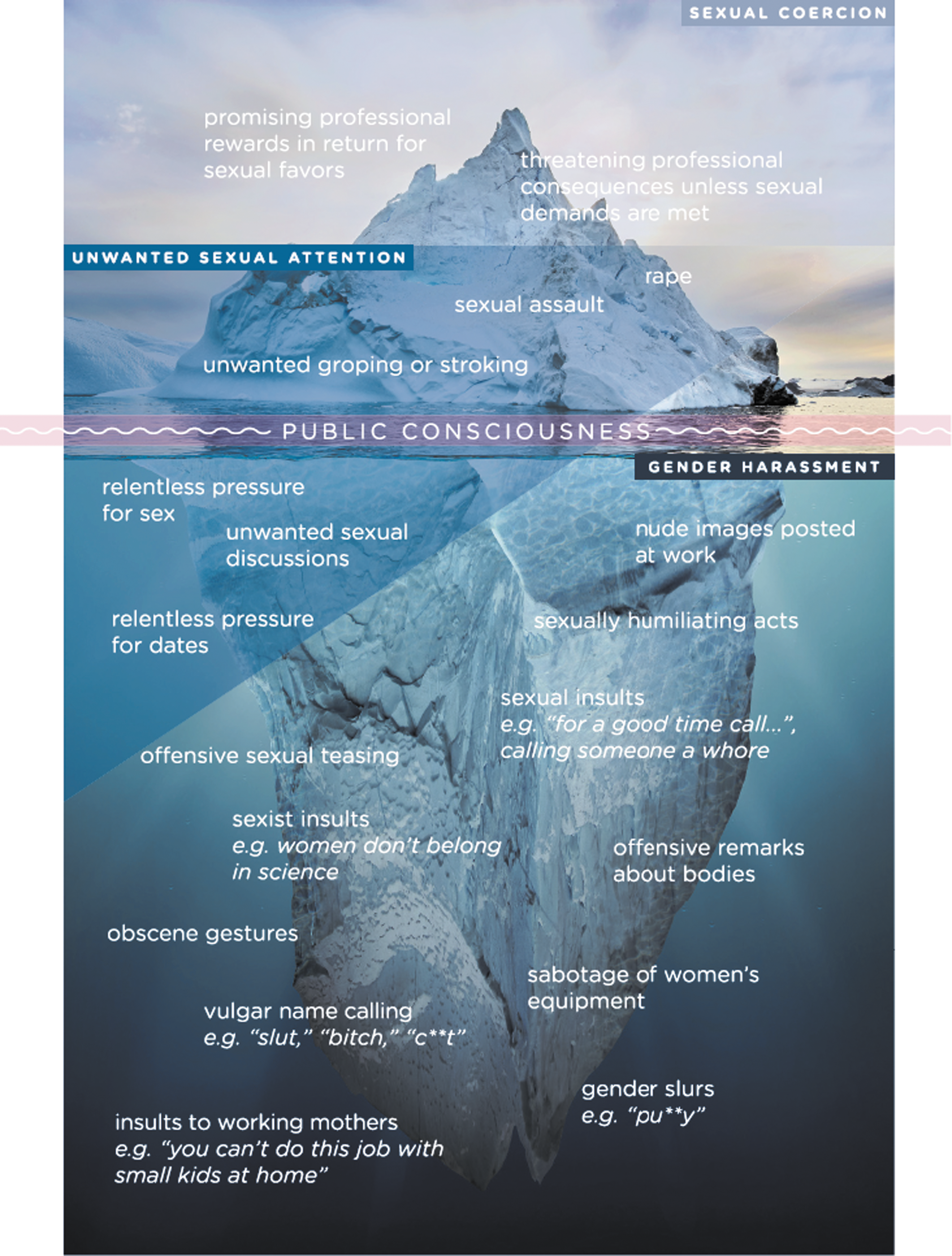
The “tip of the iceberg” depiction of sexual harassment. From: National Academies of Sciences, Engineering, and Medicine. Sexual harassment of women: Climate, culture, and consequences in academic sciences, engineering, and medicine. Washington, DC: The National Academies Press, 2018. Reprinted with permission.