




Abstract
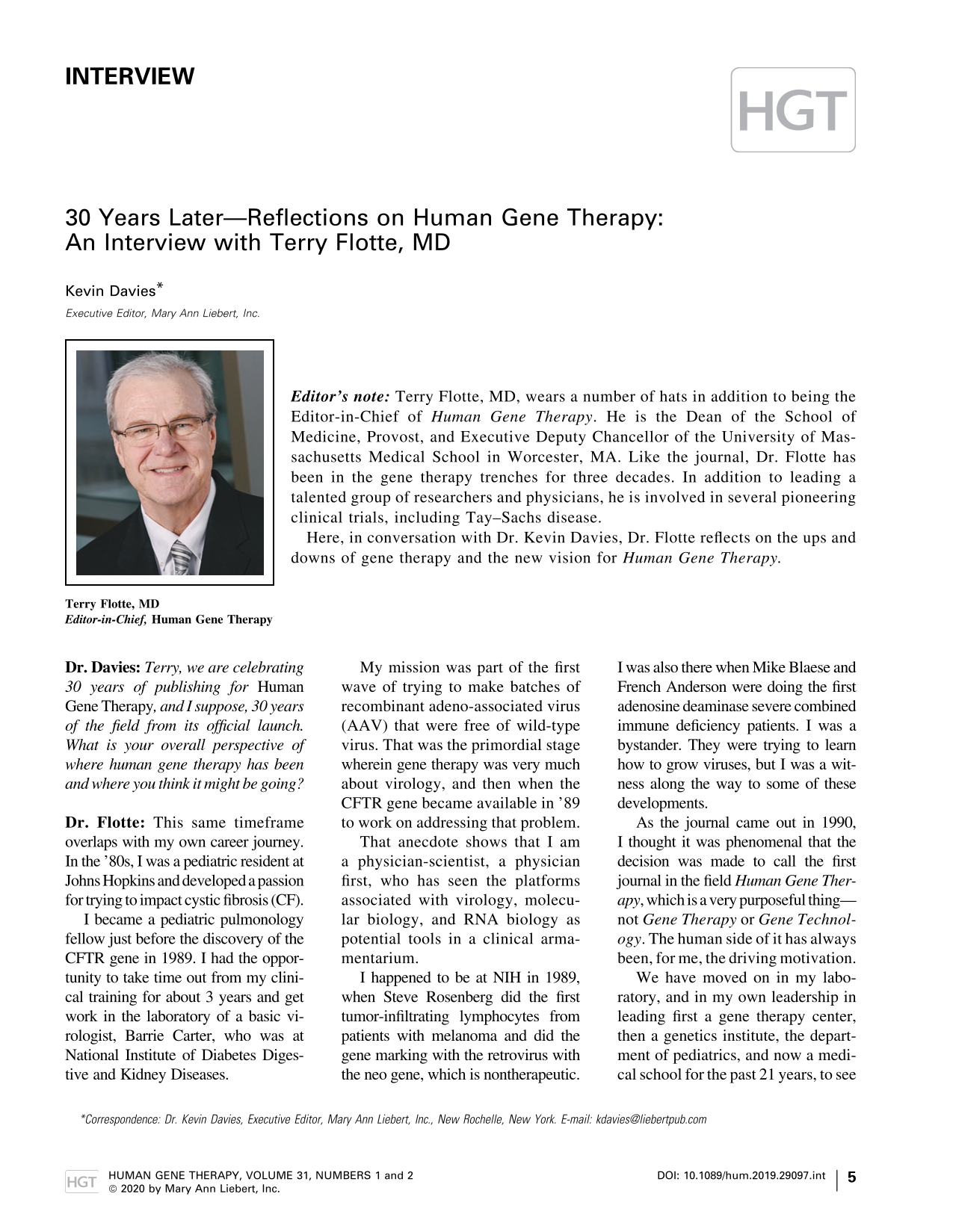

Here, in conversation with Dr. Kevin Davies, Dr. Flotte reflects on the ups and downs of gene therapy and the new vision for Human Gene Therapy.
I became a pediatric pulmonology fellow just before the discovery of the CFTR gene in 1989. I had the opportunity to take time out from my clinical training for about 3 years and get work in the laboratory of a basic virologist, Barrie Carter, who was at National Institute of Diabetes Digestive and Kidney Diseases.
My mission was part of the first wave of trying to make batches of recombinant adeno-associated virus (AAV) that were free of wild-type virus. That was the primordial stage wherein gene therapy was very much about virology, and then when the CFTR gene became available in '89 to work on addressing that problem.
That anecdote shows that I am a physician-scientist, a physician first, who has seen the platforms associated with virology, molecular biology, and RNA biology as potential tools in a clinical armamentarium.
I happened to be at NIH in 1989, when Steve Rosenberg did the first tumor-infiltrating lymphocytes from patients with melanoma and did the gene marking with the retrovirus with the neo gene, which is nontherapeutic. I was also there when Mike Blaese and French Anderson were doing the first adenosine deaminase severe combined immune deficiency patients. I was a bystander. They were trying to learn how to grow viruses, but I was a witness along the way to some of these developments.
As the journal came out in 1990, I thought it was phenomenal that the decision was made to call the first journal in the field Human Gene Therapy, which is a very purposeful thing—not Gene Therapy or Gene Technology. The human side of it has always been, for me, the driving motivation.
We have moved on in my laboratory, and in my own leadership in leading first a gene therapy center, then a genetics institute, the department of pediatrics, and now a medical school for the past 21 years, to see it as our challenge to take not just gene therapy technology, but also all of molecular biology and make it more and more relevant to the human condition.
Beyond CF, I have become engaged with many other genetic disease communities—the alpha-1 antitrypsin deficiency community, Alpha-1 Foundation, the congenital blindness community, and with a variety of rare orphan diseases, most recently the Tay–Sachs community, and others.
As a pediatric physician-scientist, we see a lot of these disorders that are affecting children and are working with families to make the lives of these patients better. They are also seeking us out. One of the interesting things that has evolved through the ups and downs of the field—a meteoric rise, an overcorrection after the Gelsinger case—is that the field had gotten ahead of itself in terms of the expectations it was creating.
Around 2008, a series of clinical successes came out in retinal disease, hemophilia, and hematopoietic stem cell-based correction of disorders. Now it looks like the field has been revived, it is a renaissance.
I counted myself among the people who never left the field because I felt that the concept of gene therapy for single-gene disorders is too simple not to work.
[Gene therapy] has been—and continues to be—limited by the technology, even in cases wherein we have clinical successes. There are limitations of manufacturing technologies that will make it very difficult to scale from a small number of patients with conditions such as inherited retinal dystrophy to larger numbers of patients. Scalability continues to be a challenge for the field.
But it has been gratifying for me over the course of the 30 years to witness the human part of gene therapy go from being a promise to a reality!
Spinal muscular atrophy was a disease we worked on for a while in our laboratory. Seeing those outcomes is extremely dramatic and wonderful. In both disorders, Duchenne and spinal muscular atrophy (SMA), there are things that we would have called gene therapy, as in viral vector reconstitution, as well as oligonucleotide splice-switching technologies, that are demonstrating efficacy in both diseases.
One more thing is about the connection to the patient communities. Over the past 3 decades, people would come to us and ask, “Is there not something your technology can offer my child?” For most of that time, we had to say, “No, it's just too early.” We are finally at a stage where we are saying, “Perhaps there's something or perhaps we can find you a trial.” It is a completely different answer.
As an institution, despite my own history working in AAV, we are platform agnostic. That is one of the reasons why I love the scope of Human Gene Therapy, because the human part comes first. We talk about this as being the era of precision medicine. What that means, when you get down to it, is that the molecular basis of disease is always the key. The mechanisms whereby those mutations lead to disease, the fact that some of them are different will lead inevitably to different solutions from a molecular toolbox point of view.
For some, gene editing is going to be an approach, or perhaps in a subset of those cases, base editing might be an approach. For others, that may not be the approach.
Another fascinating example is CF, where there is a strong founder effect of a particular mutation, ΔF508. Now that there is a triple-drug small molecule therapy [Vertex] that will work for even compound heterozygous patients that have a single ΔF508 mutation, and there are also a couple of precision small molecules that will work for two or three of the other mutations, what the CF Foundation is focused on now are technologies that will treat the other remaining 5%. They basically feel like they have drugs that will work for 95%.
The molecular signature of a solution for the last 5% looks very different than if you look at all of CF together. For instance, ΔF508 is more or less cured with small molecules, so a base editing approach to revert the ΔF508 mutation would not be as relevant in that disorder. As different categories of mutations are characterized across the different diseases, different categories are going to call for different technologies.
As an institution, oligonucleotide-based therapies are a big investment of ours, as well as viral vectors, in vivo and ex vivo. In the end, it comes back to what are the disease problems we are trying to fix?
Then you get into limitations of current vector technology around the size of the different gene payloads and instances wherein you might want to deal with both gain of function and loss of function in a single molecular therapy. So, I am very optimistic about genome editing.
There has been controversy because of the reports of editing human embryos. But to me, the only difference between the debate about human embryo editing and debates about embryo gene therapy is the fact that the tools make it more feasible to actually do it. The ethical frameworks are actually quite similar to what they have been from the very beginning, the Asilomar Conference, where as a community, we said that it is within the shared ethical understanding that using these technologies to cure disease is, in the end, ethically appropriate, and that we are much more comfortable curing a disease in a single individual than in the entire human species.
But we also have shied away across all technologies from anything that would smack of enhancement. These are the same framework discussions that are going to fall in around CRISPR. There may be other safety issues with CRISPR, but there are with every technology.
Will base editing end up with approved products in the clinic? I am not sure, because there will have to be a case made that it can be as safe and effective for particular mutations as other options. Time will tell whether the technology is robust enough to do that. We are fascinated and very enthusiastic about it. And we want to try it out and see whether it has that place.
Human Gene Therapy launched at a time when gene therapy was not very much in humans, but now it is. I think that particular place as the clinical application side of gene therapy is exploding, and I expect the journal to play an even bigger role in the coming decades.
Anything of high impact in any category related to the field will be appropriate for the journal. I think the field is still limited by manufacturing, so we are still excited by methods articles that can relate to other aspects of delivery technology or quality control technology. There has been a lag. In the first 10–15 years, there were a lot of new manufacturing basic platforms. Now, most of the changes in manufacturing vectors have been incremental, and to scale this up to treat all the patients who want treatment, we need a lot of methods innovation.
Clinical development is related to those final steps in entering the clinic. Many people have found that when they are moving their programs to get into early-stage human trials, they have to do an awful lot of work. We do not want that work to have to be duplicated. This is the section where we are very interested in the enabling studies—toxicology studies, distribution studies, early-phase clinical trials, and clinical protocols—and also regulatory issues that continue to produce some kind of impediment to clinical translation.
The journal has great opportunities to publish work that will be seen, that will be widely promoted by the publisher, and that will be cited very highly. You know, our journal was the first to cover gene therapy before the field had even gotten off the ground, and we have followed it, in good times and bad, for three tumultuous decades. This is a great time for our field and for patients. We are very excited about the future of human gene therapy and our journal!