




Abstract
Cell and gene therapy (CGT) has a variety of potential applications in HIV prevention and management. Bibliometric and network analyses suggest potential points of entry for gene therapists into HIV cure research. The existing network of CGT researchers for HIV cure will benefit from an influx of fresh ideas and energy from CGT researchers keen to embrace a new challenge for an old virus.
Cell and gene therapy (CGT) has a variety of potential applications in HIV prevention and management. Possible examples include long-term delivery of anti-HIV antibodies or chemotherapeutic compounds, interference at a variety of steps along the HIV replication cycle, or boosting of the anti-HIV immune response. One challenge for CGT in HIV is the risk–benefit trade-off. There are currently safe and inexpensive methods to prevent HIV infection. Similarly, for those already living with the infection, HIV can be treated safely with daily antiretroviral therapy (ART). There are, however, significant barriers to universal ART coverage. Gaining and maintaining access to daily ART is hampered by individual and country-level economics, social inequalities, the intersection between drug toxicities and aging, and by distribution challenges. 1,2 The final frontier, for which no safe alternative exists, is a cure that would eliminate HIV infection and with it the costs, potential health concerns, and stigma associated with the infection.
In fact, CGT has already been applied successfully to the only cures of HIV infection, in the so-called Berlin 3 and London 4 patients, and possibly the Düsseldorf 5 patient. All three men were treated for concurrent cancers with allogeneic hematopoietic stem cell transplantation (HSCT) using cells from donors with the homozygous mutation in the HIV coreceptor CCR5 (CCR5Δ32/Δ32). Their HIV remains undetectable despite withdrawal of ART for >18 months, 34 months, and 12 years for the Düsseldorf, London, and Berlin patients, respectively. However, allogeneic HSCT is associated with significant morbidity and mortality ranging ∼10–20% (Refs. 6,7 ). The scarcity of adult CCR5Δ32/Δ32 donors, as well as the cost and risk associated with the transplant procedure, means that this approach cannot be widely deployed. It underpins, though, one of the vanguard gene therapy approaches in HIV cure research, namely the ex vivo or in situ removal of CCR5 from CD4+ T cells. 8 –10
Given the success of at least the Berlin and London cases, and possibly the Düsseldorf case, it is surprising how small a fraction of HIV cure research is concerned with CGT. Between the publication of the Berlin patient case on February 12, 2009, and that of the London patient case on March 5, 2019, 6,359 HIV cure articles were published by 25,540 unique authors. Of these, a scant 227 (3.6%) CGT articles were produced by 1,229 (4.8%) unique authors.
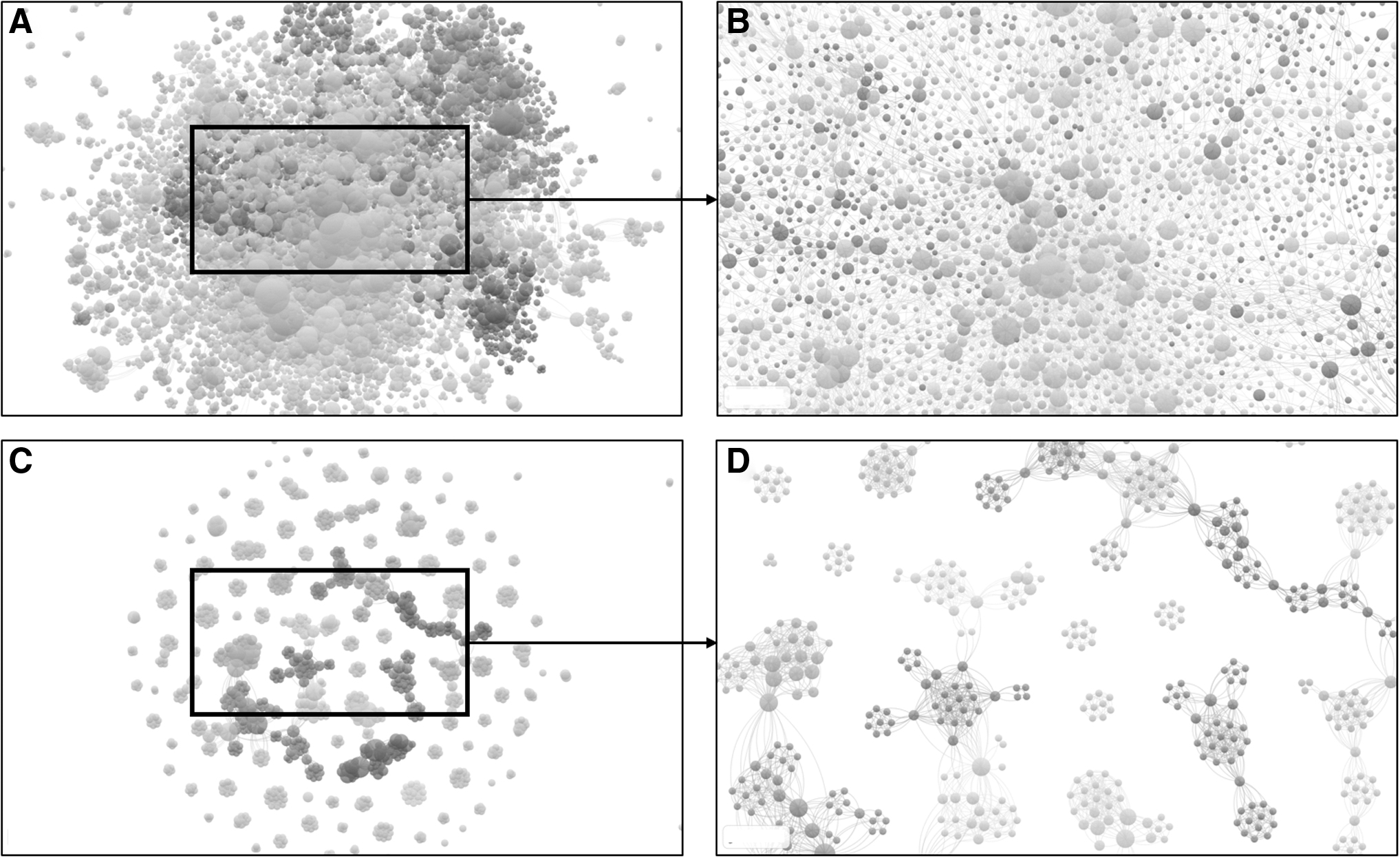
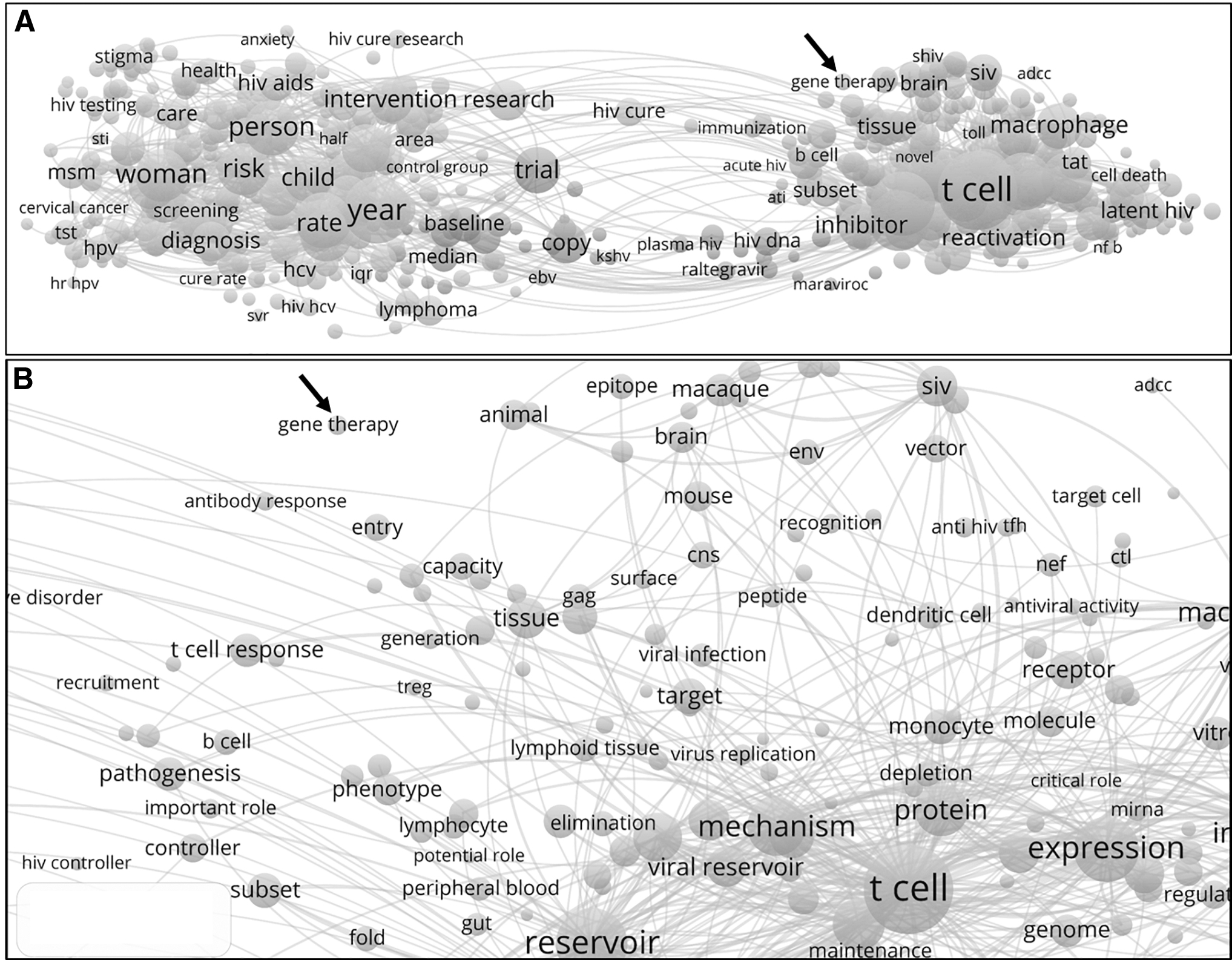
Bibliographic linkage offers one view of collaboration within a scientific community and the sharing of resources and ideas. Coauthorship network maps illustrate the number and nature of links between authors and offer drastically different views of each community (Fig. 1). Of the 24,884 authors in non-CGT HIV cure research, 76% of community members are directly or indirectly connected to one another in an intricate web of coauthorship. By contrast, the largest set of bibliographically connected authors in HIV cure CGT research constitutes only 19% of that community. Keyword network maps are also informative. The HIV cure CGT literature sits on the fringe of efforts to cure HIV and is not extensively connected to other cure efforts (Fig. 2), a pattern characteristically seen in newly emerging research fields.
Coauthorship network maps for HIV cure research
Keyword network map for HIV cure research
Does any of this matter? One study tracing the origins of cures found that it takes complex and fundamentally collaborative networks to generate a cure, involving thousands of scientists and scientific affiliations. 11 In addition to the sheer numbers, social scientists have studied the importance of position in a network in terms of power, innovation, and ability to set and achieve an agenda. Those at the center of a network have more power to influence the opinions and behaviors of others in the network, and to dominate goal setting and achievement. However, a dense network with saturated interlinkages between members increases the chances that opinions and behaviors will become homogeneous and decreases the opportunity to encounter and incorporate new thinking. 12 The HIV cure CGT field may thus be well served to remain at the fringes of the HIV cure research network, but to benefit from this position and to grow in influence and success, there must be a selective increase in collaboration within their own ranks, and with the broader network and beyond.
At a time when it is critical to strengthen the CGT cure network, COVID-19 research has upended the biomedical research enterprise, both by shutting down facilities in which such research is conducted and by diverting the attention of researchers to this new pandemic. 13 During this period of biomedical research “covidization,” 14 HIV cure research is vulnerable to drift and loss of momentum. At first glance, this appears not to have been the case so far. From January 1 to August 13, 2019, there were 613 publications on HIV cure. For the same period of 2020, there were 669 publications. By contrast, during the same periods of 2019 and 2020, there were five articles versus only one CGT cure article.
Meanwhile, for 38 million people living with HIV (PWH), the best option remains daily ART, yet only two-thirds are accessing it. 15 Enthusiasm among PWH for a cure is high, 16,17 and willingness to participate in clinical research, 18,19 including CGT approaches, 20 is largely encouraging, although there is further work to be done in demystifying CGT research. Public support for gene therapy is high for serious medical conditions, 21 and according to Altmetric, 22 among all HIV cure research, CGT garners more public interest than any other approach.
HIV is an infection with serious biological and social consequences in need of a curative intervention. The range of potential CGT approaches is limited only by imagination and a willingness to investigate them. The existing network of CGT researchers for HIV cure will benefit from an influx of fresh ideas and energy from CGT researchers keen to embrace a new challenge for an old virus.
Footnotes
Author Disclosure
No competing financial interests exist.
Funding Information
The author is an employee of amfAR, The Foundation for AIDS Research. There was no grant support for this work.