




Abstract
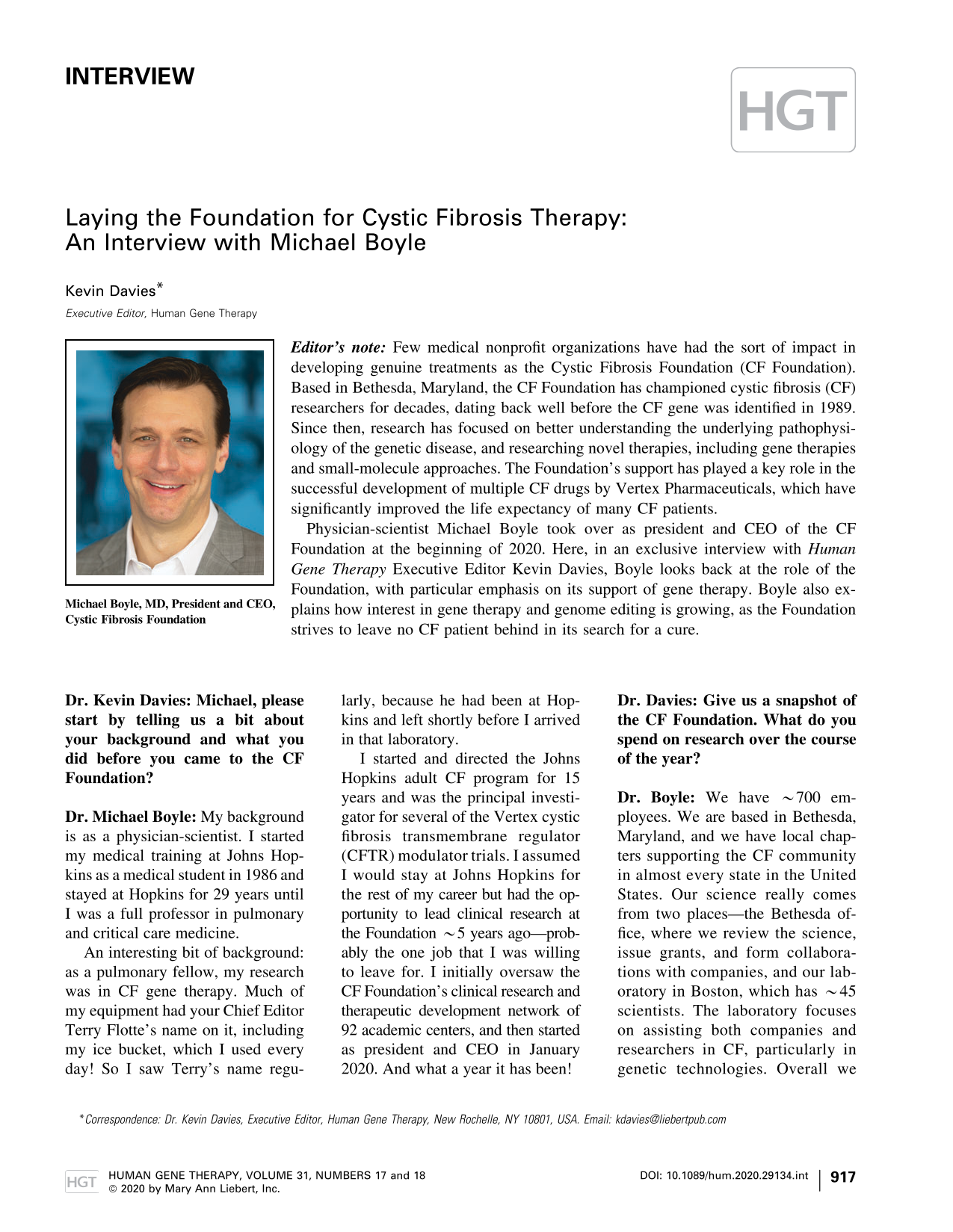
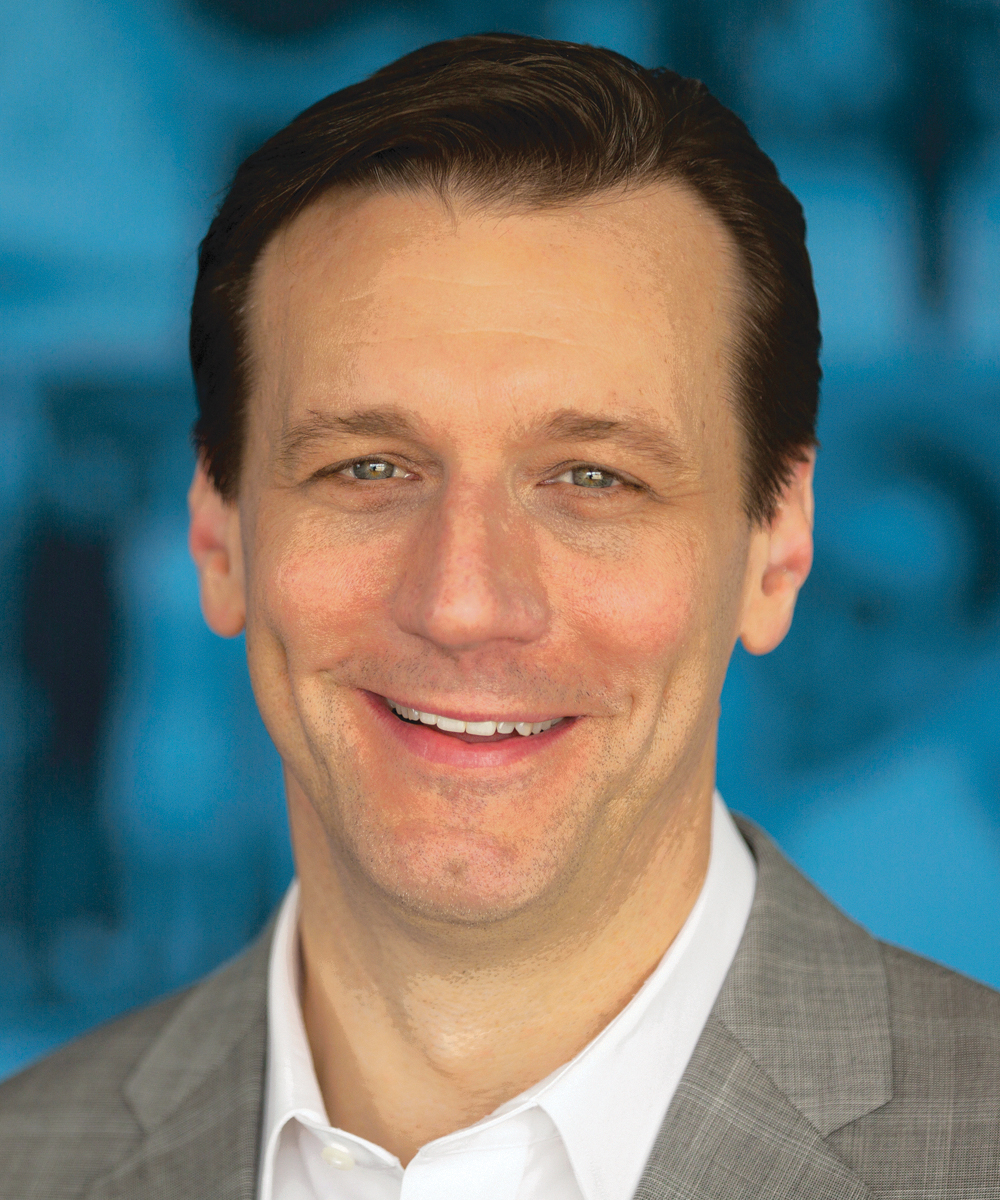
Physician-scientist Michael Boyle took over as president and CEO of the CF Foundation at the beginning of 2020. Here, in an exclusive interview with Human Gene Therapy Executive Editor Kevin Davies, Boyle looks back at the role of the Foundation, with particular emphasis on its support of gene therapy. Boyle also explains how interest in gene therapy and genome editing is growing, as the Foundation strives to leave no CF patient behind in its search for a cure.
An interesting bit of background: as a pulmonary fellow, my research was in CF gene therapy. Much of my equipment had your Chief Editor Terry Flotte's name on it, including my ice bucket, which I used every day! So I saw Terry's name regularly, because he had been at Hopkins and left shortly before I arrived in that laboratory.
I started and directed the Johns Hopkins adult CF program for 15 years and was the principal investigator for several of the Vertex cystic fibrosis transmembrane regulator (CFTR) modulator trials. I assumed I would stay at Johns Hopkins for the rest of my career but had the opportunity to lead clinical research at the Foundation ∼5 years ago—probably the one job that I was willing to leave for. I initially oversaw the CF Foundation's clinical research and therapeutic development network of 92 academic centers, and then started as president and CEO in January 2020. And what a year it has been!
Our goal is to advance therapies for people with CF, to support the care of patients, and help address the other challenges that come with having CF. We also support a care center network and play a role in connecting and advocating for patients. But our primary goal is to advance the treatments and the cure of CF.
There are ∼1,700 different mutations that can cause CF, and although those have a wide variety of effects on the protein, many cause misfolding. CFTR modulators—this new class of drug that has revolutionized the treatment of CF—help to specifically address that misfolding. This started with work that the Foundation supported with Aurora Biosciences, identifying early leads for compounds that could refold the protein and open the channel. Vertex Pharmaceuticals took over that program and has done a remarkable job of rapidly advancing these transformative therapies.
Over the past decade, the percentage of patients able to be treated by CFTR modulators has steadily increased. Initially, it was a small percentage, maybe 5%, with a drug called ivacaftor, which addressed rare gating mutations by increasing opening time of the channel. Over time, a two-drug combination of lumacaftor and ivacaftor allowed initial treatment of the most common folding mutation—F508del.
The big breakthrough however, ∼1 year ago, was the approval of a three-drug combination, which dramatically restores CFTR function for anybody with CF who has a single F508del mutation. The early treatments for F508del required patients to be homozygous, because there was a gene dose effect.
This new three-drug combination of elexacaftor, tezacaftor, and ivacaftor called Trikafta, is strong enough to restore CFTR function to ∼50% of its wild-type levels, which is sufficient to make a dramatic clinical improvement in anybody with CF and a single F508del mutation. Approximately 90% of people with CF have this mutation and, therefore, have the potential to significantly benefit from this three-drug combination. That is why it has been such an amazing story!
The specific clinical benefits of this treatment include a large increase in lung function, return of their sweat chloride, which is the diagnostic test, into a nondiagnostic range, weight gain, and fewer problems with infection. Current median predicted survival is ∼45 years and we fully expect that number will increase significantly in years to come.
We always say, however, that benefitting 90% of people with CF is not good enough. Despite CFTR modulators, many people with CF still suffer from challenging complications, and the role of the CF Foundation is to make sure we treat—and eventually cure—100% of people with CF. That last 10% will require other approaches, because a significant portion of that group has mutations that do not make protein. This group is going to require genetic approaches—including approaches such as read-through agents of premature truncation codons (PTCs) to restore CFTR function, and RNA or DNA replacement.
The credit belongs to a large group of scientists: those who discovered the gene, Francis Collins, Lap-Chee Tsui, and Jack Riordan. There was then a whole group of scientists who worked on understanding the protein, including people such as Mike Welch, Rick Boucher, and Bill Skach, our chief scientific officer. Foundation leaders including Bob Beall and Preston Campbell worked initially with Aurora Biosciences and later Vertex scientists Paul Negulescu and Fred Van Goor, who identified the small-molecule potentiators and correctors. Finally, the CF Foundation's 92-academic center clinical trial network should be mentioned, as the investigators in the network performed all of the clinical trials.
Initial work with adenovirus and adeno-associated virus (AAV) all ran into obstacles—inflammation, limited levels, and duration of expression. People realized that it was not going to be as easy as we thought. There was a shift to other therapeutic approaches including CFTR modulators. Overall there have been >20 trials of gene therapy in CF, all of which have showed perhaps modest expression but no clear clinical benefit and insufficient duration of effect. There has also been recognition that there are challenges that are specific for lung gene therapy and CF, including cell turnover of lung epithelia and tenacious CF mucus.
The flip side, however, is that there has been continued clear progress in gene therapy in other diseases. These advances and proof of concept from other diseases, as well as the requirement in CF to develop genetic approaches to assure we can treat every person with CF—no matter what their mutation—have led to a renewed focus on CF gene therapy.
This past November, at our North American CF conference, the CF Foundation simultaneously announced the data on the three-drug modulator combination, and the launch of our Path to a Cure initiative. This is a $500-million program for the next 5 years focused on advancing genetic technologies, which will help us to develop therapies for 100% of people, no matter what their mutation. Right at the heart of this is gene therapy.
AAV is our main approach currently. We recently made large awards to two AAV companies, Spirovant and 4D Molecular, for a total of up to $20 million to advance CF AAV therapy. There are some challenges however. AAV allows a cargo capacity of ∼4.8 kb. CFTR cDNA is 4.5 kb. So when you add the other required regulatory elements, it is actually too big. Work has included use of a minigene approach—a truncated functional DNA.
There has also been some work in nonviral approaches—lipid nanoparticles. There was a large CF gene therapy trial completed a couple of years ago in the United Kingdom utilizing lipid nanoparticles. There is also interest in lentivirus, as it may help address the duration of expression challenge.
There is one other potential challenge in CF, and that is the variety of 1,700 different mutations. We are not going to be able to do this one mutation at a time. Options for editing to reach a large number of CF patients include inserting a super exon or targeting the most common mutations.
Our goal is to cure CF. As exciting as these modulator drugs are, there are additional drugs that are going to be even better. We want there to be an incentive to bring forward new drugs and novel gene therapy and gene editing that will treat everybody with CF and eventually lead to that cure.
First, we know that some of the science that we are helping to support, particularly related to nonsense mutations including PTC read through therapy, has potential to benefit a large number of genetic diseases. There are thousands of diseases that are caused by nonsense mutations and may directly benefit from the science we are supporting. That is going to help not just people with CF, but also genetic illnesses everywhere.
Second is more specific for other foundations. What we say is learn from our model. There are a couple of things in the model to highlight. One of these is supporting basic science to make sure that the understanding needed to drive new therapies is present. This harkens back to our work to allow the initial discovery of the CF gene.
Another key is developing a collaborative relationship with industry. We have an incredible history of such collaboration through venture philanthropy. We have taken our funding and used it to support the best science available in small biotech or drug companies. We have incentivized them to focus on CF with funding, with expertise, through the CF clinical trial network, and with information from our patient registry. When we meet with other foundations, we highlight these components.
At the same time, we have an entirely separate program intended for industry called therapeutic development agreements (TDAs). This is for companies that have technology or therapeutic programs that may benefit people with CF. We do not have TDA deadlines. There is opportunity for millions of dollars of support, depending on the quality and stage of the research, and the potential for making a difference for people with CF.
Most recently, we have started a new incubator fund in collaboration with Longwood Fund, a biotech-focused venture capital firm, for companies with genetic technologies who are just being formed to incentivize them to focus on CF.
For the Path to the Cure program, we have a couple of key research areas that we are interested in. For gene therapy, we are particularly interested in expression and delivery issues. We need to have sufficient expression and efficiency of delivery to the airway epithelium. We need tropism for the tissues most affected by CF. And we need to address long-term expression issues, including immune response and neutralizing antibodies. For gene editing, we are very interested in identifying airway progenitor cells. This is going to be a requirement for successful lung gene editing in the future.
For all of these research programs, our website at