




Abstract
Amyloid transthyretin (ATTR) amyloidosis caused by transthyretin misfolded into amyloid deposits in nerve and heart is a progressive rare disease. The unknown pathogenesis and the lack of therapy make the 5-year survival prognosis extremely poor. Currently available ATTR drugs can only relieve symptoms and slow down progression, but no drug has demonstrated curable effect for this disease. The growing volume of pharmacological data and large-scale genome and transcriptome data bring new opportunities to find potential new ATTR drugs through computational drug repositioning. We collected the ATTR-related in the disease pathogenesis and differentially expressed (DE) genes from five public databases and Gene Expression Omnibus expression profiles, respectively, then screened drug candidates by a corrected protein–protein network analysis of the ATTR-related genes as well as the drug targets from DrugBank database, and then filtered the drug candidates on the basis of gene expression data perturbed by compounds. We collected 139 and 56 ATTR-related genes from five public databases and transcriptome data, respectively, and performed functional enrichment analysis. We screened out 355 drug candidates based on the proximity to ATTR-related genes in the corrected interactome network, refined by graph neural networks. An Inverted Gene Set Enrichment analysis was further applied to estimate the effect of perturbations on ATTR-related and DE genes. High probability drug candidates were discussed. Drug repositioning using systematic computational processes on an interactome network with transcriptome data were performed to screen out several potential new drug candidates for ATTR.
INTRODUCTION
Amyloid transthyretin (ATTR) amyloidosis is usually considered to be caused by the deposition of transthyretin (TTR), a plasma protein mainly synthesized by liver and choroid plexus, circulating throughout the body as a tetramer. The formation of amyloid TTR usually was considered as the instability of TTR tetramer, which results from the unbinding of T4, and subsequent formation leads to TTR dissociating into monomer, misfolding and the initiation of oligomerization processes of monomeric TTR and formation of amyloid fibrils, 1 Under normal physiological conditions, transthyretin is responsible for the transport of thyroid hormones and vitamin A.
However, once dissociated into monomers and oligomers, they are deposited in the form of amyloid fibrils, it becomes so-called ATTR. ATTR was once considered a rare disease; however, with advances of diagnostic technologies, more and more patients were identified with hereditary ATTR amyloidosis. 2 So far, the reported TTR mutations have exceeded 120, in which some mutations were also identified as high correlations to phenotype expression. 3 With an incidence rate of 1/538 in some areas of northern Portugal, Val30Met mutation is the most widely studied TTR mutation worldwide especially in Portugal, Sweden, and Japan. 3
Val122Ile is another commonly researched TTR mutation, which has been reported for familial amyloid cardiomyopathy, despite its low frequencies among Caucasian, Hispanic, and Asian populations. 4 The percentage of heterozygote Val122Ile mutation and development of delayed-type cardiac amyloidosis in African Americans' community are >3%. 4,5 These mutants are generally considered to be pathological and promote amyloid formation. However, even with wild-type TTR gene, it is possible to have ATTR disease in elderly populations. 2
Effective therapy strategies did not exist until 1990 when liver transplantation gradually became an effective treatment option for ATTR patients. However, limited healthy liver donors and long-term immunosuppressants could not meet the huge demand. Traditional drugs aim to relieve the symptoms of a disease, but they do not focus on the genetic causes, 6 while the therapeutic strategies against TTR type cardiac amyloidosis also mainly concenter on relieving symptoms of heart failure and other underlying diseases.
One relatively effective specific drug for TTR type amyloid cardiomyopathy therapy is tafamidis, a newly developed oral drug that works by occupying the T4 binding sites of TTR and kinetically stabilizing the tetrameric structure. 7 A multicenter random phase 3 trial has shown that compared with placebo, tafamidis could reduce all-cause mortality as well as the cardiovascular-related hospitalizations in patients with transthyretin amyloid cardiomyopathy.
Furthermore, tafamidis could also reduce the functional capacity decline, which improves life quality. 8 Patisiran and Inotersen are two other drugs approved by Health Canada, European Medicines Agency, and Food and Drug Administration (FDA) in 2018. Patisiran (Onpattroii), as an RNA interference agent, can reduce the production of both mutant and wild-type TTR by cleaving target messenger RNA bound to the RNA-induced silencing complex, thereby controls gene expression. 9 In contrast, Inotersen (Tegsediiii) could inhibit the production of hepatic TTR protein. 10
Moreover, antisense oligonucleotides prevent translation by binding to complementary RNA selectively in cells, and thus prevent target proteins from expressing as well as small interfering RNAs have also been developed. 11,12 However, few clinical trials intended to reduce amyloid levels did not reach this stated objective significantly in survival rate, such as in median overall survival 13 or caused adverse effects. Under such circumstances, repositioning available drugs for other diseases as potential therapeutic managements for ATTR becomes a reasonable strategy.
Drug repositioning is applying studied drug compounds to other therapeutic adaptation diseases, 14 which provides an alternative drug discovery and treatment strategy, and great clinical results have also been achieved in multiple other disease areas. 15,16 Compared with developing original drugs, repositioning drugs possess some noticeable advantages, for example, the verifiable safety for patients and reduced costs and time required to develop a novel candidate drug from clinical trials to clinical therapy. 17
Furthermore, the expansion of big data makes it promising and efficient to discover and reposition drugs into new uses by computational methods. 18 With the explosive accumulated information of in-patient phenotype, genotype, and other biomedical big data, computational drug repositioning gradually shed light to clinical practice.
In this study, to search potential candidate agents for treating ATTR, we conducted a typical pharmacogenomic-based drug repositioning practice. The genes associated with ATTR and gene expression data were first collected from public databases, then we screened potential drugs with a protein–protein network analysis using the ATTR-related genes and drug targets interaction data from DrugBank database. Furthermore, the result of gene expression profile in response of small molecule candidate drugs was further analyzed. Eventually, we obtained some key findings on ATTR-associated drug targets and potential repurposed treatment.
METHODS
The following steps were applied in this study, including the procedure as shown in Fig. 1A: (1), collecting ATTR-related and differential expressed (DE) genes; (2), refining the interactome network by graph neural networks (GNN); (3), screening drugs based on the proximity to ATTR-related genes calculated from the protein–protein interaction (PPI) network; (4), filtering based on the correlation between the screened drug and gene expression profile.
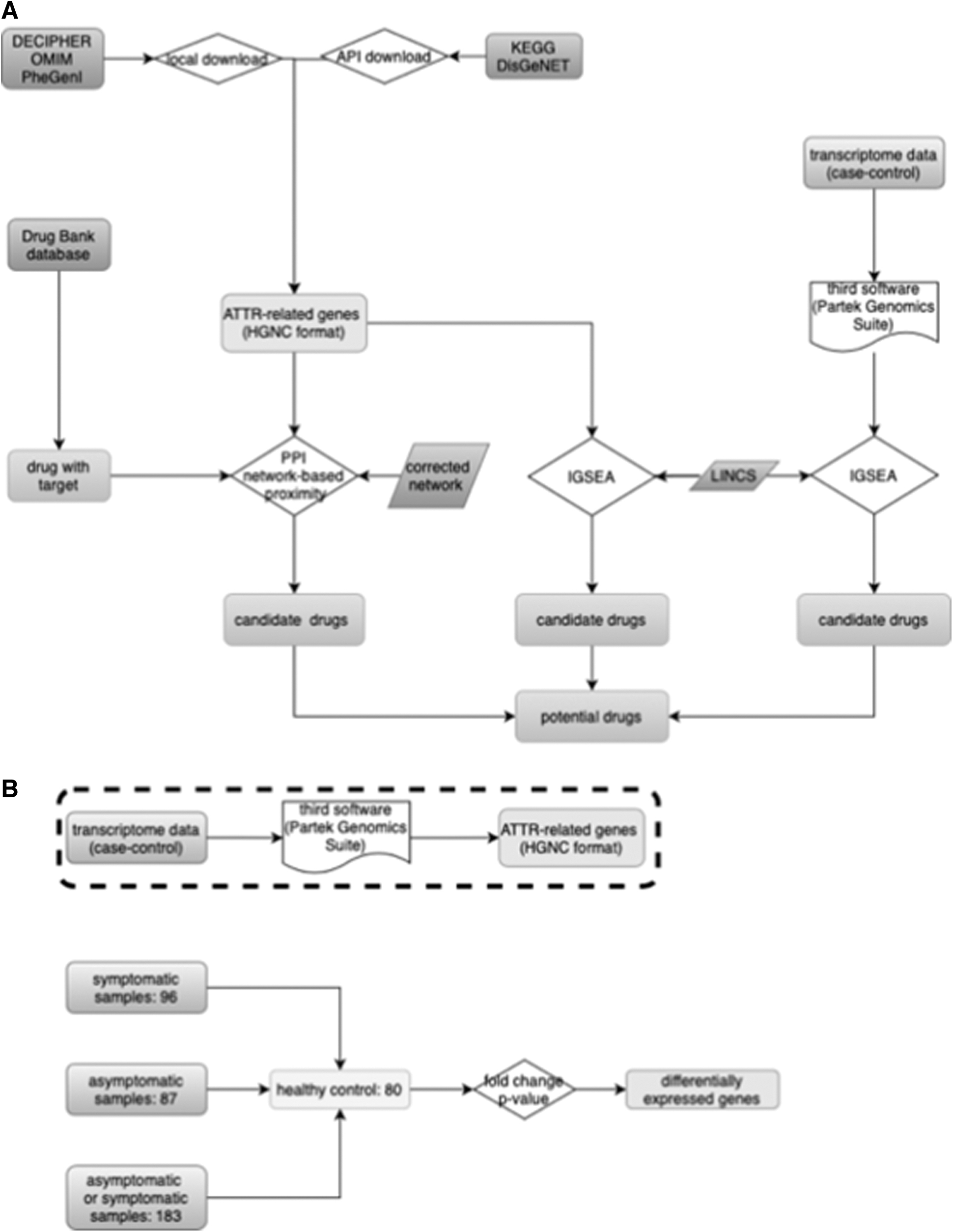
The drug repositioning workflow for ATTR disease.
Filtration of ATTR-related genes, drug list with target and PPI network
ATTR-related genes were extracted from Online Mendelian Inheritance in Man (OMIM) (
In brief, 5 genes related with the ATTR disease were retrieved from KEGG Disease Database. Querying keyword “transthyretin amyloid” retrieved only TTR gene from OMIM. Another 14 genes with genome-wide significance (p-value <5 × 10⁻⁸) were obtained from PheGenI as the source repository according to the phenotype in Mayo clinic querying the “amyloidosis” key word (
In addition, 73 genes list were retrieved from curated DisGeNET database using Unified Medical Language System ID (C2751492) 19 –21 with removing multiple familial trichoepithelioma 2 gene not included in HUGO Gene Nomenclature Committee (HGNC) and PPI networks. Finally, 74 genes list were retrieved from Enrichr database by removing the prediction result. 22,23 One hundred thirty-three unique genes were included in these five public databases.
Two hundred sixty-three samples, including 80 healthy controls and 183 V30M carriers (87 asymptomatic and 96 symptomatic persons), were downloaded from Gene Expression Omnibus (GEO) database (Fig. 1B). These data were compared in three groups: control-Symptomatic, control-Asymptomatic, and control-familial amyloid polyneuropathy (FAP) (Symptomatic and Asymptomatic). Age of carrier was calculated and plotted using R Kruskal–Wallis test and ggpubr package. The detecting threshold was set with fold-change of 1.3-fold and p-value <0.005 that would be accepted for a biomarker gene or biological signal.
According to the Principal Component Analysis plots and histogram frequency plot of all samples, using the Partek Genomics Suite software, none of the filtered samples were excluded (Supplementary Fig. S1). The class comparison uses a one-way analysis of variance (ANOVA) model of the Methods section. The one-way ANOVA model that we employed to detect DE genes proved its robustness in limma package and could tolerate a reasonable level of experimental data variance. We collected the union probe IDs of three groups (Asymptomatic 25; Symptomatic 84; FAP 42) and remove the redundant probes (Supplementary Fig. S2).
Genes from listed five public databases and DE genes in GEO expression profiles were mapped onto the official HGNC gene symbols (
A network-based approach was adopted to evaluate the correlation between retrieved drugs and ATTR disease. We integrated a curated PPI network from multiple resources, including the high-quality Human Reference Protein Interactome (HuRI) (downloaded on April 11, 2019) 25,26 using yeast two-hybrid method, the integrated Protein Interaction Network Analysis (PINA) (latest release version: May 21, 2014), 27 and the curated Search Tool for the Retrieval of Interacting Genes/Proteins (STRING) (version 11.0: January 19, 2019), only interactions with ‘combined score’ >900 was kept.
There are 648,304, 166,776 and 52,569 edges (physical protein interactions) collected from STRING, PINA, and HuRI databases, respectively, corresponding to 12,396, 17,109, and 8,275 nodes (proteins/genes), respectively. All listed proteins were mapped onto approved gene symbols from HGNC by using biomaRt package (version 2.42.0) with ensemble v77 version. However, considering these data generated by different method, we used high-quality HuRI data set as training set, to re-predict the protein interactome pairs in PINA and STRING data set.
Moreover, drug-induced gene expression profiles were extracted from the Library of Integrated Network-based Cellular Signatures (LINCS;
Enrichment analysis of ATTR-related and DE genes
Functional enrichment analysis could give us a better understanding on disease mechanisms by enriching related genes to related biological processes or pathways. 29 Gene ontology (GO) terms analysis was conducted by ClueGO plugin in Cytoscape software 30 that can improve biological interpretation of large list of genes. The pathways were enriched with Reactome database in WebGestalt website to clarify the relevant functional pathways. In this study, the significantly enriched GO term and pathway were set with the false discovery rate (FDR) value <0.05.
Re-evaluation on PPI network
In our network, only the protein pair in HuRI database generated by yeast-hybrid systematic screen have higher confidence, whereas protein interactomes from curated PINA and STRING databases have relatively lower confidence. Hence, we refined the PINA and STRING databases following the PPI network topological patterns in HuRI.
To fulfil this refinement, we referred a GNN method in recent biomedicine advances to learn latent connectivity features of HuRI data sets and infer the protein interactomes in PINA and STRING. Specifically, the GNN model is trained on the PPI subgraph pairs converted from HURI data set learning its topological patterns, then the trained model predicts the protein interactomes in PINA and STRING data sets. Figure illustrates the GNN method framework used in this work (Fig. 1).
Since this GNN framework is independent on node's side information (e.g., protein structure information), only the network topological information (i.e., PPI network connectivity information) is used to train the model. During training procedure, the model showed high performance in terms of area under the receiver operating characteristic and area under the precision-recall curve, reaching 98.2% and 97.9%, respectively. It indicates that the trained model could effectively compute and extract the topological patterns in HuRI, and thus predictions in PINA and STRING follow the learned patterns in HuRI.
During prediction procedure, we ensembled predictions from 5-cross validation models trained on HuRI data set, taking average of predicted interactome probabilities as final prediction score of each protein pair in PINA and STRING. Only 46,938 edges were retained with cutoff 0.7. Ultimately, the overall PPI network consisted of 99,108 interactions among 9,878 proteins/genes without the self-interacting and redundant pairs.
Calculation of network-based distance between drugs and ATTR
Two typical strategies, relationship of drug and disease in PPI network or structure similarity among targets, were used to reposition existing drugs for new therapies. 31 Network-based methods have been applied for drug repurposing, since in the context of PPI network, the molecular interactions in biological systems were quantified with path distance, which has been proven to be reasonable and feasible. 32 –34 In our study, a similar method was employed to evaluate the distance between drugs and ATTR genes in corrected network in similar to a previous study. 24 In theory, a shorter distance between drugs and disease genes represents a more effective therapy. The distance distribution was plotted using R ggplot package (version 3.6.1).
Transcriptome analysis of LINCS database
The gene expression profile represented a new pattern compared with healthy controls when a disease state exists. In theory, an effective drug could drive the expression profile to normal condition. We used the improved GSEA method (Inverted Gene Set Enrichment Analysis [IGSEA]) 24 to select candidate compounds in the LINCS database. Only normalized expression profile (level 3) of NPC and SKL cell lines were analyzed with 139 ATTR-related and 56 DE genes, respectively. There are 209 and 166 compounds cocultured with NPC and SKL cell lines, respectively (Supplementary Table S3). For DE genes, we additionally consider the gene regulation direction DE genes between GEO data and LINCS. If the overlapping gene number is >5, this compound will be held in candidate drug list.
RESULTS
The age distribution in TTR gene V30M carriers
Age, as a risk factor, is associated with many cardiovascular and neurodegenerative diseases. In the previous study, the impact of age to ATTR onset have been proposed. We analyzed the age distribution of 183 V30M carriers (87 asymptomatic and 96 symptomatic persons) downloaded from GEO database. As shown in Fig. 3, the overall age is larger in symptomatic groups, and there are statistically significant differences in asymptomatic and symptomatic groups with p-value 7.4e-08. The mean age is 32 and 42 years in asymptomatic and symptomatic groups, respectively. In the asymptomatic group, only 25 DE probes were filtered with p-value <0.005 and |fc| > 1.3 cutoff, with 82 DE probes in symptomatic group, which means that more genes were regulated with age increasing in V30M carriers.
Biological process of ATTR-related genes
Retrieving and analyzing the biological processes to disease-related genes can provide effective information and helps deepen our understanding of the onset of diseases. In this study, total of 139 ATTR-related and 56 DE genes were searched out while 154 and 12 main biological processes, cellular component, and molecular function were detected by ClueGo plugin in Cytoscape software (Supplementary Table S2).
The relevant pathway terms are shown in Supplementary Fig. S3. Among these significant GO terms, such as amyloid fibril formation, also included in pathway analysis, cognition and neuron apoptotic process, were included in ATTR-related GO terms. However, multiple catabolic processes and rRNA processes were included in DE GO terms. It is worth noting that Cathepsin E (CTSE) and Lipocalin-2 (LCN2) gene were both included in public database and RNA DE gene list.
As an important intermediate for antigen presentation and chemotaxis, CTSE, which GO annotations included protein homodimerization activity and aspartic-type endopeptidase activity, was considered as a potential novel FAP biomarker since inflammation may play a crucial role in FAP. 35 On the other side, LCN2 gene encodes a neutrophil gelatinase-associated lipocalin and plays a role in innate immunity 36 emerged as a critical iron regulatory protein during physiological and inflammatory conditions. In conclusion, the aforementioned results proved the genes we collected were sufficient to discuss the molecular properties of ATTR.
Candidate drug list in transcriptome analysis of LINCS database
The Heatmap chart emphasizes the expression levels of risk-related genes in the patient group and the drug group. If the difference between the patient group and the drug group is in the opposite direction, it indicates that the drug has clinical research value for potential TTR treatment. As shown in Supplementary Fig. S4, we used the data of the 10.0, 3.33, and 1.11 μm dose groups in LINCS database and made the heatmap chart for 235 individuals (217 patients and 18 receiving drug therapy).
CGK-733, KIN001-26, and GSK-10709166 are top 3 candidate drugs (Supplementary Table S3). CGK-733 was found associated with 7 DE genes in NPC cell lines, including AHSP, ARG1, CA1, COX5B, EPB42, GYPA, and GYPB. As shown in Supplementary Fig. S4A, there were significant differences between drug group and control group in 17 gene probes represented 7 DE genes listed before. KIN001-266 had overlapping gene number as 7 (NOP10, BLVRB, PDZK1IP1, SELENBP1, RPS27, COX5B, and CTSE).
Significant differences were shown in transcriptome analysis especially in NOP10, BLVRB, PDZK1IP1, and SELENBP1. GSK1070916A was found overlapping 7 DE genes (RAPS27, CA1, EPB42, MYL4, HLA-DQA1, LCN2, and ARG1) with 12 gene probes. Aurora B/C Kinase Inhibitor GSK1070916A was in Phase I (NCT01118611) in studying the side effects and best dose in treating patients with advanced solid tumors.
Distribution curve of distance between ATTR-related genes and drug targets
Interactome network emphasizes the indirect interaction between drug and disease proteins. To objectify the relationship between proteins encoded by ATTR-related genes and drug targets, value of relative proximity was introduced to describe the relationship between disease-related proteins and drugs based on established network quantitatively. If one class of drugs showed more proximity than others, it may indicate that their therapeutic effect would be better than those distal drugs.
For that reason, the weight value w was brought in to evaluate the risk genes of ATTR, which excluded the uncorrelated drugs with ATTR and ranked the ATTR-proximal drugs. A distribution curve describing the distance between drug targets and ATTR-related proteins was constructed with the range from −12.0 to 5.0 where differences exist between drugs and reference sets to ATTR-related genes (Figs. 2 and 4).
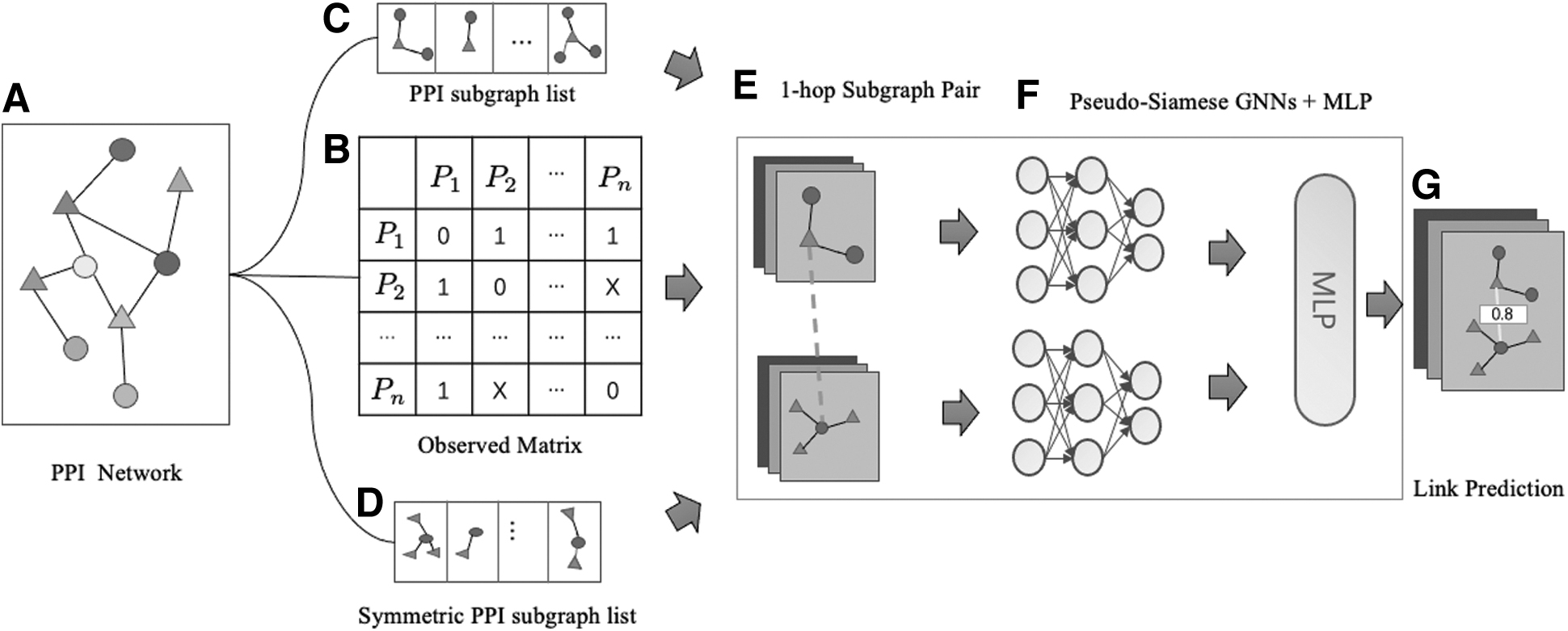
The training and inference framework on PPI network. The PPI network

The age distribution in TTR gene V30M. We analyzed the age distribution of 183 V30M carriers (87 asymptomatic and 96 symptomatic persons) downloaded from GEO database. The overall age is larger in symptomatic groups, and there are statistically significant differences in asymptomatic and symptomatic groups. TTR, transthyretin.
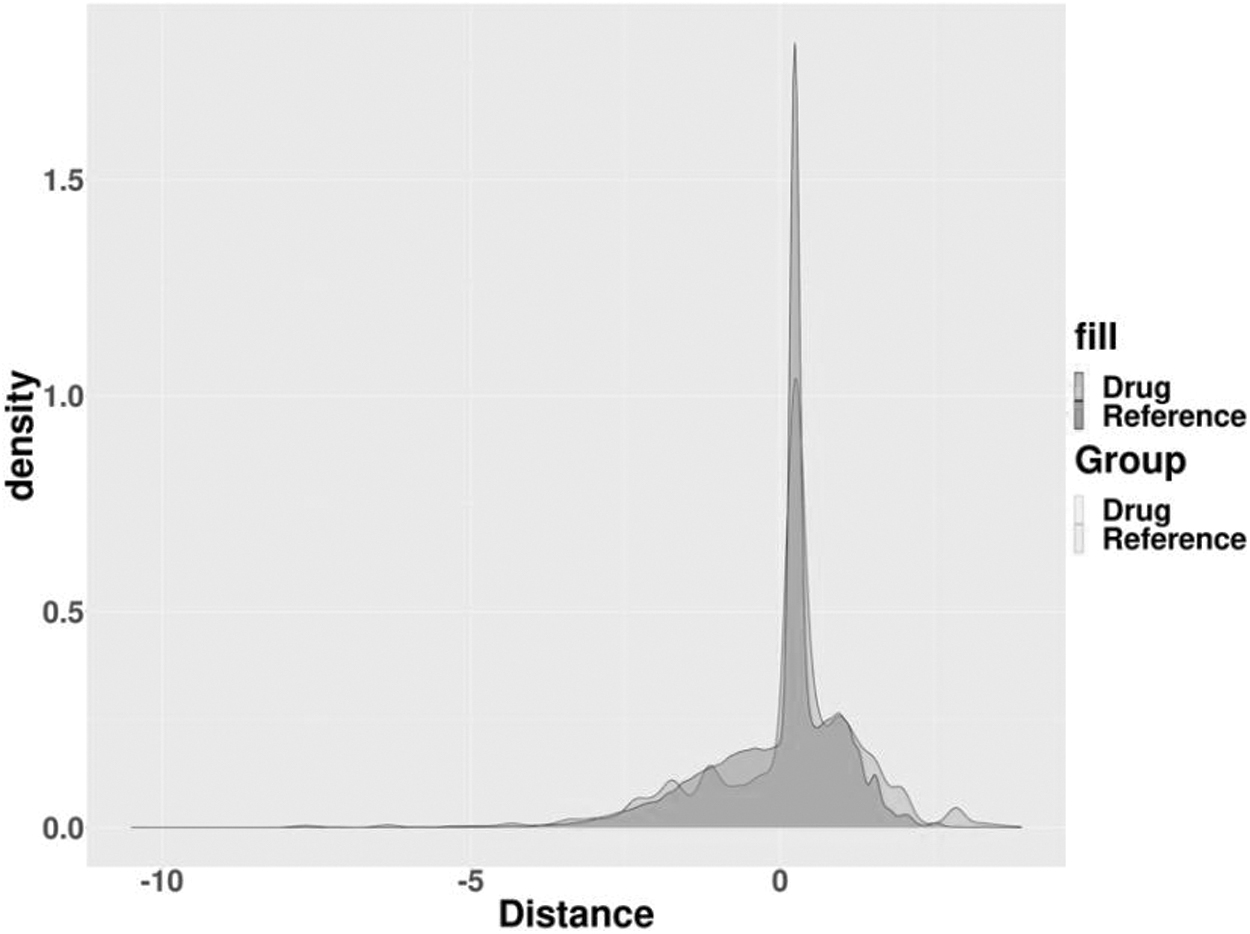
Proximity between ATTR-related genes and drugs. Distance distribution curve of screened 355 drugs compared with the reference distribution curve. The distance distribution of drugs to ATTR-related genes overlapped the reference sets with some differences.
This density curve of drugs dropped sharply near the point −0.0 and almost no overlapping in the left tail with distance less than −2, suggesting drugs whose distances were less than −2.0 might be an appropriately effective drug for ATTR therapy. Therefore, this value could be a proper threshold to screen the candidate drugs for ATTR.
In this way, a total of 355 candidate drugs were selected and considered to be close enough with ATTR, and the drugs targets including TTR gene were highlighted (Supplementary Table S3). The network analysis exposing the relationship between ATTR-related proteins and drugs helped us distinguish novel drug-ATTR linkage, and we then processed the indication and related protein or diseases of candidate drugs to verify the effectiveness of the screening. Of the total 355 candidate drugs, one of them have been approved by FDA for ATTR treatment (tafamidis with z-score −3.39), suggesting this method was effective enough in sifting ATTR candidate drugs.
Interpretation of drugs signatures
After the filtration in the PPI network, we then ran the iGSEA calculation to further reduce the number of candidate drugs for ATTR-related genes and DE genes. Finally, 77 and 55 drugs were identified for neural NPC cell line and muscular SKL cell line with FDR <0.25, respectively (Supplementary Table S3) for ATTR-related genes. There are 26 drugs in NPC and SKL cell line simultaneously existing for ATTR-related genes (highlighted with green in Supplementary Table S3).
Most of them are developed for cancer treatment. Amuvatinib, a multitargeted tyrosine kinase inhibitor, has already been applied in trials studying the therapeutic treatment of small cell lung carcinoma and solid tumors. In fact, one small molecule AT7867 and Resveratrol also exists in candidate drug lists from corrected PPI network. In these two drugs, one of them is in experimental stage for lymphatic leukemia, and one of them functions by stabilizing the structure of the TTR tetramer.
Resveratrol, being investigated for the treatment of Herpes labialis infections (cold sores), is a polyphenolic phytoalexin. Resveratrol is one potential drug for Alzheimer's disease by stabilizing the structure of the TTR tetramer. 37 There are 15 and 4 drugs identified for neural NPC cell line and muscular SKL cell line with FDR <0.25, respectively (Supplementary Table S3), for DE genes with small molecule (inchikey: UYJNQQDJUOUFQJ-UHFFFAOYSA-N; target: PTK2) in experimental stage.
DISCUSSION
ATTR-related diseases not only brought a lot of pain to patients but have also caused great social pressure. 38 As a rare disease, the genomic pathogenic mechanism in patients with TTR mutant is relatively clear; however, it involves multiple pathways and biological processes in wild-type patients, mainly elderly, which suggest that ATTR disease has distinct pathogenic mechanism in TTR wild-type and mutant patients and have strong correlation with age.
The age distribution in asymptomatic and symptomatic groups indicates that the gene expression profile of younger people (symptomatic group) may be the intermediate state along diseases process, which indicates that the elderly is more likely to acquire ATTR compared with younger people, both in TTR wild-type and TTR mutant patients. This is highly consistent with the previous studies. 2
Currently, a large number of novel chemical compounds are either undergoing theoretical research or clinical trials. 39 In this study, one computational framework was applied to relocate the potential drugs for ATTR based on transcriptome analysis and integrating the interactome network. To analyze the correlation between drug targets and ATTR-related genes, we first collected the genes linked with ATTR to represent its molecular features.
Biological function enrichment analysis was then performed on ATTR-related and DE genes and revealed several GO terms, for instance, response to corticosteroid, amyloid fibril formation, neuron apoptotic process, which, from another perspective, provided us consistent proof with current understanding of ATTR-relevant molecular mechanisms.
Measuring the distance between ATTR-related genes and drug targets on the PPI network excluded drugs of relative long distance to ATTR-related genes from the extracted DrugBank list but kept the highly proximal drug candidates. It is worth noting that we chose d(S,T) < −2.0 as the threshold to estimate whether one drug was proximal to ATTR based on the distribution curve of distance. This selection was basically based on distance distribution, it still could effectively screen candidate drugs by PPI interactome network despite potential disturbance.
The only active moiety treatment for ATTR-induced heart disease approved by FDA, tafamidis, was identified to be closely linked to ATTR from the network analysis. Among the candidate drugs screened by corrected PPI network, most of them function by stabilizing the structure of TTR tetramer. For instance, as a benzoxazole derivative, tafamidis could bind to transthyretin at the thyroxine binding site with high selectivity and affinity, thus inhibiting the decomposition of tetramers into monomers. 40,41
It has been proven that tafamidis could slow down the peripheral neuropathy progression in ATTR patients and the cardiac damage in ATTR-cardiomyopathy. 13,42 Furthermore, drugs that are now under investigational and experimental research for the treatment of ATTR showed high proximity to the TTR gene, for example, Resveratrol, copper. In the candidate drugs selected by DE genes (Supplementary Table S3), 19 drugs were presented with a number of overlapping genes >5.
Among them, 7 drugs (LY2603618, GSK126, GSK-1070916, EPZ-5676, Ponatinib, Tivantinib, and Saracatinib) were currently in or completed clinical trials in other diseases apart from ATTR. LY2603618 was known as a potential treatment for solid tumors, pancreatic neoplasms and non-small cell lung cancer. GSK2816126 was currently finished in an open-label, multicenter, 2-part study (NCT02082977) to determine the recommended Phase 2 dose with relapsed/refractory diffuse large B cell lymphoma, transformed follicular lymphoma, other non-Hodgkin's lymphomas, solid tumors (including castrate resistant prostate cancer) and multiple myeloma.
GSK-1070916 recently completed a phase I trial (NCT01118611) is studying the side effects and best dose of GSK1070916A in treating patients with advanced solid tumors. EPZ-5676 were mainly studying in acute myeloid leukemia, leukemia cutis, and myelodysplastic syndrome. Ponatinib was known as potential treatment for lymphoblastic leukemia. Tivantinib was in a prospective open-label monocentric phase I–Ib trial (NCT02049060) in combination with Pemetrexed and Carboplatin as first-line therapy in patients with advanced or metastatic cancer.
Saracatinib has been investigated for the therapy in pulmonary lymphangioleiomyomatosis. These anticancer drugs aforementioned have shown similarity with drugs in ATTR trail recruitment phase, which may remain high potential in future ATTR therapy.
In the top 10 candidate drugs (Supplementary Table S3), top 5 of them (deferoxamine, Mito-4509, dimercaprol, Edonerpic, and CAD 106) have the unique target APP gene, which have 380 edges in PPI network. Deferoxamine could provides instructions for making a protein called amyloidprecursor protein. This protein, which has been studied to be involved in the amyloidogenic pathway, 43 has been found in many tissues and organs, including the brain and spinal cord (central nervous system).
Mito-4509, Edonerpic, and CAD 106 are drug candidates that show neuroprotective activity and reductions in beta-amyloid in animal models of Alzheimer's disease, which has similar pathogenesis with ATTR disease as known as the amyloidosis of protein indicating the potential ability in ATTR treatment. The sixth molecule has 14 targets, and all of them are from PSMA and PSMB family, which GO annotations related to these genes include RNA binding and threonine-type endopeptidase activity.
Afelimomab, PN0621, AME-527, and Golimumab, all of the four drugs effecting the only TNF target, were investigated for use/treatment in sepsis and rheumatoid arthritis and psoriasis, respectively. As shown in Supplementary Fig. S4, top 3 candidate drugs (CGK-733, KIN001-26, and GSK-10709166) were found associated with different DE genes expression, mostly brought an activation of gene expression compared with control group.
Resveratrol, one of the three drugs screened by corrected PPI network and IGSEA method simultaneously, presented us with encouraging evidence to support its potential effectiveness in treatment of ATTR. As a part of polyphenols family, resveratrol can accelerate the formation of soluble nontoxic aggregates, and resveratrol analogue can combine TTR subunits of monomer to form nontoxic natural tetramer TTR. 37,44 Furthermore, resveratrol could suppress vascular smooth muscle cell proliferation, and promote autophagy, which means this compound may have potential benefits for ATTR therapy. 45
Some limitations also exist in our study. First, this approach depends on the interaction between previously filtered ATTR-related genes and drug targets, as well as the drug–disease annotation, which is far from completed. Exploring the drug targets and genes is still a challenging mission for the refinement of computational drug relocation. Second, mankind PPI network is particularly complex; due to the current limitations of algorithms and experimental techniques, information about human PPI network might be biased and cannot cover the integrated proteome.
Furthermore, different databases share different criteria for data retrieval, which could lead to some irrelevant drugs screened into out consequence. Some of drugs discussed here could be appropriate treatments in clinical practice, but none of them seems to heal ATTR. Therefore, more could be done in molecular biological research and clinical systematic investigation.
In summary, by combining molecular network methods and drug repositioning methods, we have identified several candidate drugs that may be repurposed to treat ATTR disease. Although the current result was still elementary, it can provide some threads for further investigation and research. The modified computational framework proposed here may provide some revised ideas for discovering potential drugs for rare diseases.
Footnotes
ACKNOWLEDGMENTS
We thank the Beijing Municipal Government and BILL and MELINDA GATES foundation to GHDDI for the support. We also thank Prof. Sheng Ding for helpful advice in the experimental design of this article.
AUTHORs' CONTRIBUTIONS
S.H., X.Y.H., X.Y.L., R.K.P., J.J.G., Z.T., L.R.P., and S.Y.Z. conceived and supervised the work. S.H., X.Y.H., X.Y.L., and R.K.P. wrote the article and drew the figures. All named authors meet the International Committee of Medical Journal Editors (ICMJE) criteria for authorship for this article, take responsibility for the integrity of the work, and have given final approval for the version to be published. All authors read and approved the final article.
AVAILABILITY OF DATA AND MATERIALS
Data and materials used are included in the review.
CONSENT FOR PUBLICATION
This article does not contain any individual person's data in any form. Ethics approval and consent to participate. This review does not involve any new studies of human or animal subjects performed by any of the authors.
AUTHOR DISCLOSURE
All authors have nothing to disclose.
FUNDING INFORMATION
The study was funded by The National Key Research and Development Program of China (Grant No. 2022YFC2703100); Center for Rare Diseases Research, Chinese Academy of Medical Sciences, Beijing, China; Chinese Academy of Medical Sciences (CAMS) Innovation Fund for Medical Sciences (Grant No. 2021-I2M-1-003); National High Level Hospital Clinical Research Funding (Grant No. 2022-PUMCH-D-002).
SUPPLEMENTARY MATERIAL
Supplementary Figure S1
Supplementary Figure S2
Supplementary Figure S3
Supplementary Figure S4
Supplementary Table S1
Supplementary Table S2
Supplementary Table S3
References
Supplementary Material
Please find the following supplemental material available below.
For Open Access articles published under a Creative Commons License, all supplemental material carries the same license as the article it is associated with.
For non-Open Access articles published, all supplemental material carries a non-exclusive license, and permission requests for re-use of supplemental material or any part of supplemental material shall be sent directly to the copyright owner as specified in the copyright notice associated with the article.
