




Abstract

Hemoglobin (Hb) is essential for the oxygen carrying capacity of mammalian erythrocytes. It functions as a tetramer, with two alpha-like globin chains and two beta-like globin chains as well as four heme rings, each of which is composed of a porphyrin ring and a single iron (Fe2+) cation and is capable of forming a reversible coordinate covalent bond with molecular oxygen (O2). The synthesis of Hb in erythrocyte precursors is tightly regulated in a manner that balances the production of the alpha chains and beta chains. A cluster of cis-acting DNA elements within the beta globin locus, the locus control region (LCR), are essential for proper regulation of gene expression. Mutations of the globin genes are known collectively as hemoglobinopathies. These include missense and structural mutations, such as sickle cell disease, and quantitative deficiencies of Hb, such as the thalassemias. Thalassemias collectively represent the most common monogenic disorders in the world. 1 Thalassemias primarily affecting the beta globin gene (beta-thalassemias [β-thals]) are both more common and more clinically severe than alpha-thalassemias.
A review of the global distribution of β-thals by genotype indicates that the most common beta-globin mutations differ by region. 1 Although certain mutations (e.g., the IVS1-110 and CD39) are common in southern Europe and the Middle East, other mutations (e.g., CD17, IVS2-654) are more common in southern China (Fig. 1). In this issue, Ouyang et al. sought to optimize beta-globin gene therapy in the context of the common Chinese β-thal–causing alleles. 2
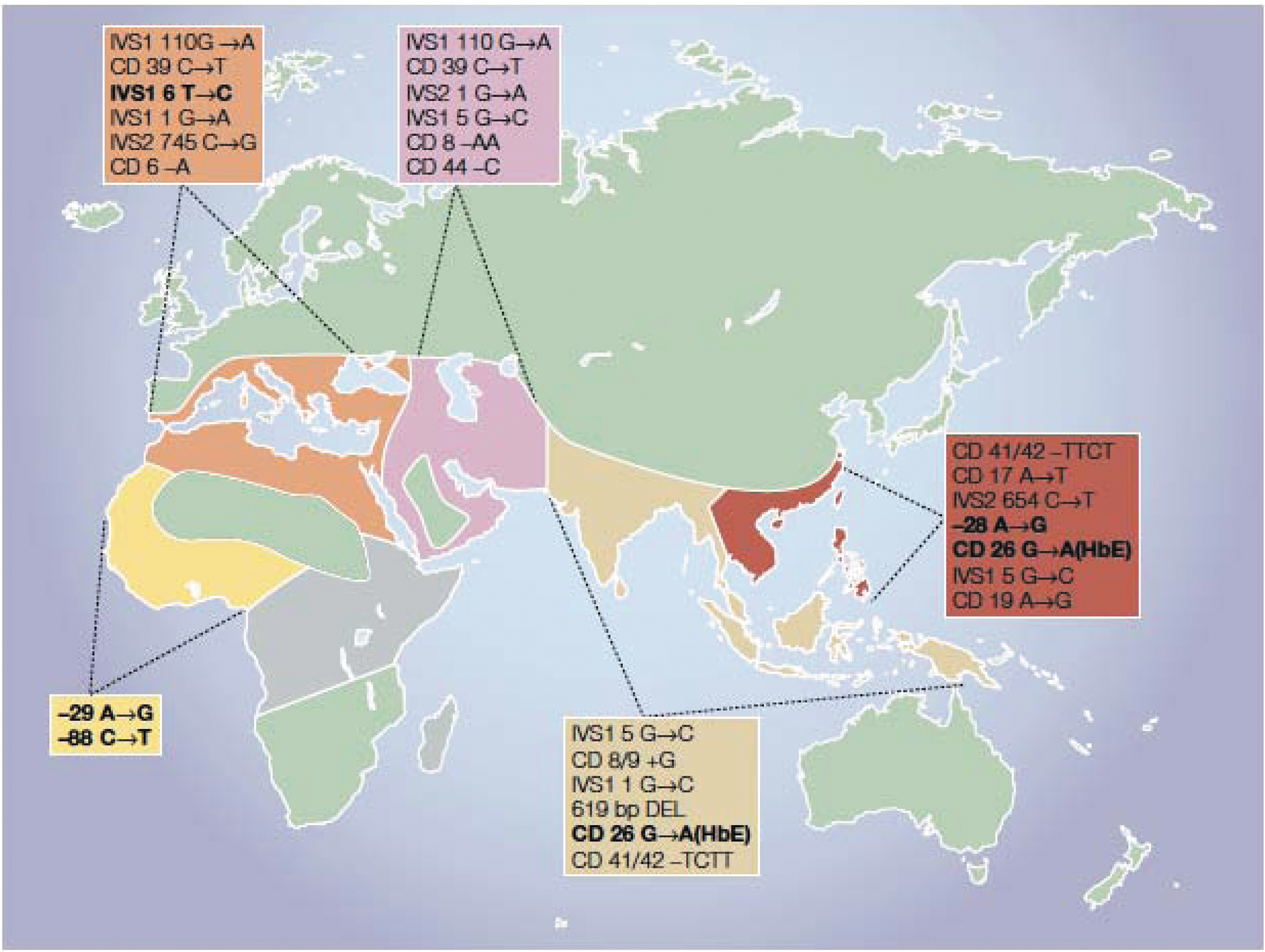
Global distribution of HBB gene mutations responsible for β-thalassemia. Milder mutations are shown in bold. Image from Weatherall 1 ; licensed from Springer Nature.
The work by Ouyang and colleagues built upon a number of successful clinical gene therapy programs, including most notably that of Bluebird Bio, whose betibeglogene autotemcel (ZyntegloR) is approved for treatment of β-thal in the European Union. 3 This vector contains an antisickling version of the beta-globin gene, designated as HBBT87Q, expressed in a lentiviral vector containing a modified LCR (LentiGlobin) in hematopoietic stem cells (HSCs), ex vivo. The primary goals of the optimizations in the Ouyang article were to optimize the LCR in their lentiviral vector to ensure that it could regulate globin chain synthesis properly in the presence of the common Chinese β-thal–causing mutations and to maximize titer and potency of the vector as a potential means to lower cost and facilitate access for a larger number of patients. Finally, they performed insertion site analysis to enable an initial safety analysis relative to the risk of insertional gene disruption.
Through a series of optimizing comparison studies performed in cord blood-derived HSCs from Chinese patients, Ouyang and colleagues determined that a modestly shortened LCR (within the so-called Lenti-HBB103 construct) along with a Rous sarcoma virus-long terminal repeat (LTR) promoter demonstrated improved activity in these HSCs and also leading to improved vector titers. They further demonstrated the feasibility of packaging this lentiviral vector with self-inactivating LTRs as a vesicular stomatitis virus-G protein (VSV-G) pseudotype at clinical grade. Their experiments demonstrated a vector copy number of ∼1.2 copies per cell in transduced HSCs, and a >50% of HBBT87Q in total beta-globin, which should be sufficient to achieve clinical effects. Finally, their insertion site analysis showed no known leukemogenic insertions. 2
In a strictly scientific sense, the work described by Ouyang et al. could be described as incremental. However, there is a broader responsibility by the biomedical community to promote the dissemination of the pioneering work done in the most scientifically advanced nations, such as ex vivo lentiviral transduction of HSCs, to a larger proportion of the global population affected by such conditions. As such, the article described here represents an important step forward in improving equitable access to such therapies throughout the world.