




Abstract

I
The concept of the mRNA vaccine was first developed in the 1990s, and the first mRNA vaccines were developed after the emergence of COVID-19. At that time people who were opposed to COVID-19 vaccines (anti-vaxxers) took advantage of semantic ambiguities in the field of gene therapy to claim that mRNA vaccines alter the human genome to spread fear about vaccines. But people in academia did not react to this anti-scientific disinformation uniformly, as some insisted on the idea that mRNA vaccines are not considered gene therapy to avoid the spread of anti-vaxxers' disinformation, whereas others emphasized the idea that mRNA vaccines are considered gene therapy because they introduce genetic material into cells of the human body to prevent COVID-19 infection. This disagreement among scientists on defining what counts as gene therapy grew.
This disagreement at a critical time for public health highlights the need to have clear terminology in fields that are rapidly evolving. This will avoid arguments on semantics, which can be exploited to spread disinformation, keep scientists focused on their research work, and prevent the spread of anti-scientific attitudes.
FIRST STEPS OF GENE THERAPY
More than half of a century ago, cell lines suitable to test the idea that foreign DNA can be introduced into mammalian cells were developed. 1 As shown in Figure 1, in 1968 the tobacco mosaic virus was used to introduce a poly-A sequence into viral ribonucleic acid (RNA). 2 That same year, it was shown that Papovavirus SV40 can integrate its genetic material into target cells. 3 In the early 1970s, the concept of gene therapy and interest in its potential for treating human diseases arose. 4 Before the recombinant DNA era, an experiment that was designed to introduce the gene for arginase into two girls suffering from hyperargininemia using wild-type Shope papilloma virus failed. 5,6 With the discovery of recombinant DNA techniques, gene transfer methods were developed and gene cloning provided a possibility for genes of interest to be introduced into target cells. 1
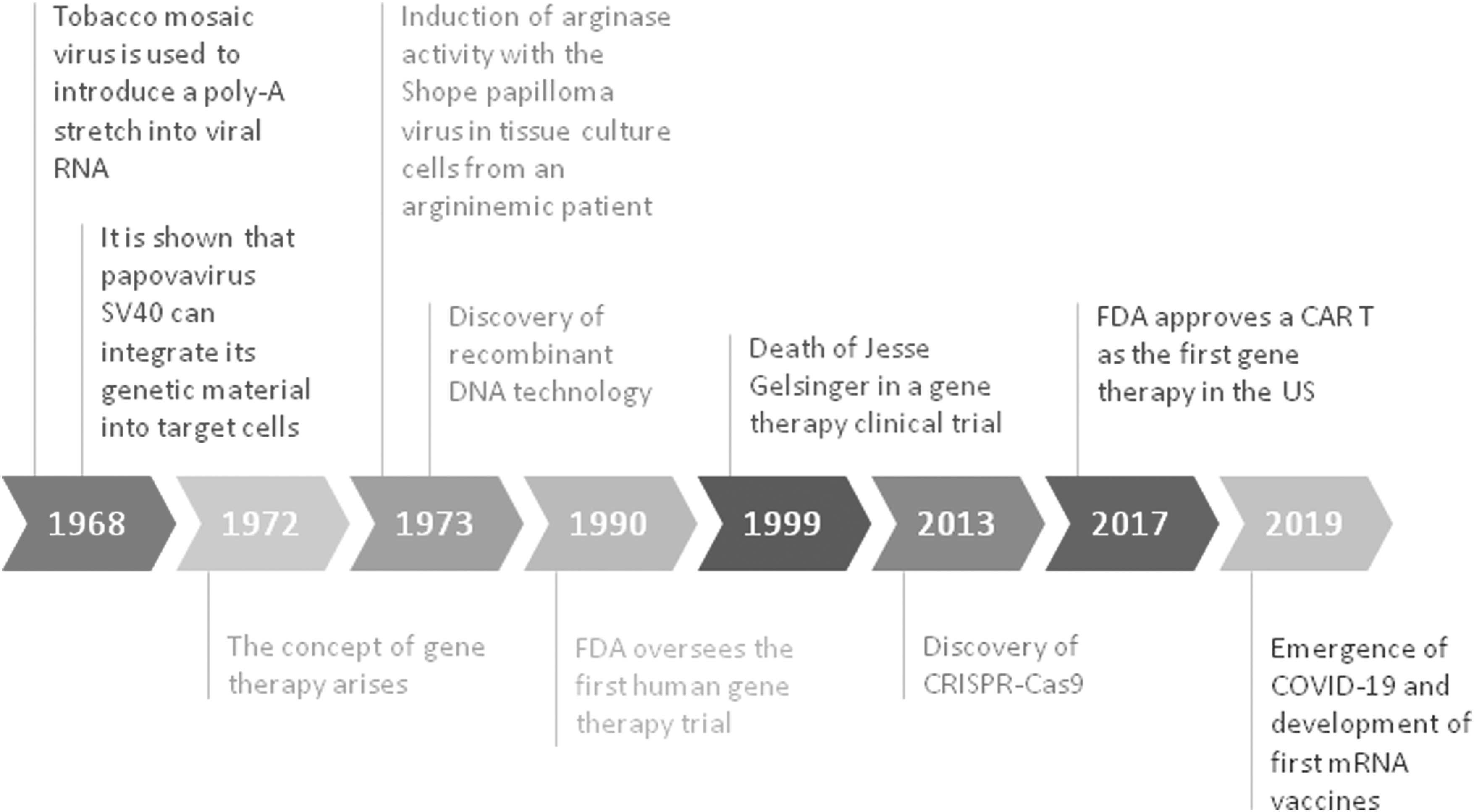
Timeline highlighting milestones of gene therapy
In 1990, U.S. Food and Drug Administration (FDA) oversaw the first human gene therapy trial with an attempt to treat adenosine deaminase deficiency by introducing the gene encoding the missing enzyme to cells ex vivo, but the effect of this treatment did not persist and the patients needed to continue receiving enzyme replacement therapy. 7 Nine years later an unfortunate outcome occurred when 18-year-old Jesse Gelsinger, who suffered from ornithine transcarbamylase deficiency, died in a gene therapy clinical trial due to his immune system's response to viral vectors. 8 After this tragic death, a great amount of scientific work has been conducted to increase the safety and efficacy of gene therapy for treating human diseases. 9
DUBITABLE SUBJECTS
Because gene therapy is a rapidly evolving field, there have been debates over whether new therapies should be classified as gene therapy. Following are some examples of those dubitable subjects:
In 1965, it was reported that a small entity in some adenovirus isolations existed, which was called AAV. 10 AAV would later be used as a vector in gene therapy. Because AAVs are predominantly nonintegrating viral vectors and the transferred gene will not be incorporated into the genome of the cell, there is a disagreement on whether therapies using AAVs as vectors should be considered gene therapy.
The discovery of CRISPR-Cas9 in 2013 revolutionized the field of gene therapy. In CRISPR-based gene therapy, the material introduced into cells is not just genetic material, it is gene-editing machinery. This makes CRISPR-based therapy different from all gene therapy treatments that had been previously developed.
Another example is CAR T cell therapy, which is an ex vivo therapy and was approved by the FDA as the first gene therapy in the United States 4 years after the discovery of CRISPR-Cas9. 11 CAR T cell therapies do not address gene dysfunction and give T cells the ability to target tumors ex vivo and, therefore, scientists have debated whether they should be considered to be gene therapies. 12
Oligonucleotide therapy uses short sequences of nucleic acids to influence gene translation and, therefore, the genome of the cell is not affected. This kind of therapy is, therefore, also a subject of debate about whether it should be considered to be gene therapy. 12
DEFINITIONS
Although the field of gene therapy is a growing field and there is a need to define it clearly, different agencies and organizations have not reached a consensus about definitions for this kind of therapy.
As shown in Table 1, the definition of several agencies emphasize using genetic material to cure or prevent diseases, some emphasize altering the genetic material of human body cells to cure or prevent diseases, and other agencies' definitions cover both. Thus, there is no specific and clear definition provided by the agencies for gene therapy, and this has always led to discussions over what exactly gene therapy is. In 2018, Sherkow et al suggested a new definition for gene therapy as “the intentional, expected permanent, and specific alteration of the DNA sequence of the cellular genome, for a clinical purpose.” 21 However, the definition of gene therapy for major regulatory and advocacy organizations has not yet changed.
The definition provided by different agencies for gene therapy
PHS, Public Health Service; RNA, ribonucleic acid.

mRNA vaccine mechanism of action.
EMERGENCE OF COVID-19
Reports of a pneumonia-like disease, which would be known as COVID-19, were first documented in late 2019. The concept of mRNA vaccine was first developed in the 1990s. 22,23 After years of research, this technology was ready at the time of the emergence of COVID-19, and so Moderna and Pfizer/BioNTech developed COVID-19 mRNA vaccines. There is an organized anti-vaxxer movement to oppose the use of widespread use of vaccines, and these people took advantage of semantic ambiguity in the field of gene therapy to sow doubt and fear about whether mRNA vaccines alter the genome of humans.
SCIENTISTS REACTED TO ANTI-VAXXERS
At this time, many scientists reacted to the disinformation being spread by anti-vaxxers. Websites including Reuters, Forbes, PolitiFact, the website of genomics education program in the United Kingdom, and many others disagreed with calling mRNA vaccines gene therapy and even Twitter blocked the accounts of many of its users who had called mRNA vaccines gene therapy. 24 –27 The disagreement among scientists on defining gene therapy got worse because those who believed gene therapy is a type of treatment that alters the human genome to cure or prevent diseases insisted that mRNA vaccines are not gene therapy, which confronted the arguments of anti-vaxxers.
However, those who believed that gene therapy is a type of treatment that uses genetic material to cure or prevent diseases emphasized that mRNA vaccines are considered gene therapy because they introduce genetic material into cells of the human body to prevent COVID-19 infection. Thus, people in academia did not have a uniform and consistent reaction to the anti-scientific disinformation.
This disagreement among scientists in the field led to arguments that wasted a lot of energy and time. Stefan Oelrich, a member of the board of management of Bayer AG and head of the pharmaceuticals division said at the 2021 World Health Summit (WHS), “Ultimately the mRNA vaccines are an example for cell and gene therapy. I always like to say, if we had surveyed two years ago, in the public would you be willing to take gene or cell therapy and inject it into your body, we would probably have 95% refusal rate, I think this pandemic has also opened many people's eyes to innovation in the way that was maybe not possible before.”
One of those arguments occurred on social media after George Church, who is a pioneer in the fields of synthetic biology and personal genomics, mentioned COVID-19 vaccines as an example of gene therapy at an Intelligence Squared U.S. debate, and Antonio Regalado, who is a biomedicine editor at MIT Technology Review, disagreed with him. In that discussion, George Church argued that gene therapies consist of genes just as monoclonal antibody therapy consists of antibodies and protein therapy consists of proteins. Genes can be RNA or DNA and, for example, in viral delivery of therapies, and can interconvert through reverse transcriptase and RNA polymerase.
Dr. Church mentioned that also other gene therapies can be preventative and they are often more effective if used before the onset of symptoms. In addition, Henry Greely, who is a professor of law and professor, by courtesy, of genetics at Stanford, mentioned that mRNA vaccines are not considered gene therapy based on the definition that is group proposed. 21 He also emphasized that we all need to remember that definitions are not an effort to nail down a deep reality, but are tools to be used and should be judged, and sometimes rejudged, by their usefulness, and that having one good definition is more useful than having many conflicting ones.
LESSONS FOR THE FUTURE
For some subjects, it can be difficult-to-impossible to achieve consensus on a precise definition of a term, but a unique definition is always necessary for regulatory purposes, improving the public's understanding of a scientific term, 21 and to avoid extensive discussion on semantics. For gene therapy, the lack of a unique and clear definition for a growing field led to a disagreement among scientists in the field, of which anti-vaxxers have taken advantage to spread disinformation and further complicate discussion in this field. There is always a need to have clear terminology in science, especially in the rapidly evolving fields, to avoid arguments on semantics and keep scientists focused on their research instead of wasting time and energy on unproductive discussions as well as to prevent the spread of anti-scientific disinformation.
Footnotes
AUTHOR DISCLOSURE
No competing financial interests exist.