




Abstract
The year 2023 marks the 20th anniversary of the British Society for Gene and Cell Therapy (BSGCT). In these 20 years, the field of gene and cell therapy has gone from promising strategy to clinical reality. This report describes the history, objectives, organization, and activities of BSGCT to advance research and practice of gene and cell therapy in the United Kingdom.
Twenty years ago, gene and cell therapy was still a dream and there was a clear need for scientists to co-ordinate their activities and to communicate better with the general public. In the United Kingdom, this spearheaded in 2003 the formation of a steering executive committee including some of us: Eric Alton, Andrew Baker (Treasurer), Charles Coutelle, George Dickson (Secretary), John Fabre, Nagy Habib, Richard Harbottle, Susan Kingsman, Nick Lemoine, Ann Logan, Vivien Mautner, Andrew Mountain, Len Seymour (President), Adrian Thrasher, and Dominic Wells.
The same year, this committee coordinated the foundation of the British Society for Gene Therapy (BSGT), which was formally registered on November 14. In 2004, elections were held, and Len Seymour was elected as founding president of the society, post in which he served until 2009. Len was followed by Adrian Thrasher (2009–2013), Andy Baker (2013–2017), Uta Griesenbach (2017–2021), and the current President Rafael Yáñez (2021–2025).
In 2012, the society's membership voted to change the name to the British Society for Gene and Cell Therapy (BSGCT), acknowledging the inextricable intertwining of gene therapy and cell therapy. The names of all board members who have served the society are shown in Fig. 1. Photographs of the boards in 2013 (first board picture available, at the 10th anniversary) and 2023 (latest, at the 20th anniversary) are included in Fig. 2.
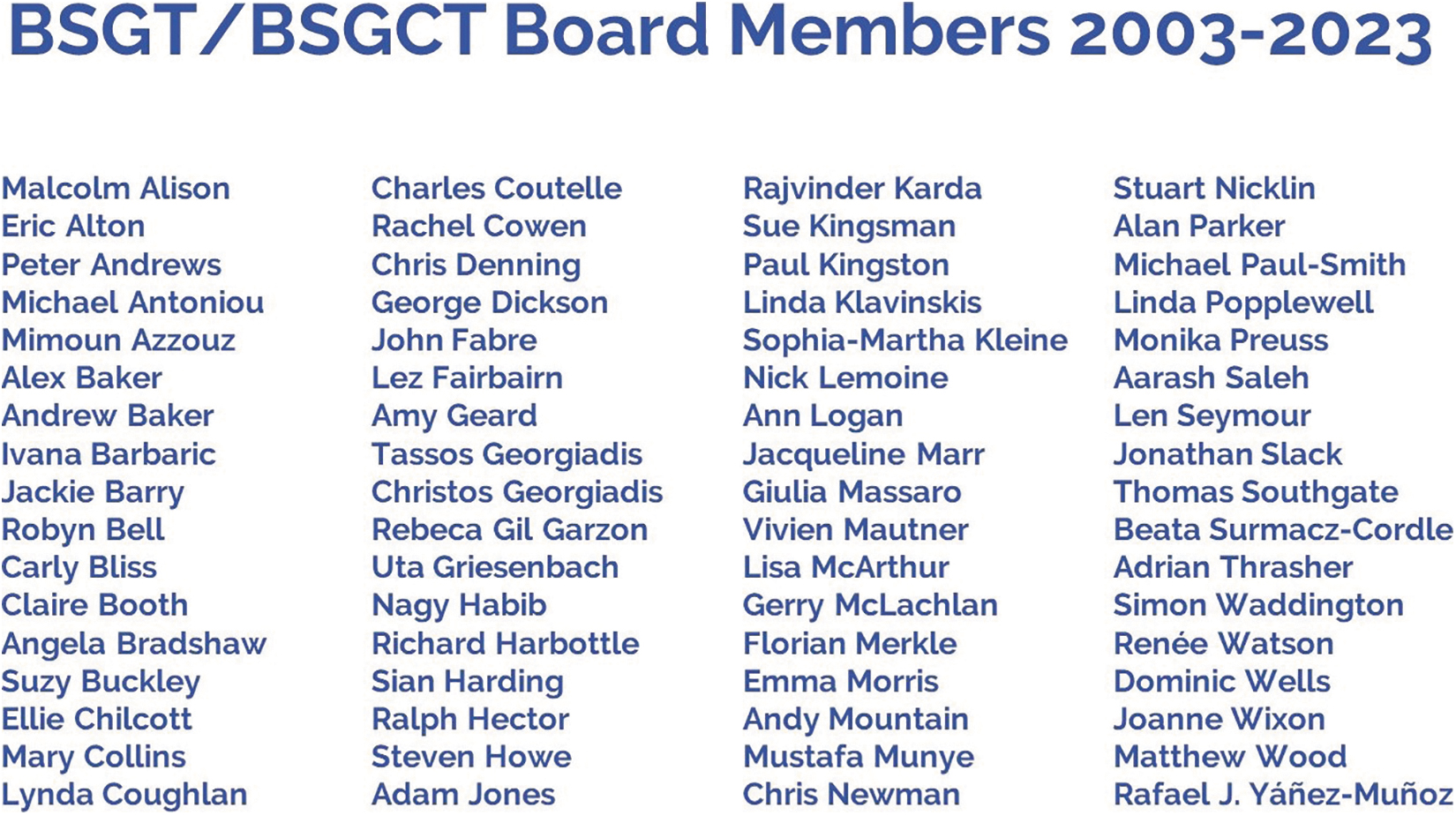
Alphabetical list (by surname) of all BSGT/BSGCT board members who have served the society from its foundation in 2003. BSGCT, British Society for Gene and Cell Therapy; BSGT, British Society for Gene Therapy.
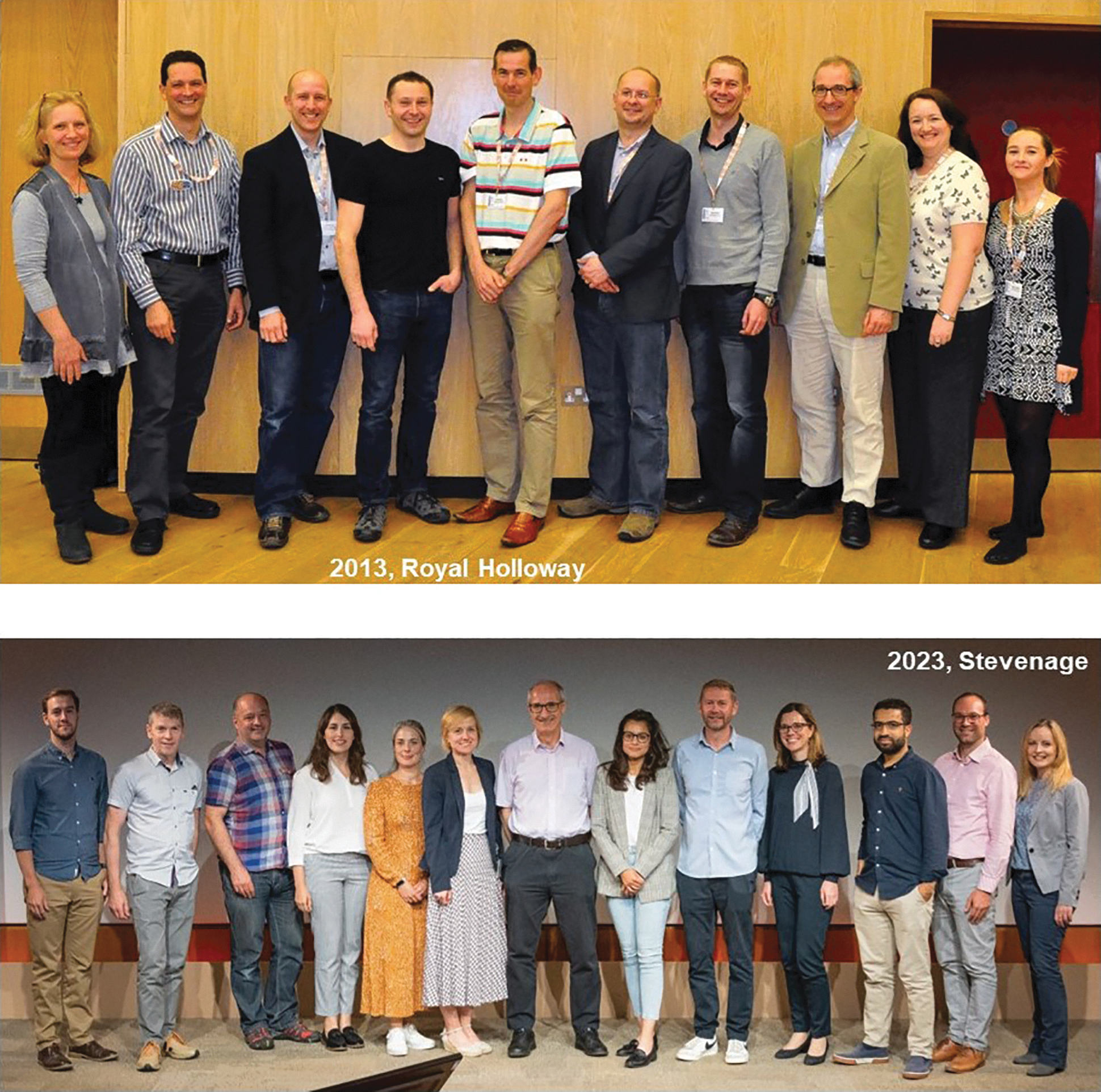
Top: Board picture from 2013, at the 10th anniversary conference in Royal Holloway University of London. From left to right: Uta Griesenbach, Chris Denning, Steven Howe, Simon Waddington, Andrew Baker, Adrian Thrasher, Stuart Nicklin, Rafael Yáñez, Suzy Buckley and Lynda Coughlan. Bottom: Board picture from 2023, at the 20th anniversary meeting in Stevenage. From left to right, Alex Baker, Gerry McLachlan, Alan Parker, Rebeca Gil Garzon, Giulia Massaro, Beata Surmacz-Cordle, Rafael Yáñez, Rajvinder Karda, Stuart Nicklin, Ivana Barbaric, Mustafa Munye, Florian Merkle, and Carly Bliss.
An inaugural department of health-sponsored meeting of the steering committee was held in 2003 at the Medical Research Council (MRC) Head Office in London. The first activity of the committee was a letter to Lancet criticizing the British Broadcasting Corporation (BBC) for their Horizon program “Trial and Error.” After the death of Jesse Gelsinger in 1999, in a clinical trial for ornithine transcarbamylase deficiency at the University of Pennsylvania, this BBC program gave the strong and explicit message that gene therapy was no longer a valid research area and that all work with viral vectors had been halted, which was not correct. 1
The society is governed by a Memorandum and Articles of Association, which state that the objects of the society shall be to advance the science and practice of gene therapy for the public benefit, in particular (but not exclusively) by: i. advancing diffusion of scientific knowledge in the field of gene and cell therapy; ii. facilitating sharing of scientific resources in the field of gene and cell therapy; iii. facilitating clinical advancement of gene and cell therapy technology; and iv. providing expert advice to strategic, regulatory, ethical, and funding bodies in the United Kingdom.
Objects i–iii were initially served through the organization of annual scientific conferences and public engagement events. The first annual conference was held at Keble College, Oxford, in March 2004, and sponsored by the International Society for Cell and Gene Therapy of Cancer (ISCGTC). To date, 19 conferences have been held, the annual flow only altered by the organization of two themed conferences in 2018 (on Lentiviral and other retroviral vectors, and Genome editing for gene and cell therapy), and interrupted by the COVID-19 pandemic, which precluded their celebration in 2020 and 2021.
Two of the conferences, Brighton 2011 and Edinburgh 2022, were jointly held with the European Society of Gene and Cell Therapy (ESGCT). The latter, with ∼2,100 attendees, was our largest ever event. Next year we will celebrate the 20th conference, Oxford 2024.
Public engagement was a core goal for the society from the outset. The first outreach event took the form of a session celebrated at the beginning of the Manchester 2005 annual conference. This quickly evolved to a full-day event under the leadership of Renée Watson, the first manager of the society. Initially called Journeys in the Genetic Jungle, the first full-day event was held ahead of the annual conference at Imperial College in 2006. Later referred to as the Society's Public Engagement Day (PED), it is regularly attended by ∼300 secondary school students and other interested parties. Talks by people affected by genetic diseases or their family members are always a highlight, to put research efforts into context and discuss risk/benefit from a much more informed perspective. The society has also participated in Rare Disease Day activities from 2011 and developed hands-on outreach materials, like the “Genes in Action Curiosity Box,” in partnership with The Curiosity Box Ltd. For many years, the society supported In2Science, thus promoting social mobility and diversity in science, technology, engineering, and medicine, and more recently this support has been channeled through a yearly program of BSGCT undergraduate research bursaries.
The society has always been very supportive of early career researchers (ECRs). ECR representatives have been selected to serve on the board of the society from 2010, with equal standing to elected members. The society provides ECRs with multiple career development opportunities, including membership of conference organizing committees, cochairing of meeting sessions and abstract reviewing.
ECR representatives lead the Society's Early Career Development and Collaboration (ECDC) subcommittee, they organize an annual ECR event, an ECR webinar series and a writing competition, and coordinate the BSGCT mentoring scheme. ECR representatives also lead the society's communications and promotion activities. Most conference prizes are awarded to ECRs, including the prestigious Fairbairn Award, established to honor the memory of Lez Fairbairn, who chaired the Manchester 2005 conference and had agreed to become the next president of the society, before his untimely death.
The society's activities are coordinated by four subcommittees. In addition to the already mentioned ECDC, we have a Public and Patient Engagement subcommittee, which organizes the PED and a dedicated webinar series; a Communication and Promotion subcommittee, leading on website, newsletter, blog, and social media; and an Equality, Diversity, and Inclusion (EDI) subcommittee, whose principles inform all activities of the society, and which reaches out to enhance Global Majority membership.
The society regularly convenes an advisory panel, the BSGCT Partner Forum, including regulatory and other government organizations, funding agencies, large pharma, small and medium-sized enterprises, biotech startups, industrial partnership experts, patient groups, and BSGCT representatives, with the following goals: to provide a forum to allow engagement with the BSGCT, to provide strategic advice to the BSGCT, to disseminate information on relevant BSGCT activities and initiatives, and to identify and help overcome challenges to the development and adoption of advanced therapy medicinal products. In 2023, BSGCT also established a partnership with The Bioindustry Association (BIA) that groups the life sciences and biotech industry in the United Kingdom.
Given the breadth and number of activities routinely organized by the society, it is also considered important to set strategic goals to ensure that novel priorities are supported. For the 2021–2025 period, these goals are to increase the membership of the society, for it to be truly representative of the gene and cell therapy community in the United Kingdom; to establish the EDI subcommittee; and to ensure that training and promotion opportunities within the BSGCT board allow for an equal, diverse, and inclusive distribution of officer posts.
BSGCT currently has a membership of ∼300 people, with a split of ∼30% academic and 10% industry; a large proportion of members are postgraduate and undergraduate students, and some are private citizens. The society's web address is
To promote and acknowledge excellence and commitment, facilitate collaboration and attendance to conferences, and training, the society will from 2024 award the following prizes and financial support to existing members:
BSGCT outstanding achievement award (biennial)
BSGCT services to the society award (biennial)
BSGCT patient and public involvement and engagement award (biennial)
ECR conference awards: Fairbairn, best oral and best poster presentation
ECR travel grants
ECR writing competition
Undergraduate research bursaries
The last 20 years have been a rollercoaster for the gene and cell therapy field. After considerable difficulties, resounding successes have been obtained on multiple fronts: mRNA and viral vector COVID-19 vaccines, oligonucleotide, viral vector and genetically modified cells for multiple inherited diseases, and CAR-T cells for lymphoma and leukemia, to name a few. Commercialization of these life-saving therapies is progressing rapidly, to ensure a sustainable supply and widespread adoption. Although challenges exist, it is undisputable that gene and cell therapy is no longer a promise and indeed is a reality. The society is proud of the contribution of the U.K. science community to this endeavor. We look forward to the next 20 years.
Footnotes
ACKNOWLEDGMENTS
The authors thank the society's managers Renée Watson (2003–2004), Rachel Mager (2004–2009), Clare Beach's Azura Events (2009–2018), Renée's Wats.On Consultancy Ltd. (2018–2023), and the current managers, Lumina Partners Europe Ltd. (2023 onwards). Simon Waddington helped researching the history of the society, and Alan Parker and Beata Surmacz-Cordle made helpful suggestions for the article.
AUTHORs' CONTRIBUTIONS
L.S., A.T., A.B., and U.G. contributed to writing—reviewing and editing. R.J.Y.-M. was involved in conceptualization and writing—original draft preparation.
AUTHOR DISCLOSURE
All authors have been (L.S., A.T., A.B., and U.G.) or are (R.J.Y.-M.) presidents of BSGCT.
FUNDING INFORMATION
No funding was received for this article.