




Abstract
Antibody gene transfer offers a promising solution to the high cost and frequent administration of monoclonal antibodies (mAbs), enabling the body to produce its own drugs economically and sustainably. This review addresses the challenges faced by antibody therapies, including economic and environmental impacts, as well as patient-related issues such as efficacy and tolerance. We propose that direct in vivo protein production, or autologous production, via plasmid DNA (pDNA) injection may address some of these challenges. This pDNA-based strategy provides a cost-effective alternative while maintaining flexibility and adaptability for various proteins, making it suitable for a wide range of pathological contexts. Additionally, gene therapy with plasmids could reduce the need for frequent injections, improving patient compliance. In this review, we provide an overview of the pioneering studies that introduced the use of pDNA for in vivo protein production. We focus on key factors for successful autologous production, such as plasmid design, vectorization, and methods of administration. Finally, we explore various applications where autologous production could serve as a promising alternative for therapeutic antibody treatments.
INTRODUCTION
Direct nucleic acid (NA) injection for autologous protein production is emerging as a transformative approach and a compelling alternative to conventional antibody therapies. The objective of this review is to demonstrate that it could provide patients with an alternative to the often-burdensome monoclonal antibody (mAb) therapies while remaining safe, less expensive, and more environmentally sustainable.
Currently, mAbs represent one of the largest markets in pharmaceuticals, with $114 billion in global sales revenue in 2019 and an expected $300 billion by 2025. 1 The characteristics and roles of immunoglobulins and engineered antibodies have been thoroughly detailed in numerous review articles. 2 As an example, Muromonab-CD3®, a mAb targeting CD3 used for kidney transplant rejection, was the first antibody approved as a therapeutic drug by the Food and Drug Administration (FDA) in 1986. 3 Since then, 164 antibodies have been approved by regulatory authorities, with 10 currently under review. Since 1997, 55% of approved antibodies have been developed to treat cancer, while 45% target noncancer conditions such as autoimmune disorders, infections, and chronic inflammatory diseases. 3 Despite its potential, antibody therapy still faces challenges at both the societal level (ecological, economic) and the individual patient level (efficacy, tolerance), all of which need to be addressed moving forward. 4 One of these challenges is the economic and environmental impact of production. The requirement for large-scale mammalian cell cultures leads to very high production costs, while the storage of these products demands significant energy. Another limitation that must be addressed in the future is efficacy and safety. This encompasses factors such as the route of administration, adverse effects, and the long-term response to injections. Repeated antibody injections, for instance, may lead to faster clearance over time, potentially requiring more frequent doses. 5 This can negatively affect patient compliance, also known as drug adherence. Poor medical adherence is a significant challenge in health care, contributing to hundreds of thousands of preventable deaths each year and resulting in billions of dollars in avoidable health care costs. 6
A possible solution to address the aforementioned challenges, such as medical adherence, could be the use of NAs for autologous protein production. Instead of relying on in vitro cell cultures, NAs could be directly used in vivo, so the patient can produce their own mAbs, offering a novel and more efficient approach to therapeutic protein production. Among the various NAs used as therapeutics, plasmids have the potential to be excellent candidates for enabling the long-term production of biologics. NAs are biological molecules essential for all forms of life, responsible for storing and transmitting genetic information. They naturally exist in all living organisms, whether eukaryotic or prokaryotic, and including viruses. Their structures and mechanisms by which they function are well known and have been described in multiple publications. 7 –9 Since the discovery of the DNA structure in the mid-1950s, various types of NAs with different functions have been identified, including plasmid DNA (pDNA), which are extrachromosomal molecules originally expressed in bacteria. 10 Plasmids are double-stranded NAs that carry genetic information and facilitate the expression of various proteins. They are categorized as coding NAs (cNAs), along with DNA, messenger RNA (mRNA), and certain forms of viral RNA. Different conformations of pDNA have been described in the literature 11 and are graphically represented in Fig. 1A. Currently, NAs have been recognized for their numerous therapeutic uses in medicine, giving rise to a new area of research called gene therapy. 9,12 Nevertheless, as history taught us in the early 2000s with the setbacks in gene therapy, 13,14 careful attention must be given to the safety profiles of these therapeutics to ensure that gene therapies can advance as safely as possible.

Plasmid DNA vector and minicircle production.
Throughout this review, we will explore how plasmids can offer new therapeutic approaches, such as autologous protein expression, enabling autologous production. We will also discuss key factors in designing plasmids that may influence therapeutic success, such as the safety profile. Finally, we will identify the various fields of application where plasmid delivery through intramuscular (IM) injections could offer a promising alternative for patients following a biological therapy while also reducing high therapeutic costs and addressing environmental and energy concerns.
AUTOLOGOUS PRODUCTION
Autologous protein production may be defined as the in vivo and in situ self-production of proteins after an injection of cNA (e.g., pDNA) into the organism (Fig. 2). The term “autologous” refers to material derived from the same individual, commonly used in the context of transplantation therapies. In the literature, autologous protein production of therapeutic mAb is most often referred to as “DNA or plasmid encoded […],” “nonviral gene therapy,” “NA-based therapeutics,” etc. Today, with the recent global pandemic appearing to have opened new opportunities for NA-based therapies, a new path may be emerging for DNA-based production in antibody therapy. This exploration, however, has been underway by researchers for several decades.
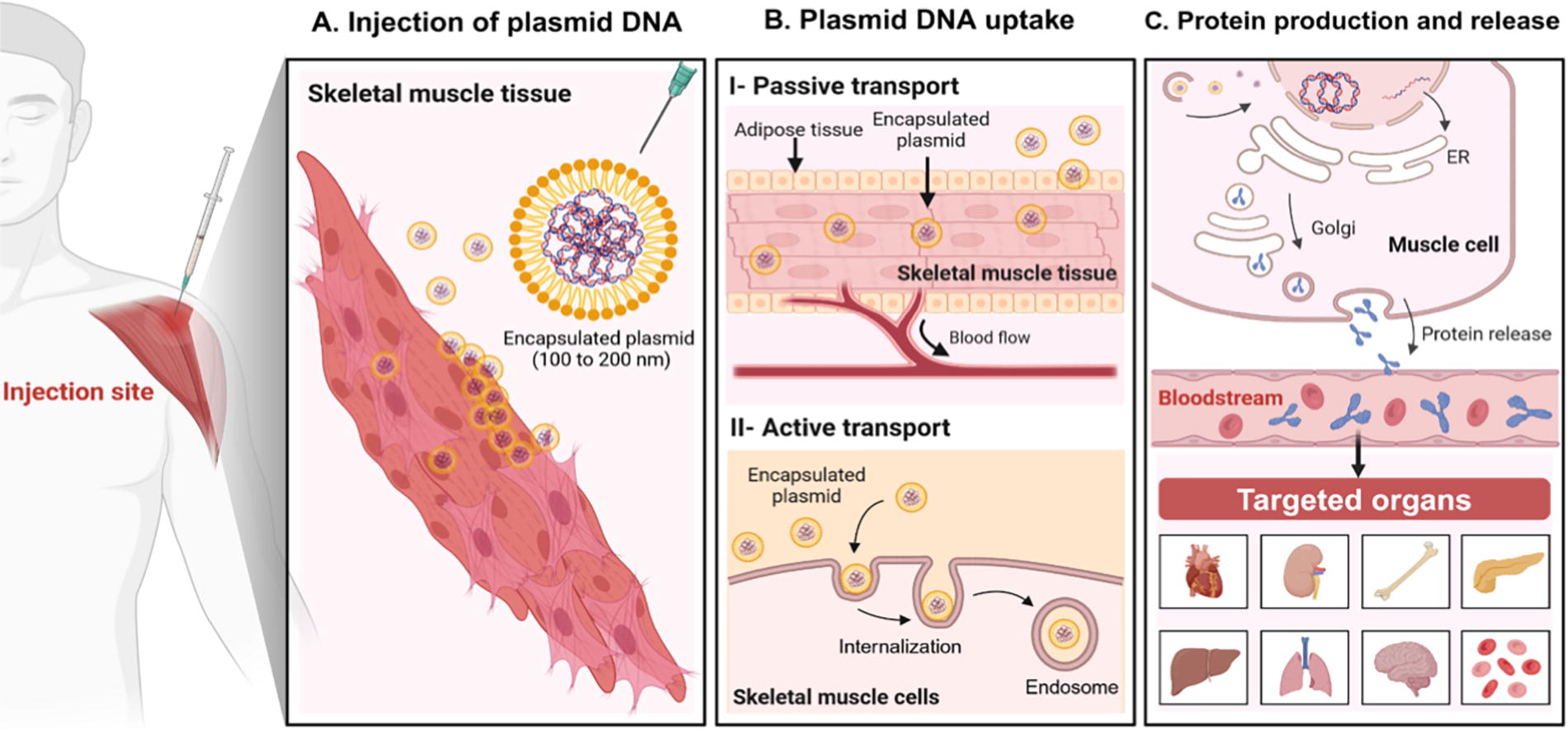
Protein autologous production following intramuscular injection of plasmid DNA. Following an injection of pDNA in the skeletal muscle tissue, plasmids will spread throughout the tissue and connect with surrounding cells
First trials
The first study reporting autologous production of a large panel of proteins dates back to 1990 and evaluated the injection of cNA, such as naked DNA/RNA, directly into the skeletal muscle tissue of mice. 15 In this study, naked pDNA and RNA encoding for reporter genes were injected into the quadriceps of mice. Following the injection, a signal from the reporter enzymes was detected not only in the nearby tissues but also in smaller amounts in other tissues (liver, spleen, skin, lung, brain, and blood); however, the signal was notably stronger near the injection sites. As expected, the protein signal measured over time in the muscles depended on the initial dose of NAs injected. Although a decrease in the presence of pDNA/RNA over time in muscle tissues was observed, foreign DNA was still detected 30 days later, and enzyme activity was detected 60 days after the initial injection of pDNA. 15 The researchers ensured that these results were attributed to the persistence of the construct in the cells in a circular form and not to its integration into the host genome. Following their previous work, Wolff et al. attempted to determine whether IM injection of plasmids could remain stable for the long term. 16 They demonstrated that the injection of the luciferase gene reporter expression vector (pRSVL) into muscle tissue enabled the expression of luciferase even 19 months after a single dose of 100 µg of pRSVL. In their study, Wolff et al. confirmed that the long-term expression was due to the persistence of the plasmid in muscle tissue, rather than its ability to autonomously replicate within the cells. Furthermore, they confirmed that the plasmid did not integrate into the host genome. The pRSVL construct carries an ampicillin resistance gene, and transformation of bacteria using total DNA extracted from muscle cells (which included nonintegrated pRSVL) resulted in the growth of ampicillin-resistant colonies. In contrast, transformation using DNA from cells with stably integrated pRSVL did not yield any ampicillin-resistant colonies. 16 In summary, these results indicated that IM injection of naked DNA allowed long-term protein expression by the plasmid construct while remaining in an extrachromosomal state.
Understanding these studies and extrapolating their results to a more human-relevant in vivo model was expected. IM injections of pRSVL were conducted in rhesus monkeys (Macaca mulatta). 17 First, as observed in mice, the results showed a linear dose–response relationship between luciferase activity in skeletal muscle tissue and the quantity of injected pDNA. The injection of a single dose of pRSVL revealed a peak of luciferase expression at 2 weeks and lower but stable expression up to 4 months. However, compared with other species, it was clear that the expression of luciferase measured in monkey muscle cells was much lower, approximately 30-fold less than in mouse muscle cells. As for toxicity, no antidrug antibodies were detected in the serum of monkeys after 16 weeks of higher injection doses of pDNA (up to 12 mg in total). This study suggested for the first time that this approach could still potentially find future clinical applications for immunization.
It is clear that exploring new molecular approaches, such as plasmid design strategies, along with improving gene delivery methods, could enable successful applications of autologous production. Therefore, addressing safety concerns related to plasmid gene therapy should be a major focus of research in the coming years.
KEY FACTORS
Plasmid structure
Designing the sequence of interest
While designing a pDNA, attention must be focused on the nucleotide sequence of the protein of interest (POI) that will take place in the multicloning site (Fig. 1B). Verification steps such as nucleotide sequence alignment or 3D molecular prediction may be helpful in preventing the expression of a nonfunctional protein. Also, depending on the therapeutic strategy, whether local or systemic expression is expected, protein addressing must also be considered. This primarily involves secretory signal peptides, some of which have been enumerated in previous works. 18 Additional attention must be given to protein folding and chain interactions, especially in the case of mAbs. 19 Antibodies, such as immunoglobulin G, consist of two identical heavy chains (VH) and two identical light chains (VL), necessitating precise nucleotide sequence design to account for proper protein folding (due to cysteine bonds). 20 Specific cases, such as fusion proteins or single-chain variable fragments (scFv), may require a different approach to designing the coding nucleotide sequence. This is to accommodate their unique structural configurations and functional requirements, including the incorporation of appropriate linker sequences that support proper folding, stability, and biological activity. 21 In addition, a recent study demonstrated that the sequence of NA—delivered antibodies can significantly affect their expression and that codon optimization may enhance in vivo protein expression. 22
Tissue-restricted expression
Another key point to acknowledge is that even local injections of NAs may enable its uptake by other tissues. It has been shown that a small number of molecules can reach the bloodstream and other organs after a local IM injection of naked pDNA and express the POI. 15 The widespread distribution of plasmids has also been confirmed following subcutaneous injections. 23 One possible solution to avoid protein expression in nontargeted tissues is to achieve restricted expression in the targeted organ by inserting a tissue-specific promoter into the nucleotide sequence of the plasmid. For example, various synthetic muscle-specific promoters have been designed to restrict the expression of a gene of interest precisely to muscle tissue. 24 Transfection and vectorization are also key factors that can influence the tissue distribution of NAs and restricted expression of protein. This will be discussed later in this review.
Safety
The safety of pharmaceutical products is a fundamental priority in drug development. In this context, it is crucial to address the safety of plasmids, even though plasmid therapies are generally considered well tolerated, 25 their administration may lead to adverse effects. Indeed, it has long been known that unmethylated CpG motifs, which are naturally present in bacterial DNA, can trigger B cell activation and promote immunoglobulin secretion. 26 Contamination with bacterial genomic DNA in plasmid preparation can also induce a similar response. 27 Additionally, plasmid vectors must be carefully selected, as they have been shown to trigger inflammatory responses that could lead to more serious side effects. 28,29
To date, numerous advancements in plasmid molecular engineering have been made to improve safety regarding the presence of prokaryotic genetic information. One example is minicircles (mc), which are originally plasmids from which all prokaryotic sequences have been removed (Fig. 1C). Various methods for producing minicircles have been described, 30 including one that utilizes an arabinose induction system in a genetically modified Escherichia coli strain. 31 The result is a significant reduction in the size of the plasmid nucleotide sequence, greatly improving the transgenes expression in vivo. 32 Various studies have already explored the therapeutic applications of minicircle DNA (mcDNA), some of which will be discussed later in this review.
Addressing industrial requirements is essential to produce pDNA and mcDNA, as quality and safety are critical factors for their potential use in clinical trials. While good manufacturing practices (GMP) for large-scale plasmid production are not yet explicitly mandated by the FDA, this topic has been discussed in another publication. 33 Nevertheless, since 1996, the FDA has issued guidance and recommendations to help industry ensure the quality and safety of plasmid-based products. 34 These same principles apply to related products such as mcDNA, with quality control measures focused on the removal of contaminants such as RNA, proteins, genomic DNA (to undetectable levels, typically <1%), and maintaining endotoxin levels below defined safety thresholds. 34 A comprehensive overview of the preparation and quality requirements specific to mcDNA production has been thoroughly reviewed by Gaspar et al. 30 Also, according to the European Medicines Agency (EMA), although pDNA is generally considered to have a relatively low risk of genomic integration (particularly following IM injection), this risk may be altered by the choice of vectorization method and therefore must be carefully evaluated. 35 Additionally, potential adverse effects and immune responses should be closely monitored, as pDNA can persist in the host and support long-term protein expression. 35
Stopping autologous production of biologicals
Long-term autologous protein production faces several challenges, with therapy safety being the most critical concern. For patients, prolonged exposure to biologics such as mAbs requires regular checkups by physicians to monitor side effects and overall health. In specific situations, such as during a pregnancy, 36 the diagnosis of severe infection or cancer, patients and physicians must be prepared to discontinue therapy promptly. While reducing doses or completely halting injections is typical for patients undergoing antibody therapy. The question remains of how to safely cease protein expression from injected NAs designed for long-term production.
In their review, Hollevoet and Declerck highlighted the control of in vivo antibody expression as a persistent challenge, noting that currently, no suitable system appears applicable for clinical use in gene therapy. 37 However, based on several theoretical studies, we can outline various methods that could be applicable for halting autologous production.
Suicide gene systems, originally emerging from cell therapies, were utilized as an on/off switch to eliminate transduced cells. 38 –40 Novel systems, such as the inducible caspase 9 (iCasp9), dimerize upon exposure to the AP1903 drug, inducing cell death by triggering caspase-dependent apoptotic pathways. 41 Based on the iCasp9 system, other similar systems have also been shown to be effective. 42,43 However, the use of the iCasp9 system as a method for arresting autologous cell production may face challenges in future clinical applications due to concerns about inducing apoptosis in healthy transduced cells, which raises significant safety issues. It would be essential to demonstrate that the suicide gene system does not negatively impact the function of the targeted organ by eliminating transduced parenchymal cells.
Another possibility could be the use of the Crispr/Cas9 system as a self-deleting system to allow the complete destruction of the targeted sequence. One study showed that adeno-associated virus (AAV) CRISPR-Cas9 system could effectively target episome and highly reduce protein expression. 44 However, because AAV may present safety concerns in gene therapy, 45 perhaps a CRISPR-Cas9 inducible system could represent a better alternative. 46
Innovative methods, such as light-responsive gene expression (optogenetics), could open up new possibilities for targeted gene expression. 47 Optogenetic control of gene expression offers a promising strategy for on-demand, localized production of therapeutic proteins by enabling precise activation of transgenes through repeated light stimulation directly at the target tissue. 48 –50 This technology may offer potential for autologous protein production, providing a safer and more controlled method for halting treatment when necessary. 51
In summary, stopping autologous production should involve a nontoxic system that is rapidly inducible without jeopardizing future NA injections. Ideally, it would function as a reversible on/off switch that is well tolerated by patients and does not hinder medical adherence.
Vectorization
Vectorization methods
In contrast to integrative gene therapy, nonintegrative gene therapy involves the transfer of NAs that do not integrate into the host genome. They can be delivered through nonintegrative viral vectors (adenovirus, adeno-associated virus, etc.) or nonviral vectors. 52,53 In nonintegrative gene therapy, NAs are introduced into a host as a transitory state, which remains in an episomal form. Following an injection, the half-life of NAs in vivo may depend on various factors such as the vectorization methods, formulation and excipients, or cell-dependent metabolism. 54 Although the first studies focused on naked NAs injection, research data have shown that vectorization of NAs is necessary to safeguard the molecules and improve gene delivery into targeted cells. 55 Indeed, injection of naked NAs into the bloodstream may result in a short half-life. 56 One contributing factor to this phenomenon could be the presence of circulating enzymes such as nucleases, which play a direct role in the clearance of NAs. 57 Additionally, toll-like receptor 9 (TLR9), expressed on the surface of red and white blood cells, acts as a DNA sensor by binding CpG-carrying DNA, thereby promoting inflammation and clearance. 58 Viral nonintegrative vectors alongside their key features previously used in clinical trials have already been established. 52 Other delivery methods, such as nonviral vectors, have been listed alongside their advantages and disadvantages. 53 As many reviews have already addressed this matter, we presented in Fig. 3 an overview of nonviral delivery methods currently being developed to improve gene delivery. 59 –72 It is worth noting that electroporation (EP) is one of the most widely used and effective methods for transferring NAs, particularly pDNA, into host cells. 73 Studies have demonstrated efficient EP of pDNA into 3D organoid models, 74 as well as successful in vivo EP following plasmid IM injection in mice. 60,75
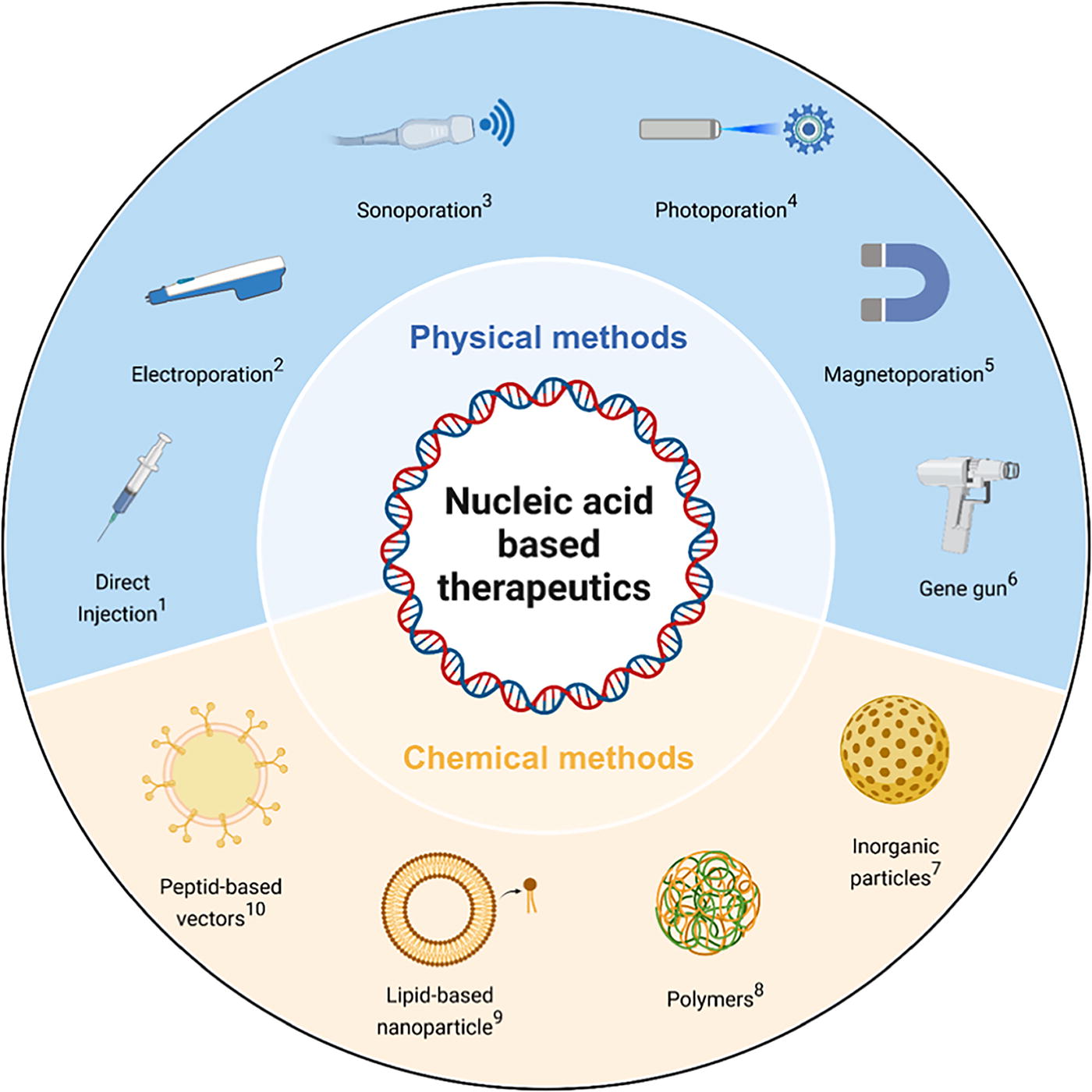
Overview of nonviral vectors for nucleic acid delivery. Nonviral vectors for nucleic acid delivery encompass physical transfection methods (blue panel) and chemical methods (yellow panel) achieved by formulation techniques. 1(Hollevoet et al., 2022), 2(Heller and Heller, 2006), 3(Pislaru, 2003), 4(Wang et al., 2023), 5(Sizikov et al., 2021) and (Li et al., 2008), 6(Watkins et al., 2005), 7(Mostaghaci et al., 2016) and (Carvalho et al., 2020), 8(Eliyahu et al., 2005), 9(Felgner et al., 1987) and (David et al., 2013), 10(Yin et al., 2010) and (Yang and Luo, 2023).
NA formulation
Formulation of NAs into lipid-based nanoparticles is a promising chemical method (Fig. 3) used to improve their delivery into specific tissues. Liposomes are vesicles formed by a lipid bilayer and can serve as vectors for drugs and NAs, such as plasmids. 76 The transfection efficiency of liposome-encapsulated plasmids is directly dependent on the incorporation of pDNA into the vesicle. 77 It has been shown that the lipid composition and overall charge of the liposome influence pDNA encapsulation and, consequently, transfection efficiency. 77 Lipid nanocapsules (LNCs) are composed of a rigid shell of lecithin and polyethylene glycol (PEG) surrounding a liquid lipid core mainly made of triglycerides. 78 To encapsulate NAs in the lipid core of LNCs, cationic lipids are complexed with the hydrophilic, negatively charged NAs to form lipoplexes. These lipoplexes are then encapsulated in LNCs. 79 Plasmid–LNCs coated with PEG have been successfully used in vivo for systemic administration in healthy and tumor-bearing mice, therefore demonstrating a prolonged circulation time, compared with noncoated DNA LNCs. 70 PEG DNA LNCs also demonstrated a specific accumulation in the tumor tissue and a tumor growth reduction using a plasmid coding for the herpes simplex virus thymidine kinase in combination with the prodrug ganciclovir. 80,81 Other vectors, such as lipid nanoparticles (LNPs), may be effective for targeting specific tissues, such as skeletal muscle. 82 Plasmid–LNPs are composed of ionizable lipids allowing the complexation with pDNA, cholesterol enhancing the stability of LNPs, a helper lipid allowing endosomal escape, and a lipid–PEG conjugate to reduce LNPs aggregation. 83 In a recent study, different plasmid–LNPs were characterized and used for the transfection of cardiomyocytes with a green fluorescent protein (GFP)-expressing pDNA. 84 Their lead LNP formulation achieved 80% transfection efficiency in cardiomyocytes in vitro and showed high fluorescence in vivo after 7 days of IV injection. NA formulation is a non-energy-intensive, reproducible method that has recently been used as the mRNA COVID-19 vaccine formulation for the IM delivery of NAs. 85 It is highly probable that this technology will continue to play a significant role in drug delivery in the future.
Administration and production
Which administration route?
There are several different routes of administration available for delivering medication, 86 each offering different benefits depending on the type of treatment and the patient’s needs. Currently, based on FDA-approved gene therapy products, 87 intravenous (IV) administration is the most commonly used route for delivering NAs in gene therapy development. However, diverse teams are exploring less common routes of administration for NAs; as an example, one is working on enabling the intact delivery of NAs through the digestive tract to achieve oral administration. 88 Additionally, a recent review has highlighted the latest advances in pulmonary delivery of NAs, the challenges, and the therapeutic perspectives for pulmonary gene delivery. 89 As we discussed, there is significant interest in NA delivery methods such as vectorization. However, it is equally important to determine the best administration route to deliver the maximum amount of NAs into a targeted organ that will become a protein manufacturer. The literature reports in vivo targeting of various organs to achieve autologous protein production, as multiple tissues seem to take up pDNA and express the POI. These include skeletal muscle, 15 heart, 90 skin, 91 thyroid glands, 92 liver, 93 joints, 94 brain, 95 and tumoral tissue, 96,97 among others. Finally, the choice of one administration route over another is not universal and should be tailored based on the specific pathology and the individual patient’s needs. Aside from the route of administration, the choice of target tissue for enabling autologous production may also need to be considered.
Targeting hepatic tissue
In 2001, Miao and collaborators were the first to achieve therapeutic concentrations of in vivo protein expression after pDNA transfer into the liver. 98 Briefly, mice were injected in the tail vein with human factor IX-encoding pDNA in a phosphate saline solution. After IV injection, pDNA was detected mostly in the liver but also in other organs. The use of a liver-specific promoter allowed restricted expression of mRNA in the liver only. Finally, neither toxicity nor immune response was reported in the injected mice. 98 Since then, many studies have been conducted on liver delivery of cNA, including the assessment of different nonviral methods to transfect hepatocytes, such as gene gun, hydrodynamic tail vein injection, and EP. 99 The liver appears to be an interesting target to achieve significant protein expression after injection of cNA. The liver excels as the body’s primary site for synthesizing proteins. Additionally, it is responsible for a significant number of post-translational modifications to proteins and is also dedicated to transporting and delivering proteins into the bloodstream. 100 However, because the hepatic system is involved in many physiological processes, safety concerns may lead to the liver being less favored as the target for gene therapies. While IV injection techniques for liver delivery are well established in mice, therapeutic application may pose greater challenges. One such challenge is the rapid clearance of NAs from the bloodstream before they reach the target organ. It has been shown that naked pDNA is quickly degraded following IV injection in mice. 56 As discussed, one possible solution is to optimize the vectorization method, while other approaches, such as the chemical modification of oligonucleotides, may improve NA pharmacokinetics by reducing their binding to plasma proteins, thereby limiting degradation in the bloodstream. 101
Targeting skeletal muscle tissue
Historically, the skeletal muscle has been widely utilized as a target for pharmaceuticals due to its easy access, making IM injections a common administration route. 102 To turn the targeted organ into a protein manufacturer, an important characteristic is its tissue cell mass; skeletal muscle tissue accounts for ∼40% of body weight. 103 Skeletal muscle tissue is mainly composed of myotubes, which are fusogenic, postmitotic, and multinucleated cells, making the tissue highly transfectable and a good protein-manufacturing tissue. 104 However, pDNA uptake by muscle cells after IM injections may depend on the size of the transfected animal and therefore the mass of muscle tissue. Results from experiments conducted in mice, rabbits, cats, and nonhuman primates showed that protein expression decreases as the mass of the animal’s muscle tissue increases. 17 One possible explanation could be the presence of connective tissue within the perimysium, which is thicker in nonhuman primates, 17 and could retain pDNA distribution and transport to the muscle cells. It has been shown that gene expression after pDNA delivery may also depend on other criteria such as muscle state, injection volume, etc. 105
Application fields
Autologous production strategy must be tailored to the specific pathology being treated. Various strategies may be employed based on the condition, with vectorization playing a key role in targeting a specific region or being systemic. The administration route, such as choosing between local versus systemic expression, and the production method, which involves determining whether short-term (e.g., immunization) or long-term (e.g., for inflammation) production is necessary, are also crucial factors.
Infectious diseases
For two centuries, vaccination has been used daily to protect us against infectious diseases. One of many reviews has admirably explored the history of vaccination since its discovery, along with the key contributors to its development. 106 Here, it would be intriguing to briefly trace the evolution of NA-based vaccination that led to the current practice of mRNA-based vaccines.
Vaccination
During the COVID-19 pandemic, the first NA-based vaccine has been approved for use worldwide. 107 Although the pandemic has highlighted the use of NA-based vaccines, IM injections of NAs for the purpose of immunization were pioneered several decades ago. Following the work of Wolff and collaborators, 16 one team has attempted to induce an antigen-dependent immune response in mice, following a quadriceps injection of pDNA, encoding for the conserved nucleoprotein of influenza A virus. 108 IM injection of pDNA encoding influenza A nucleoprotein resulted in a 90% survival rate in injected mice compared with a 20% survival rate in control mice both challenged with influenza A. In another study, intramuscular injection of pDNA encoding the hepatitis B surface antigen in mice also led to immunization against the hepatitis B virus. 109 Afterward, the same team was able to validate their results in nonhuman primates. 110 Two chimpanzees were each injected with either 400 µg or 2 mg of pDNA on four occasions (weeks 0, 8, 16, and 27). The results showed a significant difference in the antibody production response between the two injected doses. The higher dose of pDNA (2 mg) consistently led to antibody production exceeding 10 milli-international units, which was at that time considered the standard level for conferring immunization by the Centers for Disease Control and Prevention. The lower dose of pDNA (400 µg) failed to induce detectable antibody production between week 0 and week 8. However, antibody production close to the standard level was measured right after each subsequent injection at weeks 8, 16, and 27. In their study, comparisons between different hepatitis B vaccines showed that the DNA vaccine in one chimpanzee stimulated better antibody production than virus vector vaccines and was approximately as effective as the most successful subunit vaccines. The initial dose of DNA injection has a significant impact on protein expression levels in the bloodstream and consequently on the antibody-mediated immune response.
This influence on immune response likely played a role in the approval of two pDNA-based vaccines for animal vaccination in 2005. 111 The first approved in the United States was the West Nile Innovator®, developed to protect horses from West Nile virus infection, which can cause serious neurological disease. 112 The second pDNA vaccine approved in Canada was Apex-IHN®, owned by Novartis. Apex-IHN is still used today to protect fish against infectious hematopoietic necrosis virus, 111 which deadly affects salmon and trout species in freshwater systems. It is widely employed in aquaculture today to prevent viral outbreaks in fish farms. 113 During the COVID-19 pandemic, researchers worldwide have been diligently working on the development of a vaccine against SARS-CoV-2. According to EMA, two mRNA-based vaccines were authorized for use in Europe: Comirnaty® developed by BioNTech and Pfizer, and Spikevax® developed by Moderna Biotech. 114 Long-term surveillance will confirm whether the use of NAs as a tool for immunization was a complete therapeutic success. Undoubtedly, the COVID-19 pandemic has opened up unprecedented opportunities for the application of NA technology across a wide range of medical fields in the future.
Production of therapeutic antibodies
A different approach to using NAs against infectious diseases is the autologous production strategy, which enables the organism to produce antibodies on its own. This strategy could help reduce the costly and environmentally harmful mass production of antibodies.
A study in mice describes the outcome of IM injection of pDNA encoding mAbs (pDNA-mAbs), followed by in vivo local muscular EP to prevent infections from the dengue virus by antibody-dependent enhancement. 115 Mice were injected with 100 µg of pDNA encoding a neutralizing mAb with abrogated FcγR that targets the E protein of the virus, coupled with an IgG1 chain, immediately followed by EP. Analysis of mouse serum showed antibody production lasting at least 4 weeks, with a serum concentration >1000 ng/mL for up to 2 weeks. 115 Other models with physiological characteristics closer to humans, such as similar weight or blood volume, have been tested for IM administration of pDNA-mAbs followed by EP. In one study, pigs were injected with up to 24 mg of pDNA encoding a human mAb for the treatment of influenza virus infection. 116 Plasmid injections had a beneficial effect and helped reduce the virus load, although the pigs developed an antidrug antibody (ADA) response against the human antibodies. pDNA-mAbs encoding a mAb directed against the Zika virus has also been tested in both mice and Rhesus macaques. 117 Five nonhuman primates received three sequential IM injections of 6 mg of pDNA (18 mg in total) followed by EP. mAb expression ranged from 200 to 800 ng/mL for up to 3 weeks, significantly reducing viral load. Although EP administration methods may be challenging to implement for human therapy, we have observed that alternative approaches, such as formulation, could offer a promising solution.
Cancer and immunotherapy
Cancer is one of the most prevalent health issues and is responsible for a significant number of deaths worldwide. 118 Over the past 50 years, cancer research has attracted considerable attention and has become a leading field of study. The growing need to understand the disease and develop new therapies is driving ongoing research efforts. Novel cancer gene therapies include noncoding RNA therapeutics such as microRNA (miRNA) or small interfering RNA (siRNA), 119 cNA transfer, and immunotherapies. 120 The use of cNA against cancer, particularly pDNA, has been reported to be employed in multiple cancer therapeutic applications such as cancer DNA vaccines or DNA-encoded mAbs (DMAbs). 121
Cancer vaccines
Like immunization, cancer DNA vaccines aim to trigger a long-lasting immune response against specific tumorous cells. This strategy employs DNA-encoded molecules in order to induce the production of tumor-associated antigens, which are mostly overexpressed proteins found in certain forms of cancer, or tumor-specific antigens (TSAs), which are mutated self-proteins expressed by specific tumors. 122 One of many studies has reported the efficacy of cancer DNA vaccines in vivo, showing significant tumor regression in mice after IM injections of pDNA encoding human heat shock protein 70 (HSP70) fused to the mucin1 TSA (Muc1), which is overexpressed in certain forms of adenocarcinomas. 123 In their studies, the fusion of Muc1 and HSP70 enhanced interactions between antigen-presenting cells and antigen-specific T cell response. Combining the Muc1 peptide with other components proved to be more efficient than using pDNA encoding the peptide alone, as the latter was less capable of triggering an immune response. 124 Other results revealed that coadministration of Muc1-encoding pDNA and the immune adjuvant Fms-like tyrosine kinase 3 ligand could induce a stronger immune response against Muc1-expressing colon cancer. 125 Additionally, IM injections of mice with either pDNA encoding for ovalbumin or α-PD-1 mAb induced a weak inhibition of tumor growth, whereas the combination injection of both pDNAs increased tumor growth inhibition. 126 Their pDNA sequences, carrying specific skeletal muscle promoters, showed efficient protein expression and secretion by the skeletal muscle tissue.
mAbs against cancer
Antibodies have proven to be very efficient in the treatment of cancer, with many having been approved by the authorities and currently being employed as cancer therapy. 127 Initially, it was suggested that cNA encoding mAbs could address certain limitations of currently used mAbs. The first gene delivery platform reported in the literature for DMAbs was viral-based vectors, but primarily safety concerns led to the exploration of nonviral approaches such as mRNA or pDNA-mAbs. 128 One of the first applications using pDNA-mAbs against cancer was reported in 2016 by Kim and collaborators. 129 They designed a pDNA encoding the mAb trastuzumab (Herceptin), which is currently used against HER2-expressing breast cancer. They injected the pDNA intramuscularly, followed by EP in mice subjected to HER2-positive human breast carcinoma xenografts. A single IM injection of 100 µg of pDNA reduced tumor growth and showed similar results to four IV injections of trastuzumab at 10 mg/kg. They suggested that pDNA-mAbs could represent a promising alternative to the high cost of mAb therapy currently used in cancer treatments. 129 In a separate investigation, pDNA-mAbs that encode a human antiprostate-specific membrane antigen (PSMA) were administered into the quadriceps of mice, followed by EP. 130 The findings indicated that the in vivo generation of anti-PSMA mAbs in mice with transgenic adenocarcinoma mouse prostate (TRAMP)-C2 tumors inhibited tumor growth and notably enhanced survival rates. A subsequent work presented similar results with IM injection followed by EP of pDNA encoding the immune checkpoint inhibitor cytotoxic t-lymphocyte-associated protein 4 (CTLA-4). 131 These studies highlight that IM delivery of pDNA followed by EP appears to be an intriguing approach for autologous protein production. Achieving in vivo therapeutic concentrations of a POI in the serum induces significant physiological responses that can reduce tumor growth and enhance survival rates. There have been suggestions that tumor tissue could also be transformed into a site for protein manufacturing, thus enabling direct protein expression within the tumors. 64 However, unlike skeletal muscle tissue, depending on tumor locations, it might be more challenging to perform direct injections into the tissue. As for liver administration, the systemic route might be better suited to achieve delivery into the tumors, shedding light on nonviral methods such as cell-penetrating peptides, which have shown effectiveness for tumor pDNA delivery. 132 Furthermore, as tumors tend to create their own microenvironments, 133 researchers have identified specific gene promoters associated with certain types of cancers over the years, some of which are already utilized in cancer gene therapies. 134 Considering these data, intriguing results could emerge from testing tumor injections of pDNA carrying cancer-specific promoters using nonviral vectors, enabling tumor tissue-specific expression of a POI while limiting exposure to noncancerous tissues.
Chronic inflammatory diseases
As for cancer, pDNA-mAbs may find interesting applications to treat chronic pathologies such as autoimmune or inflammatory diseases. An early study assessed long-term protein production for the prevention of autoimmune type I diabetes by introducing a naked plasmid vector encoding an interferon gamma receptor/type G immunoglobulin 1 (IFN-γR/IgG1) fusion protein. This mAb directed against IFN-γ was shown to be effective in reducing hyperglycemia in autoimmune diabetes mouse models. 135 Induced autoimmune insulin-diabetic mice were injected twice with either 200 µg of IFN-γR/IgG1 coding pDNA or a blank vector. 136 Protein concentration in blood serum persisted >100 ng/mL for over 3 months, which was sufficient to mediate the effects of IFN-γ and significantly reduce the incidence of diabetes and the grade of insulitis. This study was one of the earliest to investigate the long-term production (3 months) of a fusion protein in vivo by combining IFN-γR with type G immunoglobulin. However, at that time, trials involving IM nonviral gene therapy failed to induce significant responses due to low protein concentrations, which could potentially be greatly improved through EP. 137 Also, protein production achieved using viral therapy had a much higher impact than that from naked cNA injections. 37 One challenge has been to demonstrate antibody production from the injection of pDNA-mAbs in animal models closer to humans in terms of weight, blood volume, and muscle mass. 37 In their article, Hollevoet and collaborators injected two cohorts of eight sheep with either 1 or 4 mg of pDNA encoding an ovine embryonic antigen mAb, followed by IM EP. 59 Depending on the pDNA injection dose, the results revealed a production of mAb for at least 6 weeks, with serum concentration peaks at 300 and 700 ng/mL, respectively. In the two cohorts, no ADAs were detected. However, one out of two sheep injected with 12 mg of pDNA reached a peak blood concentration of 4800 ng/mL, which led to the development of ADAs 2 weeks after the injection. The other sheep produced antibodies for 56 weeks, with concentrations at weeks 30 around 200–300 ng/mL, without detectable ADAs. 59 Their article demonstrated that effective long-term production of antibodies resulted in detectable therapeutic doses in the bloodstream of animals closer to humans.
Additionally, several studies have utilized antibodies-encoding mcDNA (mcDNA-Abs) for different pathological applications 129,138 –145 (Table 1.) Among them, a team used mcDNA encoding an anti-IL-6/TNF-R2 bispecific antibody to mediate the chronic inflammatory response in rheumatoid arthritis. 146 Collagen-induced arthritis mice were intravenously injected with 12 µg of bispecific antibody coding mcDNA. Although plasmatic concentration of the bispecific antibody was not assessed, a significant reduction in the severity of arthritic scores was observed in the mcDNA-transfected mice. Overall, it would be interesting to assess protein expression following an IM injection of mcDNA-Abs followed by EP. Currently, to the best of our knowledge, no such work has been reported in the literature. Nevertheless, no pDNA-mAbs or mcDNA-mAbs therapeutics have been clinically approved by the European and U.S. authorities. 12 Meanwhile, plasmid gene therapy for autologous protein production remains a promising strategy for treating various pathologies. It offers several advantages, including reducing the financial costs of biological drugs, improving patient compliance in certain therapies, and mitigating environmental issues.
Studies Using Direct Delivery of Minicircle DNA for Autologous Production of Antibodies
BsAb, bispecific antibody; IM, intramuscular; IP, intraperitoneal; IV, intravenous; MTA, multi-target agent.
PERSPECTIVES AND FUTURE CHALLENGES
In this review, we discussed various challenges faced by antibody therapies, including the economic and environmental impact of production, as well as individual patient-related issues such as efficacy and tolerance. We demonstrated that autologous protein production through pDNA injection could effectively answer some of these challenges. pDNA has a lower production cost and does not require the energy-intensive storage conditions needed for antibodies. Additionally, plasmid gene therapy could offer a promising solution for patients, reducing the need for frequent injections and thereby improving patient compliance. Few years ago, beperminogene perplasmid, a pDNA encoding hepatocyte growth factor, has been approved for use in Japan only, to promote angiogenesis in critical limb ischemia. 147 It is possible that new therapies like these may emerge in the future as alternatives to direct antibody injections.
Meanwhile, it is important to note that autologous production of biologics should remain dependent on the patient’s condition, as it may not be suitable for all patients due to their specific pathology or overall health status. We have seen that various methods can modulate the autologous production strategy (such as targeted tissues, plasmid promoters, formulations, etc.), which can be selected according to the therapeutic context.
Nonetheless, as seen in the past during gene therapy trials, the most important parameter when developing new pharmaceuticals is the drug’s safety profile. In this regard, recent advances, such as the production of minicircles, significantly reduce or completely prevent host immune responses. However, autologous production through the injection of pDNA still requires a safe and reliable system for termination whenever necessary. Currently, the few available solutions do not appear to be suitable for clinical use due to safety concerns. 37 A nonrestrictive on/off molecular switch or a system that directly targets the plasmid construct could represent a very promising breakthrough for autologous production therapy. Another important consideration is the industrial feasibility of such therapies. To date, pDNA amplification and even minicircle production rely on bacterial cultures. For these therapies to be viable on a large-scale industrial companies would need to produce and extract plasmids efficiently while adhering to GMP. 148
CONCLUSION
Plasmids are versatile, nonintegrative molecules that can potentially substitute for various widely utilized biologics, tackling issues related to cost, environmental sustainability, and patient compliance. This approach is especially beneficial for chronic illnesses such as cancer, inflammatory disorders, or immune-related diseases, as it allows for the autologous production of therapeutic biological agents using the patient’s own cellular systems. Recent progress in gene therapy, exemplified by the creation of the mRNA COVID-19 vaccine, has resulted in the effective vaccination of people worldwide, heralding a new chapter in NA-based treatments.
Footnotes
STATEMENT

AUTHORS' CONTRIBUTIONS
S.B. is the first author and made substantial contributions to the conception or design of the work, as well as to writing and reviewing. S.D. contributed by critically reviewing important manuscript subsection. F.R.-B. participated in reviewing. F.V.-R. and G.C.A. contributed equally to writing, reviewing, and gave final approval of the version to be published.
AUTHOR DISCLOSURE STATEMENT
The authors declare that they have no conflicts of interest to disclose.
FUNDING INFORMATION
The author(s) declare financial support was received for the research, authorship, and/or publication of this article. This research was funded by the French Higher Education and Research Ministry under the ‘Investissements d’Avenir’ grant program (LabEx MAbImprove ANR-10-LABX-53-01).