




Abstract
Ski is an avian sarcoma virus oncogene homolog best known for inhibiting TGF beta signaling through its association with the SMAD proteins. Anti-Ski antibodies (MAbs) of high titer were prepared by immunizing BALB/c mice with multifocal intradermal injections and fusing high titer antibody producing spleen cells with myeloma cells of SP2/0 origin. Three MAbs were selected for further characterization as classes and subclasses. Antibodies were produced by these three clones with high affinities ranging from 109 to 1011/m. These clones were found to be of the immunoglobulin IgG1 and IgG2b subclass with kappa light chain. They could recognize Ski as determined by Western blot analysis. The produced MAbs will be a useful tool for further investigation of Ski functions in organisms.
Introduction
Wu and colleagues reported that Ski can prevent nuclear accumulation of a functional Smad2/Smad4 complex.(8) Such evidence that Ski may operate via suppression of Smad signaling at early steps upstream of transcriptional regulation raises fundamental questions about the regulatory mechanisms whereby Ski fulfills its inhibitory function in the TGF-β signaling pathway.
Monoclonal antibodies (MAbs) against Ski were prepared in order to understand the molecular mechanisms underlying the complex roles of Ski, and to find more biological functions of this protein, as well as to investigate its mechanisms of action and how its levels of expression are regulated.
Materials and Methods
Reagents
Hypoxanthine-thymidine (HT), hypoxanthine-aminopterin-thymidine (HAT), Freund's complete adjuvant (FCA), and Freund's incomplete adjuvant (FIA) were purchased from Sigma Chemical Co. (St. Louis, MO). Dulbecco's modified Eagle medium (DMEM) was obtained from Gibco (Grand Island, NY) and fetal bovine serum (FBS) from Hyclone (Logan, UT). Goat anti-mouse IgG–horseradish peroxidase (IgG-HRP) was purchased from Jackson ImmunoResearch Labs (West Grove, PA). ImmunoPure Antibody Isotyping Kit (HRP/ABTS) was obtained from Pierce Chemical Co. (Rockford, IL). 96-well ELISA plates were purchased from Labsystems (Needham Heights, MA). Plastic culture wares were obtained from Nunc (Roskilde, Denmark). All other reagents were obtained from standard sources and were of analytical grade.
Overexpression and purification of Ski
Glutathione S-transferase (GST) protein construction and Ski fragment pull-down assay
Human Ski fragments (0-300) were purified as previously reported.(10) Briefly, the Ski fragments were cloned into the pGEX-2T vector (Pharmacia, Uppsala, Sweden). GST-Ski fusion proteins were expressed in Escherichia coli BL-21 cells (Invitrogen, Carlsbad, CA) according to standard protocols, and affinity purified by glutathione-sepharose-4B beads (Amersham Biosciences, London, United Kingdom). All constructs were sequenced before use. Ski fragment protein expression was confirmed via a 10% polyacrylamide gel electrophoresis and Coomassie staining prior to initiation of the pull-down assay. Enzyme was used to digest GST from GST-Ski, and an anion exchange column was used for further purification. GST-Ski protein was used as immunizing antigen, while Ski without GST was used as coating antigen for antibody screen.
Preparation and identification of MAbs
The protocols of immunization and MAb production were performed as described by Yang and colleagues.(11) To screen antibody in supernatant of cell culture medium, Ski without GST was coated onto the wells of microtiter plates. Supernatant of the wells containing a monoclonal cell growth was characterized for titer, specificity, and affinity. Class and subclass determination was performed using ImmunoPure Monoclonal Antibody Isotyping Kit (HRP/ABTS, Pierce, Rockford, IL) as instructed by the manufacturer.
Western blot analysis
For Western blot analysis, cells were lysed with RIPA buffer supplemented with proteinase inhibitors. Protein concentration was determined by Bio-Rad assay (Hercules, CA). Hybridoma supernatant was separated on 8% gels and transferred to a polyvinylidene fluoride (PVDF) membrane (Amersham) by wet transfer blotter. PVDF membrane was blocked with 5% dry milk in TBST (Tris-borate-saline solution containing 0.1% Tween-20). Primary and secondary antibody incubations were carried out using TBS-T containing 0.5% milk powder at room temperature Ski for 1 h. Membranes were developed using 2 mL ECL plus reagent (Amersham) for 1 min and were photographed with X-ray film (Kodak, Rochester, NY) in a dark room.
Results
Overexpression and purification of GST-Ski and Ski
The fusion protein GST-Ski reconstituted in the pGEX-2T vector was used to raise antibodies against Ski. GST-Ski were expressed and purified. The protein was subjected to SDS-PAGE analysis. A protein band at 56 kDa corresponds to GST-Ski fusion protein, and a 32 kDa band is Ski fragment. As shown in Figure 1B, the Ski digested by enzyme is more pure than that GST-Ski fusion protein (Fig. 1A). The yield of the purified GST-Ski was around 25 mg/L of cell culture, starting from 2 g (wet weight) of E. coli cells.
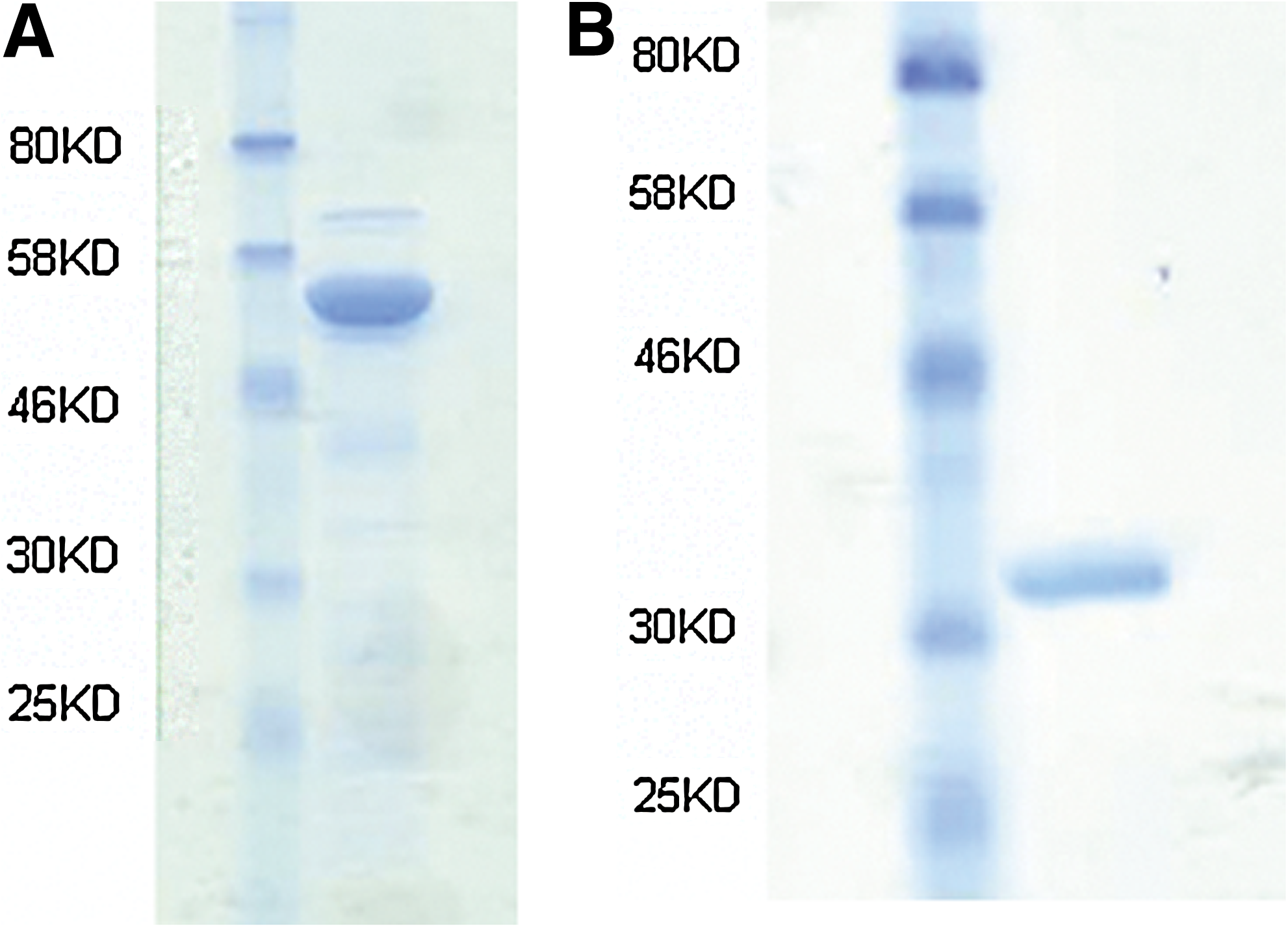
SDS–PAGE of GST-Ski (0-300 aa) fusion protein (
MAb characteristics
Table 1 summarizes the characterization of selected clones in terms of titer, affinity, class, and subclass, demonstrating that the antibodies all belong to IgG1, IgG2b, subclass with κ light chain. These were high affinity antibodies with affinity constant ranging from 109 to 1011 M-1 (Table 1).
Western blot analysis
Western blot results demonstrated that the MAbs were capable of detecting endogenous Ski protein (Fig. 2), in which the 95 − 115 kDa proteins of Ski were recognized by the antibody.
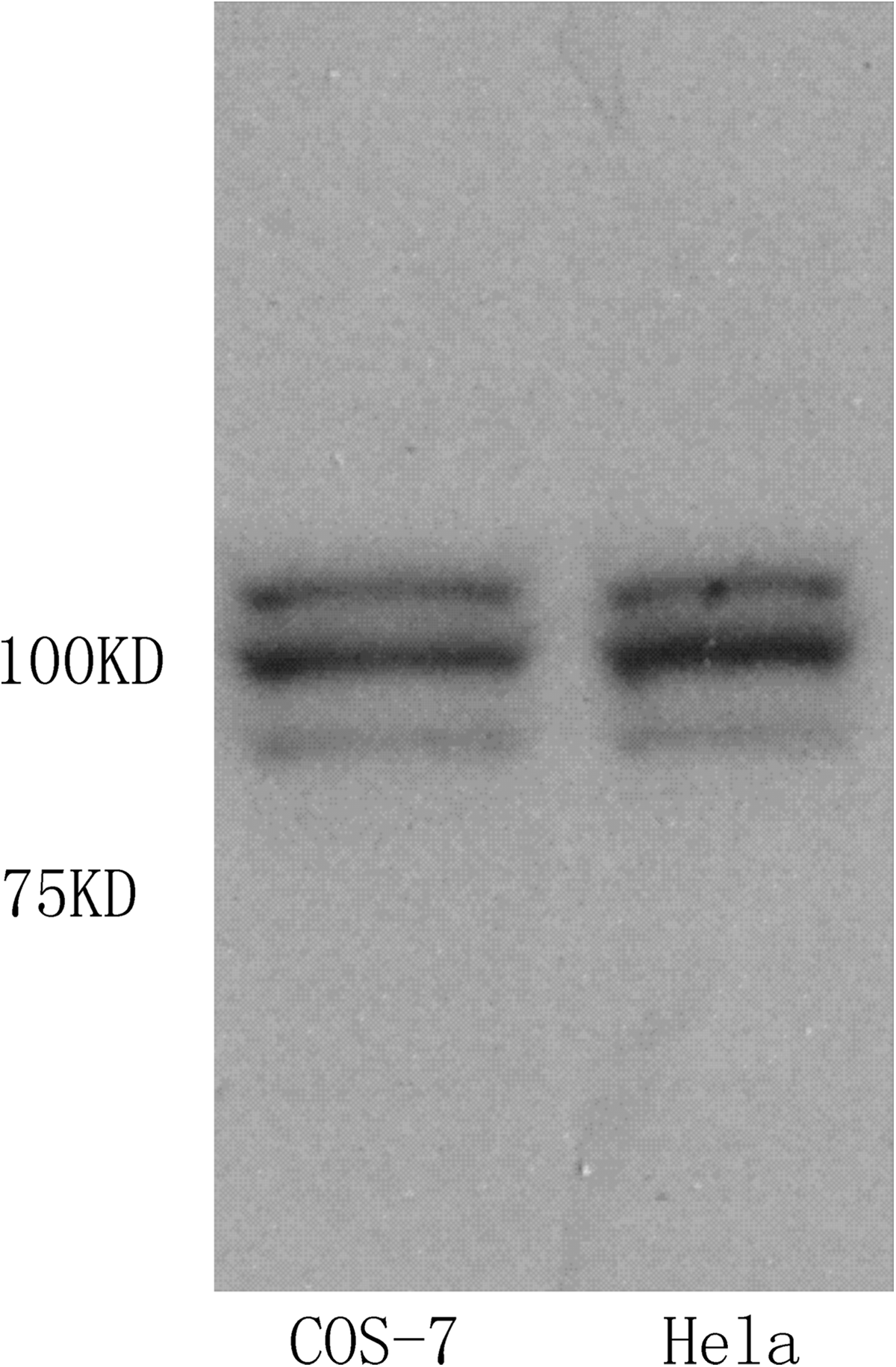
SDS-PAGE and Western blot of Ski in COS-7 and Hela cells. Total proteins of COS-7 and Hela cells containing Ski were run by SDS-PAGE and then subjected to immunodetection using antibodies against Ski. The sizes of the marker proteins are listed on the left of SDS-PAGE.
Discussion
In the present study, Ski fragments were overexpressed and purified successfully. We then described the production of monoclonal hybridomas that secrete anti-Ski MAbs. Three hybridomas that produced anti-Ski antibodies were cloned. These monoclonal hybridomas produced antibodies with IgG1, IgG2b isotypes. Following the generation of the monoclonal hybridomas that secreted anti-Ski, a sensitive immunoassay for quantifying Ski was developed using antibodies produced by E5. The production of MAbs against Ski provides immunological techniques, including Western blot and ELISA in detection, and other function of this protein.
Studies in the past few years have uncovered mechanisms that regulate Ski expression at the level of transcription, protein stability, and intracellular localization, and have defined the interaction of Ski and the Smads through structural and functional studies. Many interacting partners of Ski have been identified. But there is still investigation required to understand the roles of Ski in the regulation of mammalian epithelial cell function, transformation, and vertebrate development and also in mammalian tumorigenesis. Some but not all of these activities are dependent on the interaction between Ski and the Smad proteins. A goal in the near future is to identify and characterize Smad-independent intracellular pathways that may be targeted by Ski. While much attention in the past has been devoted to revealing the roles of Ski in human cancer cells, little is known about their functions in normal mammalian epithelial cells. This is a major challenge that deserves continued research efforts in the future. The produced MAbs will be a useful tool for further investigation of Ski functions in organisms.
Footnotes
Acknowledgments
This work was supported by the Natural Sciences Fund of China (30771923, 30900507, 30872250, 30930082, and 30801348) and the Program for Changjiang Scholars and Innovative Research Team in University (IRT 0872).
Author Disclosure Statement
The authors have no financial interests to disclose.