




Abstract
Monoclonal antibodies (MAbs) against the E2 protein of classical swine fever virus (CSFV) are useful for diagnosis and strain characterization. A purified, baculovirus-expressed CSFV E2 protein from the Paderborn strain was formulated with a saponin adjuvant and successfully used to induce an antigen-specific immune response in mice. After cell fusion a panel, designated F92G, of 12 mouse hybridomas (5-2, 11-1, 14-1, 25-2, 28-2, 31-1, 34-1, 35-2, 37-3, 38-2, 39-1, 41-1) producing CSFV-E2 specific MAbs were selected based on their Ig subclass and secretion level (μg IgG/mL). Nine IgG 1/k, two IgG 2b/k, and one IgG 2a/k MAbs were further characterized using immunoperoxidase reactivity, ELISA, and Western blot analysis. Immunoglobulin concentration-dependent immunoperoxidase and ELISA reactivity was observed for some of the MAbs with certain antigens. In general there were several reactivity patterns exhibited by the MAbs, with CSFV strains representing different genetic subgroups (by immunoperoxidase staining) and recombinant antigens (by ELISA). It was interesting to note that in some cases the strain-specific reactivity of a MAb was dependent on the test, thereby providing a clue regarding the nature of the binding site.
Introduction
Numerous laboratories have produced CSFV-specific monoclonal antibodies (MAbs) for antigenic comparisons of CSFV isolates and eventual use in diagnostic assays for rapid strain identification and differentiation during an outbreak and in serological surveillance. Starting in the 1980s, Wensvoort and colleagues(3–5) published a series of articles describing the production of pestivirus-specific MAbs and their reactivity either with virus-infected cell monolayers or virus particles, detected in horseradish peroxidase (IP) or fluorescein (IF) tests. Selection of the immunogen for MAb production was based on the successful propagation of circulating CSFV strains in the laboratory. Mouse inocula consisted of gradient purified CSFV Brescia, Baker, or Alfort/187 strains propagated in porcine kidney (PK-15) cells or porcine embryonic kidney cells and formulated with either aluminum hydroxide (ALOH) or Freund's adjuvant.(6,7) Preliminary results indicated that, regardless of the immunogen formulation, the resulting MAbs showed almost exclusive CSFV strain reactivity, meaning that the vast majority did not react with BVDV or BDV. Various CSFV IP and IF assay reactivity patterns were observed with field, laboratory, and vaccine strains demonstrating antigenic variation, which had not been previously detected using the “gold” standard neutralization plaque reduction assay (NPLA).(8) At the time, this provided a different approach to antigenic grouping of CSFV strains.
In vitro studies using MAbs demonstrated that CSFV variants that escaped neutralization could be readily obtained, suggesting that some epitopes were easily changed.(5) A possible mechanism was that point mutations in the genome resulted in changes of the CSFV envelope protein structure. Importantly, four distinct antigenic domains, designated A, B, C, and D, were identified by observing the reactivity patterns of 13 MAbs with virus antigens.(9) Domain A was further separated in three regions A1, A2 and A3. Monoclonal antibodies located in regions A1 and A2 were able to detect 94 CSFV field strains by competitive binding and antigen capture ELISA whereas MAbs located in the remaining regions and domains demonstrated various patterns of reactivity with these CSFV strains. Due to the possibility of antigenic changes resulting from point mutations, it was critical to continue generating MAbs that could detect virus variants generated in the field. To this end, Zhou and colleagues (10) used the MAbs produced by Wensvoort's group(3) for immunofluorescent staining of virus in tissues such as tonsils and kidney, thereby confirming the in vivo diagnostic application of these reagents. A report from an international workshop on the comparative analysis of MAbs against pestiviruses described the use of MAb reactivity to identify different epitopic expression of individual CSFV viruses related to passage level under in vitro culturing conditions.(11) By the end of this decade the utility of MAbs in CSFV strain identification had been clearly demonstrated and underlined the importance of expanding the number of MAbs in order to more fully carry out antigenic characterization.
Another panel of MAbs was subsequently produced by Edwards and colleagues,(12) Weiland and colleagues,(13) and Greiser-Wilke and colleagues(14) from mice inoculated with pelleted CSFV Baker A or Alfort stains produced in one of the following cell lines porcine embryonic kidney, pig lymphoma, or PK-15, formulated with either ALOH or Freund's adjuvant. This panel contained two MAbs in particular, designated WH303 and WH211, which reacted exclusively with all CSFV strains that were available for testing at that time. The variety of readily available, well-characterized MAbs assured their use in official, standardized diagnostic procedures.(15)
During the 1990s a significant amount of work was carried out on the identification of the major CSFV immunogens and their molecular structure. For example, MAb reactivity was used to propose dimerization between gp55 (E2) and gp33 (E0) via cysteine interactions. A comparison of the amino acid sequences for different CSFV and BVDV glycoproteins indicated that CSFV gp55 and BVDV gp53 shared the lowest homology (76%) compared with 90% between CSFV gp33 and BVDV gp25 and 85% between CSFV gp44 (E1) and BVDV gp48. Due to the known sequence variability of the E2 protein, it represented a promising candidate for differentiation of CSFV stains. In fact due to its immunogenicity, the E2 protein was determined to be the target antigen for most of the MAbs resulting from mice inoculated with whole virus preparations. In an attempt to increase diagnostic specificity, Kosmidou and colleagues(16) proposed using MAbs specific for E2 and E0 to produce reactivity patterns, also known as antigenic types, in order to differentiate CSFV strains. The utility of this approach was illustrated by the fact that two isolates that could not be distinguished by RT-PCR targeting the 5′ non-coding region of E2 were typed as being different by the E0/E2 MAb panel.
Epitope mapping of the E2 protein was carried out by van Rijn and colleagues(17–19) using eight neutralizing MAbs produced by Wensvoort and colleagues(3) directed against A1, B, and C regions of CSFV Brescia strain in order to isolate escape variants or MAb-resistant (MAR) mutants of Brescia and C strains. The reactivity of MAbs with cloned and COS cell-expressed E2 from MAR mutants was used to correlate MAb binding with amino acid substitutions. Based on the primary sequence and MAb-aided epitope mapping, it was possible to determine that the position of nine cysteines in the C-terminal half of E2 were conserved in pestiviruses and could be deleted without affecting MAb binding. The cysteines at the N-terminal half were essential for all identified epitopes, and this part of the molecule formed two independent structural units, one consisting of regions B and C and one consisting of highly conserved domains A and D. The structural unit consisting of domains B and C was found to be anchored by an S-S bond at amino acid locations Cys-693/Cys-737, and the unit consisting of A and D was anchored by S-S bonds at amino acid locations Cys-792/Cys-858 and Cys-818/Cys-828. Both structural units contain epitopes reacting with MAbs capable of neutralizing virus in vitro, and the immune response induced by one structural unit (B/C or A) was sufficient to protect pigs against lethal CSFV challenge.(20) Non-conserved epitopes were identified around amino acid position 713 when comparing the CSFV Brescia and C strains. The hydrophobic region just past amino acid 713, between domains B and C, was conserved and similar to that found in env proteins of orthomyxoviruses, paramyxoviruses, and retroviruses. In these viruses cleavage at the N-terminal side of this hydrophobic stretch is involved in membrane fusion.
The first report of a recombinant CSFV protein being administered to mice for MAb production was the Escherichia coli-expressed, truncated, CSFV-Alfort E2 protein.(21) The objective was to identify a MAb that could detect all CSFV stains and compete with polyclonal sera in an ELISA (cELISA). Although several MAbs had already been identified as reacting with highly conserved sites on E2, they were not able to compete with polyclonal sera.(21–24) Upon preliminary evaluation, it appeared that a suitable MAb was produced using this approach since it was able to compete for E2 binding sites with a limited number of strain-specific polyclonal sera.(25,26) However, more detailed characterization of this MAb (designated M1669), as well as other MAbs from this panel, demonstrated various reactivity patterns with E2 proteins representing different CSFV strains.(27) A significant finding was that none of the MAbs tested from this panel was able to detect the CSFV E2 protein from the Paderborn strain that belonged to genetic group 2.1 and was responsible for an outbreak in Europe.(28) A possible explanation for this was that the putative binding site for MAb M1669, around amino acid 709, was located in a non-conserved region of E2. In order to expand the MAb repertoire for CSFV antigenic typing, baculovirus-expressed E2 protein from the Paderborn strain was used to produce a panel of MAbs, which are characterized in this study.
Materials and Methods
Recombinant protein preparations
The cloning and expression of Brescia, Paderborn, and Kanagawa recombinant E2 proteins in baculovirus has been previously described.(27) The E2 protein SF21 cell lysates resulted from multiple freeze/thaw cycles of infected cell harvests, followed by centrifuge-aided clarification. The clarified Paderborn E2-SF21 cell lysate was mixed with nickel-nitrilotriacetic acid (Ni-NTA) magnetic agarose beads, and purification of the protein was achieved using a BioSprint 15 workstation, as per the manufacturer's instructions. Specifically, the 6xHis-tagged protein, which was bound to the Ni-NTA beads, was then eluted using buffers containing 250 and 300 μM imidazole.
The N-terminal region of Alfort E2 protein, corresponding to approximately 221 amino acids located at positions 690-910, was expressed in E. coli (recAlfort E2) as previously described.(21)
Production of CSFV E2-specific MAbs
The purified recombinant CSFV E2-Paderborn protein was utilized as the immunogen for 4- to 6-week-old female Balb/c mice (Charles River Laboratories, Point Claire, Canada). Specifically, 20 μg of the protein was mixed with the adjuvant Quillaja saponaria A (Quil A, Brenntag Biosector, Strandvejen, Denmark) and injected at 4-week intervals into mice intraperitoneally for the primary injection and subcutaneously for two additional immunizations. A total of 5 μg of unadjuvanted CSFV E2-Paderborn was administered intravenously and intraperitoneally 3 days prior to euthanizing the mice. Mice were euthanized by inhalation of isofluorane gas and exsanguinated before harvesting the spleen. All animal handling procedures were performed at the Canadian Science Centre for Human and Animal Health (Winnipeg, Canada) in strict accordance to the approved methods outlined by the in house Animal Care Committee.
Immunized spleen cells were isolated and processed in basal medium before fusion with a non-Ig secreting myeloma cell line P3X63-Ag8.653 (ATCC CRL-1580) using 50% polyethylene glycol (molecular weight 1500; Roche, Laval, Canada). Fused hybridoma cells were immediately plated in semi-solid hypoxanthine-aminopterin-thymidine (HAT) selection agar (ClonaCell-HY Medium D, StemCell Technologies, Vancouver, Canada) and incubated at 37°C, 5% CO2. Individual colonies that survived HAT selection were tested for specific CSFV E2-Paderborn reactivity. To ensure monoclonality, single cells that produced desired antibody were recloned successively three times by end-point dilution.
Monoclonal antibody M1669 was produced as previously described.(25) Briefly, 50 μg of a purified, E. coli-expressed, truncated Alfort/187 E2 protein emulsified with an equal volume of Freund's complete adjuvant were administered to three Balb/c mice. Three subsequent booster injections were given on days 14, 29, and 115 with the same amount of the immunogen emulsified in Freund's incomplete adjuvant. The spleen cells were fused with Sp2/0-Ag14 myeloma according to established procedures.(29) Specific antibodies secreted from hybridomas were screened by ELISA for CSFV Alfort/187 reactivity and numerically designated. The hybridoma secreting MAb WH303 was obtained from the Veterinary Laboratories Agency (Surrey, United Kingdom).
Determination of MAb Isotype and IgG concentration
Monoclonal antibody solutions were prepared by propagating selected hybridomas in medium composed of Dulbecco's minimal essential medium (DMEM), L-glutamine, fetal calf serum, and hybridoma cloning factor. Supernatant fluids were harvested and concentrated 15-fold, based on volume, using a Millipore Centriprep Ultracel YM-30 (30,000 MWCO) according to the manufacturer's instructions. Immunoglobulin isotypes in unconcentrated supernatants were determined using the IsoStrip mouse MAb isotyping kit according to the manufacturer's instructions (Roche). The IgG concentration (μg/mL) of the harvested (unconcentrated) and concentrated supernatants was determined using a Pierce Easy-Titer assay (Invitrogen, Burlington, Canada). The concentrated supernatants were diluted 10-fold in the ranges shown in Table 1 for use in immunoperoxidase testing (Table 2) and ELISA reactivity (Table 3) described below.
IgG
Testing performed at 10-fold intervals in the indicated range.
N/A, not applicable.
Positive staining at IgG concentrations (μg/mL) in testing ranges indicated.
Positive staining at indicated IgG concentration (μg/mL) only. No staining observed at 10-fold lower dilution.
Not tested at highest concentration of 5940 μg/mL.
N, no staining in the testing ranges indicated for the MAb in Table 1; NT, not tested.
Positive reaction at IgG concentration (μg/mL) in testing ranges indicated as X-X.
N represents no reaction in the testing ranges indicated for the MAb.
Positive reaction at indicated IgG concentration (μg/mL) only. No reaction observed at a 10-fold lower dilution.
Not tested at highest concentration (5940 μg IgG/mL).
Immunoperoxidase staining
Infected porcine kidney (PK-15) cell monolayers were established in 96-well tissue culture plates with the following CSFV strains: Alfort/187 (genotype 1.1), Peru A-5 (genotype 1.1), Brescia (genotype 1.2), Honduras (genotype 1.3), Paderborn (genotype 2.1), Parma (genotype 2.2), Diepholtz (genotype 2.3), congenital tremor (genotype 3.1), Kanagawa (genotype 3.4), as well as with bovine viral diarrhea virus (BVDV) and border disease virus (BDV). After approximately 2 days, the infected cells (and uninfected cell controls) were fixed with acetone, dried and stored at −70°C. The test for reactivity consisted of incubating the infected PK-15 cells and uninfected cells with MAb solutions at various IgG concentrations (μg/mL), washing off the unbound antibody, incubating with horseradish peroxidase labelled anti-mouse IgG, and then detecting the bound complex with the chromogenic substrate 3-amino-9-ethylcarbazole (AEC). A positive reaction with antibody consisted of cells containing virus being stained a reddish brown color that was easily visualized and recorded for each MAb solution at the indicated IgG (μg/mL) concentration.
Indirect enzyme-linked immunosorbent assays
The CSFV Alfort or Paderborn-specific ELISA was performed by immobilizing either E. coli-expressed truncated recombinant Alfort/187-E2 (recAlfort E2) or baculovirus-expressed Paderborn-E2 (recPaderborn E2) antigens on microtiter plates as previously described.(25,27) Non-adsorbed antigen was removed and various MAb preparations were allowed to incubate with the adsorbed antigen. After washing, horseradish peroxidase-labeled goat anti-mouse antibody was allowed to react with the bound antigen-MAb complexes. Unbound antibody was removed by washing and the chromogenic substrate was then allowed to react with the complexes. The amount of enzymatic substrate degradation was measured photometrically with the aid of a microtiter plate scanner and expressed as an optical density (OD) value. A positive reaction was recorded for a specific MAb solution, at the indicated IgG (μg/mL) concentration, when the OD reading was two standard deviations above background values. Background values were determined as the OD reading resulting from a reaction with a non-specific MAb solution prepared in the same manner as the Paderborn E2 MAb solutions.
The antigen immobilized on a microtiter plate provided in the Herdcheck CSFV Ab test kit was prepared as per instructions (IDEXX Europe BV, Koolhovenlaan, Netherlands) with some slight modifications. Detection of MAb reactivity was achieved by using the chromogenic substrate provided with the kit.
Western blot analysis
Clarified E2 containing SF21 cell lysates were electrophoretically separated on SDS-polyacrylamide gels, and the fractionated proteins were then transferred onto immunoblot polyvinylidene fluoride membrane sheets (Bio-Rad, Mississauga, Canada) and detected using a commercially purchased anti-His MAb (Qiagen, Misssissauga, Canada). The analysis of purity was determined by Coommassie staining of the gel. Monoclonal antibodies were reacted with the immobilized proteins at a minimal concentration of 10 μg IgG/mL. After incubation with horseradish peroxidase-conjugated anti-mouse antibody, the reactive bands were visualized using enhanced chemiluminescent substrate (Invitrogen).
Results
Characterization of purified recombinant E2 protein preparations
One-step purification of 6x His-tagged Paderborn E2 protein using Ni-NTA agarose beads in an automated protein purification workstation reproducibly and reliably produced a pure E2 protein preparation. Figure 1 illustrates that 250 μM imidazole was effective in eluting the E2 protein from the agarose beads in one fraction. The purity of the eluted preparation is illustrated by the appearance of a prominent band in Coomassie blue-stained polyacrylamide gel. Formulation of this purified protein with the saponin adjuvant resulted in a clear preparation with no visible precipitate or phase separation.
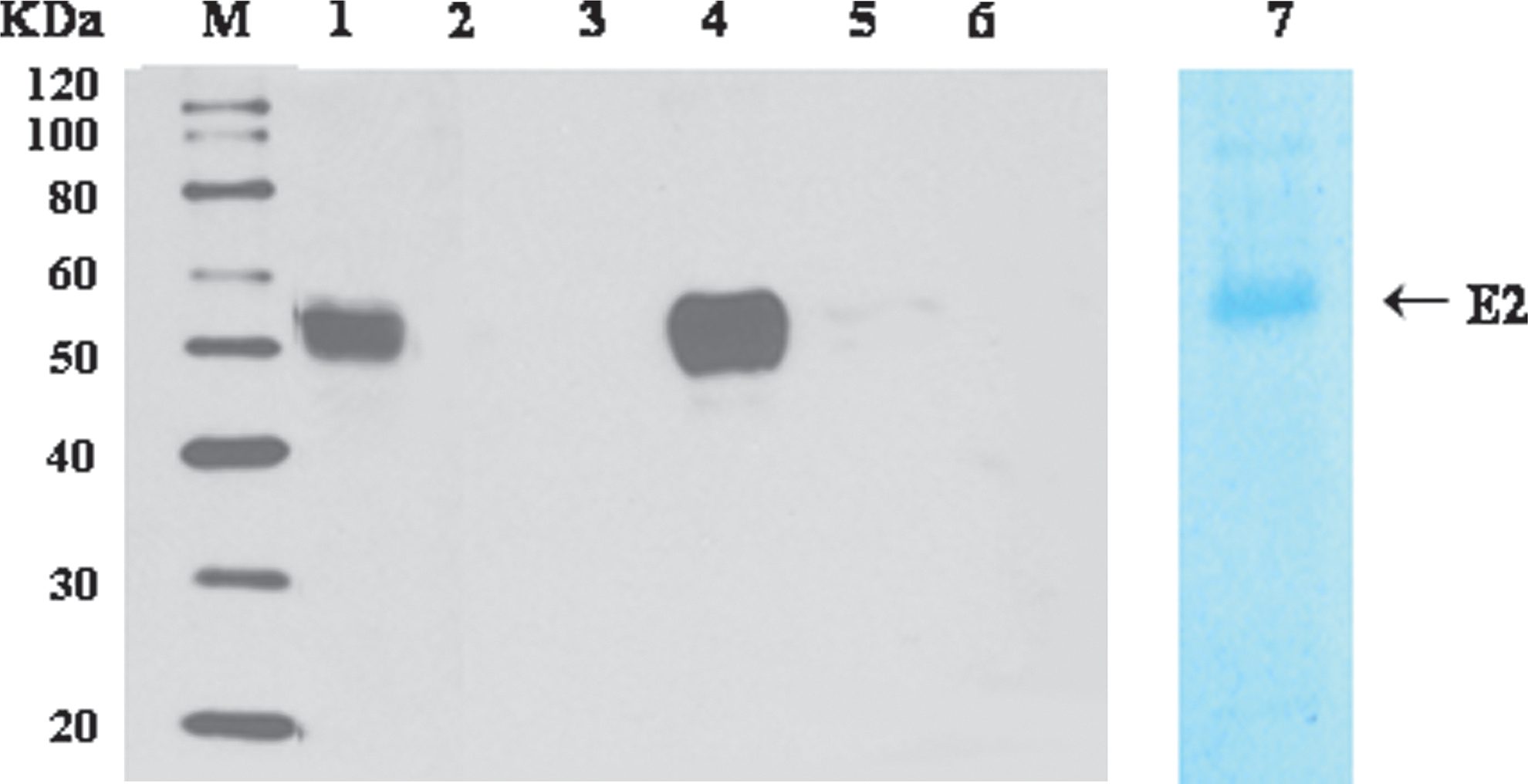
Western blot analysis of CSFV-E2 protein purification with anti-His MAb. Lysate from cells infected with recombinant virus Ac-Bac-CSFV Paderborn-E2 (lane 1) was mixed with agarose beads. The mixture was washed twice (lanes 2,3) and eluted with 250 μM imidazole (lane 4) and 300 μM imidizole (lane 5). The SF21 cell control is shown in lane 6. The purity of the preparation was examined on a Coomassie Blue-stained gel; the arrow indicates the position of the E2 protein (lane 7). The mobility of the size standards in kilodaltons (KDa) are indicated at left.
CSFV-E2 hybridoma selection and preparation of MAb solutions
High-serum antibody titers in immunized mice were confirmed by indirect enzyme linked immunosorbent assay (iELISA). A strong immune response to the E2 protein was observed with sera collected from inoculated mice, indicating that the formulated antigen was immunogenic (data not shown). Approximately 45 Paderborn-E2 ELISA-reactive MAbs were produced from parental hybridoma clones. These MAbs were designated with the prefix F92G or referred to as the CSFV G series panel. Twelve parental hybridoma clones designated 5, 11, 14, 25, 28, 31, 34, 35, 37, 38, 39, and 41 were selected for subcloning to ensure monoclonality (Table 1). The panel of secreted MAbs represented IgG subtypes 1/k, 2a/k, and 2b/k.
Since all the harvested hybridoma growth fluids were obtained under similar cell cultivation conditions and processed in a similar manner (i.e., concentrated approximately 15-fold based on volume), the relative levels of secreted IgG could be determined. They ranged from approximately 15 μg IgG/mL for the hybridoma secreting MAb 38-2 to 133 μg IgG/mL for the hybridoma secreting MAb 35-2.
Characterization of CSFV-E2 MAbs by immunoperoxidase staining
As shown in Table 2, a variety of IP reactivity profiles were observed with the G series MAb panel. In addition to BVDV and BDV (data not shown), there was no reactivity observed with the Alfort strain with any of the G series MAbs. However, a reaction was detected at a wide range of IgG concentrations with MAbs M1669 and WH303, confirming that the cells were infected and the amount of E2 was sufficient for detection to occur. Monoclonal antibody 5-2 did not react with any of the virus-infected cells at any concentration whereas MAb 25-2 only reacted with Paderborn-infected cells at the highest antibody concentration (1,290 μg IgG/mL) tested. Similarly, MAbs 35-2 and 39-1 also only showed reactivity with Paderborn-infected cells at the highest IgG concentration tested (i.e., 2000 and 1400 μg/mL, respectively). However, their specificity could not be fully determined since testing was not performed with all the strain used in this study. Immunoperoxidase reactivity with all the strains was only observed with MAb WH303, even at a fairly low IgG concentration (i.e., 0.1 μg/mL). Monoclonal antibody 31-1 demonstrated the next broadest reactivity pattern, which included cells infected with all strains except Alfort followed by G series MAbs, as follows: 34-1, which reacted with all cells infected with all strains except Alfort and Kanagawa; 41-1, which reacted with cells infected with all strains except Alfort and Peru; and M series MAb 1669, which reacted with cells infected with all strains except Paderborn and Parma. Several MAbs (11-1, 28-2, 37-3, 38-2) reacted with strains representing genetic groups 1.3 (Honduras), 2.1 (Paderborn), 2.2 (Parma), 2.3 (Diepholtz), and 3.1 (congenital tremor), but did not react with other representative genetic group 1 (Alfort and Peru) or group 3 (Kanagawa) strains. It was interesting to note that MAb 14-1 reactivity was restricted to cells infected with representative strains (Paderborn, Parma, and Diepholtz) from genetic group 2, although only at the highest IgG concentration (592 μg/mL) tested for Diepholtz-infected cells.
Characterization of CSFV-E2 MAbs by ELISA reactivity
As shown in Table 3, all of the MAbs reacted with the antigen in the IDEXX assay, although MAb 25-2 demonstrated reactivity at only the highest IgG concentration (1290 μg/mL) tested. All the MAbs, with the exception of M1669, reacted with the baculovirus virus expressed Paderborn E2 protein (recPaderborn E2). Only four of the G series MAbs (5-2, 11-1, 31-1, 41-1), as well as both M1669 and WH303 MAbs, reacted with the E. coli expressed truncated Alfort E2 protein (recAlfort E2).
Characterization of CSFV-E2 MAbs by Western blot reactivity
As reported for the immunoperoxidase and ELISA, a variety of reactivity profiles were observed as shown in Table 4. All the G series MAbs reacted with the recPaderborn E2 protein and for MAbs 14-1, 28-2, 34-1, 37-3, and 38-2 this was the only positive reaction recorded. By contrast, the M series MAb 1669 did not react with the recPaderborn E2 protein but did demonstrate reactivity with both the recBrescia and recKanagawa E2 proteins. Monoclonal antibodies 5-2, 25-2, and WH303 reacted with all three recombinant E2 proteins. In addition to reacting with the recPaderborn E2 protein, MAbs 11-1, 31-1, and 41-1 reacted with the recBrescia E2 protein and MAbs 35-2 and 39-1 reacted with the recKanagawa E2 protein.
P, detection of ∼53 kDa protein; N, no detection.
Discussion
Baculovirus-expressed proteins have been extensively used to study viral structure, biological function, antigenicity, and protective immune responses. One of the reasons for this is the ability of insect cells to facilitate post-translational modifications such as disulphide-bond formation, which is critical for secondary structure formation, such as that described in the introduction for the CSFV-E2 protein. This was demonstrated by the ELISA and Western blot reactivity of the baculovirus-expressed CSFV Paderborn E2 protein with CSFV-specific serum.(27) The immunogenicity of the baculovirus expressed CSFV E2 protein (Brescia strain) emulsified with an oil-based adjuvant was demonstrated when pigs were protected from lethal challenge.(20) However, this is the first report of a strong humoral immune response being generated with baculovirus-expressed CSFV Paderborn E2 protein formulated with the purified saponin adjuvant Quil A. This adjuvant was selected due to the importance of secondary and tertiary structure of the E2 protein where it was postulated that hydrophobic regions could influence the formation of micelles resulting in a more authentic antigen presentation.(30) This, in turn, would increase the possibility of obtaining MAbs to critical epitopes that exist on the E2 protein, which forms the virus particle. As reported for other adjuvants, sapnonins are known to alter the type of response such that immunoglobulin (Ig) isotypes and subclasses are usually changed from those of the immunogen alone. Quil A, for example, has been shown to elicit mainly IgG1 with some IgG2a, and enhancements of IgM and IgA were much less than that with Alum or Freund's adjuvants.(31) In fact this was observed in mice innoculated with the Paderborn E2-Quil A formulation, although IgG2b and IgM MAbs were also identified. The E2-specific IgM MAbs were not characterized due to their minimal fitness for use in assays.
In this study the reactivity of the MAbs was evaluated at different IgG levels since concentration-dependent MAb binding was previously reported.(20) This phenomenon was observed with MAbs 14-1, 25-2, 39-1 immunostaining virus-infected cells at only the highest concentrations tested but only for specific strains. Monoclonal antibody 25-2 also demonstrated ELISA reactivity at only the highest concentration tested with the IDEXX-coating antigen. A possible explanation is that higher concentrations of MAbs are required when there is reduced affinity due to a slight change in the binding region of a particular E2. It has been reported that differences in immunostaining corresponding to the MAb concentration were only observed with neutralizing CSFV MAbs, perhaps suggesting that their binding is stronger than binding of non-neutralizing MAbs.(20) Neutralization studies would have to be carried out in order to confirm this with the G series MAbs.
The reactivity patterns exhibited by the G series MAbs vary with respect to the CSFV strain and the specific detection test. For example, MAb 5-2 only demonstrated ELISA and Western blot reactivity with recPaderborn E2 and recAlfort E2 proteins but could not detect these antigens in virus-infected cells. Taken together, the entire panel of MAbs (including M1669) could be used to differentiate between CSFV strains representing each genetic subgroup by immunoperoxidase straining of infected cells. Generally, it was noted that the fewest number of MAbs reacted with both representative strains (Alfort and Peru) in genetic subgroup 1.1. Since none of the G series MAbs reacted with all the strains, it can be assumed that they do not recognize a conserved site, as was shown by the universal reaction of MAb WH303.
Currently the G series MAbs are being evaluated for their neutralizing activity and ability to compete with polyclonal sera in the development of an ELISA to detect various CSFV strains. This panel of MAbs will be a valuable addition to existing MAb reagents for use in epitope mapping and other diagnostic assays, such as those involving immunostaining of infected cells or tissues. In general, this study demonstrates the utility of baculovirus-expressed E2 proteins as immunogens for future MAb production, perhaps in response to the need for reagents to detect newly emerging CSFV strains.
Footnotes
Acknowledgments
This study was supported by the Canadian Food Inspection Agency, Agriculture Funding Consortium of Canada and Ontario Pork. We would like to thank Dr. Kathleen Hooper-McGrevy for the scientific review of this manuscript.
Author Disclosure Statement
The authors have no financial interests to disclose.