




Abstract
Gamma binaural beats (BB) entrainment has become more ubiquitous in recent decades, with studies showing improvements in mood and cognition. We aimed to investigate whether listening to 40 Hz BB could help mitigate mental stress and cognitive dissonance in a group of nursing faculty members and students. Participants listened to an auditory stimulus of 40 Hz BB for 15 minutes for a total of nine sessions over the duration of a three-week period. Mood and cognition were assessed with Brunel Mood Scale and Stroop’s test, respectively, before and after a 15-minute BB stimulation. The pre- and post-interventional study was conducted for the data analysis. The emotional states and cognitive performance of both groups were enhanced by 40 Hz BB entrainment. However, students benefited more from BB for navigating emotion, whereas faculty benefited more with the cognitive task. In addition, the enhancement mediated by BB improved over time among the students. Thus, 40 Hz BB seem to play a major role both in improving emotional well-being, as well as improving cognitive function, in an age-dependent manner. Implementing BB into daily routines as a part of stress management strategy may offer a low-cost noninvasive method to foster emotional stability and enhance cognitive performance.
Introduction
The cognitive and psychological status of academic faculty is a crucial factor that impacts efficacy of work in terms of providing quality education or learning motivation for students. Faculty, particularly in nursing departments, often experience stress and burnout as a result of heavy workloads, including teaching, research, and maintaining clinical competence. 1 Several studies have documented occupational stress in nursing faculty worldwide, including Nepal. 2 –5
Women were shown to be more susceptible to burnout than men, and the rate of burnout among younger faculty was significantly higher than that among older faculty. 1 In addition to academic stress factors, nursing students also suffer from stressors of the work environment due to their involvement in academic as well as clinical settings at the same time. 6 Therefore, stress coping strategies for nurses such as a mindfulness meditation app 7 and gamma-wave brain entrainment 8 are critical for health care systems.
Binaural beats (BB) entrainment is an auditory effect that occurs in the brain when two different tones are played simultaneously, one in each ear. For instance, when a 200 Hz tone is presented to the right ear and a 240 Hz tone to the left ear, the BB with a frequency of 40 Hz will be perceived. As a result, the brain produces pulsations in the amplitude and localization that are the same with the perceived sounds.
The concept of brain entrainment posits that external rhythmic stimuli can modulate the brain’s oscillatory activity, leading it to synchronize with the frequency of these stimuli. This synchronization enhances coordination of neural networks, thereby improving communication between brain regions. Enhanced synchronization, particularly within the gamma-frequency band, that is, 30–100 Hz, has been shown to facilitate more efficient large-scale neural communication and contribute to improved cognitive functions. 9,10
Besides the auditory modality, brain entrainment can also be achieved through other modalities such as visual entrainment, which uses rhythmic visual patterns; tactile entrainment, which involves vibrational stimuli or rhythmic skin tapping; and multisensory entrainment, which integrates auditory, visual, and tactile stimuli. 11 –13
Various electroencephalogram studies on BB have evidenced that brain entrainment by gamma-beats increases gamma-band activity (30–100 Hz), 8,14 which is believed to promote larger scale neural communication. 15,16 The literature emphasizes that auditory stimulation of 40 Hz enhances memory function, 8 cognitive flexibility, and attentional focusing. 17–18 Furthermore, BB in the beta range (15 and 24 Hz) have been shown to influence mood, 19 whereas those in theta (4–7 Hz) and delta (0–4 Hz) ranges have been found to decrease anxiety. 20 –22 In addition, BB (4 Hz) intervention may positively affect postoperative recovery, potentially enhancing parasympathetic dominance. 23–24 The effectiveness of gamma-band frequencies in reducing anxiety has not been well documented. Many studies had relatively short BB exposure times, ranging from 4 to 130 minutes, with an average of 26 minutes. 25 Consequently, there are a limited number of studies examining the cognitive and psychological effects of gamma BB, particularly over longer durations.
Therefore, we aimed to examine the following: (1) whether 40 Hz BB auditory stimulation on a longer term basis, that is, for nine sessions (three weeks), improves emotional states and cognitive performance of nursing faculty, as well as students; (2) whether the effect of 40 Hz BB is age dependent or BB exposure time dependent; and (3) whether BB-mediated improvement in cognitive performance is correlated with emotional states.
Materials and Methods
BB Stimulus
The auditory stimulus of 40 Hz BB was generated using an open-source audio software, Audacity. To produce BB of 40 Hz, the audio signals were created using signals of 200 Hz for the right ear and 240 Hz for the left ear. Participants listened to the auditory stimulus of 40 Hz BB for 15 minutes, for a total of nine sessions over the duration of a three-week period. Mood and cognition were assessed with the Brunel Mood Scale (BRUMS) and Stroop’s test, respectively, before and after a 15-minute BB stimulation.
Participants
All volunteer female participants were recruited from nursing faculty (n = 17 with an average age of 39 ± 3.7 years) and students (n = 20 with an average age of 21.8 ± 1.6 years) at Kathmandu University School of Medical Sciences.
The inclusion criteria were as follows: (1) faculty aged 35–45 and undergraduate students aged 18–25, who were able to participate in all the allotted time schedule for nine sessions, (2) participants in good health, with normal hearing and without mental illness according to established diagnostic criteria (Diagnostic and Statistical Manual of Mental Disorders (DSM-IV-TR) and International Classification of Diseases (ICD)-10 combined), 26 (3) no pregnancy, and (4) no alcohol, caffeine, smoking, and medication for at least 12 hours before the experiments. A written consent was taken from all the participants before starting the experiment. This study was conducted during the period from late 2021 to early 2023. The procedures in this study involving human subjects were approved by the Institutional Review Board, Kathmandu University School of Medical Science, with certificate of approval number 217/19.
Measures
The emotional states were assessed using the 32-item BRUMS (Supplementary Data S1), a self-report questionnaire. 27,28 The BRUMS-32 consists of eight subscales, each of which comprises four items. Anger items include “Angry, Annoyed, Bad-tempered, and Bitter”; Tension items include “Nervous, Anxious, Panicky, and Worried”; Fatigue items include “Exhausted, Sleepy, Tired, and Worn-Out; “Confusion items include “Muddled, Uncertain, Mixed-up, and Confused”; Depression items include “Miserable, Depression, Downhearted, and Unhappy”; Happiness items include “Contended, Cheery, Happy, and Satisfied”; Vigour items include “Active, Alert, Energetic, and Lively”; and Calmness items include “Restful, Relaxed, Calm, and Composed.” Each item was responded according to the five-point Likert scale, which ranges from 0 to 4 representing “not at all” to “extremely.” Higher scores on each subscale of positive emotions represent a better current mood, whereas those of negative emotions represent a lower mood.
Furthermore, cognitive function was assessed by Stroop’s test. 29,30 For Stroop’s task assessment, reaction time required for completing the task was used as the measurement scale. All students and 13 nursing faculty members completed the Stroop’s tasks.
Experimental Room
The normal academic classroom was used for the experiments maintaining silence and keeping control of the crowd. The room with a white/off-white wall was used to maintain the neutral perceptions of emotion and mood.
Experimental Procedure
Participants were advised to wear headphones that were clearly labeled with the words “right” and “left” and to sit up straight in a chair while maintaining a relaxed but alert posture. The participants were instructed to keep their focus on the BB for the duration of the trial and, if their minds strayed, to just be aware of it and gently bring their attention back to the sound. Both before and after listening to the BB sound stimulation, the BRUMS survey and Stroop’s tasks were completed.
A digitalized version of the traditional Stroop Color-Word task, named “Stroop UMH-MEMTRAIN,” was used to test cognitive performance. 29,31 The Stroop’s task consists of three subgroups, each with a 45-second time constraint. Participants are required to respond to this task as fast as possible. For the first task, participants are required to read the word of the given word-color pairs that are coherent (congruent), that is, those that are printed in black ink and refer to colors like “Red,” “Blue,” “Yellow,” and “Green.” For the second task, they are required to identify the color of the given neutral pairs, that is, “XXXXX” printed in colors. For the third task, they are required to identify the color of the incoherent (incongruent) word-color pairs, that is, the word “Blue” printed in Red ink. Regardless of its semantic meaning, the subject is required to name the color of the ink instead of reading the word. Thus, in this incongruent condition, participants are required to perform a less automated task. Because word reading is a more automatic cognitive process than incongruent word-color pairs, subjects should have the ability to resolve cognitive interference and inhibit incorrectness. Therefore, reaction time will naturally be slower on incoherent tasks, which helps to determine the cognitive flexibility of the brain.
Data Analysis
The acquired data output was analyzed using GraphPad Prism 9.0.0 (GraphPad Software, Inc., San Diego, CA). The normality test was analyzed using Shapiro–Wilk test (P > 0.05). For BB-mediated improvement in the score of negative emotional states and Stroop’s test, we expressed the data as the mean difference (pretest–posttest) score, whereas for the BB-mediated improvement in the score of positive emotional states, we expressed the data as the mean difference (posttest–pretest) score.
For the normally distributed data, the “paired t-test” and “unpaired t-test” were applied for the dependent and independent samples, respectively, whereas, for non-normal data, the Wilcoxon signed-rank test and Mann–Whitney U test were applied for the dependent and independent samples, respectively. Since the BRUMS-32 has eight subscales, multiple comparison adjustment was not used. All data were expressed as “mean ± standard error of the mean.”
A Pearson’s correlation was conducted to measure the strength of the relationship between BB-mediated scores of total emotional states and cognitive tests.
Results
Listening to 40 Hz BB Enhanced the Mood of Both Nursing Faculty and Students
When comparing the scores before and after listening to 40 Hz of BB on the given timeline, there was a significant decrease in the BRUMS score of nursing faculty in negative emotional states “Anger” (P < 0.01) and “Tension” (P < 0.001), whereas there was no significant decrease on the items “Fatigue,” “Confusion,” and “Depression” (Fig. 1A). Similarly, BB showed a significant improvement on positive emotional states “Happiness” (P < 0.05) and “Calmness” (P < 0.001), but not on the item “Vigour.” Interestingly, students showed very significant improvements (P < 0.001) on each of the negative and positive emotional states except “Vigour” (Fig. 1B).
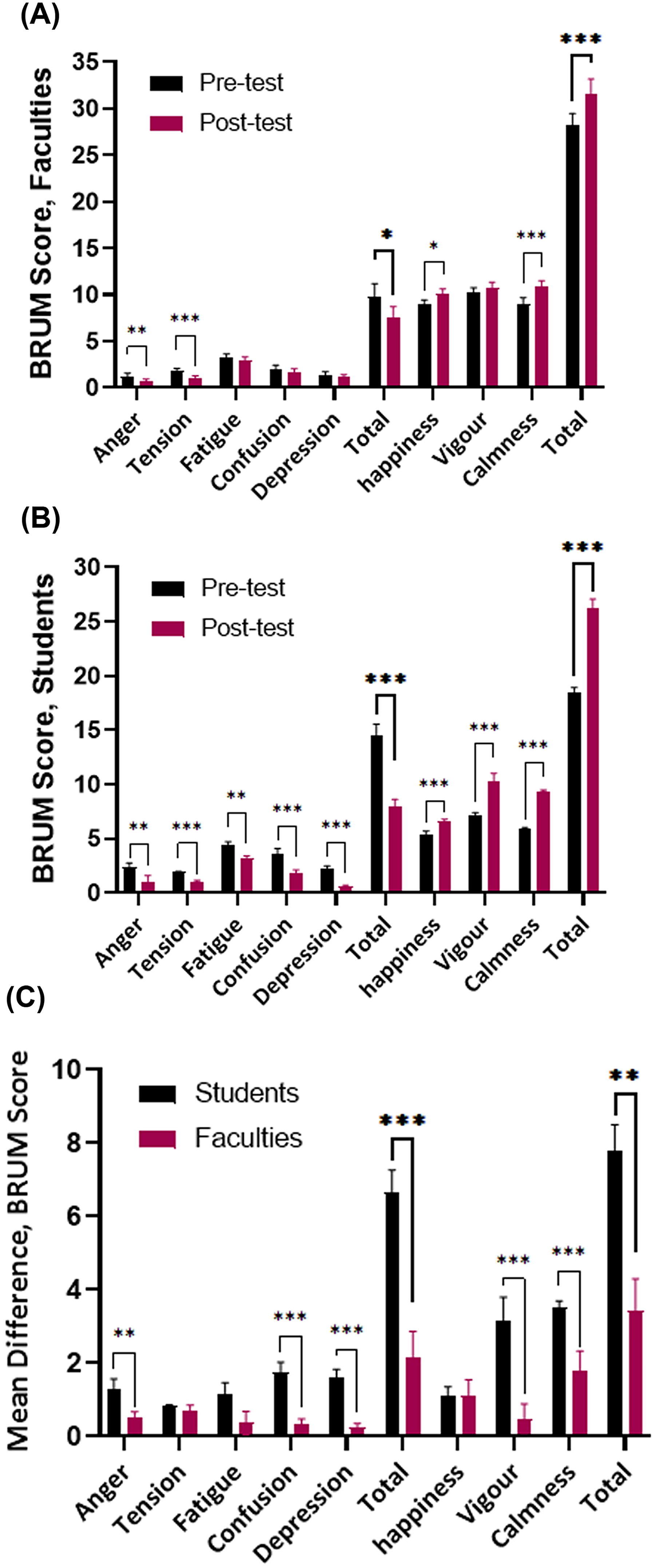
Listening to 40 Hz binaural beats (BB) helps improve emotional states. The graph shows the comparison between pre- and post-test Brunel Mood Scale (BRUMS) scores with BB auditory stimulus on female nursing
Students Benefited More from Listening to 40 Hz BB for Mood Enhancement
When we compared the mean difference of the BB-mediated change in BRUMS score (pretest–posttest), students showed significantly better improvements than faculty in reducing mostly the negative emotional items “Anger” (P < 0.001), “Fatigue” (P < 0.05), “Confusion” (P < 0.001), and “Depression” (P < 0.001). In the case of BB-mediated improvement in positive emotional states, faculty benefited more from BB in the item “Vigour” (P < 0.05). In contrast, the data trend in the item “Calmness” had a higher score in students, compared with faculty members, although the difference was not statistically significant (P = 0.08) (Fig. 1C).
BB-Mediated Effect on Mood Improved over Time in Students
The results showed that the positive effect of BB is exposure-time dependent on certain BRUMS items. While comparing the mean difference (pretest–posttest) score of session 1 and session 9, nursing faculty did not show significant differences in any of the negative and positive emotional items (Fig. 2), whereas students had significant improvements on the negative emotional item, “Tension” (P < 0.05) (Fig. 3). Meanwhile, comparing the pattern of BB-mediated effects (pretest score–posttest score) in negative emotions, data from nursing faculty showed a steady decreasing trend over time, whereas the students’ graph seemed quite fluctuating. However, for positive emotions, BB-mediated improvement over the mentioned time period was observed in “Calmness” in the nursing students (P < 0.001) (Fig. 3). In addition, it can be noticed that pre-test scores are consistently higher than post-test scores for negative items, except “Fatigue” in both faculty and students. Similarly, pre-test scores are lower than post-test scores for positive items in both groups, except “Vigour” in students. This shows that the effect of each BB session was repeatable and led to improvement in both negative and positive emotions in each session.

The 40 Hz BB-mediated improvements in the BRUMS score of nursing faculty do not differ over time. The graph shows the comparison of BB-mediated improvements between S1 and S9. S1–S9: session 1 to session 9 of the experiment with 15-minute BB auditory stimulation. Error bars indicate the SEM.
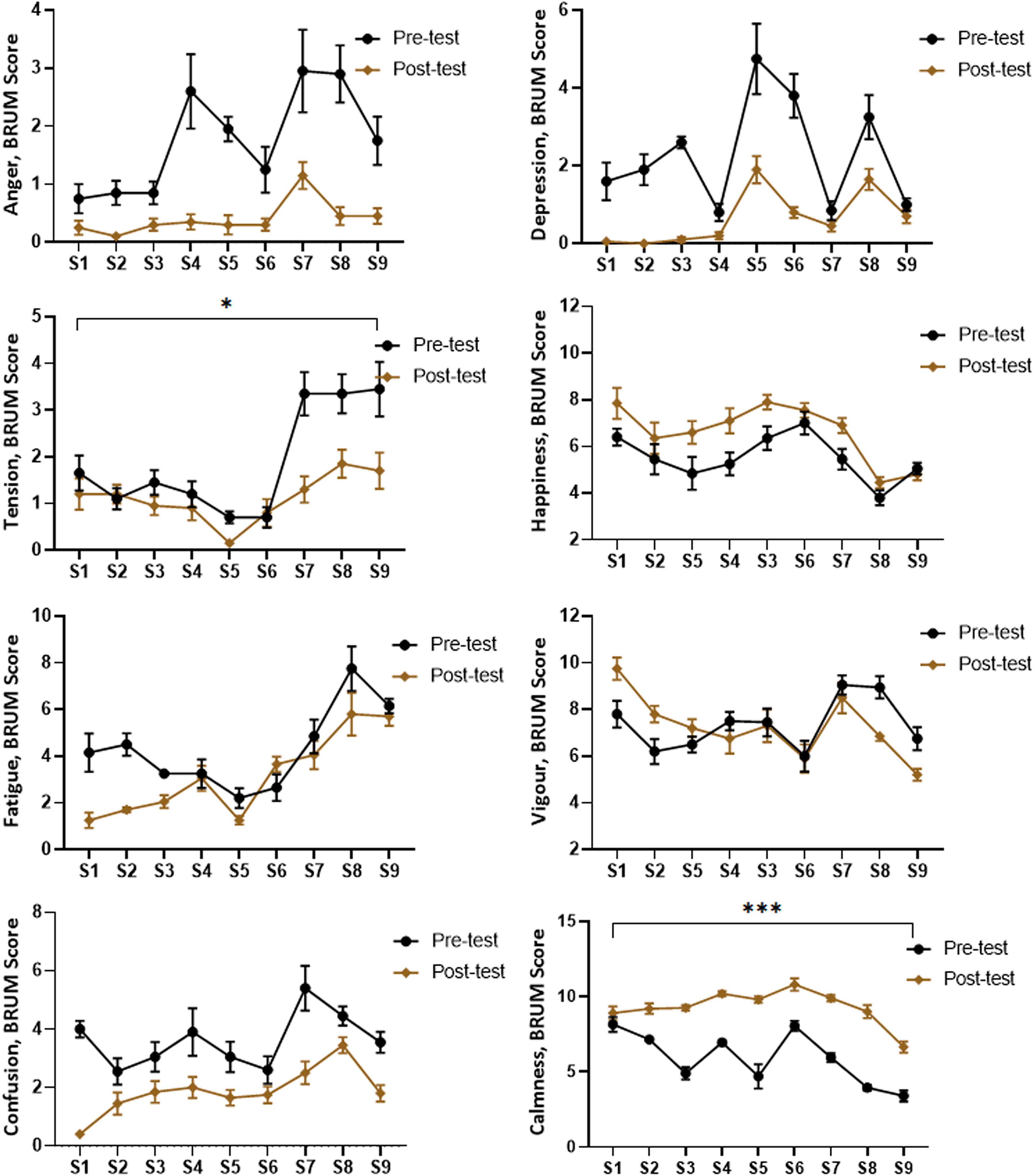
The 40 Hz BB-mediated improvements in the BRUMS score of nursing students improve over time. The graph shows the comparison of BB-mediated improvements between S1 and S9. S1–S9: session 1 to session 9 of the experiment with 15-minute BB auditory stimulation. Error bars indicate the SEM, *P < 0.05, ***P < 0.001.
Listening to 40 Hz BB Enhanced Cognitive Performance of Both Nursing Faculty and Students
There was a significant BB-mediated reduction in reaction time for all sets of Stroop’s tasks as follows: “Coherent” (P < 0.01), “Neutral” (P < 0.01), and “Incoherent” (P < 0.001) for nursing faculty (Fig. 4A). Similar results were observed in nursing students with the BB-mediated decrease in the reaction time for all sets of Stroop’s tasks (P < 0.001) except the “Coherent” subgroup (Fig. 4B).
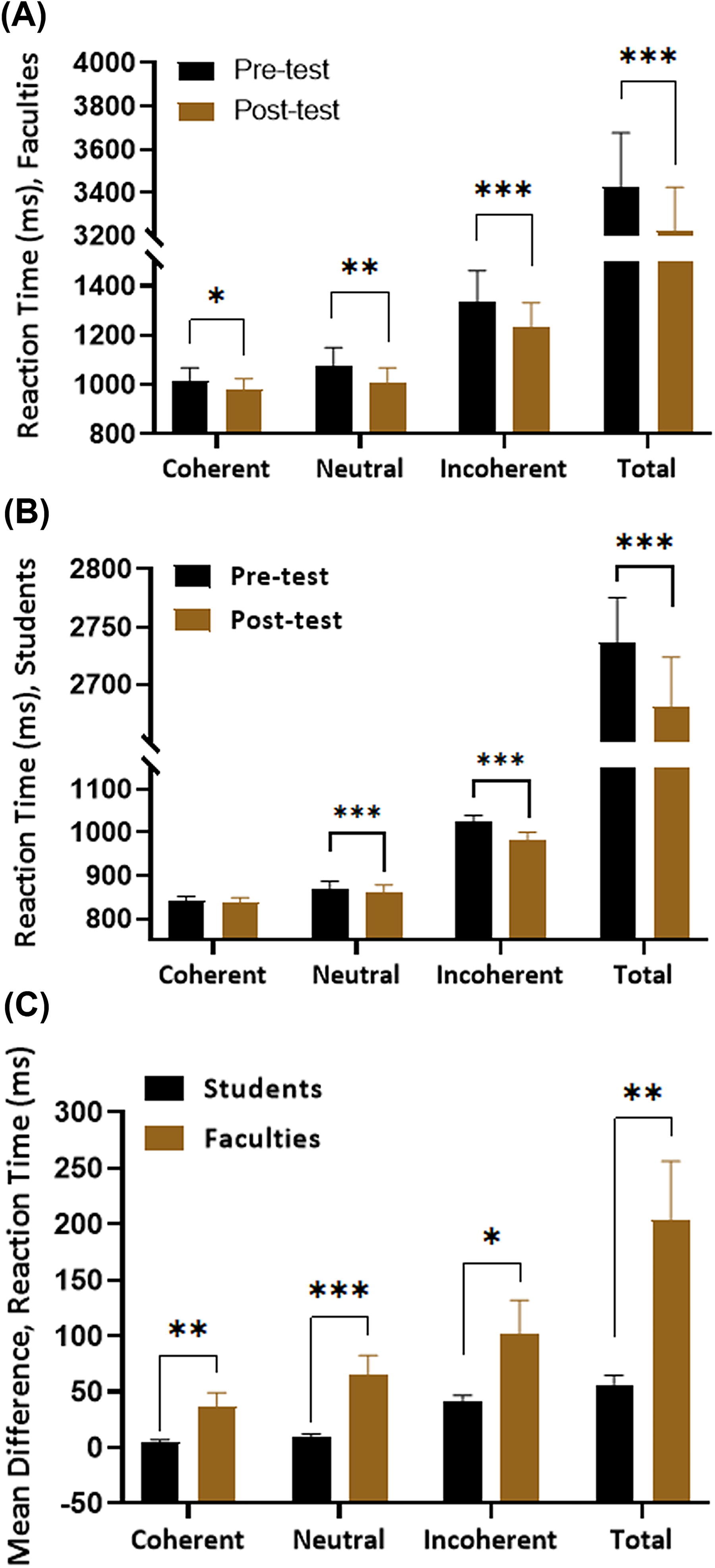
Listening to 40 Hz BB improves cognition of nursing faculty and students. The graph shows the comparison between pre- and post-test Stroop’s scores with BB auditory stimulus on female nursing
Faculty Benefited More Than Students from Listening to 40 Hz BB for Enhancing Cognition
Interestingly, while comparing the mean difference (pretest–posttest) score from the total all nine sessions, nursing faculty showed better improvements than students in all of Stroop’s tasks, “Coherent” (P < 0.01), “Neutral” (P < 0.001), and “Incoherent” (P < 0.05) (Fig. 4C).
BB-Mediated Effects on Different Cognitive Tasks Depend on the Duration of Auditory Stimulation
When we examined whether the BB-mediated impact on cognitive tasks improves over time (Fig. 5A, B), interestingly, only the nursing students’ group (P < 0.05) exhibited significant improvement over time in the “Incoherent” task (Fig. 5B).
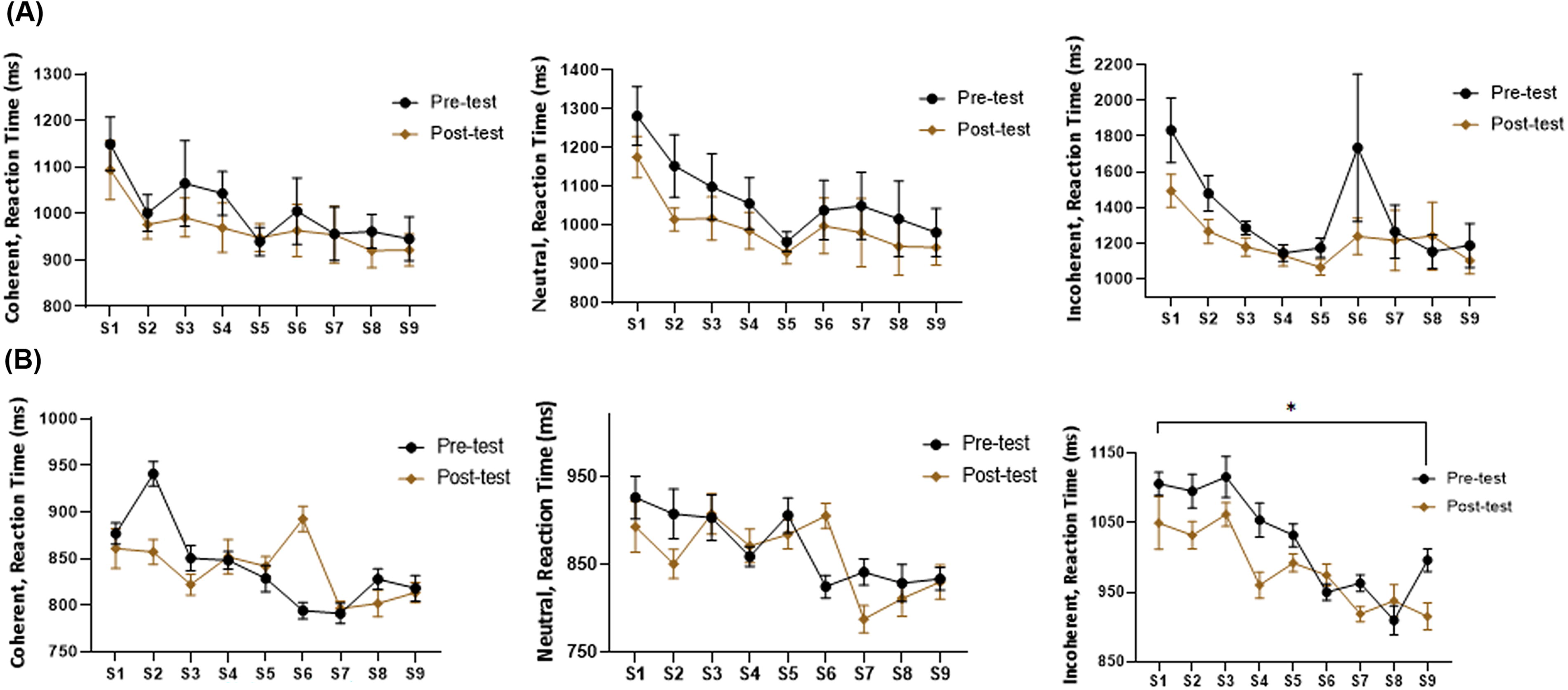
The effect of time factor in the 40 Hz BB-mediated improvements in the Stroop’s score. The graph shows the comparison of BB-mediated improvements between S1 and S9 in female nursing
BB-Mediated Effect on Cognitive Tasks is Positively Correlated with the BB-Mediated Improvement on Emotional States
The results from correlation analysis are presented in Figure 6. BB-mediated improvement in cognitive performance was found to have a moderate correlation with BB-mediated regulation in negative emotion (r p = 0.41) in nursing faculty, whereas there seems to be a weak negative correlation with the BB-mediated improvement in positive emotions (r p = −0.204).
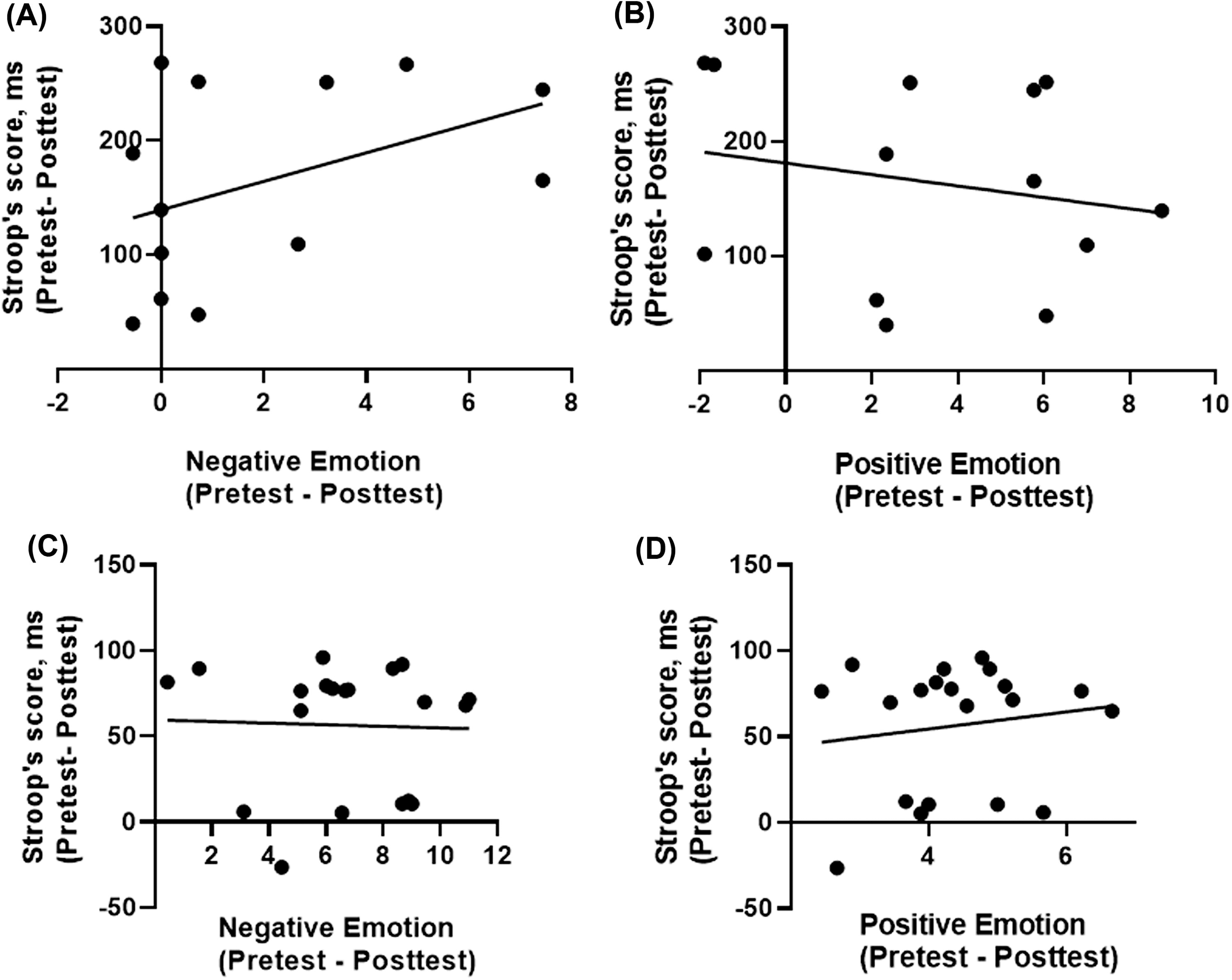
Correlations between the BB-mediated improvement in emotions and cognitive performance. The graph shows the Pearson’s correlation of BB-mediated changes in cognitive score with nursing faculty members’
For the nursing students, there was no positive correlation between BB-mediated improvement in cognitive performance and the improvement in negative emotions (r p = −0.035). However, a weak positive correlation (r p = 0.14) was observed between BB-mediated improvements in cognitive performance and positive emotion, but this correlation was not statistically significant.
Discussion
This study reported that listening to 15 minutes of BB (40 Hz) for nine sessions in three consecutive weeks helps nursing faculty (age 35–45) and students (age 18–25) to enhance mood and increase cognitive performance. Furthermore, we found that students benefited more from BB in enhancing emotional states, whereas faculty members experienced greater benefits in cognitive performance. Overall, these results suggest age-dependent effects of BB stimulation.
Effect of 40 Hz BB on Mood
The data from the 40 Hz BB-mediated change in the BRUMS score showed that nursing faculty (Fig. 1A) benefited in the selective emotion states of “Anger,” “Tension,” “Happiness,” and “Calmness,” whereas students (Fig. 1B) benefited in all the subgroups of negative and positive emotional states, except “Vigour.” Other literature also supports the benefits of 40 Hz γ-BB on mood. 8,32 According to Jirakittayakorn and Wongsawat (2017), 30 minutes of BB stimulation may be too long and could lead to adverse effects such as fatigue. However, using 20-minute BB stimulation had beneficial results, including decreased anxiety and depressive symptoms and increased vigour. 8 But it is also important to note that a single session of auditory stimulation cannot reveal the long-term consequences of BB.
When we considered academic status in the analysis, nursing faculty benefited less from BB in improving mood, compared with students (Fig. 1C). This disparity may be attributed to age, as older individuals often have enhanced emotion management skills crucial for maintaining occupational well-being. 33
In contrast, 40 Hz BB showed its long-term effect on increasing the positive emotion “Calmness” in nursing students, the younger age group. It was effective over time in improving negative emotions as well, particularly in the item “Tension” (Fig. 3). There are studies showing that depression and anxiety are quite common in female nursing students aged between 15 and 29, most probably because of their academic stress along with clinical placement. 34,35 Therefore, the γ-frequency band of BB-auditory stimulation and timeline that we used seem ideal for implementing it with this particular group.
We also evaluated the effect of 40 Hz BB in medical students from the same university. The study results will be reported elsewhere. However, a comparison between effects in these two study groups showed that nursing students benefited more than medical students in terms of “Anger,” “Confusion,” and “Depression.” In most of the nursing programs, the clinical training begins in their first year, whereas it begins in the third year for medical students. The primary sources of stress for the junior students were found to be nursing care procedures and prenatal care. 36 Given this, during their first years of study, nursing students may be more exposed to stressful circumstances, including fear of failing, challenging life experiences of patients like agony, and patient death. Therefore, 40 Hz BB may have worked better for nursing students.
Effect of 40 Hz BB on Cognition
Stroop’s test is a widely used tool to assess cognitive functions such as attention, processing speed, cognitive flexibility, and working memory. 37 The “Coherent” (reading the word) and “Neutral” (naming the color) tasks are more automated tasks assessing attention control, whereas the “Incoherent” (naming the ink color of words that are printed in an inconsistent color ink, for instance, the word “red” is printed in yellow ink) tasks assess the inhibition of interference arising from a more automated task.
Our findings from Stroop’s test suggest that cognitive performance can be improved by listening to the 40-Hz BB by both age groups, except in the “Coherent” performance of students (Fig. 4A, B). The literature suggests that processing speed reaches its peak capacity by early adulthood and then gradually deteriorates across the adult years. 38 It is possible in our case that the nursing students’ age group possessed the best processing speed and did not require improvement for performing “Coherent” tasks as much as the faculty’s age group did.
Given the reasons mentioned above, we expected to observe an age-related decline in BB-mediated improvements among faculty members. However, they showed greater improvements than students in all three Stroop’s tasks (Fig. 4C). The potential progress of young students could be limited by the fact that they were already performing close to their optimal level both in pre-test and post-test conditions. It could also be because not all aspects of cognitive functioning exhibit early age-related declines, and the performance in tests based on accumulated knowledge has been found to increase until at least age 60. 39 Studies argue that higher cognitive reserve in advanced age may be due to enriched environments or cognitively stimulating aspects of life, such as education and training, and protects against negative effects of aging and cognitive decline. Our results obtained in nursing students were confirmed by the results seen in medical students as these two study groups showed similar improvements in all three of Stroop’s tasks.
For adaptive and goal-directed behavior, inhibition that is involved in interference processing is particularly important. Age-related inhibitory deficits seem possible to get compensated by the recruitment of additional cognitive resources in frontal brain regions. 40 An enhanced contingent negative variation (anticipation and motor preparation) for older, compared with younger, adults has also been observed under effortful task conditions suggesting that older individuals may intensify preparation to maintain a reasonable level of performance. 41 The study by Gajewski et al. (2015) has evidenced the reduced Stroop interference in old adults with long-term physical exercise. 42 This evidence indicates that similar changes may occur by listening to 40 Hz BB, leading to a higher decrease in Stroop interference in the nursing faculty’s age group, compared with the students (Fig. 4C). However, when comparing the BB-mediated change (pretest score–posttest score) between session 1 and session 9, BB-mediated benefits in the “Incoherent” task got better over time in the nursing students’ group (Fig. 5B).
Correlation Between 40 Hz BB Mediated Change in Mood and Cognition
There was a moderate positive value of Pearson’s correlation between improvement in Stroop score and improvement in negative emotions in nursing faculty, although none of the correlations between improvements in cognitive function and in emotions was statistically significant. Especially in the student group, the lack of correlation may be due to the fact that students were performing optimally with short reaction times that cannot be improved upon (Fig. 6). In a study using regression analysis, the younger participants have shown strong unidirectional coupling from negative emotion to positive emotion, whereas older adults have shown significant unidirectional coupling from negative emotion to cognitive performance. 43 Despite the stereotype that aging is associated with decline, older adults appear to have better emotional regulation and problem-solving abilities. 44
Conclusion and Future Work
The present results suggest that 40 Hz BB may enhance well-being of both nursing faculty and students and improve cognitive performance. While tension may never completely disappear from the workplace, encouraging serenity can go a long way toward fostering a positive work atmosphere and delivering high-quality education.
This study has a few limitations that need to be acknowledged. We included a relatively small sample size in this investigation, which resulted in a loss of statistical power. These data might, however, offer proof to support additional research with a larger sample size.
In addition, although no control group was used for the BB treatment, the within-subject design and pre- and post-treatment comparisons demonstrated a significant impact (Figs. 1 and 4). Further research is required to obtain a better understanding of the underlying mechanism of the age-dependent impact of BB on mood and emotions. We look forward to integrative research advancements in this fascinating field.
Footnotes
Acknowledgments
The authors thank Mr. Kishor Khanal (Statistician, Assistant Professor) and Dr. Abha Shrestha (Assistant Professor), Department of Community Programs, Dhulikhel Hospital, Kathmandu University Hospital, for their invaluable assistance with the biostatistical data analysis.
Author Disclosure Statement
No competing financial interests exist.
Funding Information
This research was funded by the University Grant Commissions (UGC) Nepal under the grant no. SRDI-75/76-HS-8.
Supplementary Material
Supplementary Data S1▪
References
Supplementary Material
Please find the following supplemental material available below.
For Open Access articles published under a Creative Commons License, all supplemental material carries the same license as the article it is associated with.
For non-Open Access articles published, all supplemental material carries a non-exclusive license, and permission requests for re-use of supplemental material or any part of supplemental material shall be sent directly to the copyright owner as specified in the copyright notice associated with the article.
