




Abstract
Photosystem I (PSI), a protein complex found within the thylakoid membrane of green plants and some bacteria, drives nature's 90-terawatt solar energy conversion process known as photosynthesis. Kudzu (Pueraria lobata) is an invasive vine from eastern Asia that grows in the southern United States, spreading at ∼500 km2 per year and causing extensive environmental damage. This article reports the first integration of nature's optimized solar energy converter—PSI from the fast-growing, invasive leaves of kudzu—with the ubiquitous platform of integrated circuits—silicon—to prepare a “wet” photoelectrochemical cell. Herein, we report on the success of PSI films extracted from the kudzu leaf and deposited on boron-doped silicon (p-Si) to enhance photoelectrochemical current over p-Si alone.
Introduction
Photosystem I (PSI), a protein complex that drives photosynthesis in higher plants (monomers) and cyanobacteria (trimers), uses a system of chlorophylls to harvest incident photons of light and transfer this energy to a special pair of chlorophylls known as P700. Upon receipt of the incident energy (photon), rapid charge separation occurs (within 10–30 ps), releasing an electron down an intra-protein energy cascade to an iron-sulfur complex called FB. 1 In nature, the soluble, iron-containing protein ferredoxin shuttles the electrons away from FB − to achieve a nearly perfect quantum yield. 2 This remarkable photocatalytic functionality, PSI's nanometer size, and its vast abundance have encouraged researchers to incorporate PSI into biohybrid structures, with many successes reported over the past decade. 3 –8
In prior work, our group successfully extracted PSI protein complexes from spinach leaves and deposited them on various substrates, such as gold, glass, indium tin oxide (ITO), and alumina, to investigate “wet” photoelectrochemical cells where diffusible redox mediators transfer electrons between a PSI-coated working electrode and a counter electrode. 9 In 2007, we generated ∼4 nA/cm2 of photocurrent with isolated PSI submonolayers deposited on gold electrodes. 10 The following year, we developed a rapid assembly approach to achieve dense PSI monolayers, which resulted in ∼100 nA/cm2 of photocurrent, and we later incorporated nanoporous gold electrodes to increase the PSI/electrode interfacial area, reaching ∼300 nA/cm2. 11,12 Further studies led our group to investigate thick multilayers of this exciting protein on Au substrates, achieving ∼10 μA/cm2 of photocurrent in 2010. 13 One of the persistent challenges with the deposition of PSI has been controlling the orientation of the protein on the substrate and within the film's layers, so that current flow in a particular direction is not cancelled by that from oppositely oriented photosystems. Very recently, we have been able to circumvent this issue through band gap alignment using boron-doped silicon (p-Si) substrates and PSI from spinach leaves, reporting an average photocurrent of ∼875 μA/cm2 for ∼1 μm thick films at 0.2 M concentration of methyl viologen mediator. 14
Demand for molecular electronics is on the rise, opening the door to a vast array of opportunities for biohybrid devices, such as sensors and photovoltaic devices. PSI is an abundant biological resource that is both economical and robust, making it an attractive protein-molecular complex for these devices. Conventional electronics cannot match the density of the molecular circuitry found in photosynthetic complexes. 7 Considering the explosive potential for PSI, a transition from spinach and pea plants to non-traditional food sources such as kudzu could become an increasingly important strategy.
Kudzu is a rapidly growing vine covering in excess of 810,000 hectare (ha) of the southern US. 15 It is a member of the pea family Leguminosae and was introduced into the US as a soil stabilizer, animal food, and ornamental vine in 1876. 15 As many consider the vine a nuisance, it is surprising to learn of its commercial appeal. Kudzu is used as a cooking starch, a natural medicine, fibers for weaving and paper production, a source for methane and gasohol, a supplement for existing bioethanol feedstocks, and a food for ruminants. 15 –17 Unfortunately, kudzu has a devastatingly negative impact in the southern US, where it quickly overtakes local vegetation, crops, and forest. In 2009, Sage et al. stated that kudzu costs the US economy more than $500 million per year in lost crops and forest productivity, expenditures for control, and damage to property. 16 Approaches to eradicate this pesky weed are expensive, challenging, and potentially harmful to the environment. Studies suggest that the eradication of established kudzu areas would require multiple years of applied herbicides and alternative plantings. 15,18 Due to the extensive problems associated with this vine, the United States Congress placed kudzu on the list of federal noxious weeds in July of 1997. 15,18 Consequently, identifying commercial applications for this vine is a prudent strategy for controlling its growth. One such opportunity is to isolate the PSI protein complexes found in its leaves. As PSI is homologous in higher plants, we would expect that films of kudzu-based PSI would enhance the solar conversion of p-Si in a similar manner as does spinach PSI. 1 Herein, we report on the success of PSI extracted from the kudzu leaf and deposited onto p-Si to enhance photoelectrochemical energy conversion compared to p-Si alone.
Materials and Methods
PSI complexes were extracted from hand-picked kudzu leaves following the procedure to extract PSI from spinach leaves. 12 Briefly, the thylakoid membranes were isolated via maceration with subsequent centrifugation as described by Reeves and Hall, and modified following the procedure outlined by Ciobanu et al. 19,20 Further centrifugation separated the PSI complexes from the thylakoid membranes. Finally, purification was achieved by use of a chromatographic column packed with hydroxylapatite (Sigma Aldrich, St. Louis, MO) as described by Lee et al. and Shiozawa et al., who successfully extracted the protein complexes from a variety of green plants, e.g., Canavalia ensiformis or Jack-bean plants and Nicotiana (tobacco plants). 21,22 The product was characterized using UV-vis absorbance spectroscopy (Varian Cary 5000 UV-VIS-NIR spectrophotometer, Agilent Technologies, Santa Clara, CA) according to Baba et al. 23 Briefly, the P700 content was determined chemically by measuring the ferricyanide-oxidized minus the ascorbate-reduced difference spectrum. For the oxidation of FB − in PSI, 1 M potassium ferricyanide was added to the sample cuvette, and for the reduction of P700+, a mixture of 0.5 M sodium ascorbate and 5 mM dithiothreitol was added to the reference cuvette. The difference extinction coefficient was 64 mM−1 cm−1 for the red absorbance minimum with respect to the isosbestic point at 725 nm.
PSI was deposited onto lightly doped p-Si substrates (University Wafer, Boston, MA) using the vacuum-assisted method. 11 Prior to deposition, 1 mL of PSI solution was dialyzed in 4 L of deionized water using 10 kDa Biotech Cellulose Ester dialysis membrane tubing (Fisher Scientific, Pittsburgh, PA). This reduced the concentrations of salt and surfactant in the solution. When this aqueous solvent is removed from the dialyzed PSI solution via the vacuum-assisted deposition process, the hydrophobic regions of PSI complexes that were previously stabilized by surfactant seek stabilizing interactions with the hydrophobic regions of other PSI complexes in the film, forming a dense multilayer. The substrates were initially cut to approximately 1.3×3 cm2 and subsequently etched in hydrofluoric acid (Sigma Aldrich). A 30-μL drop of the PSI solution was placed onto an area of 3.85×10⁻⁵ m2, established with a circular mask (Gamry Instruments, Westminster, PA), and dried in a vacuum. The process was repeated 12 times to achieve the desired thickness. The resulting film was rinsed in deionized water. The entire deposition process required ∼2 h.
Gold substrates were prepared by thermal evaporation. Silicon wafers were rinsed with ethanol and water, and then dried in a nitrogen stream. Chromium (100 Å) and gold (1250 Å) were sequentially evaporated onto the silicon wafers at rates of <2 Å s−1 in a diffusion-pumped chamber with a base pressure of 4×10⁻⁶ Torr. The wafers were cut to sample size approximately 1.3×3 cm2 and rinsed in ethanol and water. The gold was placed in 2 mM 2-aminoethanethiol hydrochloride in ethanol for ∼30 min, rinsed in ethanol and placed in 2 mM terephthaldialdehyde in ethanol for ∼30 min (Sigma Aldrich) to establish self-assembled monolayers for covalent attachment of PSI to the substrate. The PSI was deposited using the vacuum-assisted method described above.
Reflectance-absorbance infrared spectroscopy (RAIRS) measurements of PSI deposited onto the gold were taken with a Varian 3100 FT-IR, Excaliber Series spectrometer with Resolutions Pro software (version 4.0.5.009; Digilab, Inc., Marlborough, MA). The RAIRS p-polarized light was incident at 80° from the surface normal. The data were taken in single reflection mode with a liquid-nitrogen cooled, narrow band mercury cadmium telluride detector. Spectral resolution was 2 cm−1 after triangular apodization. Each spectrum was collected over 500 scans with a bare gold substrate as the background. A water spectrum was measured by rescanning the background sample in the presence of water vapor and was subtracted from the spectrum of each sample for better resolution of the peaks of interest in the 1,400–2,000 cm−1 range. Otherwise, the presence of water was minimized by the flow of dry air through the sample compartment.
Electrochemical measurements were obtained using a CHI660a electrochemical workstation equipped with a Faraday cage (CH Instruments, Inc., Austin, TX). A custom three-electrode cell consisting of the p-Si substrate as the working electrode, platinum mesh as the counter electrode, Ag/AgCl as the reference electrode, and an aqueous electrolyte solution of 20 mM methyl viologen trichloride hydrate (Sigma Aldrich) with 0.1 M potassium chloride (Fisher Scientific) was used for all electrochemical measurements. A Gebrauch KL 2500 LCD lamp (Micro Optical Solutions, LLC, Newburyport, MA) equipped with a 633 nm high-pass filter providing incident intensity of 0.19 W/cm2 was used for all photo-response measurements. A p-Si substrate was etched in hydrofluoric acid, rinsed in deionized water, and transferred to the customized electrochemical cell for immediate measurement as a baseline for subsequent data measurements of PSI/p-Si.
Film thicknesses were measured on a Dektak 150 stylus profilometer (Veeco Instruments, Inc, Plainview, NY) with a standard scan. The resolution was 0.074 μm for a 2,000-μm length scan over 90 s. The stylus radius was 12.5 μm with a force of 0.0637 N.
Results and Discussion
After completing the extraction of PSI from kudzu leaves, a UV-vis spectrum was measured to verify the solution composition. Characteristic peaks at ∼440 nm and ∼680 nm (Fig. 1) are consistent with the chlorophylls of PSI. Further analysis using Baba's method yielded a chlorophyll/P700 ratio of 89 and PSI concentration of 3.4×10⁻⁷ M, which is an order of magnitude lower than the average concentration reported for spinach-extracted PSI by our group. 9,23
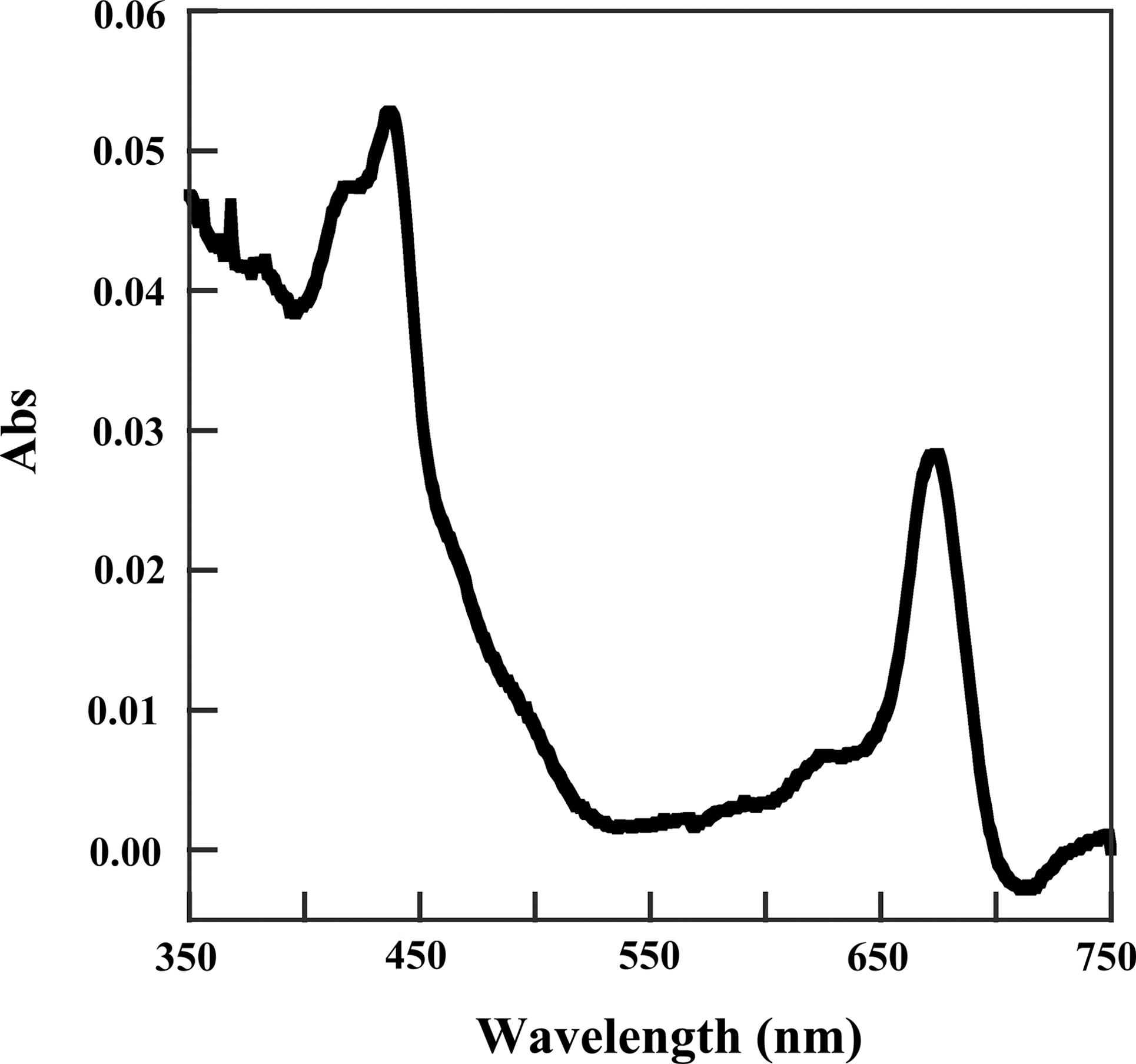
UV-vis spectrum of the characteristic absorbance peaks for PSI extracted from kudzu in 0.2 M phosphate buffer (pH 7.0) with 0.05% (wt/vol) TritonX-100.
Films of PSI complexes were prepared simultaneously on silicon and gold surfaces by depositing the PSI solution into a well-defined area, applying a vacuum of ∼30 mTorr for 10 min, and repeating 12 times. Profilometry measurements provided an average thickness of 0.59 μm with a standard deviation of 0.29 μm across the surface. A RAIRS spectrum of the PSI film on gold was collected to identify the dominant compositional groups from the protein complex. The reflective gold surface was necessary to provide good reflectance signals for the accumulation of the spectrum. Fig. 2 shows the Amide I and Amide II peaks at 1,664 cm−1 and 1,546 cm−1, respectively. These peaks represent the amide carbonyl stretching and the NH bending, respectively, confirming the presence of the protein on the surface. 24
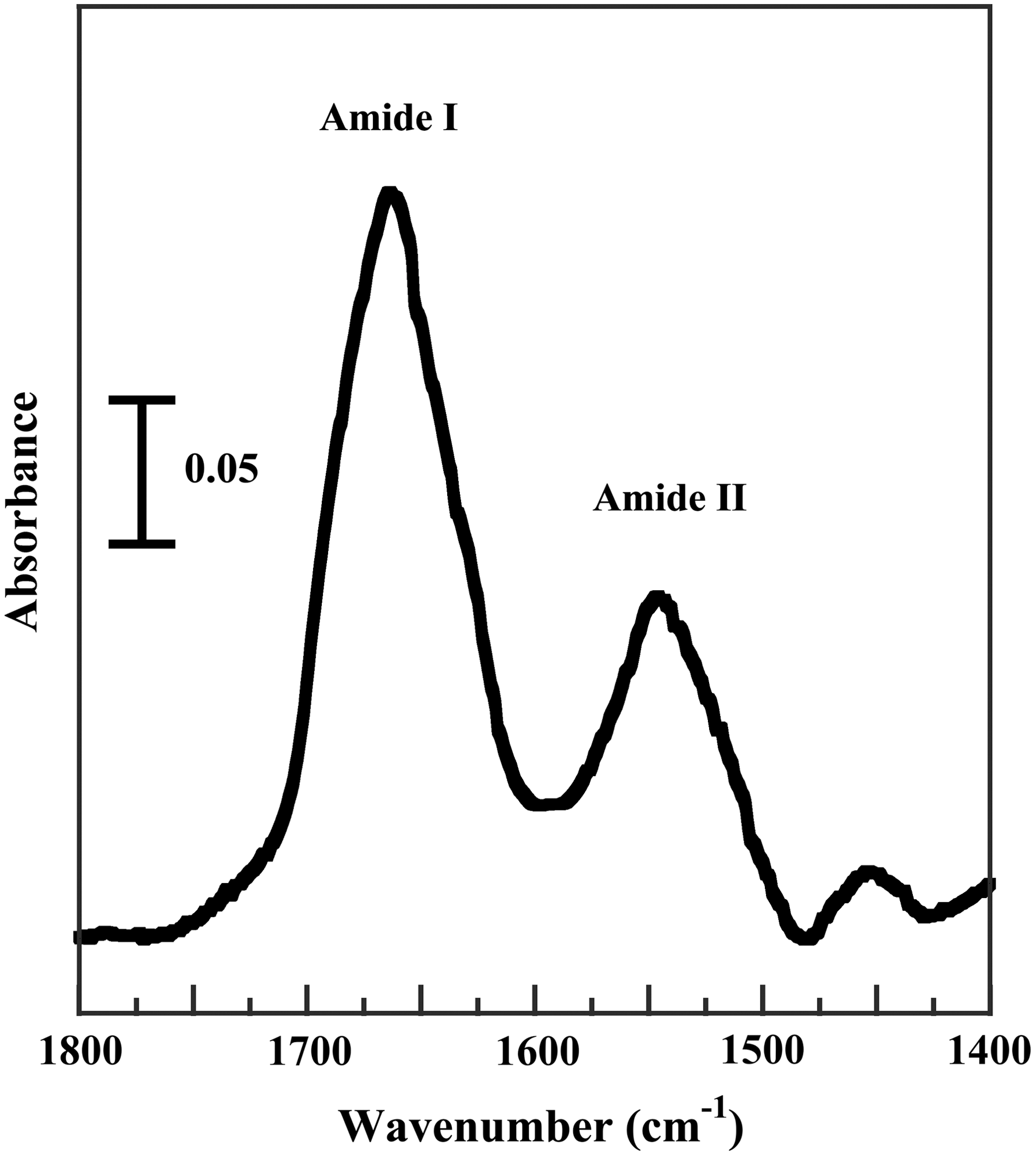
Reflectance absorption infrared spectrum of the Amide I and II peaks at 1,664 and 1,546 cm−1, respectively, for a 0.9-μm thick PSI film deposited on gold.
Photochronoamperometry was performed to measure the ability of the protein to remain photoactive in this cast film out of its native environment. When PSI is irradiated, the chlorophylls absorb the incident photons and transfer them to the P700 chlorophyll dimer, which becomes excited and quickly releases an electron, becoming P700+. The electron travels down the electron transfer chain to the FB (iron-sulfur) site, located on the stromal side of the complex, reducing it to FB −. 25 In our design, the soluble mediator, methyl viologen, then oxidizes FB − and transfers the electron to the platinum counter electrode. Meanwhile, the valence band of the p-Si releases an electron to the P700+ site, and the cycle repeats as long as sufficient irradiation and mediator are present.
The measurements of current at open-circuit potential are shown in Fig. 3. These measurements were taken with the cell isolated in the dark for 30 s, irradiated 30 s, and again measured in darkness (30 s to 60 s irradiation). The bare p-Si working electrode responds to irradiation with a measured current density of ∼29 μA/cm2, while the current density of PSI on p-Si measures ∼67 μA/cm2. This response confirms photocurrent enhancement from the PSI-modified p-Si electrode. The enhancement observed in the presence of the PSI film is due to band gap alignment between the p-Si (valence band energy=0.5 V vs. normal hydrogen electrode (NHE)) and the PSI reaction center, P700 (0.43 V vs. NHE), and the FB − site (−0.58V vs. NHE) and the redox mediator's formal potential (−0.45 V vs. NHE). 14 In this system, the electrons flow in one direction, from the silicon to the P700 site, where they are excited and transferred to the FB site and transported by the redox mediator to the counter electrode. Using the same conditions, the kudzu PSI film deposited on gold achieved a photocurrent of ∼9 μA/cm2, 4–5 times lower than that of the PSI film on p-Si. Opposite PSI orientations that occur during deposition can result in current cancellation on metal electrodes, whereas enhancement in photocurrent for the PSI film on p-Si is due to the unidirectional transfer of electrons attributed to the band gap alignment. 26
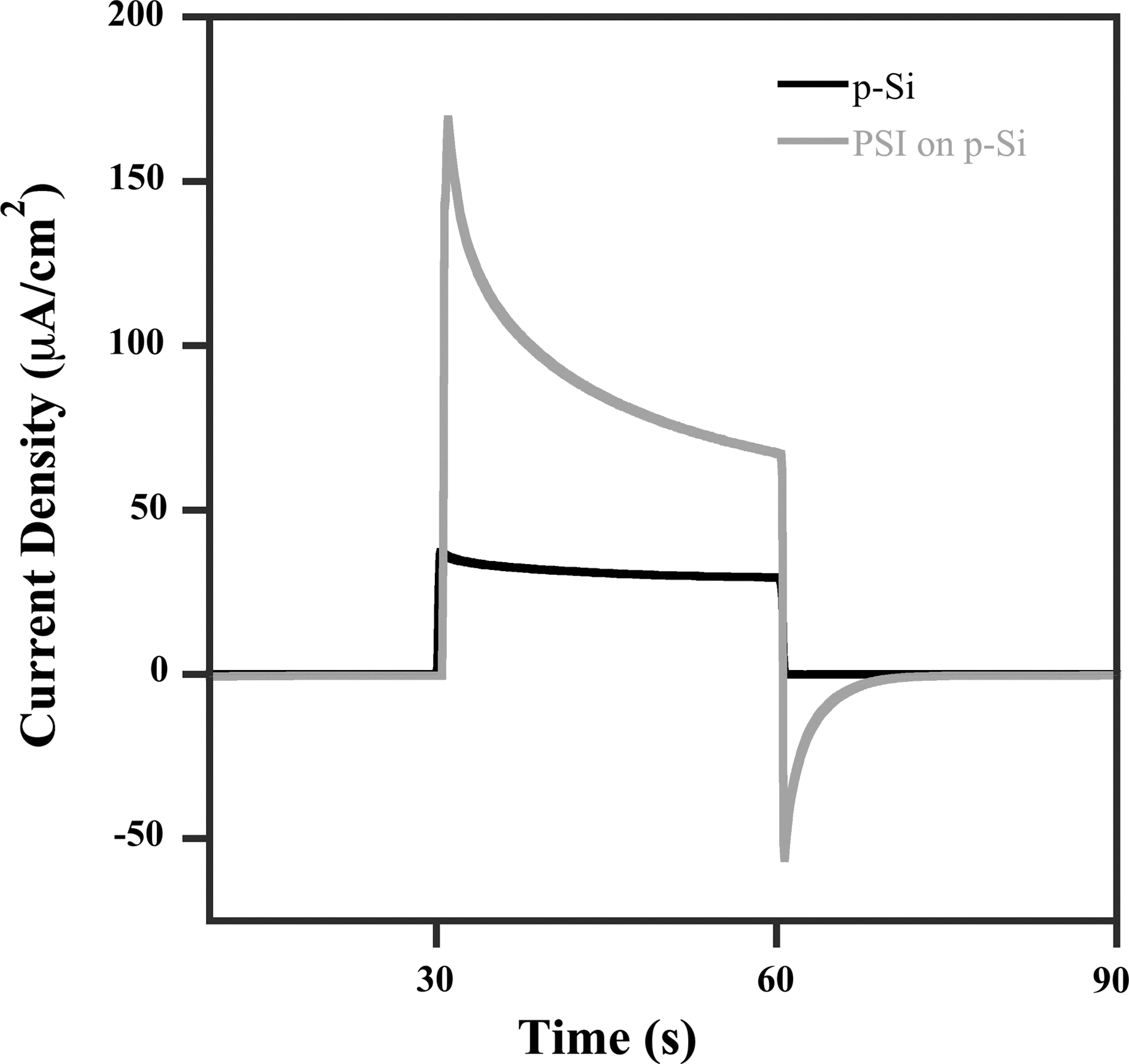
Photochronoamperometric measurements of bare p-Si control and a PSI film deposited on p-Si in a “wet” electrochemical cell with 20 mM methyl viologen trichloride hydrate and 0.1 M potassium chloride in aqueous solution.
Fig. 4 shows the influence of applied voltage to the working electrode in these experiments. Adding a negative 100 mV bias to the electrode supplies excess electrons to the circuit. The additional availability of electrons allows the photocurrent in this sample to increase to ∼173 μA/cm2, ∼4 times the photocurrent measured for p-Si at this potential (40 μA/cm2). When the working electrode is biased with positive 100 mV, the photocurrent is repressed by the lack of available electrons. At positive 100 mV bias, the PSI photocurrent of ∼22 μA/cm2 is 2 times the measured photocurrent in p-Si alone (11 μA/cm2). These data reflect the aforementioned importance of the band gap alignment in this photoelectrochemical cell.
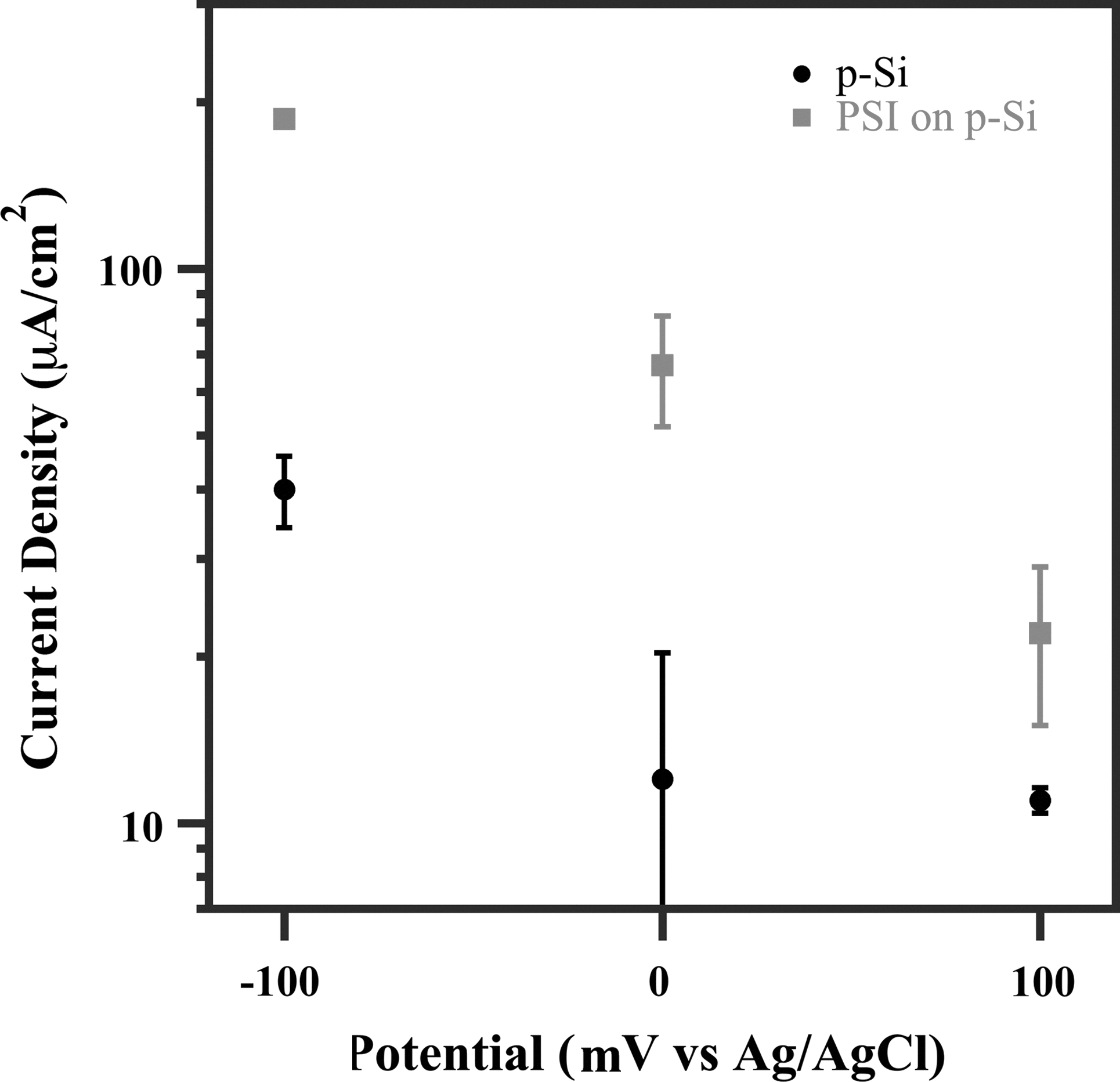
Effect of applied bias on the photocurrent measured for bare p-Si control and a PSI film deposited on p-Si. 0 mV refers to an open-circuit potential of −278 mV and −361 mV for the bare p-Si and PSI film, respectively, vs. Ag/AgCl reference electrode.
Conclusions
We have shown that PSI can be extracted from kudzu leaves and deposited as thin films to enhance the photocurrent response of p-Si. Furthermore, these designs can be biased to produce additional photocurrent. Although kudzu is considered a nuisance in the US, its rapid growth combined with advancements in photoelectrochemical performance of PSI in biohybrid architectures suggest that many impoverished areas of the world could grow and harvest the leaves of this “weed” as a means to provide solar power to those who otherwise live without electricity.
Footnotes
Acknowledgments
The authors would like to thank Karla Dumeng from University of Puerto Rico and Will Crosby from University of Tennessee at Martin for their assistance in preparing the kudzu leaves for the extraction process. This work would not have been possible without generous financial support from the US Environmental Protection Agency (SU8360221), US National Science Foundation (DMR 0907619 and EPS 1004083), and a Scialog Award from the Research Corporation for Science Advancement. Original funding for this project was provided by the United States Department of Agriculture-CSREES (2005-35603-15303) and a Vanderbilt University Discovery grant.
Author Disclosure Statement
No competing financial interests exist.