




Abstract

• In Europe, industrial biotechnology has been identified as one of six key enabling technologies to improve European industrial competitiveness.
2
In addition, biobased products are one of the six key markets identified in the European Lead Market Initiative. On a member state level, for example, Germany launched the National Research Strategy BioEconomy 2030. • In China, long-term support of industrial biotechnology and related strategic planning are reflected in China's 12th Five-Year Plan. Biotechnology is one of seven strategic emerging industries, and biomanufacturing is one of the projects for sub-industries. • In Japan, the government initiated the Biomass Nippon Strategy in 2002, which requires that 20% of all plastics consumed have to be produced from biomass by 2020. • In Thailand, a National Roadmap for the Development of the Bioplastics Industry includes specific strategies designed to strengthen the domestic bioplastics industry.
The implementation of these strategies still appears to be in an early stage, but they may come to have a critical role in the deployment of biobased products, particularly since these products frequently compete in the marketplace with mature petrochemical products. Moreover, the balance of the policies affecting biobased products and bioenergy or biofuels may impact which market segment biomass and other resources, including R&D personnel and capital, are deployed.
This article aims to provide an overview of the most relevant government measures concerning biobased products as well as to identify similarities and differences in related policies globally. It provides answers to the following questions: which measures have been implemented and how were they designed (e.g., dedicated measures in industrial biotechnology, horizontal policies); how do policy approaches for industrial biotechnology differ globally; what are the different kinds of measures being employed and to what magnitude are they being applied; and what are the main challenges for implementing the various types of policy instruments?
The survey mainly focuses on the US and Canada for North America, Germany and France in the European Union, and China and Thailand in Asia. These countries are among the most active in industrial biotechnology globally. Select examples from other countries are given as well. Four types of strategic measures for stimulating innovation and industrial policy are analyzed: R&D funding; support of pilot/demonstration plants; support of commercialization (e.g., investment incentives); and demand-oriented policies (Fig. 1). These measures cover important activities along the innovation chain from research to commercialization and market penetration.
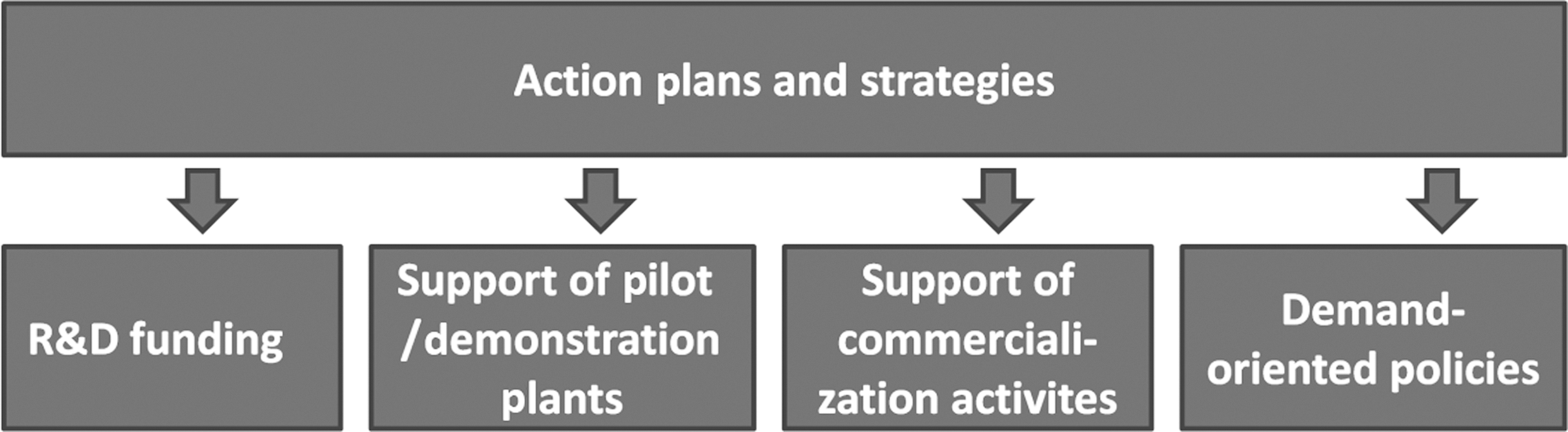
Policies along the innovation chain.
R&D Funding
Direct and indirect R&D funding has significantly increased for industrial biotechnology in the last decade. Most R&D programs do not only cover biobased products, but include projects for biofuels and other technologies as well. It is usually unclear whether the measures are mostly dedicated to biofuels or also provide comparable or substantial support for biochemicals and biomaterials. 3
In the US, all relevant programs cover biobased products and biofuels together. The US Department of Energy (DOE) partly promotes R&D for biobased products in its biomass programs, as in the Biomass Multi-Year Program Plan. In addition, the Biomass Research and Development Initiative (BRDI) of the US Department of Agriculture (USDA) and the DOE coordinates federal R&D for biofuels and bioproducts. In April 2011, the DOE and USDA announced up to $30 million annually in funding for the BRDI for a 3 to 4 year period. 4 Similarly, in Canada, various federal and provincial R&D programs (e.g., the Agricultural Bioproducts Innovation Program and Ontario's Biotechnology Cluster Innovation Program) include the funding of biobased products.
In the European Union, biobased products are supported primarily within the 7th Framework Programme for Research and Technological Development (FP7). One of the areas within this scheme is Food, Agriculture and Fisheries and Biotechnology, in which €1.9 billion (USD2.5 billion) is earmarked for the financing of research projects from 2007 to 2013. Other important support activities are carried out within ERA-Industrial Biotechnology funding program and technology platforms such as SusChem. 5 In addition, a few countries support specific R&D programs for industrial biotechnology. For example, Germany provides specific R&D programs for themes such as genomics or fermentative conversion of renewable resources, as well as cluster-oriented approaches such as the program BioIndustrie 2021, and cross-sectional network-oriented programs such as the Innovation Initiative Industrial Biotechnology that was launched in 2011. Similarly, in France, Industry and Agro-Resources (IAR), among the sponsored competitive clusters (pôles de compétitivité) is dedicated to the commercialization of biochemicals. It unites stakeholders from research, academia, industry, and agriculture in the regions of Champagne-Ardenne and Picardy to advance the non-food use of plant biomass.
Specific R&D programs related to biofuels and biochemicals in China are classified under the country's 863 Program and 973 Program, and under the National Innovation Fund. They include feedstock processing, enzymatic modification, and technological processes for biofuels and biochemicals. 3 The percentage of total R&D spending under these programs for projects related to biobased products is unclear. In Thailand, the National Innovation Agency has a budget of Baht 79 million (USD2.5 million) for 68 research projects aimed at developing new technology in cooperation with the National Research Council of Thailand. 6
Support of Pilot/Demonstration Plants
The funding of applied development for building pilot and demonstration plants has gained traction recently for two reasons. First, more basic R&D has provided results that support promising projects. Second, scale-up of processes from laboratory scale to commercial plants appears to be more technologically challenging for biocatalysis than for traditional chemistry. Thus, substantial time and cost requirements arise, which lead to financial gaps for R&D institutions and industry. Most of the countries and regions studied provide substantial support for R&D to address these gaps, but they differ in whether their main focus is R&D programs or supporting pilot/demonstration plants.
In the US, pilot and demonstration plants, in general, receive intensive support. This support tends to favor the use of biomass for energy production; however, support of biomass-based materials is increasing. In December 2009, the DOE announced that it would support 19 biorefinery projects. 7 Eight of these projects explicitly aim to include the development of biomaterials from biomass, and together they garnered government support of $178 million.
Within FP7, the European Commission announced financial support of biorefineries in the amount of €52 million (USD67.2 million), with a further €28 million (USD36.2 million) provided by partners from industry, universities, and research institutions. The program includes three major projects (BioCore, EuroBioRef, SUPRBIO) and aims to convert biomass into second-generation biofuels, biochemicals, and other materials. In member states, mostly single projects are supported. In France, the BioHub program focuses on the development of cereal-based chemical products and is supported by a €22 million (USD28.4 million) subsidy and a €20 million (USD25.9 million) reimbursable loan. An isosorbide demonstration plant was launched in July 2009 in Lestrem. In addition, French research clusters received €20 million (USD25.9 million) to build a pre-industrial demonstration plant in Toulouse in the area of white biotechnology. In Germany, a lignocellulose biorefinery pilot plant built in the Leuna chemical park is supported by €8.5 million (USD11 million).
In Thailand, the cabinet approved a framework for promoting investments in the bioplastics industry in December 2010. The cabinet agreed to a government budget of Baht 300 million (USD10 million) to support the establishment and operation of pilot plants with capacities of 1,000-10,000 tons/year for three years (2011–2013). In addition, the government supports commercial investment in these projects within five years (2011–2015) with a budget of Baht 600 million (USD20 million). There are 20 projects in total managed by 33 public and private companies. 8
These examples of funding show differences in the main focus of support. The US concentrates on biorefineries with a key focus on biofuels, and biobased products only benefit partly. Thailand focuses on bioplastics, while in Europe the support is more fragmented.
Support of Commercialization Activities
Many countries support start-ups and small and medium enterprises (SMEs), as these are important players in commercialization efforts (e.g., the Small Business Innovation Research (SBIR) Program in the US). Therefore, horizontal policy measures across industries and firms are usually implemented. Other important policy measures include incentives for investments in manufacturing facilities. The justification for such incentives is often the subject of controversy. They may disturb competition as they often favor individual firms, and questions over the government's ability to pick the “winners” arise. However, investment incentives play a role in determining the geographical location of new plants in capital-intensive industries. 9
Investment incentives may be provided for programs in certain industries or regions (e.g., tax allowances) or for individual cases involving large amounts of aid. For biobased products there exist only a few reported cases with quantified information about investment incentives. Myriant was awarded a $50 million grant from the US DOE for its biobased succinic acid plant in Lake Providence, Louisiana. 10 BioAmber announced that it received CAD35 million (USD35.7 million) in combined grants and loans from the Ontario Ministry of Economic Development and Trade for the construction of a biobased succinic acid and 1,4 butanediol facility at Sarnia, Ontario. 11
There are also some qualitative statements of significant investment incentives, such as for the construction of plants by NatureWorks in Thailand, Pyramid in Germany, and Metabolix Explorer in Malaysia. 12 –14 Nesbitt reports that China provides incentives to profitable companies that display production efficiency. In addition, China provides tax and investment incentives for emerging industries in biochemistry. Thailand currently offers special incentives for the bioplastics industry, such as a tax incentive program offered by Thailand's Board of Investment. It includes corporate income tax exemptions for up to eight years and an additional 50% reduction in corporate income tax for five years. 6
In the future, incentives may gain more importance, for better or for worse. The capacities of the plants will rise, and their local economic impact will increase. In such cases, geographical differences in related policies may increase. In the European Union, there is a control mechanism in place for state aid; a scaling-down mechanism for government awards for investment above €50 million (USD64.6 million). This mechanism reduces the maximum of the permitted incentives by the member states.
Demand-oriented Policies
Demand-oriented measures include systemic policies, regulations, public procurement measures, and support of private demand. 15 In many countries these are widely used for biofuels and/or bioenergy. However, such policy instruments are rarely in place for industrial biotechnology.
In the US, the BioPreferred program sets regulations for public procurement. The program aims to increase the purchase and use of renewable, environmentally friendly biobased products and instructs government agencies to procure bio-based products preferentially under certain conditions. Biobased products may be adopted in the program if they are commercially available and have sufficient capacity and price competitiveness versus fossil-based products. The requirements that biobased products have to fulfill differ between groups, and this may relate to biobased content or sustainability criteria. To date, 83 product groups have been approved in the first seven rounds of proposals. The biobased content required for the various product groups varies from 7% to 94%. In addition, the USDA has finalized the voluntary labeling program for biobased products. The BioPreferred label focuses on newer-generation biobased products and excludes mature products. 16 This is because innovative biobased products would have disadvantages in markets in which mature biobased products have a significant market share, and this could deter the introduction of products and an even higher biobased content.
In Europe, the Lead Market Initiative includes various measures ranging from public procurement to tax incentives, regulations, quotas, or mandatory use for biobased products. 17 But these are only just beginning to be implemented. 18 Standardization activities are an exception. These efforts intend to improve information about the characteristics of biobased products. In 2008, the European Commission set standardization mandates for biobased products and for biopolymers and biolubricants. The results have been documented in technical reports that are intended to precede actual technical specifications and full European standards. Subsequently, additional mandates were set for biosurfactants and biosolvents.
Other demand-oriented measures have been implemented in fragments. France, for example, has set an indicative target of increasing the share of biomass as raw material to 15% in 2017. Furthermore, in some European countries such as Belgium, incentives for using packaging made from biomass are in place. 19 The Dutch packaging tax favors bioplastics over petrochemical plastics. In Germany, packaging law exempts plastic packaging from the costly return system until December 2012 if it contains at least 75% biobased materials.
These examples highlight the difficulties in implementing policies to expand availability and use of biobased products. The heterogeneity between biobased products is enormous. Their application fields, level of technological maturity, and product characteristics differ fundamentally, so it is essentially impossible to implement policy measures with uniform criteria. In addition, the consequences of a measure that would span these product groups are difficult to assess ex-ante, including potential unintended effects such as competition distortions. As a result, countries are implementing measures step-by-step for some product groups, and expanding them later to include others.
An important path for policy measures would be the increasing use of sustainability criteria. This could increase the justification and acceptance of measures favoring biobased products. However, the lack of harmonization among sustainability criteria is a major issue. Some steps have been taken to standardize such assessments. The Organisation for Economic Co-operation and Development (OECD) has provided a “Draft OECD Recommendation on Assessing the Sustainability of Bio-based Products” for public consultation. 20 The European Commission services (DG Environment, DG Enterprise, and DG Research) and the Joint Research Centre have developed a guidance handbook for good practice, entitled International Reference Life Cycle Data System (ILCD) Handbook. 21
Conclusions
Table 1 summarizes the most important measures for biobased products in the previously discussed countries, all of which have increased policy support for biobased products in recent years. The most widely adopted measures to foster biobased products have been R&D programs and incentives or individual aid for pilot/demonstration plants. Incentives for commercial plants are slowly on the rise, while demand-oriented policies to foster market penetration are implemented only partially.
Summary of Policy Measures for Biobased Products
PPP, Public-private partnership.
Some countries focus on strategic applications or technology generation. Examples include bioplastics in Thailand and biorefineries in the US. In Europe, activity is less focused but is taking place on a continent-wide level, complemented by specific programs or individual project support in member states. However, it is difficult to judge which country's strategy is likely to have the greatest success and if the existing and pending measures can be justified from an economic point of view. For such an assessment, a more comprehensive analysis of the respective innovation systems would be needed. In addition, the effects of agricultural policies and concurrences and synergies with efforts to promote bioenergy and biofuels have to be taken into account. A comparison with reviews on policies for biofuels reveals that the policy landscape for biobased products still seems to be in an emerging stage in all countries. 22 Although it is not clear how the policy mix will evolve, it can be expected to change fundamentally in structure in the forthcoming years.