




Abstract

The first entirely DOE-sponsored biomass conference, Biomass 2008: Fueling Our Future, was held to facilitate the dialogue between academics, industry, and policy-makers regarding the technical, market, and policy mechanisms needed to make biofuels a robust contributor to our nation's energy portfolio while maintaining a focus on sustainability that would enable domestic sources of food, feed, fiber, and fuel to coexist. Foremost in the minds of the attendees that year was the potential commercialization of the first cellulosic biorefineries. In February of the previous year, DOE had announced six public-private commercial-scale biorefinery demonstration projects and went on to announce funding for additional smaller-scale demonstration projects to diversify the portfolio, totaling approximately $500 million in federal investments. 1 –3 To get to this demonstration and deployment stage, the technology had to come a long way in addressing the difficulties and risks inherent to creating this new and innovative industry.
Efforts to overcome the barriers associated with cost-competitive bioenergy date back to the 1970s and were initiated by the National Science Foundation and subsequently transferred to DOE. Early projects focused on understanding the possibilities of producing biofuels and using biomass in advanced energy systems. At the time, biomass was a small part of multiple DOE programs covering transportation, power production, and the chemicals industry. In 2002, the Department's Biomass Program was formed to consolidate biofuels, bioproducts, and biopower research efforts into one comprehensive program focused on the best use of biomass to meet the nation's energy needs. From the 1970s to the present, DOE has invested more than $3.7 billion, including more than $900 million in Recovery Act funds, in a variety of research, development, deployment & demonstration (RDD&D) programs covering biofuels, biopower, feedstocks, municipal wastes, and a variety of biobased products. Key federal policies, major legislation, and program funding levels are shown in Fig. 1 .
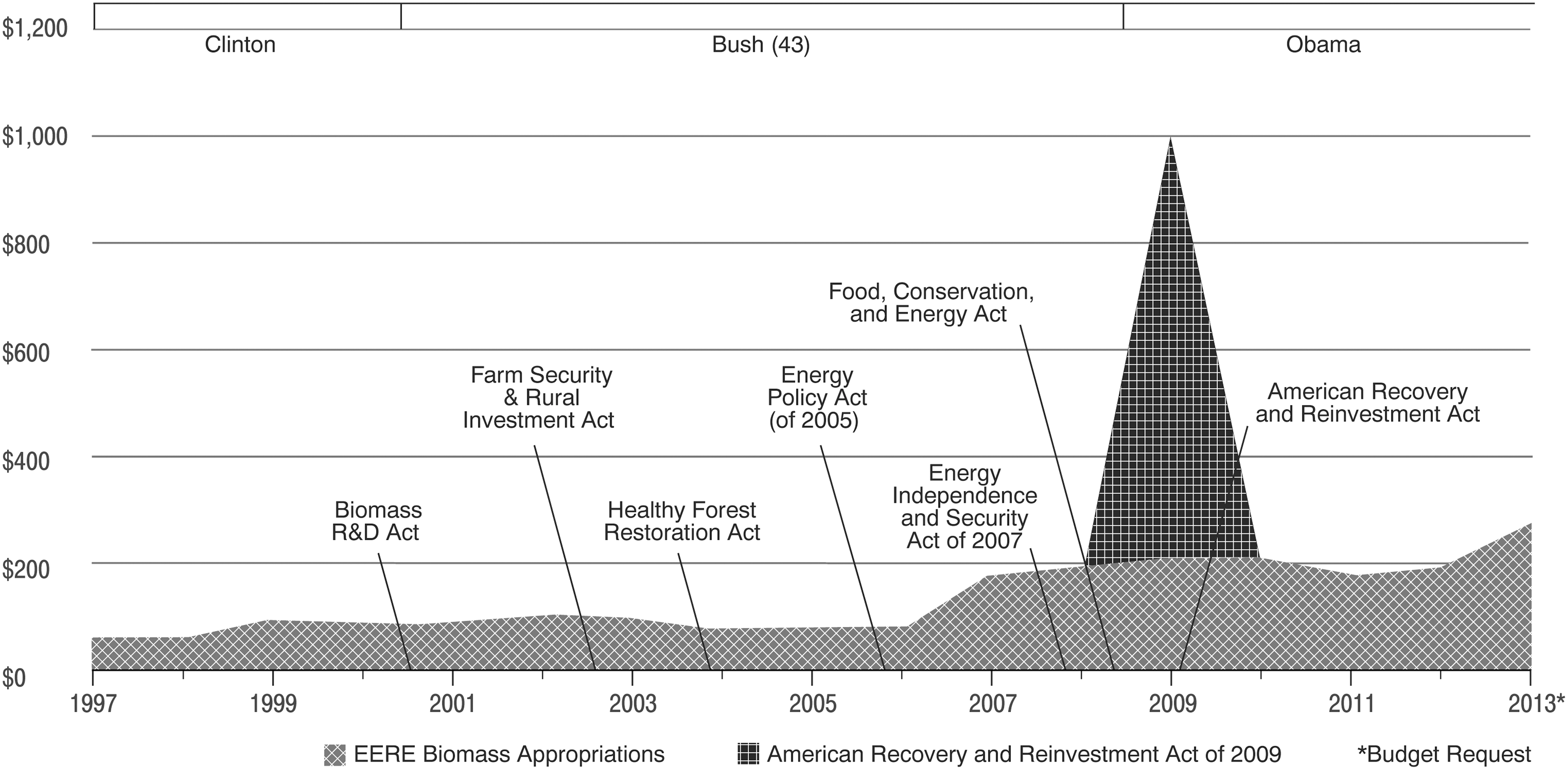
Changes in biomass research funding over the course of presidential administrations, major legislations, and key federal policies.
Over the past decade, these investments have been critical in addressing our national energy challenges and building a strong foundation for domestically produced biofuels as a significant part of the US energy mix. Dependence on imported petroleum is one of our greatest economic and national security risks. Almost 95% of US transportation energy comes from oil, and about half of this is imported. We spend about $1 billion per day—accounting for more than two-thirds of our national trade deficit—to satisfy our need for oil. While the high price of oil is a source of concern to every American in recent years, the unpredictable variability in its cost further compounds this concern.
In addition to the serious energy security and economic implications, our reliance on oil has environmental consequences as well. While advances in combustion and emission-control technologies have reduced emissions of criteria pollutants over the last two decades, the transportation sector remains responsible for approximately one-third of US energy-related carbon dioxide (CO2) emissions. Combustion of biofuels and production of biopower also releases some CO2, but that release is largely balanced by the CO2 uptake that occurs during the growth of plants used as feedstock. Depending on how much fossil energy is used to grow and process the biomass, bioenergy can substantially reduce net greenhouse gas (GHG) emissions. Biomass is the only renewable energy resource that can be converted to a liquid transportation fuel, and increased use of renewable fuels provides the best near-term option for reducing GHG emissions from the transportation sector.
DOE's Biomass Program has long recognized the importance of balancing the need for food, feed, and fiber in the bioenergy equation. In 2005, the DOE, in collaboration with the US Department of Agriculture (USDA), published the resource assessment report Biomass as Feedstock for a Bioenergy and Bioproducts Industry: The Technical Feasibility of a Billion-Ton Annual Supply, which, based on numerous assumptions about current and future feedstock inventory, production capacity, availability, and technology, concluded that there was an estimated billion tons of “potential” biomass within the contiguous US—enough to displace approximately 30% of the country's petroleum consumption at that time without displacing biomass necessary for food, feed, and fiber. In 2011, DOE updated the original 2005 Billion-Ton Study with added in-depth production and costs analyses and sustainability studies. 4 The 2011 report used more rigorous models and data analysis to test the feasibility of increasing biomass production to help meet the nation's energy needs. The new report also included in-depth analyses of land-use changes and balance among food, feed, and energy crops. Both reports' findings demonstrate that increases in biomass-derived energy sources can be achieved in a sustainable manner through the use of widely accepted conservation practices, such as no-till farming and crop rotation.
The high cost of delivering feedstocks to a biorefinery and converting those feedstocks to fuels and/or chemicals is a key challenge that the DOE's Biomass Program is working to overcome. The Biomass Program defines these and other research barriers through the publication of technical roadmaps and the program's Multi-Year Program Plan. 5 These documents provide an operational guide to help the Biomass Program manage and coordinate its activities, while also providing public and private partners and stakeholders with resources to help articulate the program's mission and goals.
While the overall mission of the Biomass Program is focused on developing advanced technologies for the production of fuels, products, and power from biomass, near-term goals have focused on the conversion of biomass into liquid transportation fuels. Historically, the program's focus has been on RDD&D for ethanol production from lignocellulosic biomass. The driving factors behind the program's historical focus on cellulosic ethanol included technology readiness as indicated by the initial two decades of investment in the biochemical conversion process for cellulosic ethanol. DOE-funded R&D in this area has led to a well-developed body of work regarding the performance of ethanol as both a low-volume percentage (E10, up to 10% ethanol) gasoline blend in conventional vehicles and at higher blends (E85, up to 85% ethanol) in flexible-fuel vehicles. In addition, starch-based ethanol is a well-established commodity fuel with wide market acceptance. Federal legislation has also predominantly focused on cellulosic ethanol production as a “second-generation” biofuel to displace imported petroleum-based transportation fuels with domestic renewable fuels. Continued success and growth of the US ethanol industry can help pave the way for the future introduction of cellulosic ethanol into the marketplace.
By focusing on cellulosic ethanol, the program was able to facilitate major advancements in the biofuels industry by providing a proof of concept that non-food based feedstocks can be converted to fuel. These efforts include projects led by major enzyme companies to reduce the cost of enzymes capable of degrading lignocellulosic biomass into component sugars for further conversion into fuels and products. This enzyme research effort began in 2000 and resulted in 30-fold reductions in cost. It was quickly followed by additional public-private efforts that led to announcements by major enzyme manufacturers regarding commercialization of these enzymes for biofuels production. 6,7
Technology improvements such as these enzyme advances, development of microbes capable of fermenting multiple sugars to fuels, and integrated processing improvements across the whole value chain provide the necessary data for the program's efforts, via techno-economic analysis, to select biofuel conversion technologies with the most promise and near-term technical viability. The ultimate goal is to identify and validate pathways that have the best chance of being cost-competitive in the marketplace. Since the first Biomass Conference in 2008, the DOE's Biomass Program has expanded its scope to include the development of other advanced biofuels that will contribute to the volumetric requirements of the Renewable Fuel Standard (RFS). This includes biofuels such as biobutanol, hydrocarbons from algae, and biomass-based hydrocarbon fuels (renewable gasoline, diesel, jet fuel). Thus, while the program's short-term objectives include demonstrating commercially viable cellulosic ethanol production, the investments the program has made in technologies that can reduce the recalcitrance of lignocellulosic biomass will be leveraged toward the development of third-generation advanced biofuels, bioproducts, and bioenergy.
Participation in Biomass 2012: Confronting Challenges, Creating Opportunities—Sustaining a Commitment to Bioenergy confirmed growth among a broad-based stakeholder community committed to the success of an advanced bioenergy industry. This year, the conference was co-hosted by Advanced Biofuels USA (Frederick, MD), a non-profit dedicated to promoting public understanding, acceptance, and use of advanced biofuels. Participation reached a record high 740 people from 46 states and 17 countries, and diverse stakeholder groups along each step of the bioenergy supply chain were represented. The conference featured high level participation from across the Obama Administration, including the Departments of Energy, Agriculture, and Defense and the Environmental Protection Agency, as well as members of Congress, which underscores the continued support for the industry at the highest levels of government.
The conference highlighted the progress of several advanced bioenergy projects that broke ground in the last year. These projects, first discussed at the Biomass 2008 conference, illustrate the tangible progress being achieved by leading companies in the nation's advanced biofuels industry. Progress is real, construction is underway, steel is in the ground, jobs are being created, and the advanced bioenergy industry is building momentum faster than many thought possible only a few years ago. This industry encompasses a broad variety of conversion pathways, biomass feedstocks, commercialization strategies, and end products. These technologies will utilize the diverse biomass resources identified in the Billion-Ton Study, and will be designed to produce not just cellulosic ethanol but also biobased replacements for a range of petroleum products, including gasoline, diesel, jet fuel, and chemicals. Beyond success in technology and deployment efforts, the industry needs stable policies to help support continued growth across this new industry. Biomass 2012 underscored the centrality of policy issues for the future of the advanced bioenergy industry.
The path forward for the advanced biofuels industry in the US is exciting, yet tenuous. The Energy Department's R&D efforts over the past decade are paying dividends today, as evidenced by the several biorefinery projects currently under construction. Still, significant challenges, including financial, policy, and market uncertainties, need to be overcome. As the DOE's Biomass Program continues its work with public and private partners to drive down costs and further improve performance and efficiency, we expect to see continued progress towards a robust and cost-competitive advanced biofuels industry in the US.