




Abstract

Biotechnology companies have developed the technology to produce a range of chemical molecules that can be used as biofuels, fuel additives, renewable building block chemicals, or biobased polymers. The challenges of creating entirely new upstream feedstock and downstream market value chains—in markets that are dominated by fossil fuel incumbents—while simultaneously raising capital for construction of pioneer biorefineries warrant public policy assistance.
A coordinated framework of policy initiatives is needed to attract innovative industrial biotech companies and to help build biorefineries that convert biomass to value-added biofuels, biobased plastics, and renewable chemicals. Policy support of industrial biotech innovation at national, state, and local levels will help spur significant investment in local economic zones in both the agriculture and manufacturing sectors, a nexus that forms the basis of the bioeconomy. Some states and countries are already attracting industrial biotech companies, and new biorefineries are being built. New agricultural feedstock infrastructure is also being developed.
Since 2007, the Biotechnology Industry Organization (BIO) has tracked the development of pilot, demonstration, and commercial advanced biorefineries across the US and Canada ( Fig. 1). In 2007, a handful of pilot-scale biorefineries existed for proving new biotechnology processes and working out economic and technical issues prior to scale-up. Today, with support from successful US federal programs, more than 65 biorefineries—thermochemical, biochemical, and hybrid, with variations on different process stages—have achieved milestones toward commercial development of a diverse array of feedstock and technology combinations for advanced biofuels, biobased products, and renewable chemicals. Many developers are raising capital to build new commercial-scale facilities.
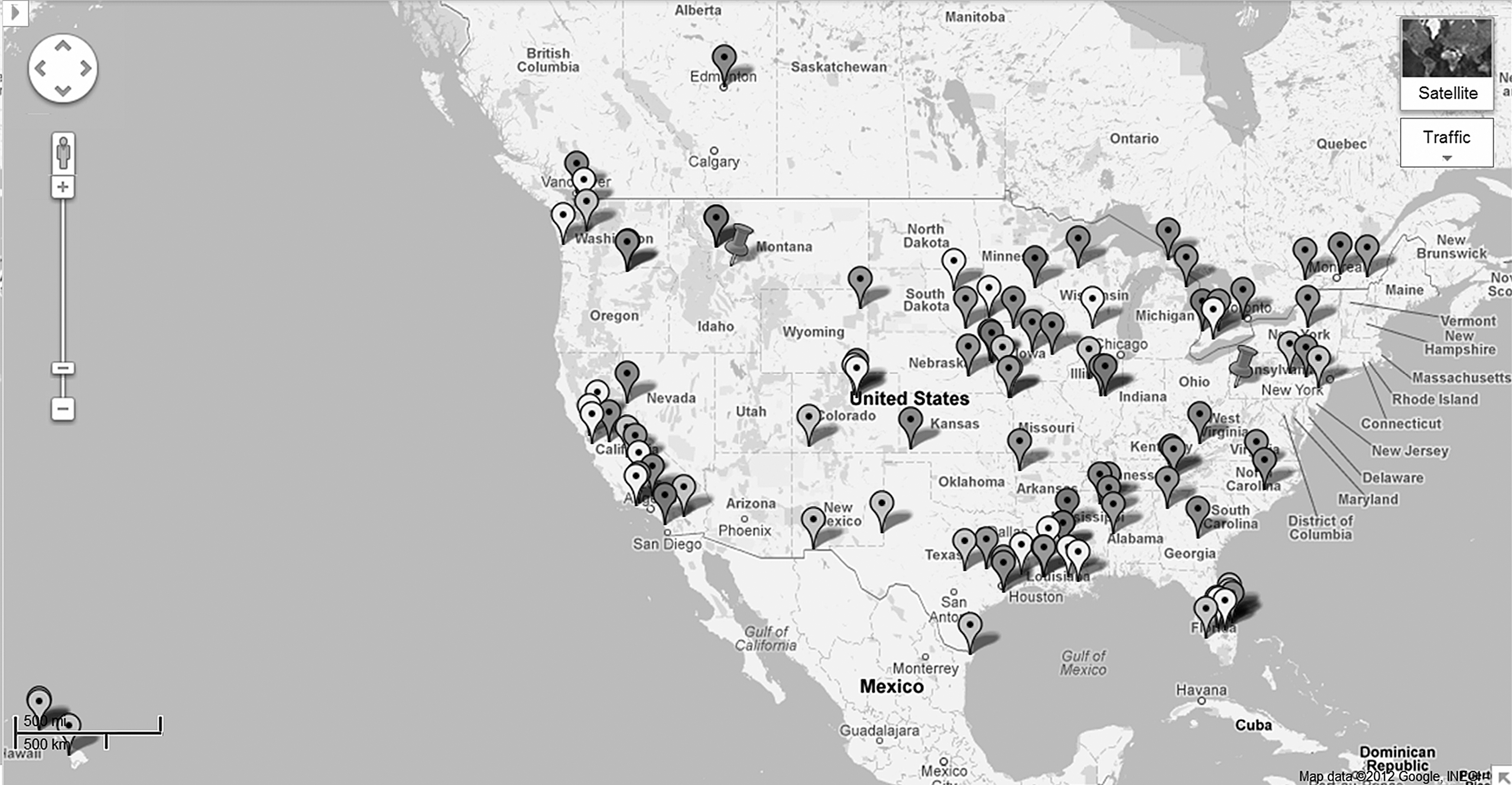
Existing and planned North American biorefineries for advanced biofuels and renewable chemicals (color version distinguishing planned vs operating cellulosic biorefineries, advanced biofuel biorefineries, algae biorefineries, and renewable chemical biorefineries available at
The projects BIO has tracked are also pursuing a range of capital formation strategies, including licensing of technology, adding advanced biofuel capacity to existing conventional capacity, or converting conventional capacity to advanced production. A stable, long-term policy framework that can be deployed at either a national or state level and that draws on the success of existing US programs is vital to continued investment and commercialization progress.
Biorefinery Construction
Start-up companies raising capital and developing a market for a new technology face significant challenges. The process of taking any new technology from the laboratory and scaling it up in early commercialization is often described as “the valley of death.” Construction of first-of-a-kind commercial-scale biorefineries is one of the greatest challenges to the industrial biotechnology sector.
New large-scale biorefineries require significant capital expenditures. A 2009 report from Bio Economic Research Associates (Cambridge, MA) estimated that 389 new biorefineries, ranging from 20 million to 200 million gallons per year in nameplate capacity, need to be constructed by 2022 to meet the volume requirements under the federal Renewable Fuel Standard (RFS). The total capital cost was projected to be more than $95 billion. In a June 2010 study, US Department of Agriculture (USDA) estimated the total cost of building the 527 biorefineries needed to meet the RFS2 advanced biofuels goals at $168 billion. A 2009 report from Sandia National Laboratories found no fundamental barriers to the construction of an even larger 60 billion gallon biofuel industry, though capital expenditures on the order of $250 billion were needed to construct a complete value chain from feedstocks to fuel delivery.
In addition to new biorefinery construction, many companies have developed, and are continuing to progress, advanced biofuels and renewable chemical technologies that can be used with existing, idled, or underutilized US manufacturing facilities. Industry efforts are underway to repurpose or retrofit these facilities, including first-generation ethanol facilities, biodiesel refineries, and pulp and paper mills. This strategy requires less capital than siting and building a new facility, but permit requirements and costs can vary state by state.
Biofuel producers' ability to raise capital—in particular debt capital—has been hampered by the recent economic recession and banking crisis, making public-private partnerships a critical component to getting projects off the ground. Private companies can leverage public support to attract greater private investment or secure debt equity for projects, which will enable faster commercialization of advanced biofuels and renewable chemicals at lower capital costs.
Federal programs, such as grants to support continued research and development, loans, or loan guarantees to match private capital investment, have helped to hurry the market introduction of advanced biofuels. The federal Biorefinery Assistance Program provides for loans for the development, construction, and retrofitting of commercial-scale biorefineries. It also provides for grants to help pay for the development and construction costs of demonstration-scale biorefineries. Under the program, loans are issued by private commercial lenders, not the government, but the program is managed by the USDA, a federal agency with extensive experience in loan guarantee programs. USDA has a loan portfolio of over $100 billion, with more than 97% of those loans up-to-date on payments and supporting good jobs across the country.
Banks working with the USDA also have decades of experience in commercial lending to small businesses. Companies receiving these loans have been required to invest a substantial amount of their own funds, so they have a clear incentive to succeed. Successful projects cost the taxpayer nothing, other than program administrative costs. This program and its signal of federal support have become vital to unlocking private capital for next-generation biorefinery construction ( Fig. 2).
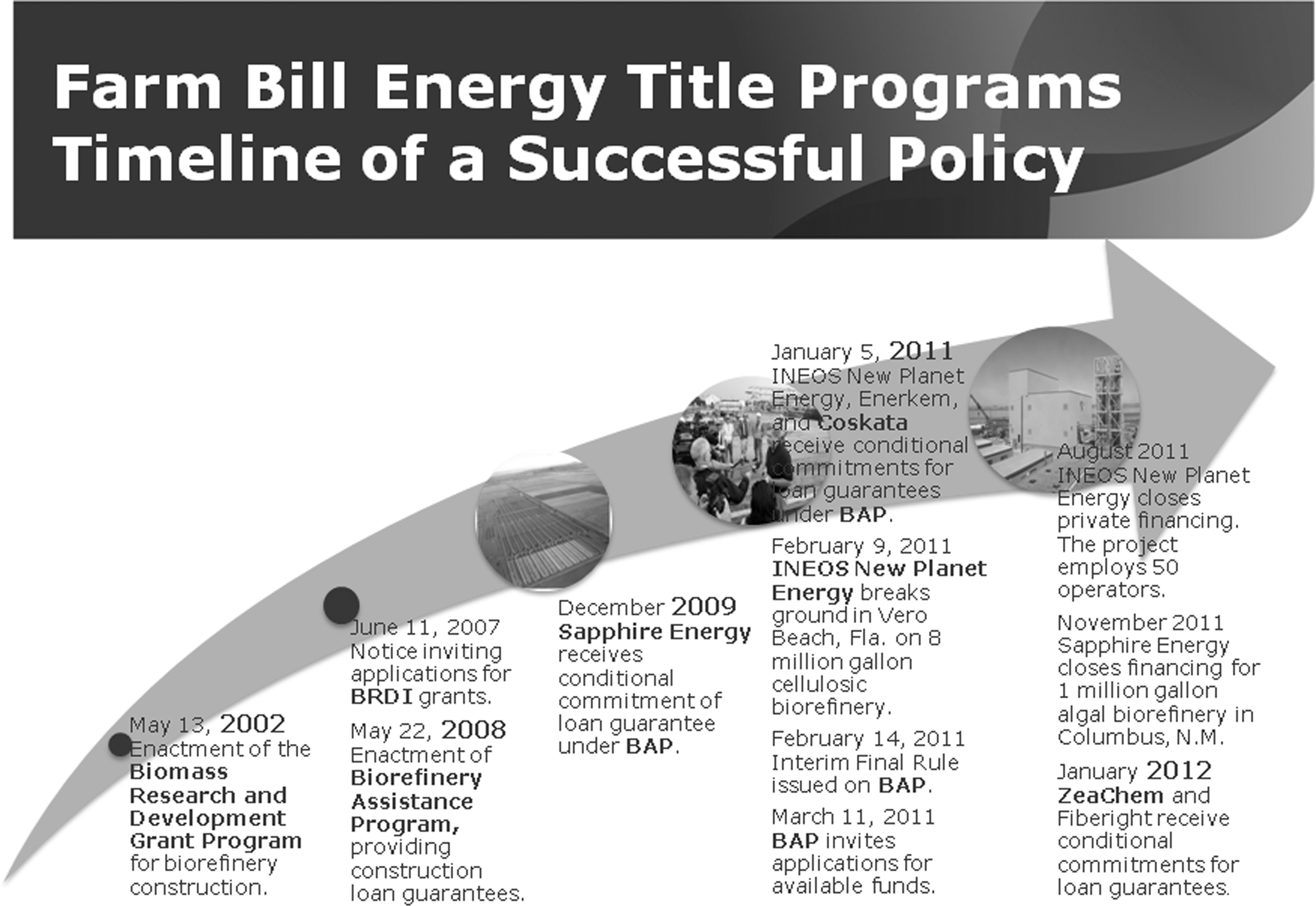
Highlights of Farm Bill Energy Title programs.
PROPOSAL
• Establish a matching grant program to fund projects to construct new biorefineries, or to repurpose or retrofit existing idle or underutilized manufacturing facilities for the production of advanced biofuels and/or renewable chemicals.
• Create programs to streamline and expedite the permitting process for biorefinery construction.
New Feedstocks
An available, continuous, and consistent supply of biomass for energy is essential to the continued development of the domestic biofuels and bioproducts industries. However, the development of such a supply from purpose-grown energy crops (PGECs) is challenging for many reasons, including hesitation by farmers and landowners to produce PGECs on high-yielding farmland where traditional crop rotations exist, as well as concern about a lack of a mature market. Another factor is the availability of crop insurance that will cover these new PGECs because, generally, banks and investors require crop insurance as collateral to approve operating loans for farmers that would cover the cost of the seed.
States can promote the production of PGECs by supporting the establishment and production of eligible crops for conversion to bioenergy in selected areas and assisting agricultural and forest land owners and operators with collection, harvest, storage, and transportation of eligible material for use in a biomass conversion facility. States should also ensure that funds are directed primarily to production of next generation crops for biofuels and bioenergy; establish a dedicated funding mechanism for awarded contracts; provide for eligibility of non-food Title I crops; and clarify eligibility of certain other PGECs.
At the federal level, the 2008 Farm Bill directed the USDA Risk Management Agency (RMA) to study the feasibility of developing crop insurance programs for biofuels feedstocks. RMA is currently studying the feasibility of providing insurance for six specific PGECs, but no formal program has been created to date. At the state level, Southeast agriculture commissioners have raised this issue, but no program has been created. One must be established in the near term to keep up with the momentum and demand for the development of greater domestic sources of energy.
PROPOSAL
• Direct state Departments of Agriculture to conduct and finalize research on the feasibility of providing state crop insurance to producers of corn stover, straw, and woody biomass, as well as energy cane, switchgrass, and camelina, and utilize that research to work with stakeholders, including industry and policymakers, to establish formal state crop insurance programs that will cover PGECs.
Market Preference
Governments can prime market demand for renewable products by establishing purchasing and acquisition preference programs. At the federal level, the USDA has created a biobased markets program to drive the use of biobased products. At the state level, Ohio, in particular, has adopted a mirroring bill to establish a biobased product-preference program that incorporates specified requirements and defines “biobased product.”
Government agencies can also expand support of advanced biofuels by establishing state procurement preferences for renewable fuels used in state government vehicle fleets. The federal RFS and its consistent implementation is one of the fundamental policy drivers for continued development of the US biofuels industry, especially for advanced and cellulosic biofuels ( Fig. 3). The RFS helps provide industry and investors some long-term policy stability and market access necessary to foster capital formation and commercialization of these fuels. The large volume of the advanced biofuels mandate of the RFS (21 billion gallons by 2022) permits a number of technologies, feedstocks, and strategies to compete for market space, depending on their ability to achieve cost competitiveness and regulatory approvals and meet end-user needs. Many states, such as New Jersey and Missouri, already have such programs.
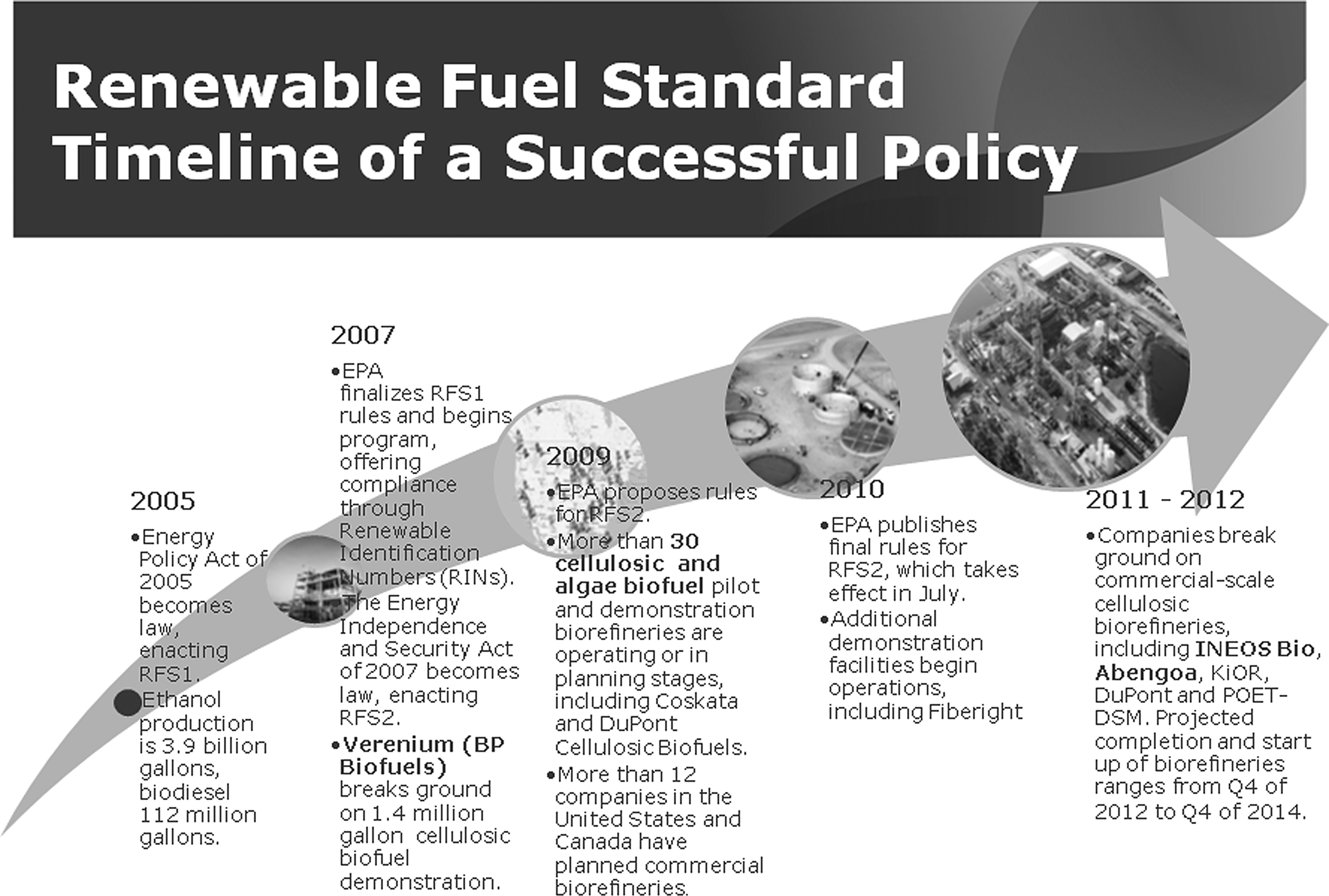
Tracking the impact of the Renewable Fuel Standard policy.
Though the US military represents only 2% of the US fuel market, it possesses enough purchasing power to drive development of new advanced biofuels in sufficient quantities at the right price. By playing the role of an early customer and partner, the Department of Defense can speed commercialization of advanced biofuels that can grow to meet commercial consumer market needs.
Proposal
• Require state agencies to give purchasing preference to biobased products during procurement cycles (i.e., require agencies to use all biobased alternatives when available and cost-competitive).
• Require state agency procurement and usage of advanced biofuels (i.e., require all government fleet vehicles be flex-fuel capable and require use of renewable fuels in government vehicles capable of their use).
Tax Policy
While capital costs for construction of next generation biorefineries are a substantial barrier to commercialization, targeted tax credits can incentivize capital formation and investment by lowering the overall cost for companies and private investors. Governments can provide an investment tax credit option (available in lieu of production tax credits) for emerging advanced biofuels, renewable chemicals, and biobased products project developers to help accelerate construction of next generation biorefineries and speed deployment of emerging industrial biotechnologies. Production tax credits can encourage the revitalization of manufacturing and startup of new facilities.
Most chemicals and plastics used today are made from petroleum. Advances in industrial biotechnology have led to renewable chemicals and bioplastics from renewable feedstocks that are providing innovative new products. Currently, bioplastics are used in everything from cups to carpets to cars, green airplane deicing compounds, and cosmetics. Most of these products are competing in markets presently dominated by petroleum-based products, and renewable chemicals still make up only a small percentage of total chemicals and plastics sales.
While federal and state policy has appropriately encouraged and supported the development of the biofuels sector to the benefit of rural economies, the environment, and national security, federal tax policy has largely failed to recognize and foster the substantial benefits provided by non-fuel renewable chemicals. Further, tax credits for cellulosic biofuel production are set to expire at the end of 2012, before most companies will be able to claim them.
Proposal
• Provide an investment tax credit (ITC) for new next-generation biorefineries to help defray capital costs for construction or retrofit of existing facilities. Establish production tax credit incentives for advanced biofuels, renewable chemicals, and biobased products.
Workforce Training, Technology Training, and Innovation
Industrial biotechnology companies are creating valuable solutions to some of America's most pressing problems. They are creating high-value careers and invigorating local manufacturing in an environmentally sustainable way. However, it takes a specific skill set to work in this field. Thus, the development of future workers should begin with higher education institutions at the state level. Indeed, to support growth in this promising sector, states should institute workforce programs that give potential job seekers the tools they need to seek employment at an advanced biofuel, renewable chemical, or biobased product company. States like California have taken a special interest in this growth model and have invested millions of dollars in state grants to train state workers at the University of San Diego. Colorado has a similar program in which its state government awarded $3 million to the Colorado State University for biofuels workforce training.
Proposal
• Develop state-based educational programs and curricula to facilitate workforce training in the industrial biotech sector at community colleges and universities.
• Create clusters and incubators that will focus on fostering new industrial biotech companies and tech transfer.
Public Education and Outreach
The advancing field of industrial biotechnology can transform the US economy by fundamentally changing the way we make and use fuels, chemicals, and materials. Industrial biotech companies are developing new feedstocks and biological catalysts for production of advanced biofuels, renewable chemicals, and biobased products. Because these feedstocks, manufacturing methods, and products are based on plants and biological processes, they are more efficient, sustainable, and environmentally friendly. Since many of these technologies are still in early stages of development, there is less understanding of their potential among the general public. Broad popular understanding of industrial biotechnology, renewable chemicals, advanced biofuels and biobased products is necessary, given the need for public policy to encourage research and development, commercialization, and market development.
At the federal level, the BioPreferred label assures consumers that a product or package contains verified amounts of renewable biological content. This biobased certification label is offered as an aid to consumer decision-making and provides buyers an easy way to find biobased products. This labeling program provides an important market-facing complement to government procurement and market preference programs.
Proposal
• Create campaigns to educate the public on the availability and societal benefits of industrial biotechnologies.
Conclusions
Industrial biotechnology is creating significant new economic development opportunities for the US. Policies that have supported successful early development of biorefineries form the basis for a model policy framework that governments at the national or state level can use to spur economic development associated with innovative industrial biotech companies. Benefits can include creating new markets for agricultural products, keeping productive or strategic farm land in use, improving trade balances, and generating high-value careers associated with research and development, manufacturing, and biotechnology.