




Abstract

The objective of the planning workshop was to develop a science roadmap (strategic plan) with recommendations for implementation of a new program in nanotechnologies in the USDA for agriculture and food systems. Planning workshop participants were leading nanotechnology researchers and administrators from Land Grant Universities and nanotechnology program leaders from other federal agencies. In developing this strategic plan, the workshop participants heard nanotechnology leaders from National Science Foundation (NSF), Department of Defense, Department of Energy, National Institutes of Health, National Aeronautics and Space Administration, Department of Commerce/National Institute of Standards and Technology, Environmental Protection Agency (EPA), Food and Drug Administration (FDA), the National Nanotechnology Coordinating Office, and the National Science and Technology Council's (NSTC) subcommittee on Nanoscale Science, Engineering, and Technology.
NIFA has identified specific science priority areas in agriculture and food systems (global food security and hunger, climate change, sustainable energy, childhood obesity, and food safety), several of which can directly benefit from research in nanotechnology. A principal recommendation from the workshop stated that USDA/NIFA should significantly enhance support for research in nanoscale science and engineering in agriculture and food systems through strong participation in the NNI goals. Areas of specific benefit to agriculture and food systems were identified: pathogen and contaminant detection; identity preservation and tracking; smart treatment delivery systems; smart systems integration for agriculture and food processing; nanodevices for molecular and cellular biology; nanoscale materials science and engineering; environmental issues and agricultural waste; and education of the public and future workforce. 2
The National Planning Workshop participants recommended a significant financial investment in research as an enabling technology for agriculture and food systems. The recommended budget was $36.3 million/year for fundamental research (principal investigator-driven) and in theme challenge areas, for multidisciplinary grants; establishment of several centers of excellence; support for public education/outreach; research infrastructure (specialized instrumentation); and educational support of graduate fellowships and postdoctoral education.
The USDA, through NIFA, responded to the workshop recommendations by initiating a competitive grants program under its National Research Initiative (NRI) for nanoscale science and engineering in agriculture and food systems in the 2003 Federal Budget. Since 2003 the program, with some operational interruptions in 2007, 2009, and 2012, has received 425 applications to the program (Fig. 1). The program has been very competitive, with 64 grants awarded for a success ratio of 15%. Some of the brightest researchers have identified the significant potential for nanotechnology in addressing critical agriculture and food challenges. The program success has now encouraged other funding programs within USDA to incorporate nanoscale science and engineering approaches in their programs. Overall, the nanotechnology research and education expenditure has grown to more than $10 million/year over the last nine years (Fig. 2). Currently, about 250 active nanotechnology research and education projects of broad agriculture and food interests are supported by the agency. 3
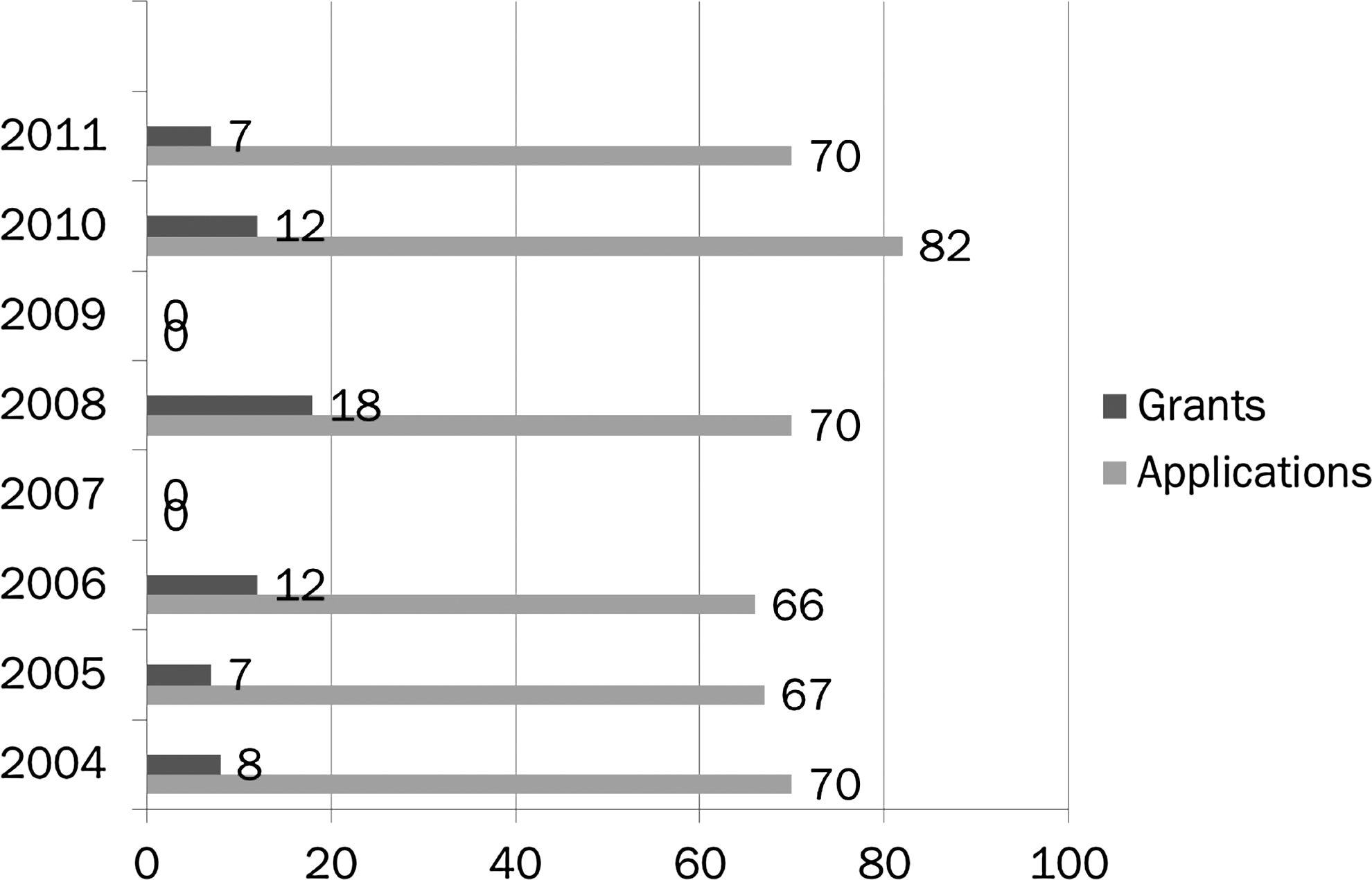
History of National Institute for Food and Agriculture (NIFA)/National Research Initiative (NRI)/Agriculture and Food Research Initiative (AFRI) nanotechnology program applications and funded projects (2004–2011); success rate 64/425=15%.

National Institute for Food and Agriculture (NIFA) investments in nanoscale science and engineering R&D and education started from zero and have grown significantly.
To further illustrate the nature of the nanotechnology program in the NRI/Agriculture and Food Research Initiative (AFRI)—the largest competitive grants program within the agency—it is interesting to note the areas of science and engineering of the funded projects. Interest in the program based on the types of grants awarded clearly shows a major emphasis on nanomaterials and nanoscale devices and systems (sensors/sensing systems), which match two of the main program component areas of the NNI Strategic Plan:
1
• Sensors/sensing (18) • Nanostructures/nanoparticles/nanomaterials (37) • Surfaces/coatings (5) • Public perception/education (3) • Conference (1)
It is worth noting that projects in education, public perception, and acceptance of nanotechnology applications in food and agriculture systems have also been supported, though at a relatively small scale given the limited funding. This is of particular importance to agriculture and food—a lesson learned from the previous experience through the development of biotechnology for agriculture and food production.
Another characterization of the NRI/AFRI-funded projects is that most of the successful grants are issued in the area of food safety/health/nutrition. More recently, because of the public's concerns about the environment, health, and safety implications of nanomaterials and nanotechnology, grants have addressed these concerns as well as educational projects: • Food safety/health/nutrition (35) • Environment, Health and Safety (7) • Plants/crops (5) • Animals/animal systems (4) • Bioenergy (4) • Public perception/education (3) • Gastrointestinal studies (2) • Other (3) • Conference (Food Initiative) (1)
Nanoscale science and engineering has an important role in creating a safer and more productive agriculture and food system. The food supply chain can and will be affected by the utilization of nanotechnology at each point in the system along the supply chain from production through domestic consumption. While commercial advances and technological impacts are limited due to the relative newness of using nanotechnology in agriculture and food systems, some encouraging results have been obtained. From the perspective of food safety, nanotechnology has much to offer: • Carbon nanotube and surface-enhanced Raman spectroscopy nanosensor arrays can ensure the safety of the food supply by identifying the presence of pathogens, toxins, and bacteria, and actively eliminating their impact; • Edible nanoparticle sensors can detect food quality and safety; • DNA barcoding methods are a simple, rapid, and low-cost method for simultaneously detecting the presence of multiple bacteria and pathogen targets in the environment and foods; • Biosensors can detect the presence of avian influenza virus; • Nano-sensing formats have value for food packaging, freshness, and sustainability.
To promote and expand the role of nanoscale science and engineering in food and agriculture, it will be necessary to address the inherent safety of nanomaterials that enter the food chain as well as articulate the benefits of nanotechnology in this sector. To meet this need, the NRI/AFRI program has included risk assessment of nanoparticles relevant to agricultural production and foods in the priorities of its request for applications (RFA) and to support this research since 2008. The program has also sought out a collaborative effort with EPA and NSF through a joint solicitation to support fundamental and applied research related to engineered nanomaterials in the following two areas:
4
• Evaluation of potential exposures to engineered nanomaterials including an exploration of environmental and biological fate, transport, and transformation of these materials throughout their lifetimes; • Increased scientific understanding of engineered nanoscale additives and ingredients intentionally introduced into food matrices for delivery of important micronutrients and modification of sensory attributes.
International research collaboration is also encouraged in this solicitation. The program has jointly funded 14 projects with a total of about $15 million.
In addition to the health and safety issues of possible new nano-produced foods, there is a concern among some non-governmental organizations (NGOs) related to broad social and ethical issues. One concern is that nanotechnology will become concentrated within multinational corporations and that this could impact the livelihood of the poor. These areas of health and safety and their impact on agriculture infrastructure are currently topics of intense interest and debate, mirroring some previous emerging technologies, particularly biotechnology. 5
The public's skepticism is influenced by a number of concerns, including a fear of novel risks, trust or lack of trust in the regulatory process, and wider social and ethical concerns. This highlights several key needs:
6
• Increased research on toxicological impacts of nanomaterials, particularly in areas relating to risks posed by ingesting nanomaterials; • Addition of a definition of nanomaterials to food legislation to ensure that all nanomaterials that may interact differently with the body as the result of their small size and other affiliated physical and chemical properties be assessed for risk before they are allowed on the market; • Collaboration by food regulators and the food industry to develop a database of information about nanomaterials in development to anticipate future risk needs; • Creation and maintenance by food regulatory agencies of products containing nanomaterials as they enter the market to promote transparency.
To address the issues of perceptual risk and social and ethical concerns we propose that a number of steps should be pursued: • Develop a broad coalition of scientists, engineers, farmers, food processors and manufacturers, interested NGOs, government agencies, and consumers to engage in discussions that will promote common understanding and agendas; • Develop comprehensive interactions with the FDA and EPA to discuss relevant regulatory issues; • Develop public–private partnerships in which agricultural and food companies interact with universities, the USDA, EPA and FDA; • Create increased opportunities for the public to participate in open forums to promote a fact-based understanding of concerns and benefits.
We envision that the convergence between nanotechnology, biotechnology, plant science, animal science, and crop and food science/technology will lead to revolutionary advances in the next 5–10 years, including the following: “re-engineering” of crops, animals and microbes at the genetic and cellular level; nanobiosensors for identification of pathogens, toxins and bacteria in foods; identification systems for tracking animal and plant materials from origination to consumption; development of nanotechnology-based foods with lower calories and less fat, salt, and sugar while retaining flavor and texture; integrated systems for sensing, monitoring, and active response intervention for plant and animal production; “smart field systems” to detect, locate, report, and direct application of water; precision and controlled release of fertilizers and pesticides; development of plants that exhibit drought resistance and tolerance to salt and excess moisture; and nanoscale films for food packaging and contact materials that extend shelf life, retain quality, and reduce cooling requirements.
Introduction to Special Research Section
This special issue of Industrial Biotechnology journal highlights four projects that are in differing stages of development of nanoscale science and engineering in agriculture and food systems. The paper from the Luo Laboratory (Ruiz, Kiatwuthinon, Kahn, Roh, and Luo) presents a promising potential scale-up method for cell-free protein production that integrates microfluidic devices and DNA-based hydrogels (P-gels). It is envisioned that this system could provide a cell-free platform for both high throughput and scale-up production of multiple proteins. Dimkpa, McLean, Britt, and Anderson provide a review of biotic and abiotic environmental factors that modify the biological activities of Ag, CuO, and ZnO nanoparticles with a focus on the metabolic responses of plants and their root colonizers. The use of a simple soft lithography-based fabrication protocol for nutrient encapsulation in pH-responsive polymers and biopolymer blends approved for food use is presented by Higuita-Castro, Gallegru-Perez, Lowe, Sands, Kaletunç and Handsford. VandeVoort and Arai present the effect of Ag nanoparticles on soil denitrification kinetics.