




Abstract
The performance of filamentous fungi in submerged cultivation determines their suitability for large-scale industrial biotechnology processes and is the result of complex interplay between the physical and chemical parameters of the process and the cellular biology of the fungi. Filamentous fungi have a natural ability to degrade complex substrates through secretion of a large number of diverse enzymes and to produce a number of metabolites that inhibit or prevent the growth of other species in the surroundings. These features have been exploited by industry, resulting in multi-billion dollar processes for producing enzymes and metabolites of value. However, the wealth of diversity of these species is still not fully represented in large-scale bioprocesses, and thus advancement from discovery to application is one of the challenges for modern biotechnology. Acceleration of the process can be achieved through integrated approaches for assessing cellular performance (quantitative physiology), genetic modification of strains (metabolic engineering), and omics analyses and modeling (systems biology). In this review, we evaluate state-of-the-art of filamentous fungal applications in industrial biotechnology , focusing on physiological aspects of the fungi that provide the basis of their cellular performance. We also discuss the advancement of systems biology approaches and how the establishment of these tools for fungal research has begun to reveal the possibilities for further exploitation of these organisms. Increased future focus on multicellular physiology and relevant assays will lead to fungal cells and processes that are customizable to a greater degree, finally allowing the full potential of these complex organisms and their product diversity to unfold.
Introduction
In prokaryotes (such as Escherichia coli) and yeast (such as Saccharomyces cerevisiae), systems biology approaches have been well developed in the post-genomic era—S. cerevisiae was sequenced in 1996, followed by E. coli in 1997. 1–2 Quantification of physiological features was achieved by applying a variety of highly advanced techniques and tools for studying and manipulating the biological systems responsible for production of desirable metabolites. Subsequent modeling—in particular, by combining transcriptomic, metabolomic, and proteomic data— provided the necessary basis for powerful advances in our holistic understanding of these organisms. 3 With more than 1,300 articles in the literature since 2000 that include both the terms “yeast” and “systems biology,” the application of systems biology approaches in yeast is clearly well established. Systems biology research involving filamentous fungi lags behind, however, partly because whole genome sequencing of these organisms (Neurospora crassa, Aspergillus oryzae, Aspergillus niger, Trichoderma reesei, Penicillium chrysogenum) took place much later than for other organisms, and partly due to the challenges inherent in working with submerged cultivation (fermentation) of multi-cellular fungi in reproducible and standardized ways—an essential requirement for the statistical methods applied to interpret the “omes.” 4 –8
Much of the research until now has been based on metabolic engineering approaches and genetic manipulation involving single genes, which, while providing valuable data, are not sufficient for integrated systems biology approaches. To advance these approaches in filamentous fungi, further development of models and improved data integration are required. Carefully designed and controlled, reproducible cultivation techniques that produce the tailor-made biomass needed to define cellular physiology under specific conditions are of equal importance. To obtain high-quality data from omics analyses, the cultures must be grown under tightly regulated and controlled conditions, harvested and stored using methods that preserve their metabolic state, and then be processed for use in advanced assays.
Considerable advances in lab-scale fungal cultivation techniques were made over the last 10–15 years as our understanding of how to cultivate organisms for optimal characterization or performance improved. Highly reproducible, replicate bioreactor experiments that provide quality biomass can now be performed with filamentous fungi, thus tackling one of the major challenges in the field. 9 –13 It is therefore not a coincidence that the terms Aspergillus and systems biology are now appearing together with greater frequency in the literature, in 83 articles published since 2007, where the first genomes were published. Although the gap between yeast and filamentous fungi remains, it is clear that systems biology approaches in filamentous fungi are increasing exponentially. In this review, we highlight the progress in quantitative fungal physiology and omics-driven analytical tools and how merging these disciplines can accelerate integrated approaches for in-depth characterization of fungal cell factories.
Cellular Performance of Established Fungal Cell Factories
Filamentous fungi have served as industrial cell factories for more than half a century, and large-scale processes based on these organisms are therefore well established. The broad application of filamentous fungi in industry covers biochemicals, proteins, and pharmaceuticals. 14 –18 Examples include the citric acid production process using A. niger and penicillin production using P. chrysogenum, in which incremental improvements and new insights have been documented over many decades. 15,19 –24 The characterization of filamentous fungal hosts for expression of proteins also dominates the literature, and this field has been thoroughly reviewed in recent years. 18,25
Cell Factory Characteristics
While Penicillium is still recognized for its production of various beta-lactams in very high yields, the genus Aspergillus is widely used in industry for the production of both organic acids and enzymes. 25–26 T. reesei is the organism of choice for production of cellulolytic enzymes, as it exhibits high levels of secretion and harbors more than 200 genes for polysaccharide-degrading enzymes. 27 Organism specialization is, of course, partly dependent on the genetic background. Penicillium species have been domesticated for large-scale antibiotic production through intense strain improvement programs and selection for morphological types that ease cultivation and processing. 28 Aspergilli have been exploited for their production and secretion of organic acids; they are particularly attractive for this application because they tolerate low pH and process conditions can determine which acid(s) are produced. The versatility of this genus is further underlined by the fact that Aspergilli are used to produce more than 60% of the industrial enzymes made with filamentous fungi. 29 Their capability for glycosylation and proper protein processing offers advantages for these applications. 30
As indicated above, many decades of research have led to the use of filamentous fungal production hosts (cell factories) in modern industrial biotechnology. These strains have been selected and highly adapted to the specific conditions of the processes to which they are applied. The interplay between the physical and chemical parameters of a production process and the biological properties of the cell complicate cell-factory selection. 31 Morphology also poses a challenge due to the filamentous nature of the growth and the differentiation of cellular compartments as hyphae extend. 32,33 This leads to heterogeneity in terms of the morphological forms present and the cell (compartment) types that contribute to the overall performance of the culture. 34 The challenge is to balance cellular potential, process design, and economic feasibility. High broth viscosities, and thus low oxygen mass transfer, are the main physical factors governing protein productivity in filamentous fungal cultivations. These have been optimized by applying specific feeding strategies to improve glucoamylase production by both A. oryzae and A. niger. 11,35
Based on these considerations, and with a focus on the cellular biology, the characteristics of desirable filamentous fungal cell factories are summarized in Table 1, with the listed advantages driven by process economics and the need for viable large-scale operation. 36
Desirable Cell-Factory Characteristics and the Advantages They Confer for Industrial Applications 36
Improving Cell Factories
To improve our understanding of established cell factories in expanded applications, or to extend novel fungal species to the realm of industrial biotechnology, methodologies to ensure that analyses can be performed accurately on cells arising from specific and controlled cultivation environments need to be developed. Cellular performance is the term used to define the capabilities of a cell under a specific set of cultivation conditions; it facilitates the comparison and evaluation of different species or differing conditions. Classical parameters of physiological characterization—growth rate, yield, and productivity estimation—are the cornerstone of cellular performance assessment.
Metabolic engineering has enabled significant improvements in cell factory efficiency by targeting and examining the effects of genetic modifications that lead to improved cell factory characteristics. 37 –39 In multiple rounds of strain design, genetic modification and analysis of the resulting cellular physiology have led to sequential improvement and led to filamentous fungi as highly efficient cell factories. The directed approaches of metabolic engineering have been the main strategy for tackling substrate-utilization issues, improving product yield, eliminating unwanted by-products, and introducing or extending metabolic pathways. The product spectrum continues to expand as processing know-how and understanding of cellular physiology improves. 40 –45 To this end, metabolic models, control analysis, and flux analysis using 13 C-labelled substrates have been employed for benchmarking strains and quantifying the consequences of genetic modifications on metabolism. 46 –52 These approaches were developed and established before genome sequences were available, but are still valid in the post-genome era.
Non-direct approaches, such as evolutionary engineering, can also be applied when substrate tolerance or product toxicity are an issue. 53 While these techniques are well established for yeast—particularly with regard to mixed sugar utilization—to our knowledge, applications in filamentous fungi have not yet been demonstrated. 54,55
Even in modern fungal biotechnology, basic approaches to parameter estimation are still the foundation for most quantitative fungal physiology studies. The standard for detailed physiological characterization was set in the late 1990s and is exemplified in studies that employ different cultivation modes to study various physiological states. 56 –58 Such studies provided highly reproducible data on growth rates, yield coefficients, and productivity, allowing an assessment of conditions for optimal cellular performance.
As highlighted above, metabolic engineering is a useful systematic method in which strains are constructed through genetic engineering with the aim of introducing/improving desirable cell factory characteristics (Table 1). However, cellular robustness, derived from enzyme redundancies and complex regulatory circuits, often enables the cell to counteract the genetic modifications. For this reason, systems biology approaches have become increasingly popular to assist in the identification of targets for genetic engineering. The increasing number of available genomes in particular has enabled the shift to data integration from several omics techniques, which facilitates a holistic view of cellular functions. Omics-driven analyses are rapidly becoming an essential approach to evaluation of genetic regulation that underlies quantified metabolic responses.
Omics-Driven Cell Factory Characterization
Systems biology approaches for cell factory characterization of filamentous fungi that incorporate gene expression analysis are rapidly emerging. 39,59 –61 This section will, therefore, concentrate on genome-wide analyses and the integration of transcriptomics data with physiological characterization in submerged cultivations. An overview of selected studies is provided in Table 2. 9,62 –84 Omics studies that have investigated desirable cell factory characteristics can be broadly grouped into three categories: efficient carbon utilization; high yield; and efficient product secretion. Aspergilli are known for their ability to utilize a broad range of substrates and to use these substrates efficiently. They are also able to maximize their energy production through the stringent coordination of regulatory networks for carbon-source utilization. Fungal cultivation physiology coupled with transcriptomics has been used to provide valuable insight into regulatory responses caused by single substrates, combinations of substrates, and complex carbon substrates.
Overview of Omics-Driven Cell Factory Characterization in Filamentous Fungi
Efficient Carbon Utilization
Bioconversion of a wider range of substrates is becoming increasingly relevant as biosustainability becomes a requirement in process design. Transcriptomics also has an important role to play in the identification of genes required for efficient catabolism of carbon sources present in complex and waste substrates. 68,71 –74 Due to the abundance of xylose in hemicellulose, the regulatory mechanisms involved in using this carbon source as opposed to glucose have been investigated in three different Aspergilli. One study developed and validated a method for transcriptome analysis of Aspergilli, and allowed identification of conserved gene responses to growth on glucose and xylose in A. niger, A. oryzae, and A. nidulans. 85 This technique was used to provide a comparison of A. oryzae and A. niger growing on maltose, which is utilized in industrial processes as an effective inducer of enzyme production. 69 The study illustrated the routes for maltose transport and metabolism and revealed how maltose may affect gene expression, pointing toward targets for improved protein secretion. In another study, glycerol metabolism was investigated in three Aspergillus species, leading to the identification of possible regulatory binding sites, as well as giving insights into cross-species evolution. 73
Carbon catabolite repression, the regulatory mechanism that controls carbon utilization, is mediated by transcription factor regulators, including the CreA protein. In one of the first studies to employ a DNA microarray of an Aspergillus species, transcription analysis of wild type and creA mutant A. nidulans strains was performed, and growth on glucose and ethanol was compared. 86 This work gave an overview of the global response caused by CreA and highlighted the advantage of large-scale transcriptional analysis for studying broadly acting transcriptional regulators such as CreA (Table 2).
High Yield and Improved Product Secretion
High yield and efficient secretion capacity are key criteria when expression hosts are being considered for an industrial process. In a study to assess the physiological characterization of A. niger grown in chemostats with xylose or maltose as the limiting substrate and growth controlled at the same rate. 80 The data obtained included transcription profiles and an estimation of quantitative physiological parameters. The increased secretion potential on maltose was related to the induced transcription of more than 90 genes that regulate protein secretion, leading to the identification of putative regulatory elements and a greater understanding of the secretory pathway in filamentous fungi.
High-yielding strains have also been the subject of transcriptomics studies investigating the response of process physiology to protein over-expression. One example is a study on the effect of glucoamylase over-expression in maltose-limited chemostats through transcriptomics. 80 A notable finding was the identification of a set of only 40 differentially expressed core genes that ensure high protein traffic through the secretory pathway. In a study of T. reesei, gene expression was correlated to protein production rate in chemostat cultures at a range of specific growth rates. 78 This work allowed for the identification of biosynthetic activities with positive and negative effects on protein production and indicated possible regulatory mechanisms in the observed physiological responses.
While studies on Aspergilli and T. reesei have centered on carbon metabolism and productivity, Penicillium research has focused on secondary metabolite production, with emphasis on the biosynthetic pathways and product spectrum expansion (Table 2).
Tailor-Made Biomass for Omics Analyses
The common factor in the omics-driven cell factory analysis studies reviewed above is the controlled cultivation techniques that produce tailor-made biomass specifically for the various approaches employed. Obtaining biomass through standardized cultivations in bioreactors, where the physiological parameters can be estimated and integrated with omics data, is a growing trend. It must be stressed that the quality of the omics data depends on the quality and reproducibility of the cultivations, which provide an accurate snapshot of metabolism at a given point in time and have definable physical, chemical, and physiological conditions.
Figure 1 outlines the boundaries and interplay between the various approaches that are useful for investigating and quantifying the cellular performance of industrially relevant microorganisms. Quantitative physiology still forms the knowledgebase in terms of overall culture performance, and essentially directs selection of the biomass for further characterization of strains. This biomass can be utilized directly in omics analyses, but it is often advantageous to employ strain modification in one or more rounds of metabolic engineering before analyses are performed. In this extended cycle, systems biology techniques allow for data integration of all analyses with genome sequences, and models can form the basis for predicting targets for further improvement in cellular performance.
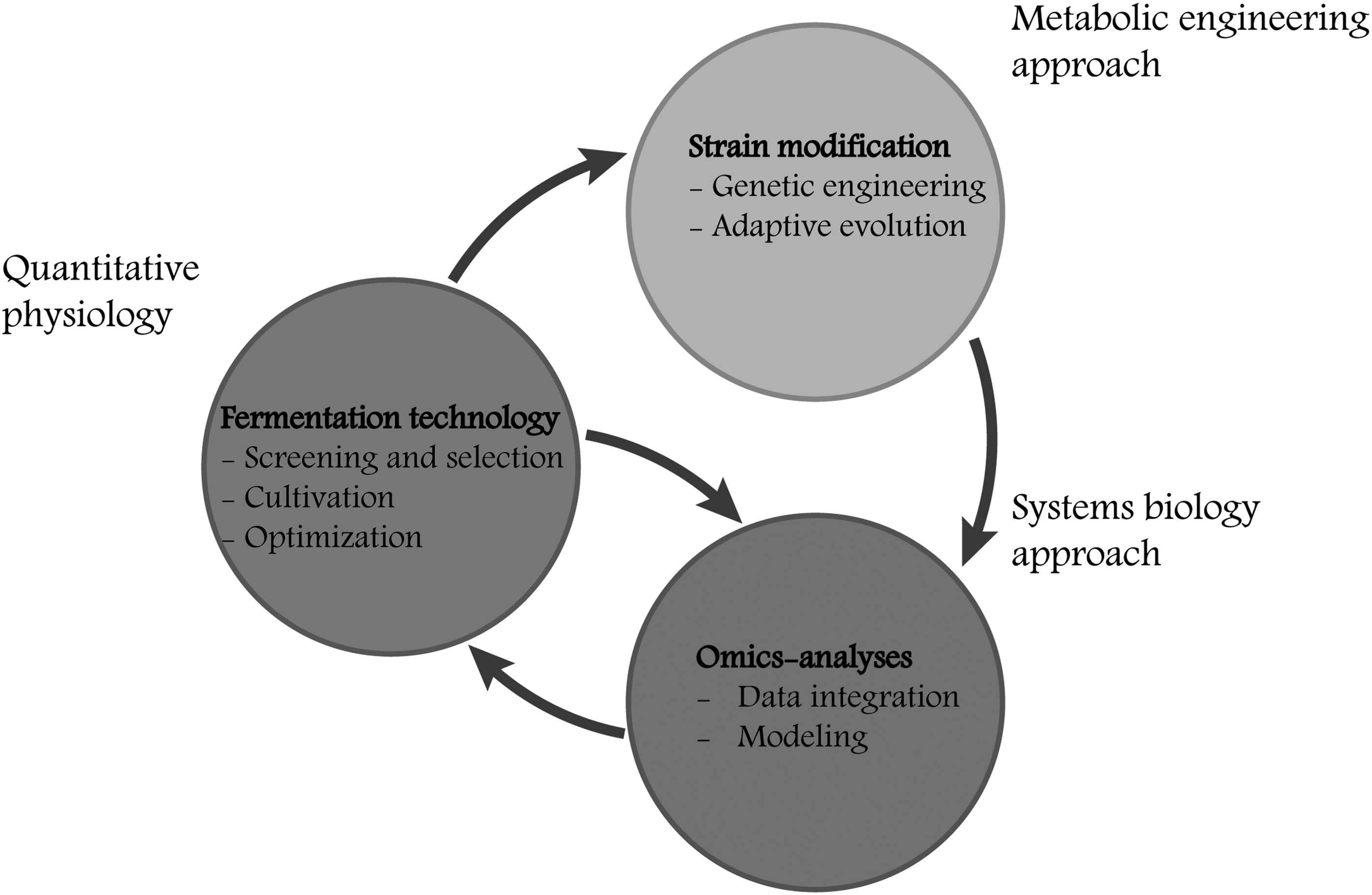
The boundaries and interplay between quantitative physiology, metabolic engineering, and systems biology approaches in analysis of cell factory performance.
Previous studies have relied mainly on batch or continuous culture to obtain biomass for omics analysis. However, the use of state-of-the-art controlled cultivations in combination with omics has found an important role in work employing reproducible carbon- and energy-limited retentostat cultures. These have been applied to study the transcriptional response of A. niger at growth rates approaching zero. 80 Related studies by the same group focused on carbon starvation and showed a correlation between transcriptomics analysis and the morphological development of the culture—leading to the proposition of a model for the carbon starvation response of A. niger. 10
While integration of process data, physiological characterization, and transcriptomics analysis is well advanced, further application of the knowledge gained from genome-wide analyses should be the next goal for systems biology approaches in filamentous fungi. Increasing the scale of data integration efforts to combine more systems biology disciplines, such as pathway reconstruction, metabolomics, metabolic flux analysis, proteomics, and transcriptomics—as opposed to the currently predominant single-methodology studies—is required to move to a systemic understanding of cell factories. Substantial leaps forward could also be made by more efficiently utilizing the omics data already available and applying this information to make targeted improvements in cell factories already employed in industrial processes. A particularly overlooked aspect of filamentous fungi is the complexity derived from their essentially multicellular nature, which could benefit greatly from targeted multi-omics efforts to develop completely designable and customizable submerged bioreactor cultivations.
Conclusions
Systems biology approaches based on tailor-made biomass from highly controlled cultivations are now established, and, combined with the development of advanced techniques and tools for studying cellular performance, can provide a deeper understanding of potential uses of filamentous fungi in industrially relevant processes. We predict that the next decade of research on these complex cell factories will see significant advancements. In particular, the integration of omics-based technologies will drive substantial development in our ability to customize fungal cell factories and their processes. Increased knowledge of cellular performance will allow these processes to be more tunable, as it becomes increasingly possible to modify cultivation parameters and in wider intervals than used in currently employed processes.
Furthermore, we believe that the native product diversity within filamentous fungi should be further exploited to bring forward new candidates with potential applications in biosustainable processes. In addition to the ongoing discovery of new enzymes for the degradation of complex biomass, the field can move further into the conversion of complex substrates into new value-added products from fungal secondary metabolism, e.g., pigments and flavor compounds.
The current and future impact that the reduced cost of genome sequencing has had in advancing applications of filamentous fungi cannot be overstated. Access to the genome sequence of the cell factory of choice greatly extends the possibilities of physiological characterization and analysis with all omics-derived technologies. The ability to sequence more fungal genomes generates the possibility of new heterologous products from both enzymes and fungal metabolism. The ways in which genome sequencing are being employed have also started to change the traditional industrial biotechnology approaches to mutation/selection cycles. This method has proven highly effective for generating efficient producer strains, and can now be further rationalized with back-sequencing to identify beneficial mutations for reinsertion into platform strains.
In conclusion, we find that cellular performance evaluation and characterization should focus on multicellular physiology and the development of reliable screening assays and methods for detailed characterization using omics and high-throughput analytical methods. If this is accomplished, fungal cell factories and processes can become highly customizable, utilize fungal bioproduct diversity to its full potential, and reduce the timeframe from product discovery to industrial production.
Footnotes
Author Disclosure Statement
The authors declare no competing financial interests exist.