




Abstract
Microalgae are cultivated as clonally propagated, rapidly multiplying aqueous crops that require unique approaches for crop improvement. Adoption of seed-banking practices from terrestrial agriculture can help to assure quality control of a cultivated microalgal variety or strain from a master propagule bank through to commercial scale-up. Screening for pathogens at specific stages is recommended for algal biomass intended for use in aquaculture, specifically to protect larval health during larviculture and to exclude entry of human pathogens for a quality food product. Contributions to the improvements of an algal cultivar also can be made by innovation in molecular tools. The identification of inducible promoters, constitutive promoters, and a means to combat transgene silencing in Chlorophytes enables progress in strain improvement using genetic engineering. Seven promoters were assayed to determine the ability to express transgenes in a bioprocess green alga, Marinichlorella. Two viral promoters (Cauliflower Mosaic Virus CaMV 35S and Paramecium bursaria Chlorella virus Vp54), one light-inducible promoter (RbcS2), and four inducible promoters from a different genus of Chlorophyte, Chlamydomonas (Amt1;1, Amt1;2, Rh1, and Nit1), were shown to express transgenes transiently at various levels. For further high-quality, stable gene expression, nesting a transgene in an orientation-dependent manner inside the intergenic spacer region from Chlamydomonas reinhardtii was shown to reduce transgene silencing in nuclear transformed C. reinhardtii.
Introduction
Commercialization of diverse microalgae strains in a variety of production conditions for nutritional bioproducts and for aquaculture feed has become well established globally over the last two decades. Use of microalgae for derivation of other sustainable specialty chemicals and commodity components is also being developed. The use of crop improvement to bolster and broaden the commercial impact of microalgae is still largely in its infancy. One shortcoming in this improvement process is in the propagation step of this clonal crop; “certified seed” protocols for quality control in the starter cultures to produce biomass with the desirable characteristics are lacking. Quality control helps to assure strong performance of a cultivated crop variety. The relative lack of availability of advanced tools for genetic engineering to produce desired variations is another shortcoming. Both factors directly impact performance for the full range of end applications.
The certified seed model is quite common for agriculture crops, such as canola, soybean, and corn. Certified seed is also the term used for clonally propagated potatoes, which are similar to algae in that the propagule being cultivated is not a true seed. Being microscopic, clonally propagated, and cultivated in aqueous medium are all factors that give rise to the unique challenge of maintaining axenic and monospecific microalgae cultures that are under the constant threat of contamination by bacteria, protozoa, or non-target algae species. As a result, culture crashes are not uncommon, and performance is compromised if cultures are not strictly maintained. 1 While best practices are described for culture collections, adoption of certified seed practices used for terrestrial crops is not detailed enough to enable quality control of a cultivated variety or strain of microalgae from a master bank through to commercial scale. 2 This quality control should include screening for pathogens in propagative stock for biomass intended for use in aquaculture, specifically in larviculture.
Contributions to the improvements of a cultivar are also made by innovations in molecular tools. Nuclear transgene silencing is a major obstacle impeding the successful use of unicellular algae as biofactories for generating commercially important proteins or products. Breakthroughs in combating transgene silencing will lead to advances in the simple production of single-protein products to the complex production of metabolically engineered strains for the advanced production of biofuels, pigments, and bioplastics. There have been numerous accounts of the problems regarding nuclear transgene silencing in various species and especially in unicellular algae. 3 For example, approaches such as ultraviolet mutation followed by selection for antibiotic resistance have been tried to combat transgene silencing with a limited degree of success in Chlamydomonas reinhardtii. 4 The development of economically viable microalgal expression systems is currently hindered by recombinant protein yields that are inconsistent and low. 5 Although extensive research efforts focusing on promoters, introns, and regulatory sequences have increased the yield of recombinant protein, further work is still needed to address nuclear gene silencing. 6 It appears that the major hurdle of gene silencing needs to be overcome before recombinant proteins can be expressed at economically viable levels from nuclear transgenes in microalgae. 7
Use of the rRNA intergenic spacer (IGS) region appears highly promising for mitigating silencing of nuclear transgenes in algae. The general features of the IGS region—namely enhancers, spacer promoters, and upstream promoter elements—are conserved among species ranging from yeast, to amphibian, and mammals; however, the region length and DNA sequence are unique to each species. 8 In the model plant Arabidopsis thaliana, placement of 2.26 kb of Sal repeats from the IGS region of A. thaliana upstream of a CaMV 35S promoter enhanced in vivo expression of heterologous protein-coding sequences. 9 These Sal repeats were proposed to reduce silencing of nuclear transgenes in higher plants due to effects on chromatin structure. 9 The potential of the IGS region to address transgene silencing within the protist kingdom has been largely ignored. Nevertheless, novel, effective utilization of unique IGS DNA sequences in microalgal species renowned for transgene silencing—such as in Chlamydomonas—was recently described and is further detailed here. 10
In addition to gene expression stability, an important component to any transgenic system is identifying effective promoters. These promoters can be constitutive or inducible. Strong constitutive promoters are required for high accumulation of transgene products. The use of an inducible promoter allows for the production of the transgene to be controlled so that metabolic load is reduced during scaling. Ideally the control of the inducible promoter is tight and, when induced, transgene expression needs to be strong.
Algae viruses represent a largely unexplored source of genetic elements for engineering algae and plants. 3 One such under-explored algal virus promoter, the Vp54 constitutive promoter from Paramecium bursaria Chlorella virus, is used in this study. Ribulose-1,5-bisphosphate carboxylase/oxygenase (RuBisCO, RbcS2) is a commonly used light-inducible promoter from plants or microalgae. The C. reinhardtii RbcS promoter has been successfully used in the green alga Dunaliella salina and Chloroidium ellipsoideum, formerly Chlorella ellipsoidea. 11,12 The plant viral constitutive CaMV 35S promoter from cauliflower mosaic virus is a commonly used promoter in plants and algae. Recently, the CaMV 35S promoter has been used in Haematococcus sp. and in Dunaliella bardawil. 13,14
In instances in which constitutive gene expression is not required or perhaps harmful to algae viability, inducible promoters can be used to control more precisely the timing of transgene expression. Expression of the ammonium transporter genes Amt1;1 and Amt1;2 from C. reinhardtii are known to be induced in a low- or no-nitrogen environment; Amt1;2 expression is further induced by the addition of ammonium (7.5 mM). 15,16 The Rh1 gene is known to be responsive to increasing levels of carbon dioxide. 17 The Nit1 gene is preferentially expressed when extracellular nitrate is not limiting (4 mM NaNO3). 18 The implementation of these inducible promoters in commercially important unicellular algae will allow for controlled transgene expression.
In addition to quality-control methods for clonally propagated aqueous crops, this manuscript will outline a rapid transient assay for transgene-promoter efficacy in microalgae. The data presented indicates that the IGS from C. reinhardtii, in an orientation-dependent manner, is able to minimize transgene silencing in C. reinhdartii clones. The DNA sequence and overall structure of the C. reinhardtii, Chlorella vulgaris, and KAS603 (Marinichlorella) IGS regions will also be discussed.
Materials and Methods
Quality Assurance in Certified Seed Cultures
In plant breeding terms, “certified” means that strict standards of genetic purity, freedom from disease, and seed viability have been followed during the preparation of seed stocks, and that only a given number of passages through culture are allowed before returning to the original source of the strain. 19 The principles of certified seed potato were applied to microalgae as another clonally propagated crop for which pathogen testing is an integral component. 20 Standard plant seed classification terms have been changed in this manuscript to be more suited to algae culture. For example, the terms Prenuclear and Nuclear seed stock—typically used in potato seed classification—have been changed here to Cryopreserved Master Bank and the Working Bank for algae seed classes, respectively.
Molecular Tools
Transient polyethylene glycol (PEG)-mediated transformation of KAS603
A transient PEG transformation protocol was adapted for Chlorella-like Marinichlorella KAS603 using methods developed for the model plant A. thaliana. 21 This microalgal species—previously referred to as a Chlorella given its general appearance and shared suitability for large-scale production of biofuel and animal feed—is phylogenetically unique as a separate genus from Chlorella within the Trebouxiophyceae. 22,23 Briefly, KAS603 was propagated in F2PO media (Cell-Hi F2P [Varicon Aqua Solutions LTD., Worcestershire, UK] plus 0.2 M mannitol and 0.2 M sorbitol). The enzymes 1% cellulase R10 and 0.5% macerozyme R10 in protoplast preparation buffer (0.4 M mannitol, 20 mM 2-(N-morpholino)ethanesulfonic acid [MES], 20 mM KCl, 10 mM CaCl2) were used to digest the cell wall from 3.75×10⁶ cells/mL in the dark with shaking at 60 rpm at 25°C for 16 h, followed by an additional 8 h with fresh enzyme solution.
The resulting protoplasts were washed twice with W5 buffer (154 mM NaCl, 125 mM CaCl2, 5 mM KCl, 2 mM MES) and once with Mmg buffer (0.4 M mannitol, 15 mM MgCl2, 4 mM MES). All centrifugation was performed at 400 g for 3 min. Protoplasts were resuspended at 7.5×10⁶ cells/40 μL in Mmg buffer for each PEG transformation. Next, 5 μg of circular DNA was added, followed by the addition of 40 μL of Mmg 4000 (40% PEG 4000 in Mmg buffer). Each transformation was mixed and allowed to incubate in the dark for 30 min at room temperature. After the incubation period, protoplasts were washed with F2PO and allowed to recover for 36 h before harvesting for RNA analysis. For Amt1;1 and Amt1;2 transformations, the recovery was done in F2PO without NO3; for Amt1;2, 7.5 mM NH4Cl was added 12 h before harvest.
Stable nuclear transformation of C. reinhardtii
C. reinhardtii growth and electroporation were performed according to GeneArt Chlamydomonas Engineering Kits (Life Technologies, Grand Island, NY). Briefly, a C. reinhardtii culture was diluted to a starting optical density at 750 nm (OD750) of 0.06 in tris-acetone-phosphate (TAP) media and allowed to grow at 28°C on a rotary shaker with 50 μE/m2/s light until OD750 reached 0.3–0.5. Then, 15 mL of cells per transformation were concentrated via centrifugation at 2,500 g for 5 min into 250 μL of TAP-40 mM sucrose solution and electroporated (600 V, 50 μF, resistance infinity) with 2 μg of linear DNA. Cells were allowed to recover in 10 mL TAP-40 mM sucrose for 24 h followed by plating on TAP-agar-Hygromycin (10 mg/mL). The resulting individual Hygromycin-resistant colonies were plated in 2 subsequent rounds of selection; each time a single colony was isolated and streaked to obtain a new single colony before removal of a selection for scale-up of the clone. The integrity of the transgene and surrounding IGS DNA was verified by polymerase chain reaction (PCR).
RNA extraction
RNA extractions were performed using Nucleospin RNA Plant (Macherey-Nagel, Düren, Germany). Manufacturer's instructions were followed using rapamycin buffer for lysis. The off-column deoxyribonuclease (DNase) treatment was performed with an increased incubation time of 3 h at 37°C. The resulting RNA was column-purified and eluted in 30 μL water. Complete removal of DNA was verified by PCR (not shown).
Reverse transcription (RT)-PCR
Super Script III One Step RT-PCR (Invitrogen, Carlsbad, CA) was performed using 2 μL of template RNA according to manufacturer's instructions. Primers for either Hygromycin or green fluorescent protein (GFP) were used depending on plasmid used for transformation.
Results
Following a well-defined seed banking practice and quality assurance program will help to ensure the consistent, high-quality product that is required in commercial practice to meet customers' needs and expectations. Table 1 describes a general propagation process adopted and simplified from seed potato practices. The culture typically requires the most time going from cryopreserved state of the Working Bank to carboy volume (20 L) for the Active Seed 1. Variations and improvements of this process are certainly possible. For example, preserving live algae at an ambient temperature is one attractive and time-saving new technology. 24 Simple steps such as adoption of quality-control nomenclature used to describe the seed classes during propogation of terrestrial agriculture crops might provide the conceptual blueprint needed to help mitigate risk as the commercial impact of microalgae broadens across markets.
Propagation of Certified Seedstock for Microalgae Biomass Generation
Quality control is based in part on testing of two pathogens desired to be absent in the trade: Vibrio (a pathogen to aquaculture organisms) and Salmonella (a human pathogen); determining bacterial contamination in a culture; algal cell counts using Neubauer hemocytometer.
DNA fingerprinting confirms the strain by sequencing part of the coding region for ribosomal RNA such as for the conserved 18S rRNA region of the algal genome. Cyanobacteria generally need to be axenic for DNA fingerprinting by 16S rRNA sequencing.
ABR is the algae-to-bacteria ratio that measures total colony forming units of bacteria compared to algae cell count.
Add another two weeks to reach to higher densities in Varicon or similar narrow tube systems.
As detailed in this manuscript, the ideal algal culture is quality-certified based on parameters of purity of the product, algae composition, and culture viability. Purity of the product is expressed in two ways: as a simple ratio of algal to bacterial cell numbers (ABR) quantified visually using microscopy, or as a percentage that factors in the relative size and contribution of each cell to the overall product biomass since algae cell size varies with strain (a calculated value for percentage of algae in total biomass). The minimum acceptable ABR standard is set at 10:1. As a percentage of total biomass, we consider an acceptable standard to be 99% algae (unialgal) and 1% bacteria once in the final seed class of Certified Seed. Confirmation of the intended algal strain is performed using DNA fingerprinting. DNA fingerprinting refers to DNA sequencing of the conserved 18s rRNA region of the algal genome. Instances of trace amounts of other algae strains, expressed in percentage of total cell count, have been reported. An optional factor to include may be algal viability, as measured by natural chlorophyll fluorescence of intact algae cells with many genera, or by employing standard viability stains. 25 Also, specialized equipment such as a FlowCAM (Fluid Imaging Technologies, Scarborough, ME) can be used to monitor live/dead cells and perform cell counts to obtain growth rates to assess algal viability.
Pathogen screening is recommended for future routine testing of algal biomass intended for larviculture feed. This testing would occur in the certified seed stage. Vibrio is a pathogen of aquaculture organisms that causes a measurable reduction in productivity. 26 Accurate testing can be incorporated into a quality assurance program for live algae feed; for example, using specialized medium for plating to quantify bacterial cell-forming units (e.g., Hardy Diagnostics, Santa Maria, CA). Moreover, our recent experience is that exporters of live algae will need to meet requirements in an increasing number of destination countries that biomass be pathogen-free.
Through the purchase and cultivation of certified seed, the customer-grower is also assured of performance attributes. Since decisions by customers regarding which feedstock to purchase will be driven by cost, algae strain performance is integral to algae feedstock becoming a competitive option. Algal genetics and consistent phenotypes are key to reducing costs, so properly preserving high quality strains becomes mandatory for success. These consistent performance attributes also complement practices used for International Organization for Standardization (ISO)-certified quality-management systems in production, such as for nutritional ingredients.
The transient expression assay developed here was used as a rapid screen for determining the efficacy of various promoters and their induction conditions in KAS603. Figure 1 shows the two gene cassettes used for the transient assay. 27 The pMF124cGFPble gene cassette was used to test the efficacy of 5′RbcS2, Vp54, Amt1;1, Amt1;2, Rh1, and Nit1 promoters. 27 The pHm3A gene cassette was used to gauge the strength of the CaMV 35S promoter in KAS603. 28 Relative strength of the promoters in the present study is as follows, from highest to lowest: Amt1;1, Rh1, Amt1;2, Vp54, CaMV 35S, Nit1, and RbcS2 (Fig. 2). A promoterless construct showed no expression in the assay (Fig. 2, lane 5). Five of the promoters assayed showed strong expression: Amt1;1, Rh1, Amt1;2, Vp54, and CaMV 35S. Two of the promoters, Nit1 and RbcS2, showed poor expression in KAS603. The rapid-screening assay used in this study to determine promoter efficacy and conditions for induced expression is a valuable tool to allow the quick determination of optimal promoters for transgene expression. This screening method is especially useful when developing transformation protocols for novel microalgal species of commercial importance that have not yet been utilized for transformation.

Gene cassettes used in transient expression assay in KAS603.
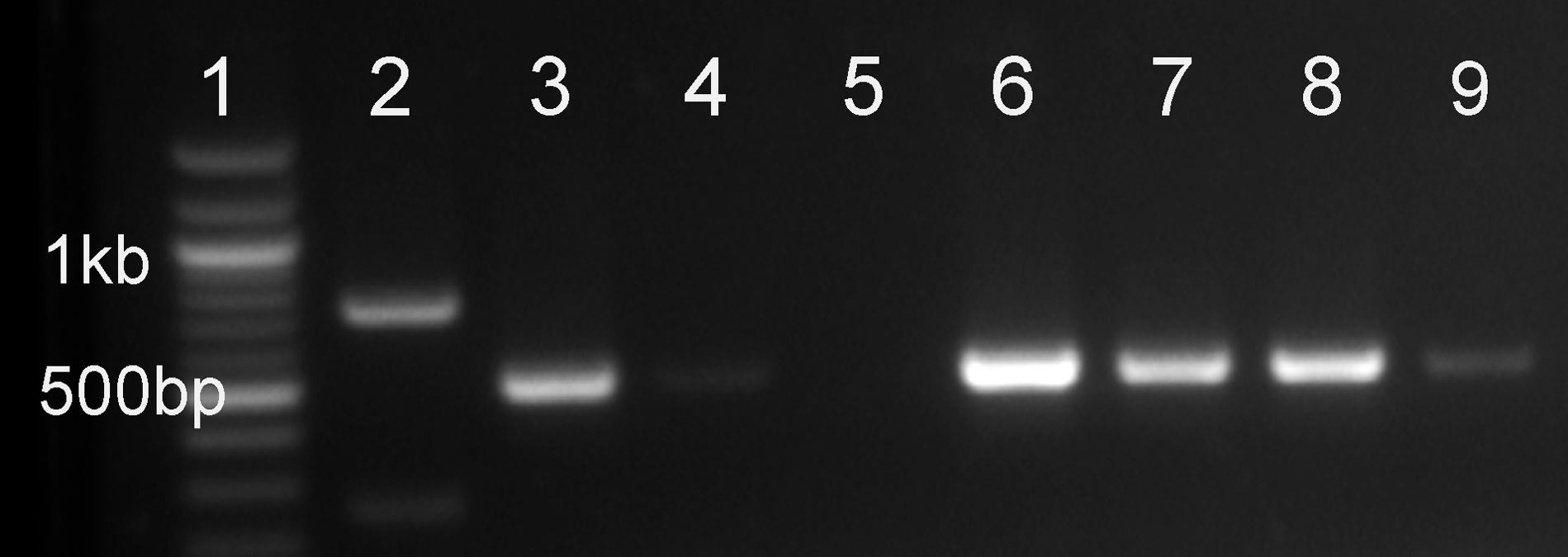
An ethidium bromide stained agarose gel of RT-PCR of RNA showing transient expression in KAS603 36 h after transformation. All amplicons are from GFP cDNA from pMF124cGFPble gene cassette except lane 2. 100 bp ladder (lane 1); HPT cDNA amplicon from CaMV 35S promoter in pHm3A gene cassette (lane 2); Vp54 promoter (lane 3); RbcS2 promoter (lane 4); no promoter (lane 5); Amt1;1 promoter (lane 6); Amt1;2 promoter (lane 7); Rh1 promoter (lane 8); and Nit1 promoter (lane 9).
To keep production costs down for all algae-based bioproducts, it is important that transgenic algae maintain transgene expression when grown in the absence of antibiotics. Gene silencing when transgenic lines are removed from selection is a major problem. Furthermore, stability in a commercial culture of a rapidly dividing organism such as microalgae used in semi-continuous fermentation culture is essential. When transgene expression is driven by the Rbc promoter in C. reinhardtii, 80% of lines are silenced when off selection; when driven by the Hsp70A/Rbc fusion promoter, 36% of lines are silenced when off selection. 29 In the present study, use of the IGS of C. reinhardtii was able to reduce the percentage of transgenic C. reinhardtii lines showing silencing of the β2-tubulin promoter-driven Hygromycin-resistance gene (Fig. 3B). When the gene cassette (p_Chlamy1 from Life Technologies) was not nested in the IGS region, 71% (n=7) of transgenic lines showed silencing; when the gene cassette was nested in the forward orientation of the IGS region, 62% (n=8) of transgenic lines were silenced. Only 14% (n=7) of transgenic lines showed transgene silencing when the gene cassette was nested in the reverse orientation of the IGS region (Fig. 3A ). This significant reduction in gene silencing reduces the number of transgenic lines that need to be screened in order to obtain a line that possesses the optimal transgene expression without antibiotic selection.
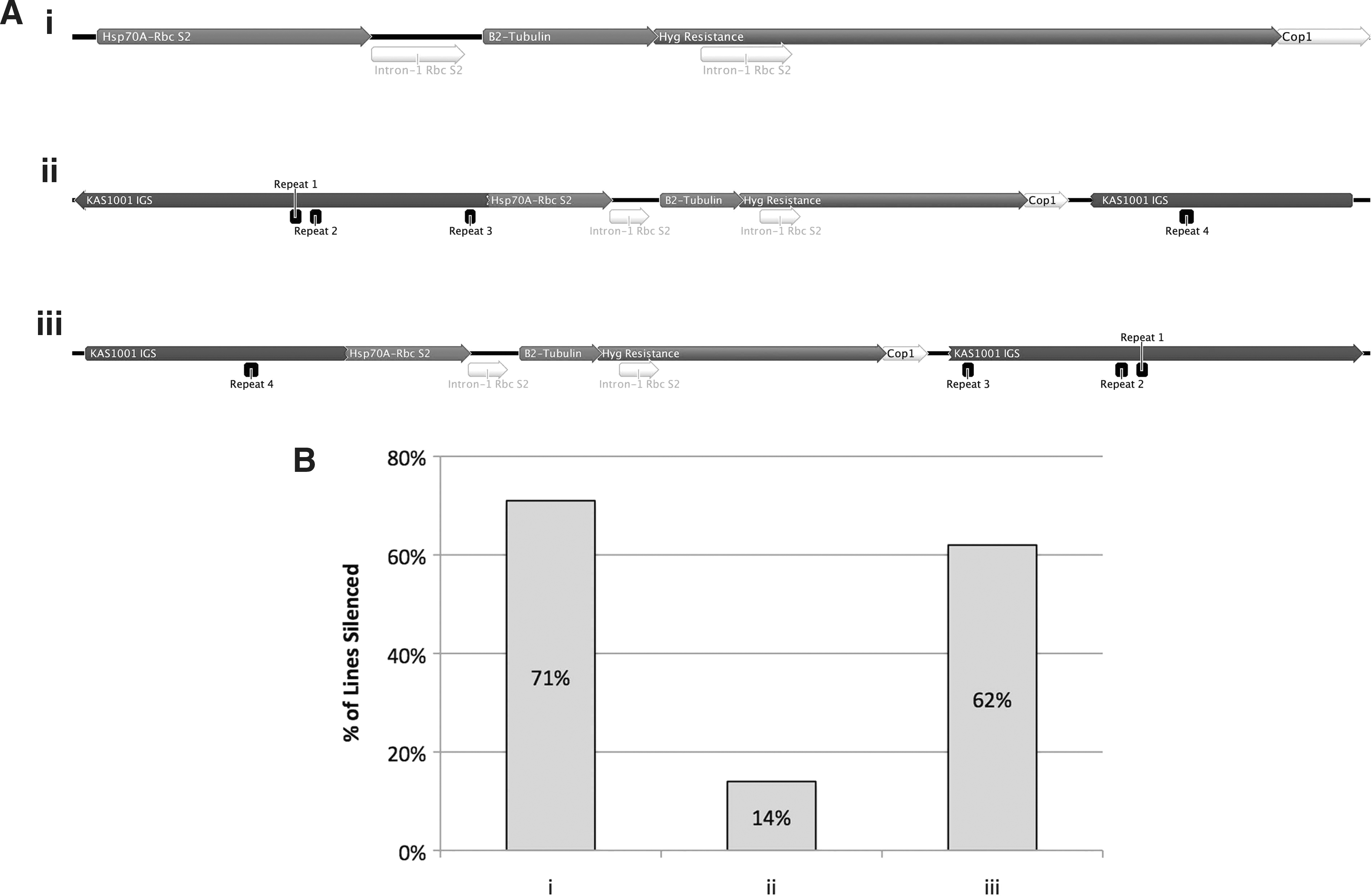
Gene cassettes, IGS DNA context, and transgene silencing chart for nuclear transformed C. reinhardtii.
The IGS has been shown to contain various elements for enhanced expression of the rRNA genes (Fig. 4). 8 We analyzed the IGS for various bioprocess microalgae species to identify multiple, previously unknown features (region length, DNA sequence, tandem repeats, etc.). We identified tandem repeats and determined their consensus sequence (length, copy number, percent matches) for three species of microalgae. 30 The IGS of the C. reinhardtii (GenBank database KJ466353) used in the present study is 2,684 base pairs (bp) and contains four unique tandem repeats (Fig. 5). C. reinhardtii has the following four tandem repeats: GTGTGTGCGC (10 bp, 2.7×, 88%); GGGTACCTTA (10 bp, 3.3×, 91%); CACACCCCCGACCA (14 bp, 1.9×, 100%); AACCCCGTAA (10 bp, 3.8×, 86%). For comparison, Fig. 5 also depicts the IGS for C. vulgaris (GenBank KJ466354) and KAS603 (GenBank KJ466355). C. vulgaris has a 2,804 bp IGS with two unique tandem repeats: AGCACCCCTGCCTTGGCGTCTGCTCACACCTCACACCCCAGCCAGGCACTAGCAGGCAGCACCCACCACACCGGCAGCCCCTGTCACACCGCTCGCAATGGGATGGCAGCTGCCTGGCACTCCAGCAATCTCC (133 bp, 3.3×, 94%); and GGCAGCACCAGCAACACC (18 bp, 2.0x, 89%). The tandem repeats in C. reinhardtii and C. vulgaris share no sequence similarity. KAS603 has a relatively short IGS region (1,239 bp) and does not contain any tandem repeats. There is no sequence similarity among the three species sequenced and analyzed in this study. A. thaliana IGS repeats have been shown to enhance transcription of an rRNA minigene in Xenopus laevis oocytes. 31
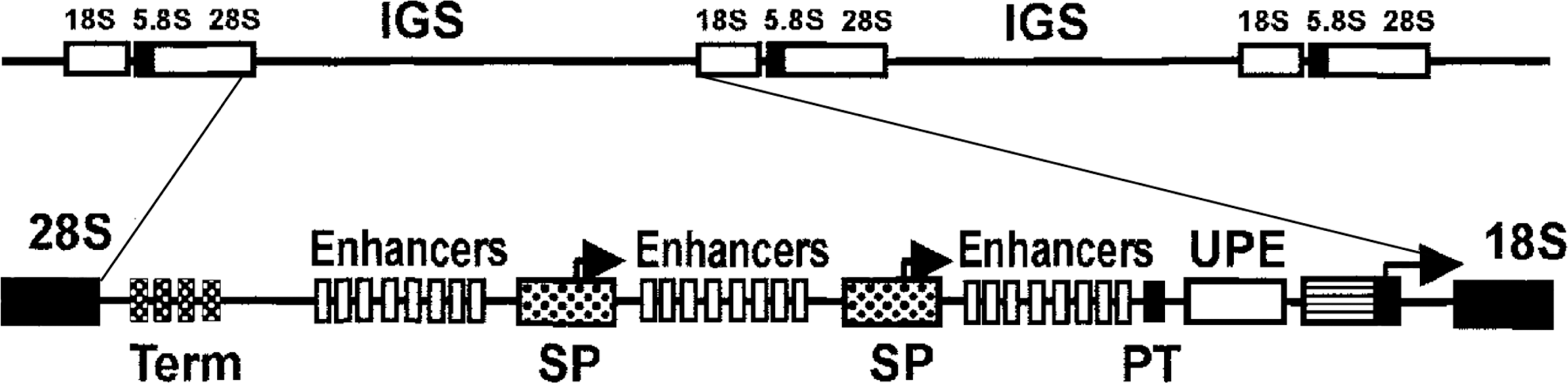
General features of a generic IGS. 8 Generic organization of rRNA coding units separated by IGS. The IGS commonly contains the listed components: terminators (term); enhancers; a spacer promoter (SP); a proximal terminator (PT); and the upstream promoter elements (UPE). Sites of transcription initiation are indicated by bent arrows.
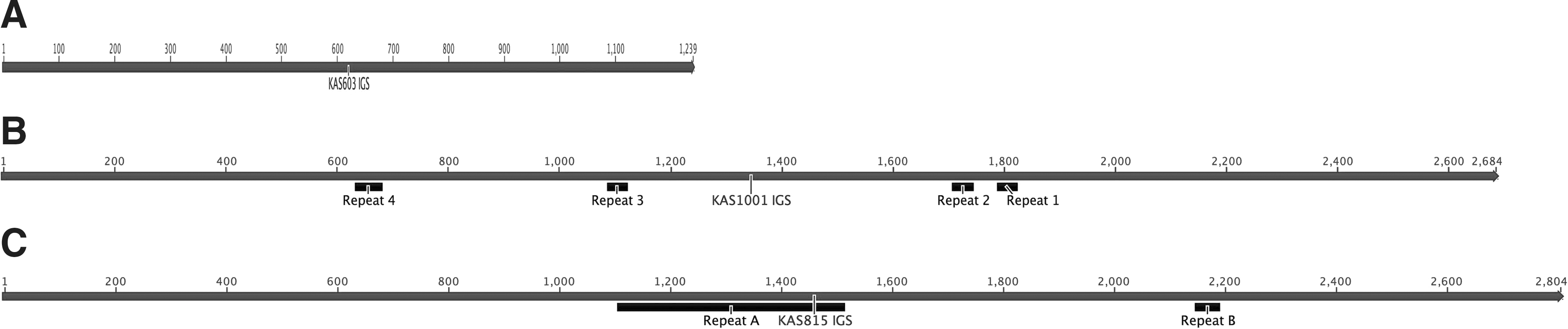
IGS of three different algae species with dissimilar DNA sequence and tandem repeats.
Discussion and Conclusions
For KAS603, we were able to identify five promoters with strong transient expression (Amt1;1, Rh1, Amt1;2, Vp54, and CaMV 35S) and two promoters with weak transient expression (Nit1 and RbcS2) using the KAS603 transient assay. The correlation between the transient expression assay and expression over time in stable nuclear integrated transgenic lines will be verified when stably transformed algal lines are generated.
By nesting a transgene within the IGS region of C. reinhardtii, we were able to reduce the percentage of lines showing transgene silencing in C. reinhardtii from 71% to 14%. The IGS region length, DNA sequence, and tandem repeats from different microalgal species observed here show substantial variability. Future work can be done to test IGS regions from different microalgal species and transgene nesting positions to obtain even higher and more consistent transgene expression.
Footnotes
Acknowledgments
This work was supported in part by United States Department of Agriculture (USDA) Small Business Innovation Research (SBIR) grant (2009‐33610‐20294) to Kuehnle AgroSystems.
Author Disclosure Statement
No competing financial interests exist.