




Abstract

Introduction
The policies for energy, water, and food have numerous interwoven concerns, including access to essential services and resources, environmental impacts, national security, and price volatility. These issues manifest in very different ways in each of the three “spheres.” Systems thinking is required to address such a wide swath of possible topics. 1 Still, due to the vastness of the individual areas and the difficulty of considering all three together, there is little work focusing on how to support decision making at the nexus. As a result, policies and regulations can often inadvertently create suboptimal signals to economic, national security, or environmental concerns. Even when policy is designed by considering more than one area, few approaches have comprehensively addressed the broader interdependencies. 1
This article uses algal bioresources as a lens through which to consider aspects of this nexus. These three spheres are especially relevant in the case of algal bioresources. Due to a unique set of attributes, algal bioresources offer a potential for disruptive change through opportunities for increased energy resources, enhanced food supplies, greenhouse gas mitigation, or new routes to wastewater remediation—though likely not all four simultaneously. The varied, complex, and interdependent pathways and value chains inherent in the consideration of algal bioresources provide an excellent case for exploring these issues further. We consider various scenarios to demonstrate the trade space and to differentiate aspects of risk and trade-offs.
Algal Production Systems at the Nexus
The approach to the energy-water-food nexus normally depends on the perspective of the policymaker, 2 which might provide some context for how technologists view system optimization. A large body of literature focuses on the production of biofuels from algal systems and directly relates to many aspects of this nexus. 3 –17 In the case of algal biofuels production, one must consider and weigh costs and benefits for producing or optimizing fuel or food production, and simultaneously consider sensitivities to water quality, climate-change emissions, the use of waste streams like flue gas or wastewater, local and national energy-security and food-security issues, and competition from other food or fuel value chains. Even within these product categories there are numerous possibilities for specific product types. Figure 1 shows an example of one of many schematics that that could accommodate various product cycles optimized for different outputs and options for fuel, power, or other production systems.

Possible pathways for biodiesel, biomethane, and bioethanol. 11
Ideally, multi-stakeholder, multiple optimization analysis with sensitivities on boundary conditions and scenario design will lead to a system design that addresses key stakeholder priorities. As an example, the focus on the outputs of lipids, carbohydrates, or proteins in microalgae fuel production processes offers one way to consider trade-offs. However, to increase the usefulness of this type of analysis, broader considerations that incorporate factors from economics to social impacts must be defined in terms of scope and of prioritization by different stakeholder groups. This sort of analysis can be complicated because the analyst might be a stakeholder in the outcome of a specific route and could be unaware of the landscape of the other product sectors.
Techno-economic analysis (TEA) and life-cycle assessment (LCA) have been conducted for microalgae for fuel production. 18 –21 In addition, a US national algal biofuels technology roadmap was developed in 2010. 22 It cites several reasons for increased attention to algal biofuels, which have “combined to capture the interest of researchers and entrepreneurs around the world. These include: (1) high per-acre productivity, (2) non-food based feedstock resources, (3) use of otherwise non-productive, non-arable land, (4) utilization of a wide variety of water sources (fresh, brackish, saline, marine, produced, and wastewater), (5) production of both biofuels and valuable co-products, and (6) potential recycling of CO2 and other nutrient waste streams.” 22
Defining Co-Products
Each part of the value chain—such as algae feedstocks, cultivation practices, harvesting and conversion, and infrastructure development—offers a range of possibilities in terms of impacts on final products and interim impacts on the environment. This is also true of how one conceives of co-products in a given system. A typical pathway of algal biofuels into products such as biogas, hydrogen, or biodiesel often serves as the totality of the system boundary for optimization. But this type of analysis only offers a confined view of the full scope of the pathways. In addition to the various fuel-related outputs, other products, ranging from food for animals to health food supplements (direct algae or derivatives such as EPA, DHA, etc.), coloring substances, fertilizers, and niche chemicals serve to complicate further a holistic view of the subject. Figure 2 provides a good sense of the typical “co-products” perspective. It is not unusual to find analysis focused solely on production costs, which combine (or imply a combination of) lowest price inputs (such as wastewater for nutrients) with highest value co-product credits (such as food or feed), or high-volume primary products such as fuel (to achieve scale economy) with low-volume, high-value co-products (such as omega-three fatty acids or carotenoids). Although these combinations are worth considering for special cases, for the most part they are mutually exclusive. Analyses that indicate otherwise have added support to contrarian views that the concept of algal biofuels is fundamentally flawed.
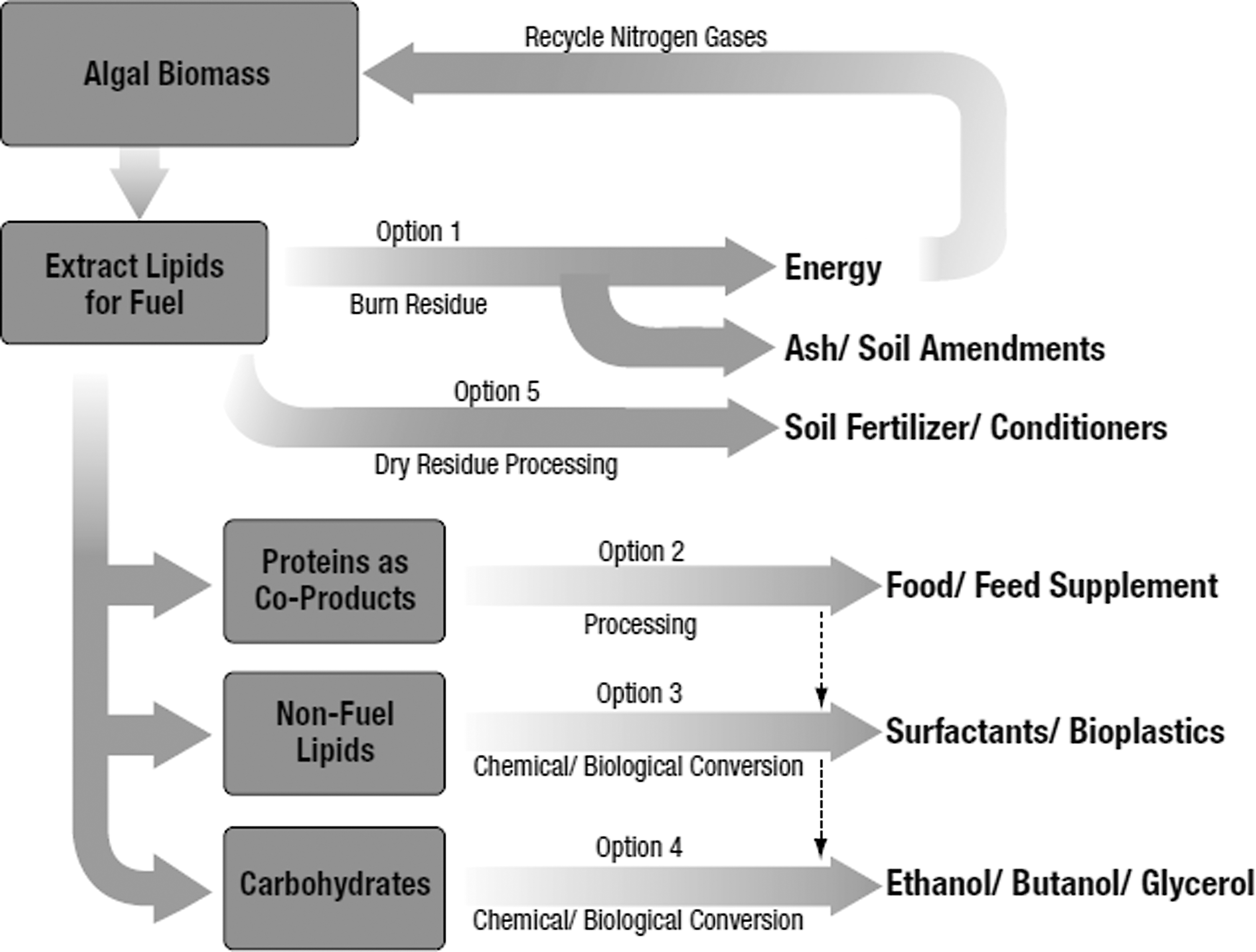
Recovery and use of “co-products.” 22
In light of this, the term “co-products”must assume a value judgment and an optimization focus (ie, on fuels). If, instead, the system were optimized for food output, or optimized for carbon sequestration and waste treatment, or if possible products were optimized for revenue, then this co-product schematic would look very different, as would the production scale and value proposition. That is, the system outputs can be “optimized” toward different primary products; prudent planning and decision making account for this flexibility. This is particularly true from an investor viewpoint, but also from a public-policy perspective, given the complex trade-off among food, fuel/energy, and water experienced by a growing number of people.
It is interesting to note the recent shifts by two companies (DSM-Martek, Heerlen, the Netherlands; and Solazyme, South San Francisco, CA) that have developed technologies for the production of algal biomass by dark heterotrophic growth on sugars in stirred tank reactors. Each of these companies has shifted its focus toward the other's product area, as DSM-Martek has announced a partnership with BP (London, England) to explore biofuel production, and Solazyme has begun to market products for the food and cosmetic sectors. As another example, if wastewater treatment were the focus of a system or project, the animal (or human) feedstock output would be affected because processes optimized for water treatment are not designed to produce materials for use in these sectors. 4,5,9,23 In addition, for biofuel-optimized designs access for some “co-products” requires that new processes be linked to the biofuels production process, such as the capture of nitrogen and phosphorus contained in algal waste after lipid extraction for use as fertilizers. 11 The issue of nitrogen and phosphorous capture can add other complexities to TEA and LCA analyses, because internal recycling of these nutrients to support algal cultivation can provide LCA credits, but at a lower value, whereas sales to other markets (in the form of animal feed or even green fertilizer) may provide additional value but lower the apparent sustainability of the fuel production process.
Analysis Options
Evaluating the fundamental outputs of harvesting microalgae in terms of proteins (amino acids), carbohydrates, and lipids (fatty acids) (Table 1) allows one to consider what kind of scenarios, sensitivities, constraints, and boundary conditions to impose on scenario analysis to provide insights into how to optimize these systems. Yields of these three output types (or four if nucleic acids are included) vary between and within microalgae strains depending on culture conditions, such as harvesting times. In a lipid biofuel production scenario, data such as these could lead to goal-setting to maximize product yield by extending cultivation time (eg, toward late harvest). Davis shows that, for example, in an open pond environment, the lipid content has the most impact on the production cost (in terms of $/gal). 19 However, prolonged cultivation time could lead to lower overall productivity because of reduced amount of biomass harvested annually (due to reduced growth rate late in culture cycles and increased probability of culture crashes caused by infestation with pests, predators, or pathogens), and thus the mid-harvest point could well provide the greatest annual productivity. In a protein-only scenario (for food or feed), the early harvest time produces the maximum protein, dropping precipitously due to nitrogen limitation as harvest time extends. In both scenarios, however, more detailed analyses are required because the amino acid and fatty acid profiles also change with cultivation time, and the quality of product (not just the volume of product) could enter into the decision making.
Chemical Composition of Two Microalgal Strains Grown under Different Conditions 24
Understanding the trade-offs among yields, quality, and risks of products over time adds considerable complexity to typical steady-state analyses on economics and sustainability, and further demonstrates that particular scenarios or products can be emphasized even within a single algal strain by changing process conditions. Such variations can have important impacts on economic and sustainability results. For example, a recent harmonization analysis considering both TEA and LCA assessments for a fuel-production scenario (to maximize lipids, for example) found that a series of engineering improvements to reduce emissions and costs resulted in a minimum greenhouse gas profile for a lipid content ranging between 20–30%, with higher greenhouse-gas emissions on either side of this range, although fuel production cost continued to decrease at increasing lipid content levels. 19 This result comes about as a function of co-product utilization, whereby co-product benefits–in this case, anaerobic digestion of spent algal residues–become diminished as non-lipid components become a smaller fraction of the biomass, which has a stronger impact on LCA than it does on TEA under the assumptions employed. Alternatively, operating conditions can be optimized for a given production scenario and biomass composition through detailed understanding of TEA and LCA implications. For example, the same harmonization analysis noted competing strains on optimum seasonal operations for an algal facility, with a 22% increase in annual greenhouse-gas emissions for a biofuel facility operating at low productivity during the winter months (due to high power demands for pond mixing) but at a 10% cost savings relative to shutting the facility down in the winter (again reflective of the specific product and co-product assumptions employed). Such trade-offs could also be identified for carbohydrate- or protein-emphasized scenarios.
From an investment standpoint, systems that offer opportunities to maximize revenue and minimize costs are most desirable, particularly if dynamic optimization can adjust product outputs to changing market conditions. If one were to assume that all of the algal components can theoretically be used for fuel or food via various production techniques, one could then analyze trade-offs on a broader basis than if taking a fuel supply maximization, or cost minimization of dollars per gallon, approach. For example, Nagle et al. provide data for the potential production of biofuels from three algal biomass fractions enriched for lipids, carbohydrates, and protein. In combination, these three processes can provide more than 3 times as much energy per acre compared to lignocellulosic biomass. 24
An approach that assumes the use of all algal components allows for explicit consideration of trade-offs in the area that became most contentious for first-generation biofuels from cereal crops. Various scenarios are possible, including the following: • • • • • •
Any of the above considerations could serve as starting points for a more in-depth analysis of the underlying factors at stake. For example, within the context of “food vs. fuel” considerations, there are differing priorities that ultimately constrain the system. Namely, a biofuel scenario is inherently predicated on a favorable energy ratio (eg, providing more energy in the fuel product than the amount of fossil energy required to produce it), as well as low overall greenhouse gas emissions relative to petroleum fuels. These stipulations carry tremendous influence on system design and operational targets through considerations such as the necessity to avoid thermal evaporation of water using fossil inputs during lipid extraction. 26 However, such considerations are not necessarily of paramount importance in a scenario other than energy production, such as for food or high-value nutraceuticals. In these cases, thermal evaporation to very low moisture content might be required, but the incurred energy penalty is acceptable. In the case of food production, higher priority can be placed on considerations such as product quality/safety, nutritional value, or specific algal strain employed (eg, natural vs. genetically modified organisms), which place entirely different constraints on system design.
Furthermore, commodity fuels require simplistic production operations to achieve ultimate cost parity with fossil fuels–wholesale prices on the order of $3/gallon gasoline-equivalent–while food products including high-value food components garner a much higher market value at present, estimated by one study to be on the order of €250/dry kg or $300,000/ton, and thus can afford more complex or costly production systems. 27,28 To assist further in cost minimization in a fuel scenario, wastewater may be utilized to mitigate nutrient demands; for example, Lundquist estimates a favorable production cost of algal biofuel at $28/barrel if algal biomass is grown in small quantities for the primary purpose of wastewater treatment. 21 However, the use of wastewater would be impractical in a food-production scenario for obvious reasons of product quality and safety.
In addition to scenario work, a qualitative risk framework could be developed that allows a simple decision-making process in varying locations. This could help stakeholders with highly differing “value perspectives” better understand trade-offs, as different parties value different impacts in different ways (Fig. 3). Similarly, different locations or communities value different approaches and products in different ways, depending on their resources and needs.
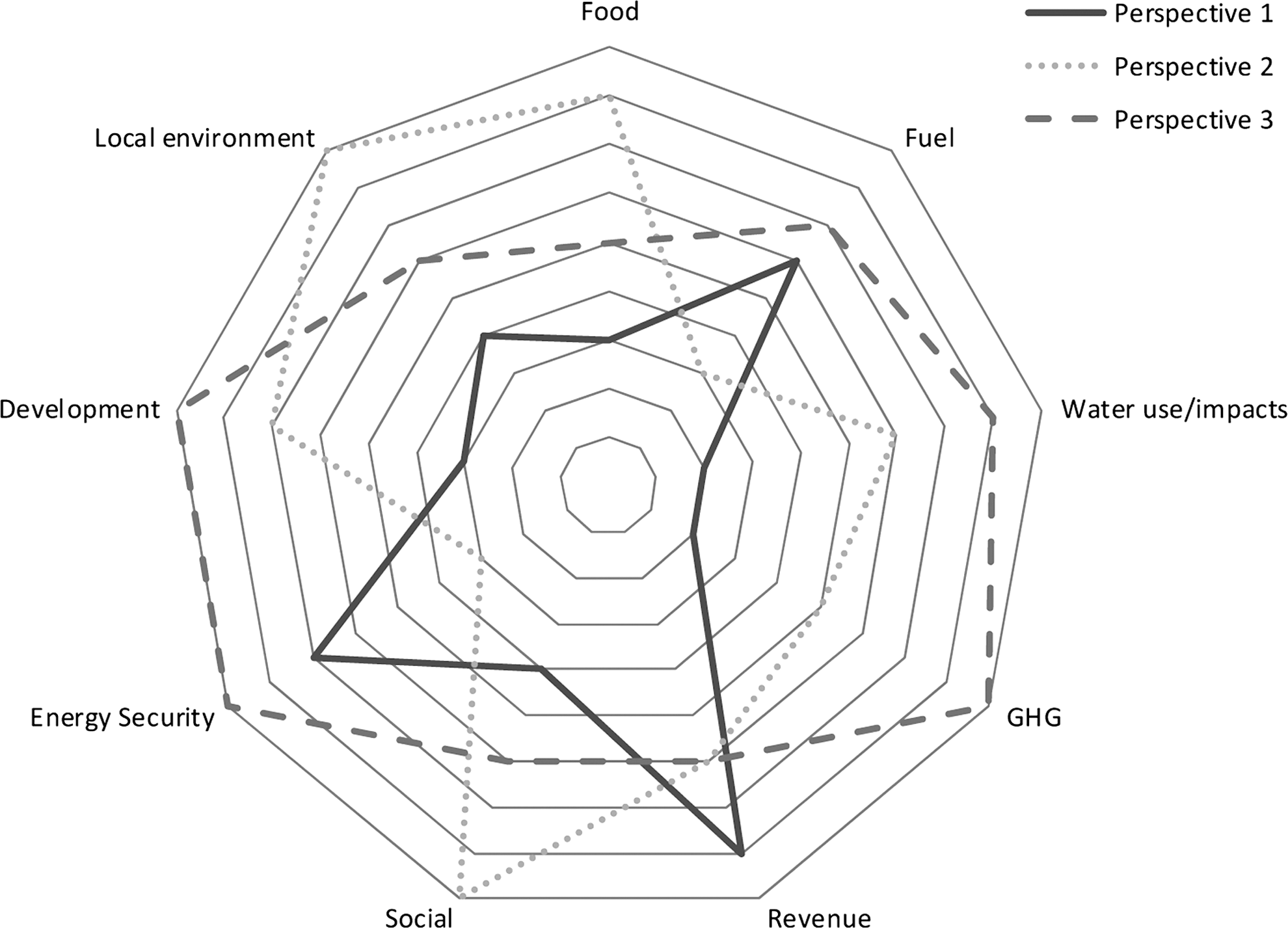
Varying perspectives or trade-offs related to algal biofuels production.
Conclusions and Next Steps
Algal systems offer a unique opportunity to consider the energy-water-food nexus. Evaluating the potential benefits and impacts of these systems requires a deep understanding of the fundamental science of the processes in combination with technical, life-cycle, financial, and policy analysis. 29 Providing transparent and explicit treatment of a range of possible future pathways for algal systems can help inform policy, investment decisions, and research and development prioritization. Developing a consistent framework that accounts for the design and operational flexibility of algal systems will enable robust decision making across multiple stakeholder perspectives. It would also be useful in identifying major areas of risk, suggesting mitigation strategies to avoid or manage ongoing risks for the nascent algal system markets, and inform dialogue related to the energy-water-food nexus.
Footnotes
Acknowledgments
This work was supported by the Bioenergy Technologies Office of the US Department of Energy. Special thanks to Lieve Laurens and Nick Nagle of the National Renewable Energy Laboratory for careful reading of the manuscript and suggestions for improvements.