




Abstract

Executive Summary
Based on scientific evidence and a realistic view of the use of food crops in biobased industries, our position is that all kinds of biomass–food and non-food crops–should be accepted for industrial uses. The choice should be dependent on how sustainably and efficiently these biomass resources can be produced.
Of course with a growing world population, the first priority of biomass allocation is food security. The public debate mostly focuses on the obvious direct competition for food crops between different uses: food, feed, industrial materials and energy. However, we argue that the crucial issue is land availability, since the cultivation of non-food crops on arable land would reduce the potential availability of food just as much or even more.
We therefore suggest a differentiated approach to finding the most suitable biomass for industrial uses. In a first step, we must address the issue of whether the use of biomass for purposes other than food can be justified at all. This means taking the availability of arable land into account. Several studies show that some areas will remain free for other purposes than food production even after worldwide food demand has been satisfied. These studies also show potential for further growth in yields and arable land areas worldwide.
The second step is then to find out how best to use these available areas. Recent studies have shown that many food crops are more land-efficient than non-food crops. This means that less land is required for the production of a certain amount of fermentable sugar, for example–which is especially crucial for biotechnology processes–than would be needed to produce the same amount of sugar with the supposedly “unproblematic,” second generation lignocellulosic non-food crops. Also, the long-time improvement of first generation process chains as well as the food and feed uses of byproducts make the utilization of food crops in biobased industries very efficient.
Editor's Note:
The complete nova-Institute paper is available at
Another very important aspect that argues in favor of industrial use of food crops is the flexibility of crop allocation in times of crises. If a food crisis occurs, it would be possible to reallocate food crops that were originally cultivated for industry to food uses. This is not possible with non-food crops–they can only ensure supply security for industrial applications.
We therefore believe that political measures should not differentiate simply between food and non-food crops, but that criteria such as land availability, resource and land efficiency, valorization of byproducts, and emergency food reserves should be taken into account. Furthermore, research into first generation processes should continue and receive fresh support from European research agendas, and the quota system for producing sugar in the European Union should be revised to enable increased production of these feedstocks for industrial uses. Additionally, we support a level playing field between industrial material uses of biomass and biofuels/bioenergy in order to reduce market distortions in the allocation of biomass for uses other than food and feed.
Biomass Use in the European Union and Worldwide
With an increasing world population, ensuring food security is the first priority of biomass usage. At the end of 2011, there were about 7 billion people on our planet. The global population is expected to reach more than 9 billion people by 2050. This alone will lead to a 30% increase in biomass demand. Increasing meat consumption and higher living standards will generate additional demand for biomass. The European Commission came to the following conclusion in 2012: “Global population growth by 2050 is estimated to lead to a 70% increase in food demand, which includes a projected twofold increase in world meat consumption. […] As global demand for biomass for food and industrial purposes grows over the coming decades, EU agriculture, forestry, fisheries, and aquaculture capacity will need to be sustainably increased.” 1
Food and feed clearly are the supply priorities for biomass use, followed by biobased products, biofuels, and bioenergy. In 2008, the 10 billion tonnes of biomass harvested worldwide were used as follows: 60% animal feed; 32% food; 4% material use; 4% energy use.
Although agricultural yields can be significantly increased in many developing countries, and arable land can still be expanded by a few hundreds of millions of hectares worldwide without touching rainforest or protected areas (even in the EU there are between 2.5 and 8 million hectares of arable land that are not currently in use), arable land and biomass are limited resources and should be used efficiently and sustainably.
Huge Potential for Increasing Biomass Availability
As the numbers above show, the industrial material use of biomass makes up for only a very small share of biomass competition. Other factors have a much greater impact on food availability. Due to increasing demand for food and feed as well as bioenergy and industrial material use, the crucial question is how to increase the biomass production in a sustainable way: 1. Increasing yields: Tremendous potential for increasing yields in developing countries is hampered by a lack of investment in well known technologies and infrastructure, unfavorable agricultural policies such as no access to credits, insufficient transmission of price incentives, and poorly enforced land rights. 2. Expansion of arable land: Some 100 million hectares could be added to the current 1.4 billion hectares without touching rainforest or protected areas. Most estimates calculate up to 500 million hectares. These areas will require a lot of infrastructure investment before they can be utilized.
2,3
Both aspects mean that political reforms and huge investment in agro-technologies and infrastructure are necessary.
There is also huge potential for saving biomass and arable land: • Reduced meat consumption would free up a huge amount of arable land for other uses. Deriving protein from cattle requires 40 to 50 times the biomass input than protein directly obtained from wheat or soy. • Reducing food losses will also free up huge areas of arable land. Roughly one-third of food produced for human consumption is lost or wasted globally, amounting to about 1.3 billion tonnes per year.
4
• Increasing the efficiency of biomass processing for all applications by the use of modern industrial biotechnology; • Using all agricultural byproducts that are not inserted in any value chain today. Lignocellulosic residues in particular can be used in second generation biofuels and biochemicals. • Finally, the use of solar energy, which also takes up land, for fueling electric cars is about 100 times more land-efficient than using the land for biofuels for conventional cars. In addition, solar energy can be produced on non-arable land, too. Increased use of this means of transportation would release huge areas of arable land that are currently used for biofuels. This should be an important part of the strategy beyond 2020.
5
First- Second-, And Third- Generation Feedstocks
The use of biomass to obtain different chemicals and materials is virtually as old as mankind (eg, birch bark pitch use dates back to the late Paleolithic era). It has been conducted on an industrial scale for over 100 years. For example, starch is used on a large scale in the paper industry. Today, a wide range of chemicals, plastics, detergents, lubricants, and fuels are produced from agricultural biomass, mainly from sugar, starch, plant oil, and natural rubber, the so-called first-generation feedstocks. Because of the potential for direct competition with food and animal feed, politicians and scientists have in the last 10 years introduced the idea of using lignocellulosic feedstock as a raw material for fermentable sugars and also for gasification. Lignocellulose means wood, short-rotation coppice such as poplar, willow, or Miscanthus, or else lignocellulosic agricultural byproducts like straw. These are the so-called second-generation feedstocks. Very recently, more and more research is being carried out into using algae as a feedstock; this is known as a third-generation feedstock.
Whether the use of second-generation feedstocks will have less impact on food security is questionable. Note that this paper does not distinguish between food and feed crops, since animal food is simply a precursor to food uses. Public debate only focuses on direct competition between food crops for different uses. One of the most common questions is, “When will your company switch from food crops to second-generation lignocellulosic feedstock?” From our point of view this is the wrong question. The real question is, “What is the most resource-efficient and sustainable use of land and biomass in your region?” It is not a question of whether the crop can be used for food or feed; it is a question of resource and land efficiency and sustainability. The competition is for land. Land used for cultivating lignocellulosic feedstock is not available for food or feed production.
Current Frameworks for the Industrial Use of Biomass
Under the social challenge, “Food Security, Sustainable Agriculture, Marine and Maritime Research and Bio-economy,” the Horizon 2020 proposal makes the following statement about biomass use: “The aim is the promotion of low carbon, resource efficient, sustainable and competitive European bio-based industries.” In this context, a biobased industry infrastructure based on first-generation technology (mainly starch, sugar and oil) is not seen as an appropriate future choice for Europe. Biorefinery projects that focus on food crops especially tend to be viewed more critically in Europe than elsewhere.
The effect of this is that EU research policy is focused on mobilizing efforts to be the leader in the deployment of biorefineries that rely on second-generation lignocellulosic and third-generation algae feedstocks.
Several NGOs want to freeze the use of food crops, especially for biofuels, because they fear direct competition with the food market and a severe impact on food prices and food availability for the poorest. 6,7 In 2012, the European Commission reacted to these demands with a proposal to decrease the biofuel mandates with regard to fuel crops and ILUC in order to improve the environmental impact of biofuels. 8 International companies are also seeking to avoid using food crops as part of their biomass strategies and are focusing instead on second- and third-generation feedstocks.
Today, most of the biobased chemicals and plastics rely on first-generation feedstock, and the technology as well as the economies of the second and third generation have yet to prove themselves viable beyond subsidized cases. Recently we have seen some promising achievements in terms of enzyme costs and performance. On the other hand, many projects failed and a lot of companies are stopping or delaying activities in second- and third-generation endeavors, in part due to the low cost of conventional carbon sources (eg, shale gas).
By contrast, the US, Brazil, and China are pushing ahead with the development of industrial biorefineries that use food crops as a feedstock with the aim of kick-starting their biobased industries; yet, of course, they are at the same time supporting the second and third generations. In the US, for example, an increased mandate has been implemented for the inclusion of corn-based ethanol fuel and chemicals, and it was stated in advance that this would be effective for the next 15 years at least. These factors give the EU's competitors a clear first-mover advantage. Industry needs more time to develop the right technologies for second- and third-generation feedstock usages and therefore the first-generation feedstock should be considered as an important, long or even everlasting bridge to the second and third generations—if these turn out to be more efficient from a land-use perspective in the future.
A Differentiated Approach to Finding the Most Suitable Biomass for Industry
There is no black-and-white answer to the question of what constitutes the most suitable biomass for the biobased economy. Depending on local conditions, it is possible that any one—or indeed several—of food crops, lignocellulosic crops or algae are favorable in terms of sustainability, food security, environmental impacts and economy.
One important factor influencing these impacts is the use of byproducts. If food crop or agricultural waste byproducts are available and not already used in other processes, these second-generation feedstocks are expected to have the lowest impact and to be the most favorable. But there is limited availability of byproducts that are not already in use, and the processes for utilizing them are not yet established. 9 It is important to recognize that availability depends on market demand and is influenced by incentive schemes. In general, byproducts currently used as feed or feedstock for industry are not available for other purposes in the foreseeable future.
So if arable land is planted with short-rotation coppice such as poplar or willow, Miscanthus or other high-yield grasses instead, we are not much closer to answering the question about the differing adverse impact of either food or lignocellulosic crops. Land-use and resource efficiency—over the whole process chain of biomass use—need to be taken into consideration.
When politicians and industry reacted to public debate during the 2008 food crisis, they gave too simplistic an answer to the potential food versus industry conflict, concluding that industry should switch to non-food crops as soon as possible. From our point of view, the question of food versus non-food crops is in itself oversimplified, as well as misleading. The real questions and conflicts are different, since both uses compete for land. Which crops use the land most efficiently and sustainably?
This means that any appropriate answer would include asking whether there are free agricultural areas left in the country or region that are not necessary for food and animal feed production, domestic use or export. In most countries and regions, arable land remains available for the potential production of biomass for industrial uses, whether material, energy, or both. In this case, the real question is, “How can we use these free areas as a sustainable feedstock for industry with the highest resource- and land efficiency, the highest possible level of climate and environmental protection, and the lowest competition with food?”
Depending on local conditions, food crops can fulfill these criteria just as well as non-food crops, and this will remain the case in the future. In some cases, they may even score higher in these categories. So the dogma of “no food crops for industry” can lead to a misallocation or underutilization of agricultural resources, ie, land and biomass.
How are Food Crops Utilized for Industrial Material Use Today?
Typically, all parts of a food crop such as sugar, starch, oil, proteins, and fibers are used in a wide range of applications. Biorefineries for food crops have existed for many years. Biorefineries convert all parts of a harvested crop into food, feed, materials and energy/fuel, maximizing the total value. If this maximum output value were not attained, the prices of the food and feed parts would go up.
For example, using sugar, starch or oil for biobased chemicals, plastics or fuel leaves plant-based proteins, which are an important feedstock for the food and animal feed industry. At present, the world is mainly short of protein and not of carbohydrates such as sugar and starch. (Even Europe is a net importer of plant proteins from North and South America. Local production of industrial crops generating protein byproducts, would decrease these protein imports, and correlated land.) This means that there is no real competition with food uses, since the valuable part of the food crops still flows into food and feed uses. Table 1 and Figure 1 give an overview of the valorization of processed fractions of crops, if the main use is material use, dry matter only. The percentage is related to grain or fruit only; additional (lignocellulosic) fibers from straw, leaves, etc. are not taken into account.
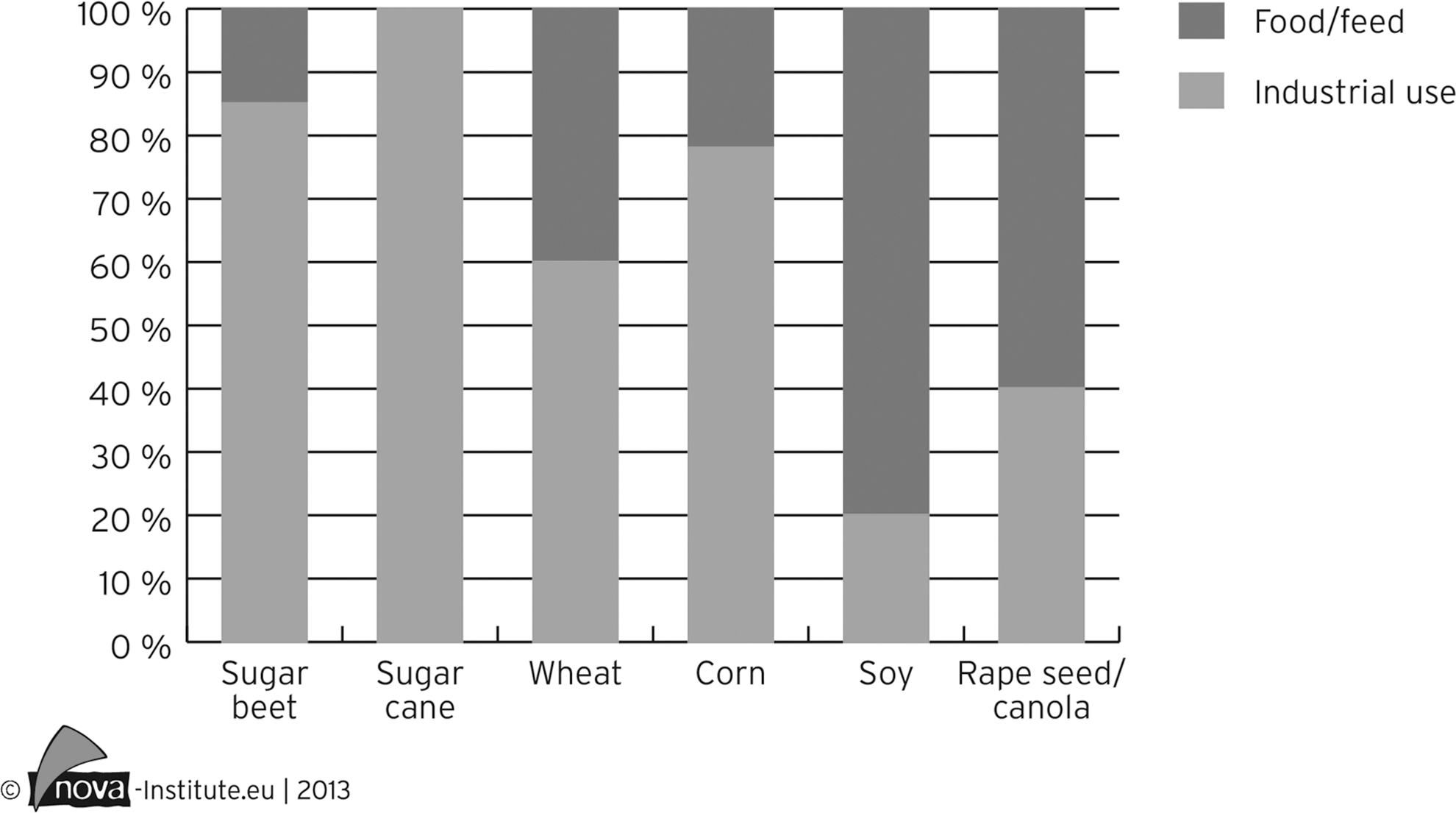
Valorization of components of food crops used in industry, considering only the special case of when all carbohydrates (sugar beet, sugar cane, wheat, and corn) or oils (soy and canola) are used for industrial material use only, and their byproducts subsequently used for food and feed.
Considers only the special case of when all carbohydrates (sugar beet, sugar cane, wheat, and corn) or oils (soy and canola) are used for industrial material use only, and their byproducts subsequently used for food and feed.
Sources: Kamm B, Gruber P, Kamm M. Biorefineries–Industrial Processes and Products. Weinheim: Wiley, 2006; IEA Bioenergy, Task 42 Biorefinery, Country Reports, 2012. Available at:
For oil crops, the protein-rich press cake often constitutes a much larger share of the harvested biomass than the plant oil used for oleochemistry. Starch crops have protein-rich byproducts such as vital wheat gluten or corn gluten, which play an important role in human nutrition or in the animal feed industry. The protein fraction and the fiber-rich fraction are always used in the food and feed industries due to their high value in these markets, even in cases in which the carbohydrates are used completely for chemicals.
Hence, an increase in the use of food crops for industrial applications increases local protein production for animal feed, replacing imported soy proteins. Also, from an animal nutrition perspective, it is better for growth to feed the protein and fiber fraction separately and not the whole grain.
Resource Efficiency
Food crops have been cultivated for a couple of thousand years. They were the first cultivated plants and there have been large improvements in yield per area. Furthermore, the use of sugar, starch, and oil is well established in the food, feed, and chemical industries. The processes have been optimized and commercialized for decades—but advanced biotechnology can nevertheless lead to further efficiency gains.
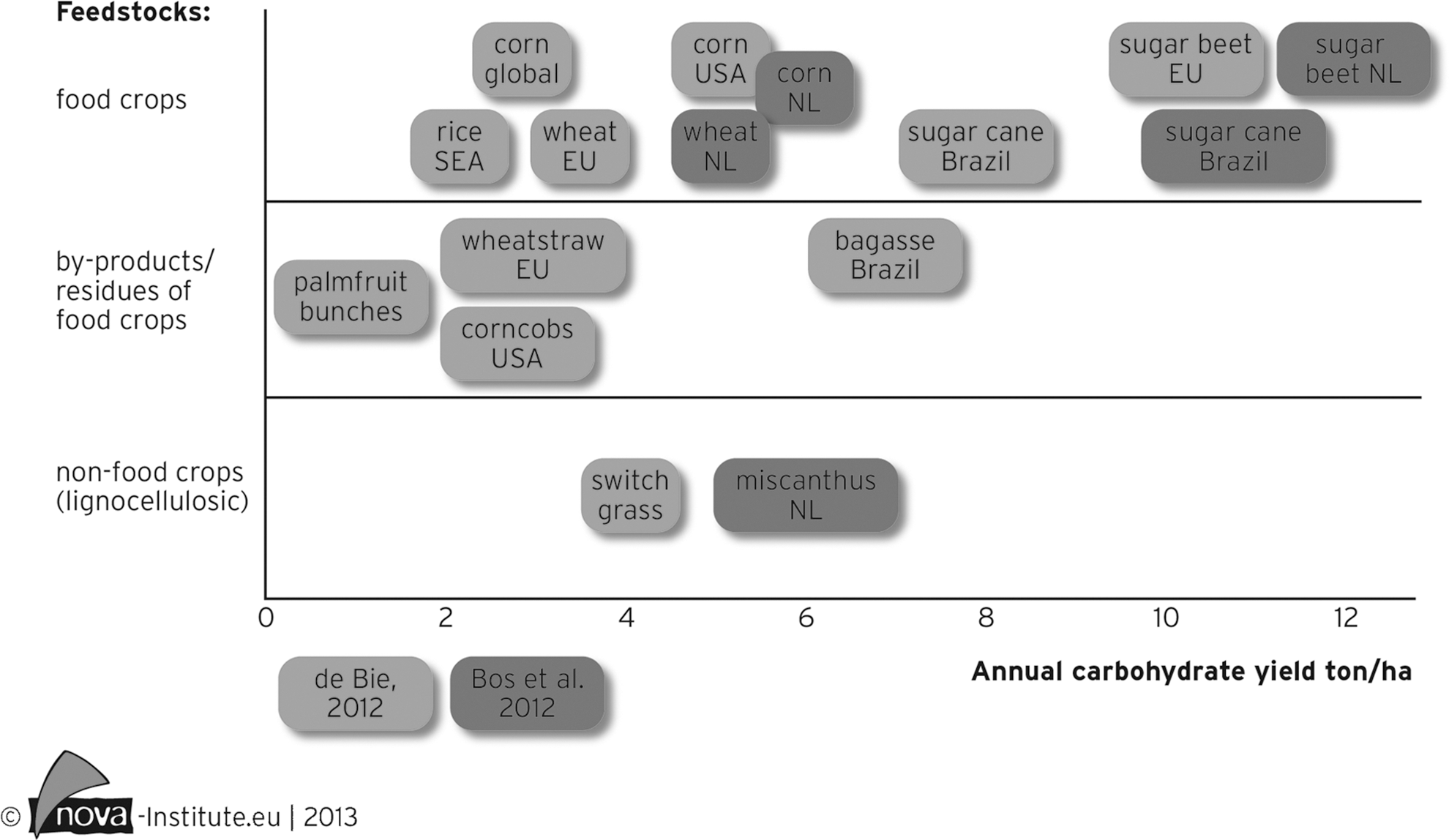
In terms of fermentable sugar yields per hectare, sugar cane and sugar beet in particular can be more resource-efficient than second-generation lignocellulosic crops. A recent publication by Bos et al. shows that the land use per tonne of biobased PLA, bio-based PE, and bioethanol is lower for sugar beet and sugar cane than for the lignocellulosic perennial crop Miscanthus ( Fig. 2 ). 10 Also, avoidance of non-renewable energy use (NREU) for the various biobased products compared to their fossil-fuel-based counterparts is greatest for sugar cane, sugar beet, followed by maize, Miscanthus, and wheat. Therefore, sugar cane and sugar beet have the highest land-use efficiency in terms of the amount of product per area, as well as the smallest CO2 footprint. Similar results were presented by de Bie (Fig. 2). 11 The annual carbohydrate yield in tonnes/ha is highest for sugar beet in the EU (>10), followed by sugar cane in Brazil (8), bagasse in Brazil (7), corn (US, 5–6), switch grass (US, 4), and wheat (EU, 3–4).
Flexible Application of Food Crops–Emergency Food Reserve
One aspect that is rarely mentioned for some reason is that food crops for industry can also serve as an emergency reserve of food and feed supply, whereas second-generation lignocellulose cannot be used in the same way. This means that food security can be assured through the extended use of food crops. In a food crisis, sugar cane (Brazil) and corn (US), for example, can be immediately redirected to the food and feed market. This is especially possible with crop varieties certified for food and feed.
This already occurred in Brazil in 2011 via a flexible bioethanol quota, whereby the quota is reduced if there is demand for food or feed. This kind of flexible quota can be used to stabilize market prices for food and feed. In contrast, a fixed quota like the one operating in the EU and the US tends to destabilize market prices.
By contrast, lignocellulosic crops such as short-rotation coppice (SRC) only provide industrial supply security. SRC cultivation takes up land that cannot then be used for food and feed production. Land is often blocked for a relatively long period of time. In a food crisis, the biomass yield from SRC fields cannot be used for food and feed, thereby maintaining the pressure on the food and feed markets.
First-generation crops also have the potential to give the farmer more flexibility in terms of his crop's end use. If the market is already saturated with food exports of a crop, this allows the crop to be diverted towards industrial use. The reverse is also true when there is a food shortage. The same cannot be said of non-food crops with single, industrial use.
If the industry is forced to use only nonfood crops, this will lead to more land use for non-food crops, which would in fact induce an artificial scarcity of land for food crops. Growing food crops–on land that is currently either not at all or not properly in use–will, however, increase the global availability of these crops, increase the market volume and thus reduce the risk of speculation peaks as well as shortages in certain parts of the world. It is often argued that utilizing lignocellulose will not take up any land, as long as only byproducts are used and no specified cultivation for industrial purposes takes place. However, the potential availability of lignocellulosic byproducts that are not already valorized in other applications is severely limited and cannot form the basis for an entire industry.
In summary, growing more food crops for industry creates a quintuple win situation: • The farmer wins, with more options for selling stock and, therefore, more economic security. • The environment wins, due to greater resource efficiency of food crops and the smaller area of land used. • Food security wins, due to flexible allocation of food crops in times of crisis. • Feed security wins, due to the high value of the protein-rich by-products of food crops. • Market stability wins due to increased global availability of food crops, which will reduce the risk of shortages and speculation peaks.
Level Playing Field for Industrial Material Use and Bioenergy/Biofuels
Allocation of biomass to different sectors plays an important role in biomass availability. The first priority should always be food security, but after that the allocation of feedstocks between energy and material uses should be based on criteria such as the availability of possible substitutes, environmental friendliness, climate protection, added value, employment and innovation.
Bioenergy and biofuels receive strong on-going support for commercial production (quotas, tax incentives, green electricity regulations and more). By contrast, however, there is currently no similar, comprehensive European policy framework in place to support biobased materials and products. Without comparable support, biobased materials and products will further suffer from underinvestment from the private sector. Current policy leads to market distortion regarding feedstock availability and allocation, which increases the price for land and biomass.
There are several good reasons for differentiating between industrial material use of biomass as opposed to bioenergy and biofuels and for preferring the use of the limited biomass for materials over the use of biomass for bioenergy and biofuels: • The industrial material use of biomass leads to a much higher turnover, added value and employment per tonne (and also per hectare) along the long added value chain. Estimations show that this can be 5 to 10 times higher than for bioenergy and biofuels. • Biobased materials and products show greater land and resource efficiency than bioenergy and biofuels, especially if recycling and cascading utilization are realized, with energy recovery as an end-of-life option. • Biobased materials and products serve as a carbon sink during their lifespan in contrast to biomass for energy and fuel, which rerelease the carbon immediately during their use phase and/ or end of life. More biobased durable goods from industrial use in particular will allow carbon to be captured and stored during the critical period of climate change over the coming decades. • Bio-based materials and products cannot be as easily replaced by other renewables as bioenergy/biofuels can be by solar and wind power. • Due to their higher added value, biobased materials and products need less financial support than bioenergy/biofuels–or even no specific support at all, if market distortion from unbalanced support for bioenergy and biofuels is reduced. • In total, industrial material use of biomass makes less demand on resources than energy and fuels, so the potential pressure on land and biomass is lower. Furthermore, much higher biobased shares can be reached in the specific material application sectors than in the energy and fuel sectors.
A new political-economic framework is needed to rebalance the financial support for energy and industrial material use of biomass. Whatever the application, this new framework should be linked to climate protection, resource efficiency, employment, and innovation.
Impacts on Policy
We propose the following: • All kinds of biomass should be accepted as feedstock for the biobased economy. • Potential political and financial measures should only be based on higher resource and land efficiency, sustainability, and a lower environmental footprint of the biomass, and the lowest possible level of competition with food. • The acceptable biomass must of course also meet established international sustainability standards. • European research agendas should again support first-generation processing lines for biobased chemistry and materials to improve resource efficiency and sustainability and especially to find the best applications for all parts of the crop in the food, feed, materials, and energy sectors. • Research should also identify the most resource- and land-efficient crops and production pathways for specific regional conditions and applications. • Increase the European production of sugar for industry via a reform of the existing quota systems. • Implement a level playing field between industrial material use and biofuels/bioenergy.