




Abstract

Research experiences at an early postsecondary educational stage are often pursued by students wanting to enhance their resumes and/or graduate school applications, enhance their laboratory skill sets, learn how scientists reason or expand their scientific literacy, or for a myriad of other reasons, both personal and professional. 1 –8 Unfortunately, laboratory-based research opportunities at community colleges have historically been exceedingly scarce. Since nearly one-half of all postsecondary graduates in the United States enroll in community colleges, this scarcity necessarily limits access to undergraduate research opportunities for a tremendous percentage of college undergraduates in the US. 9 Programs such as the Community College Undergraduate Research Initiative 10 (CCURI) and several university-specific offerings have been instituted in an attempt to ameliorate this shortcoming, but much work remains to be done in this regard. 11 –13 This case study highlights the development of an undergraduate research initiative at a community college that may serve as a guide for others hoping to follow suit.
The Lone Star College Biotechnology Institute
With a total enrollment exceeding 90,000 students, the Lone Star College (LSC) System is the second largest community college system in Texas and is the fastest growing community college system in the US. The LSC Biotechnology Institute (LSCBI) is located on the LSC-Montgomery (LSC-M) campus and is home to the oldest biotechnology associates degree program in the state of Texas. Biotechnology students are trained with industry-relevant skills including genetic cloning, polymerase chain reaction (PCR), chromatography, spectrophotometry, cell culture, and bioinformatics. Students completing the program typically either gain employment with a life science (or related) company in the Greater Houston area or transfer to a local university to continue their education. Much of this success in placing graduates in vocational or educational settings can be attributed to the emphasis in the curriculum on practical skill development that not only makes them highly competent laboratory technicians, but also enhances a mastery of the theoretical foundations that underlie many aspects of biotechnology.
Undergraduate Research Initiatives
A 2008 bond referendum led to the construction of a new Health Sciences Center on the LSC-M campus and, consequently, an expansion of the biotechnology laboratory facilities. The original laboratory was then repurposed to serve as a “Project Lab” that supports research projects for LSC-M biotechnology and biology students, other college students and local high school students in need of a facility to complete academic requirements such as science fair projects and internships. Conversations with students and faculty members who expressed interest in becoming involved with research projects revealed that renewable energy applications of biotechnology were the most popular choice for an initial research focus. Members of the biotechnology faculty subsequently narrowed the focus further to two main research themes: algae-derived biofuels and biodiesel. These projects began rather modestly, but several key drivers led to a rapid diversification and expansion of research project themes on the LSC-M campus.
Key Drivers
Donations from External Partners
As a community college workforce program, the LSCBI relies heavily on local companies to provide guidance to faculty and administrators regarding critical training needs, to allow field trips and tours for biotechnology students, to serve as a source of adjunct faculty and guest speakers for cutting edge and highly specialized presentations, and to offer internships and employment to students and graduates. The debut of the algae and biodiesel projects immediately sparked interest from both established and new biotechnology partners and led to the acquisition of some resources that provided far greater opportunities for student research participation. A sampling of some of the more significant contributions follows: • Molecular Logix (The Woodlands, TX) donated a laminar flow hood, a centrifuge, and other equipment. • Yokogawa Corporation of America (Sugar Land, TX) donated an integrated production control system for the development of an automated on-campus algae production facility. • Rice University (Houston, TX) donated a scanning electron microscope for the characterization of anaerobic microbes underlying a microbial fuel cell (MFC). • Harvel Plastics (Easton, PA) donated custom fabricated polyvinyl chloride (PVC) tubes and fittings for the construction of pilot-scale photobioreactors (PBRs) for algae cultivation in a biorefinery context.
External Collaborations
Industry collaborations are central to the success of any workforce program, and the biotechnology program at LSC-M is no exception. Three collaborations have proven to be particularly instrumental in catalyzing rapid advancements in the research initiatives of LSCBI and deserve special mention. In the summer of 2010, Fluid Imaging Technologies (FIT, Yarmouth, ME) provided a loaner particle image analyzer (“Flow Cam”) that allowed LSCBI to offer an on-campus internship centered on algae cultivation and high level analysis using this cutting edge technology. In 2012, LSCBI and FIT significantly enhanced their already thriving partnership with two transactions: LSCBI purchased a Flow Cam, and FIT CEO Kent Peterson travelled from Maine to Texas to award a student scholarship for outstanding research accomplishments.
Aperion Companies (Scottsdale, AZ) provided LSCBI with an $82,000 award to expand the Institute's research efforts toward water bioremediation. This generous donation provided students with research opportunities that support Aperion's efforts to develop a fully sustainable master planned community in Rio West, a new property development project near Albuquerque, NM. David Maniatis, CEO of Aperion, followed up this donation two years later with an additional $31,000 award to expand the algae research efforts of LSCBI students who built an open pond on campus and to initiate a long-term aquaponics project with algae at the base of the supporting food chain.
Rick Berman, the CEO of Algae Farm USA (The Woodlands, TX), offered two novel indoor pond systems (Fig. 1) to be purchased by LSCBI at cost. This patented technology provides LSCBI students with opportunities to conduct research on cutting edge algal cultivation approaches and to benchmark these against more traditional technologies.
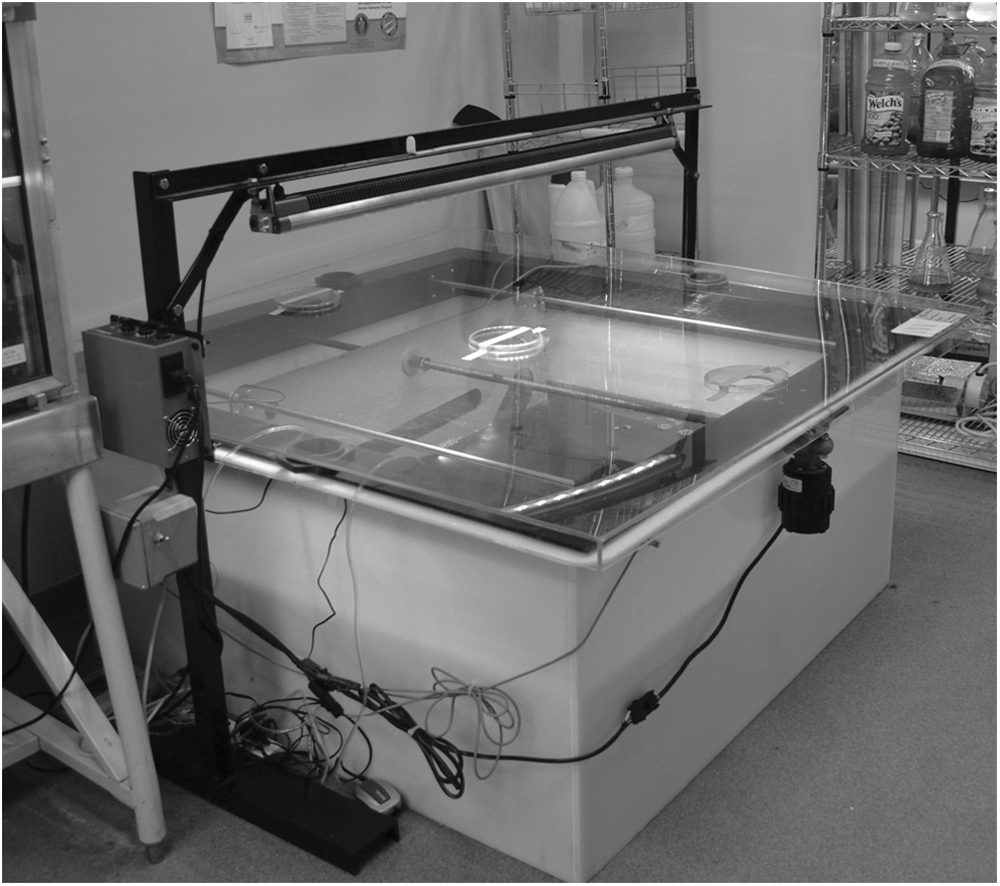
An indoor pond prototype developed by Algae Farm USA is being benchmarked by Lone Star College-Montgomery biotechnology students to determine the feasibility of growing large quantities of algae indoors.
Passionate Students
In our experience, biotechnology students are focused, motivated, and highly capable. Some students at LSC-M have risen above the already rigorous academic requirements that must be met to obtain an Associate's Degree or Advanced Technical Certificate (ATC) in biotechnology. Below are examples of students who have distinguished themselves in the context of undergraduate biotechnology research at LSC-M; they illustrate what can be achieved when a motivated student takes full advantage of the offerings and resources of the program.
• Andrew Mark was LSCBIs first student to complete an on-campus internship. He played a vital role in establishing LSCBI's Project Lab algae biofuels infrastructure and piloted detailed analyses of the initial algal cultures with FIT's loaner Flow Cam. His stellar academic career culminated with his acceptance to medical school.
• Michelle Coleman led a pilot-scale algae cultivation project highlighted by the care and maintenance of a 400-gallon photobioreactor. Michelle's experiences with this project contributed significantly to her subsequent employment at Huntsman Technology Center (Houston, TX) and her assignment to develop an algae-derived feedstock for surfactant production to offset the potential impact of crop-based feedstock on global food supplies.
• Erica Lochman was the first LSCBI intern to do a “split internship” in which she spent approximately half of her required 320 hours engaged in an upstream project involving algae cultivation, harvesting, and dewatering and a company-based “downstream” project at New Energy Fuels (Waller, TX), a local biodiesel refinery, where she was later employed.
• Tim Hall contributed extensive work to the biodiesel project and pioneered microbial fuel cell research in the LSCBI Project Lab, for which he was awarded a scholarship by Fluid Imaging Technologies. In addition, Tim presented a poster at the 2013 American Society for Microbiology Texas Regional meeting and won first prize in the Environmental Microbiology division (Fig. 2).
• Mike Doyle contributed significantly to the sustainability of the LSCBI algae culture collection (Fig. 3) by investigating inexpensive and sustainable methods to use local resources to produce media capable of supporting the cultivation of numerous freshwater algae strains (Fig. 4). Mike completed his research internship and was subsequently hired by Opexa Therapeutics (The Woodlands, TX), a biotechnology company involved in the development of a T cell-based treatment for multiple sclerosis.
• Mary Hubley investigated real-time PCR (RT-PCR)-based assays that amplified housekeeping genes from bacterial species and generated species-specific melt curve profiles. This sophisticated assay can be used as part of a rapid screening process to identify and characterize bacterial ecosystems that underlie electricity production in MFCs. Mary parlayed her strong academic record and high level molecular biology-oriented research experience into admission into the Molecular Genetics Technology program at the M.D. Anderson Cancer Center (Houston, TX).
• High School students who worked as interns as well as our student volunteers deserve a collective mention because they tend to be exceptionally driven, passionate, academically successful, and/or appreciative of such a rare opportunity. Most of these students have already chosen a STEM career for their futures. They decided to take advantage of the available research opportunities to help propel them toward their lofty goals.
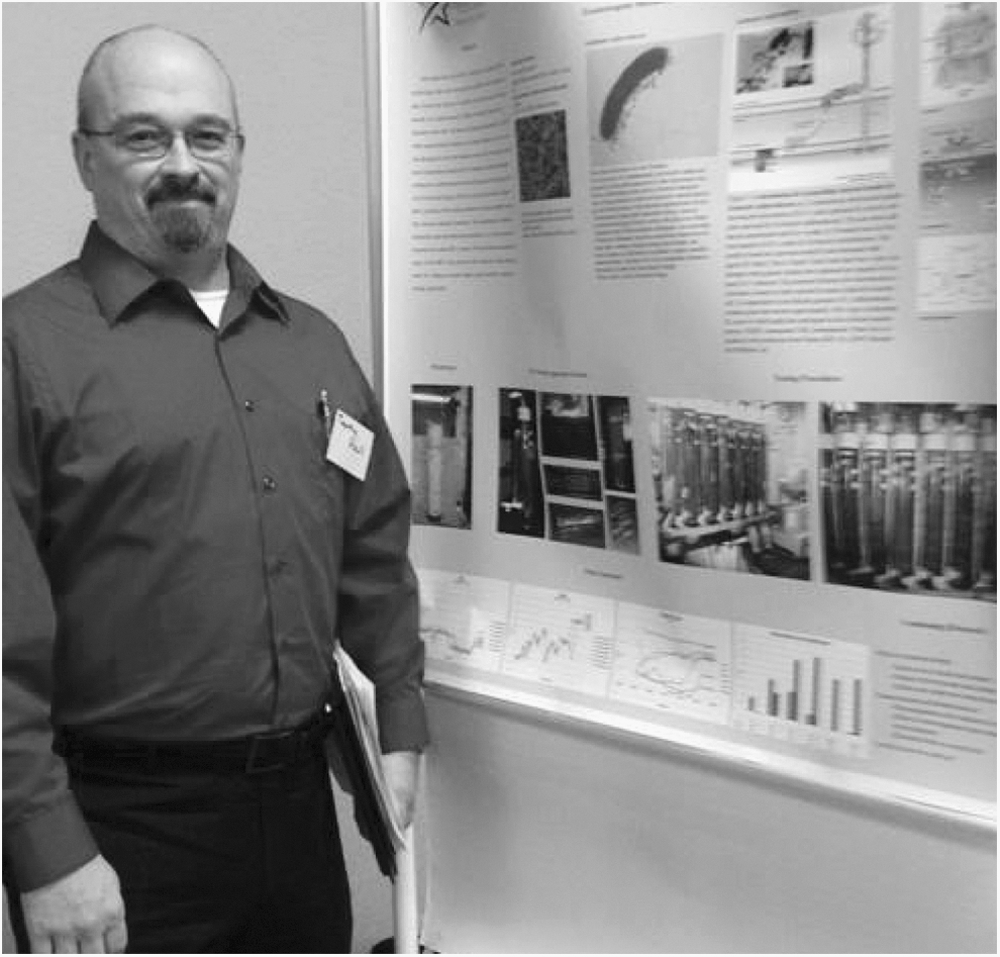
Lone Star College-Montgomery biotechnology student Tim Hall next to his poster describing the microbial fuel cell research he presented at a 2013 Texas Branch of the Association for Microbiology conference. The poster won first prize in the environmental microbiology division.
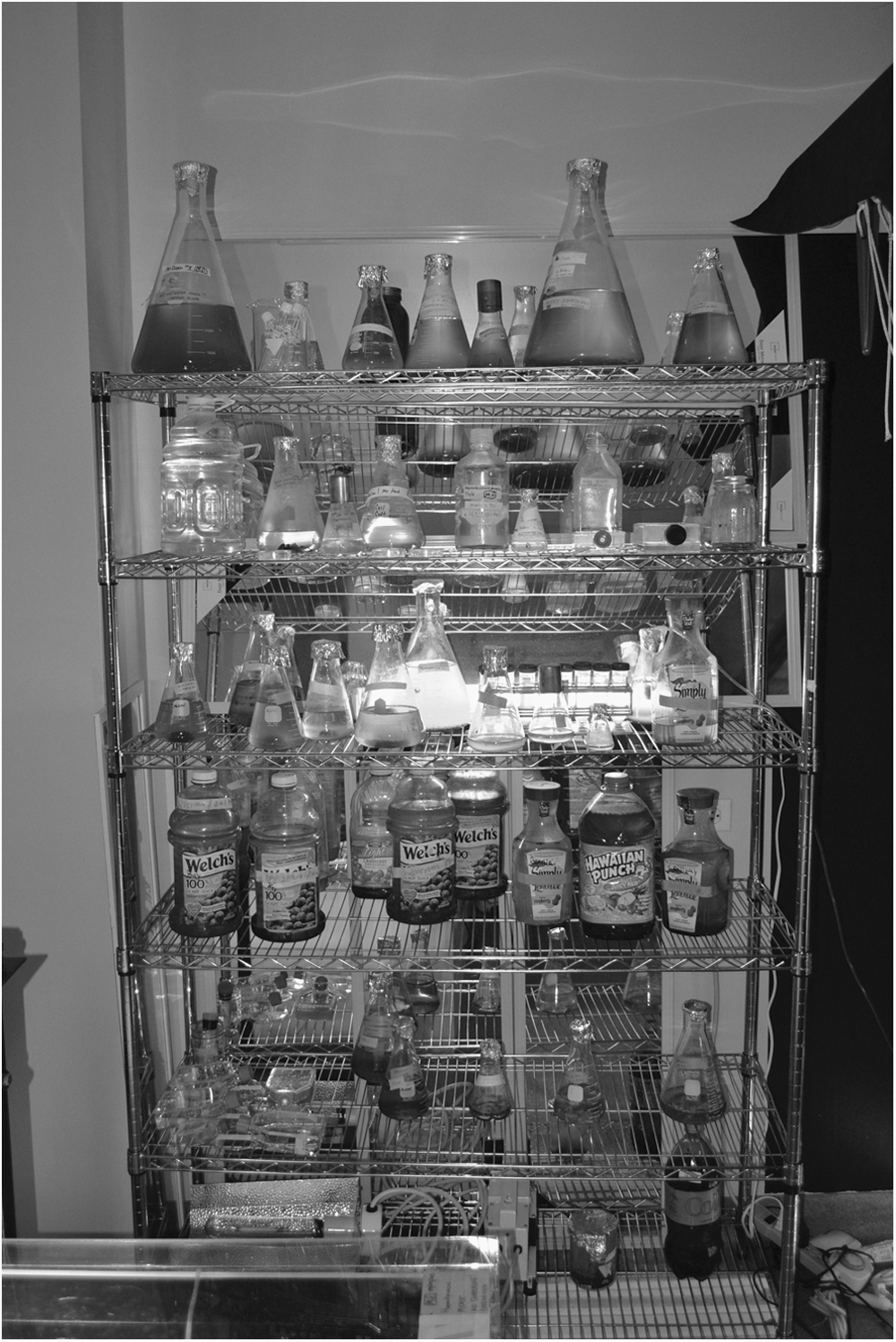
Algal culture collection at Lone Star College-Montgomery includes 45 different strains.

Lone Star-Montgomery student Mike Doyle was instrumental in establishing the algae culture collection used in numerous algal-based research projects.
Faculty and Administrative Support
Significant student research opportunities would not be possible without faculty and staff mentors who dedicate time, energy, and personal resources to provide the expertise, guidance, and support to maximize the engaging educational experience that is so often associated with undergraduate research.
No significant faculty project can succeed without buy-in from the college administration. The LSCBI student research initiatives have been extensive, and the realization of this vision has been due to the unwavering support of many administrators within the Lone Star College System. For example, the Chancellor of the Lone Star College System, Dr. Richard Carpenter, promotes a system-wide policy that protects intellectual property rights for students who make scientific and/or technological discoveries during their research experiences. In addition, Dr. Carpenter supports a highly successful “Chancellor's Faculty Technology Innovation Grant” program. This provided the funding, for example, for a hybrid solar and wind energy project that provides a significant percentage of the power to support the LSCBI Algae Production Center.
The president of LSC-M, Dr. Austin Lane, provides essential campus-level support, including facilitation of the development of multiple Memoranda of Understanding (MOU) that have formalized key partnerships between LSCBI and third party organizations. The Lone Star College Foundation has been instrumental in managing financial and equipment donations to the LSCBI from third party individuals and organizations and has also funded multiple “mini-grants” that have enabled several small scale research or infrastructure improvement projects. Another component of the program's success is the role played by the college relations staff at LSC-M. By promoting research opportunities and related matters to students across the campus and system, high quality students were attracted to the program who might not have otherwise learned about our opportunities.
Lessons Learned
Undergraduate STEM research initiatives are intrinsically rewarding educational experiences for both students and faculty. However, the decision to partake in such an initiative should be carefully considered because of the extensive buy-in that is absolutely required by faculty, staff, administration, and, in some cases, community partners. Significant financial, material, and infrastructure resources are required for long-term initiatives. Convincing all of the necessary individuals that committing such resources to projects that have no inherent guarantee of success can be a daunting task.
Despite all of these obstacles, such initiatives are worth the effort for numerous reasons. Student engagement can reach unprecedented levels, especially if the research project in question has the potential for real-world application and the student gains the sense that he or she is contributing to finding solutions for important problems. Moreover, the critical thinking, high level of commitment, and other features of a college research experience hold tangible benefits for graduates who list such experiences on their resumes or university applications. These benefits are highly valued by potential employers and competitive academic program admission committees.
Finally, the intrinsic rewards experienced by faculty and staff involved in such research projects cannot be understated. The opportunity to work with highly engaged, motivated, and talented students on a regular basis is an experience that can rejuvenate the morale of an employee who might otherwise become overwhelmed by such negative influences as politics, burnout, the tedium of committee work, and other inevitable offshoots of large educational organizations. The positivity that a role as a research mentor for an enthusiastic student has the potential to create make many or most of these negative experiences that may arise during the course of a long career seem insignificant by comparison.