




Abstract

The concept of a biobased economy was a common reality until the discovery of oil and gas reserves a century ago. This is no longer a matter of the past. With the decline in the discovery of these reserves, the necessity to reform our economy is becoming increasingly clear. Recent discoveries of previously inaccessible gas reserves have not fundamentally changed this notion. However, serious concerns have arisen related to the effects of a biobased chemical industry replacing a petroleum-based industry on the one aspect of our economy that has always remained biobased, i.e., the food supply chain. These concerns present a serious challenge to the necessary developments required to attain a fully sustainable biobased economy. Most significantly, a truly sustainable and renewable biobased chemical industry should not compete with our food supply.
The challenge of a Knowledge Based Bio-Economy was the basis of one of the research calls from the European Communion in its 7th Framework Programme for Research and Technological Development (FP7-KBBE). One key aspect of this program (2007–2013) is that projects should be based on European added value: research projects are to be carried out by consortia that include public and private participants from different European countries; and fellowships in FP7 require mobility over national borders. The proposed research challenges should have a complexity that can only be addressed at a European level and involve multiple disciplines. This is exactly what the biobased economy challenge puts forward.
In 2010, a core-team consisting of four European research and technology organizations (RTOs) joined forces to develop a research program to address the Knowledge Based Bio-Economy call for proposals from FP7. The team comprised Fraunhofer Gessellschaft (FhG) of Germany, VTT Technical Research Centre (VTT) of Finland, the Flemish Institute for Technological Research (VITO) in Belgium, and The Netherlands Organisation for Applied Scientific Research (TNO). Its formation led to the BioConSepT proposal (
As confirmation of the successful approach to setting up BioConSepT, the proposal received a positive evaluation after extensive peer review. The subsequent contract negotiations resulted in two of the industrial partners stepping down due to strategic considerations and three new partners joining the consortium based on their interest in the field of research and the design of the collaboration.
BioConSepT consists of a consortium of experienced partners with highly complementary expertise, including five research and technology organizations (RTOs), nine large industrial companies, and 16 small- and medium-sized enterprises (SMEs) from 12 European countries. Table 1 gives an overview of all participants tabulated by type and member state.
BioConSepT Consortium Partners
BioConSepT was established as a €13 million (USD17.8 million) project that aims to demonstrate the technical and economic feasibility of white biotechnology processes that convert second generation biomass into valuable bi-functional platform chemicals (e.g., short- and medium-chain length di-acids) for producing bioplastics. These biobased plastics are 30% less costly and 30% more sustainable than those produced via the corresponding conventional chemical route or first generation process using glucose.
Integration Along the Value Chain
BioConSepT was established in line with the newly developing concept within the chemical industry of emerging partnerships and alliances. In this vision, individual partners focus on their own strengths but benefit from their collaborations along the business chain from the source to the consumer. This situation is clearly a new development and is specific for the chemical industry. In the food industries, most chains are completely owned by a single industry. Table 2 presents a selection of these partnerships and alliances for a few common chemical building blocks. These partnerships include biotechnology start-ups and large industries. BioConSepT aims at demonstrating the feasibility of an integrated chain approach, which is regarded as the basis for the next generation of industrial biotechnology processes. The technological objectives of BioConSepT focus on all individual aspects along the production chain, from plant biomass to pilot plant (Fig. 1 ).
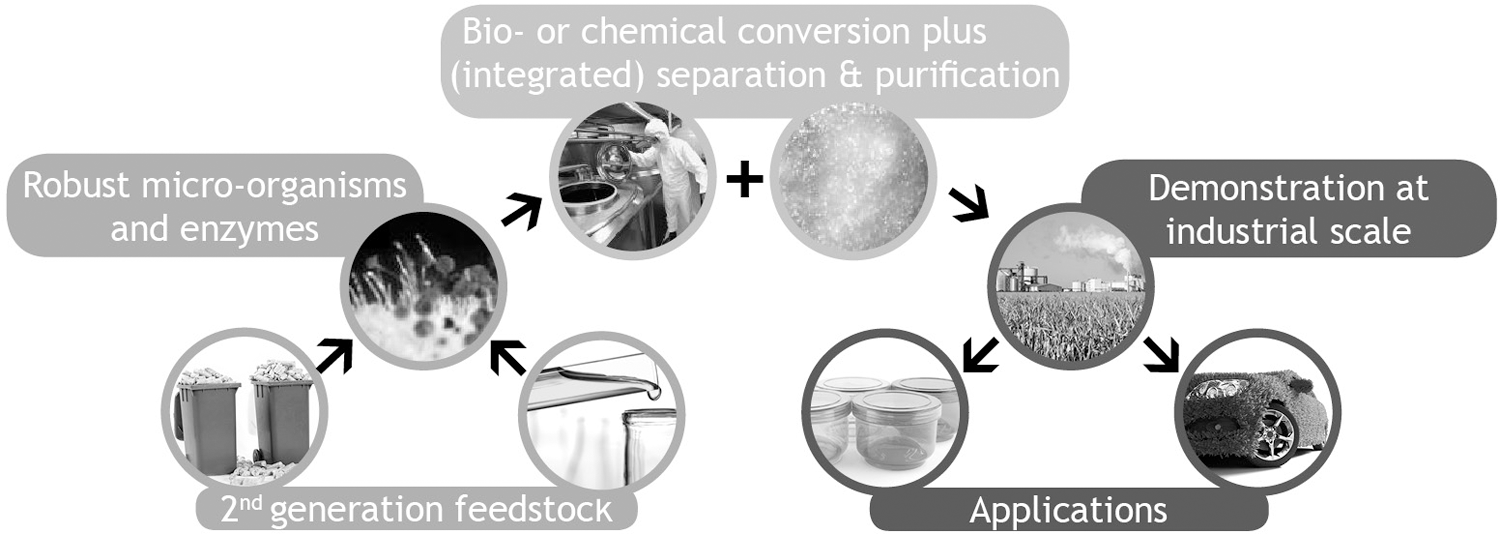
Integration of bioconversion and separation technology for the production and application of platform chemicals from second generation biomass (BioConSepT).
Selection of Industrial Alliances and Partnerships for the Production of Biobased Building Block Chemicals
BioConSepT focuses on four main areas. First is the development of robust enzymes and microorganisms suited for the more dirty second generation feedstock. Secondly, to reduce equipment costs and the number of process steps for the integration of bioconversion and highly selective separation technologies. Another focus area is to facilitate easy integration in existing production chains by deploying combinations of bio- and chemical conversions and by proving the suitability of the produced platform chemicals for biobased polymers, resins, plasticizers, solvents, and surfactants. The fourth goal is to realize the first demonstration of integrated production chains from second generation feedstock to platform chemicals at industrially relevant scale. BioConSepT will bring novel technologies from the laboratory to pilot scale by implementing high-level applied research. The consortium's large industrial parties and SMEs expect new products, processes, services, and customers with a potential value of hundreds of millions of Euros.
One of the main drivers behind the transition towards a sustainable biobased economy from a European perspective is the need to maintain and improve the competitiveness of important European industrial sectors like the chemical industry, the agro-food sector, the paper & pulp industry, and the energy sector by means of innovation. A strong process industry will be a key factor for the retention and creation of jobs in the European Union (EU). Furthermore, the now mandatory obligation to identify more sustainable industrial production processes with significantly lower emissions of greenhouse gases (GHG) such as CO2, less pollution of water and air, and a lower energy and materials consumption drives the biobased transition. Moreover, the necessity to secure a supply of energy and feedstock while becoming less dependent on other, often politically unstable regions, contributes to political incentives to stimulate these developments. For the EU, the biotechnological production of fuels and chemicals from renewable biomass presents a real opportunity to establish a leading position in this area on a global scale.
From Platform Chemicals to Applications
The production chains on which BioConSepT focuses are biobased platform chemicals for bioplastics manufacturing, as shown in Fig. 2. Because of their potential for widespread usage in bulk applications such as biobased plastics (rubbers, polyamides, and polyesters), in which they can replace oil-based chemicals, itaconic acid and succinic acid are expected to experience huge market growth, Others, like α,ω-dicarboxylic acids from natural fatty acids, have similar potential, especially for the production of commercial plastics such as polyesters, polyamides, or polyurethanes. The furane dicarboxylic acid (FDCA) market is currently small due to the products' high price. But it has a huge potential as a replacement for terephthalic acid, which is used for the production of polyethylene terephthalate (PET)-based plastic materials. A prerequisite for the use of these platform chemicals in bulk markets is the ability to be competitive with not only the oil-based but also glucose-based alternatives. For market acceptance of the developed chains/platform chemicals, testing products in various applications is important.

BioConSepT's target molecules.
Structured Along the Production Chain
The research, technology, and development issues that comprise a BioConSepT project are managed in eight work-packages. A demonstration work-package covers piloting of the developed processes at industrially relevant scale. The various work packages are not only tightly interlinked with each other but also, cross-vertically, the two value chains (lignocellulosics and oils & fats) are intertwined. Two types of work-packages form the major activities and generate the key outcome of the project regarding economical and sustainable production processes for important platform chemicals and applications thereof: 1) biocatalyst development and production; and 2) process development with integration of conversion and separation processes towards end-user applications. These research and development work-packages are supported by a work-package dealing with the provision of relevant pretreated biomass.
Biomass Provision and Pretreatment
Two types of biomass are evaluated for a project: second generation lignocellulosic biomass; and non-edible fractions of fats and oils. After characterization and selection, both types of feedstock are pretreated using cost-effective, state-of-the art, and newly developed processes, resulting in sugar and fatty acids “crude,” respectively.
Biocatalyst and Production-Process Development
The next development step in the value chain deals with selection and further development of robust host strains by metabolic engineering to suit industrial processes. Enzymes for use in in vitro conversion processes are another area of development. Fig. 2 depicts the platform chemicals targeted for these processes. These hosts strains enable the development of cost-effective and sustainable processes to convert inexpensive second generation biomass fractions into the desired platform chemicals. Various processing strategies, e.g., batch, fed-batch, continuous processes, simultaneous saccharification and co-fermentation, consolidated bioprocessing, as well as reactor design and control systems are being evaluated.
Integration of Conversion and Separation Processes Towards End-User Applications
Subsequently, microbial (fermentation), enzymatic, and chemical conversion processes are integrated with selected downstream purification processes, such as in situ product recovery (ISPR) approaches, to reduce downstream processing costs and improve the fermentation or (bio)chemical reactions by removing products, inhibitors, etc. Further optimization and testing of the defined technologies (extraction, electrodialysis, adsorption, crystallization, membrane filtration, distillation) will target the integrated purification and other downstream processes essential for relevant end-user applications such as polymers, plasticizers, resins, surfactants, and solvents. Different partner clusters formed around these applications will define the requirements (amounts, purity, etc.) for platform chemicals at bench-scale production for end-user application tests.
Piloting and Scale-Up to Industrial Scale
The next phase of the project, beginning in 2014, will involve the development of a comprehensive overview of the most promising routes and processing steps, as well as the bottlenecks and showstoppers. This will derive from the research and development work done during the first phase of the project, which will serve as the basis for generating Conceptual Process Design (CPD)of the two major chains. The CPD will provide essential information for the Conceptual Engineering Designs (CED) required for the further scale-up of equipment and facilities to the technical dimensions needed for the intended industrial demonstration. The pilot-scale phase will result in the production of two platform chemicals, one from the lignocellulose chain and one from the fats/oils chain. It will yield sufficient material for application tests by end-users. After the piloting phase the CPD and the CED of the two chosen products will be finalized, creating an outlook for industrial-scale production.
Techno-Economical and Sustainability Assessment
The second phase of the project will also include economical and sustainability analyses using well established life cycle analysis (LCA) approaches, integrated into a built-in sustainability, market, and reality check for the whole project.
Playful Understanding of Bioprocesses
A playful, yet serious part of the project deals with a game to understand the biobased economy as an extraordinary dissemination tool to target policy makers, PhD students, and laypersons. The production of biobased chemicals from second generation feedstock, as developed in BioConSepT, is one of the cornerstones of the biobased economy. Dutch programmers from TYGRON are working with other scientists to develop a highly interactive game to transform complex scientific data into close-to-reality simulation tools, which leads the player from the national scale of decision making down to the factory scale, being challenged to make decisions on feedstock selection, profitability, markets, business climates, siting, etc.
Intellectual Property
Consortium members have access to professional guidance in Intellectual Property (IP) procedures and other related matters in training workshops designed to develop a high awareness of these delicate issues. In addition, BioConSepT is developing a patent tool for screening the external IP landscape. The aim is to establish a significant number of IP-protected and thus exploitable results during the project.
Impact and Outlook
BioConSepT aims to improve the methods and processes for chemical and bioconversion of second generation feedstock and the integration of these conversion processes with downstream separation/purification processes. The integration of these processes will lead to cost reductions in downstream processing. Another outcome will be improved yields of the conversion processes.
The social impact of this project derives from the fact that industrial biotechnology is targeted as one of the “key enabling technologies” for Europe. As such, it is expected to have an enormous impact on the creation and preservation of jobs in Europe. The combination of biotechnology and the need for new resources that can be transported in a sustainable way will create a new era of sustainable, intensive agriculture to support the biobased economy. The results expected from BioConSepT, which uses both lignocellulosic material and vegetable oils as feedstock, will support the implementation of these technologies and the achievement of these goals.
The environmental impact of BioConSepT will be a significant reduction of greenhouse gas emissions through the use of renewable feedstock. The less resource-intensive combinations of chemical and biological processes with improved product removal steps will lead to drastically reduced water and energy consumption and much less waste.
Collaborative efforts from BioConSepT are not only contributing to the strategy of the consortium as a whole, but also to the strategies of each individual partner. In addition to BioConSepT, several of the RTOs are also developing their own specific technologies that may feed into a next-generation bio-concept (or BioConSepT). At TNO, the recent discovery of the High Yield Organic Acid biosynthetic Production Pathway (HY-App) is an example of these developments, which may lead to further improvements of the results already obtained from BioConSepT.
Each of the production chains, from feedstock to applications, consists of 4 to 6 steps, and at least 3 or 4 different partners are needed to form a chain. Each of these partners contributes with specific technologies/products in a certain part of the chain. This illustrates the important role that cooperation across the chain has in bringing processes for the production of biobased platform chemicals and end-products from second generation feedstock from the laboratory environment to industrial demonstration and implementation. This area is still in the different stages of development, and we can expect significant breakthroughs in technology as well as in economic feasibility and sustainability.
The partners in BioConSepT are convinced that intense cooperation will lead to a faster, better, and more sustainable transition. This underlying belief in the power of cooperation is what brought together the RTOs, which are members of the European Association of Research Technology Organisations (EARTO), to apply this same concept under the new European framework program Horizon 2020. These EARTO partners have teamed up not only for the project proposal phase, but are also contributing to the program definition phase of Horizon 2020 that is now underway in the EU offices.