




Abstract
Precipitation of sparsely soluble calcium oxalate causes scaling problems in the pulp and paper industry. A potential solution is to degrade the oxalic acid using oxalate-degrading enzymes. Four novel fungal oxalate decarboxylases were evaluated in experiments with 16 pH-adjusted bleaching filtrates collected from mills producing mechanical pulp or kraft pulp. The enzymes were also tested in five of the filtrates from mechanical pulping at authentic pH and elevated temperature (55°C). The enzyme that performed best in the screening was selected for a small-scale experiment performed in a mill producing mechanical pulp. The enzyme degraded 70% of the oxalic acid in the fresh filtrate after one hour, without pH adjustment and at the prevailing process temperature (65°C). The new enzyme performed considerably better than the well-studied oxalate decarboxylase from Aspergillus niger, which only degraded 4% of the oxalic acid under the same conditions.
Introduction
Modern oxidative bleaching methods combined with efforts to recirculate process water have led to increasing problems with oxalate scaling. This occurs when sufficiently high concentrations of oxalic acid and calcium ions accumulate in the process water and the pH is raised such that precipitation of calcium oxalate is favored. 1 Calcium oxalate precipitation may occur in the pH range 2–8. 2 The oxalic acid comes from the wood, but is also formed from wood components during oxidative bleaching. 3,4 Precipitation of calcium oxalate is known to cause other types of problems as well, including formation of kidney stones in humans and beer stones in the brewing industry. 5,6
Oxalate-degrading enzymes such as oxalate oxidase and oxalate decarboxylase (ODC), may be used to degrade oxalic acid in process water from the pulp and paper industry. 7 However, if enzymatic control of oxalic acid is to become a reality the enzymes must be able to withstand the harsh conditions that are often prevalent in industrial pulping processes. Challenges include varying pH values, high temperatures, and compounds in the process water that inhibit the catalytic action of enzymes. 8 –10 The aim of the present investigation was to find new oxalate-degrading enzymes that perform well under authentic process conditions. Although the option to engineer enzymes to obtain desired properties existed, we chose to search for novel fungal ODCs and assay their function in authentic filtrates and at high temperatures.
A series of four novel ODCs were studied with respect to their ability to degrade oxalic acid in a collection of 16 bleaching filtrates from both mechanical pulping and kraft pulping. The results were compared to previous attempts to utilize ODCs for degradation of oxalic acid in filtrates from pulp mills, with particular attention paid to results obtained using the well-studied ODC from the filamentous fungus Aspergillus niger. 8 The enzyme that performed best in the screening experiment was selected for additional testing in a mechanical pulp mill. This subsequent experiment was designed to test the feasibility of the approach under realistic industrial conditions, albeit at small scale.
Materials and Methods
Filtrates for Laboratory Experiments
Sixteen different filtrates from mills producing mechanical and chemical pulp were used for evaluation of the enzymes. Eight of them (filtrates A–H) originated from mechanical pulping of softwood; three (filtrates I–K) from mechanical pulping of aspen; and five (filtrates L–P) from kraft pulping. The filtrates had previously been chemically characterized and frozen for storage. 8
Quantification of Oxalic Acid
High-performance anion-exchange chromatography with conductivity detection (ICS-2000 and ICS-3000; Dionex, Sunnyvale, CA) was used to determine the concentrations of oxalic acid in the filtrates. Separation was performed with either an IonPac AS 15 (4×250 mm) analytical column with an IonPac AG15 (4×50 mm) guard column, or with an AS18 (4×250 mm) analytical column with an AG18 (4×50 mm) guard column. All columns were from Dionex. The mobile phase consisted of a 2–5 mM solution of sodium hydroxide (Sigma-Aldrich, Steinheim, Germany), and the flow rate was 1 mL/min. Before analysis, the samples were filtered through a 0.22-μm nylon syringe-driven filter unit (Millipore, Billerica, MA). The definition of soluble oxalic acid and the method for determining the total oxalic acid concentration can be found in Sjöde et al. 8
Degradation of Oxalic Acid in Ph-Adjusted Filtrates
The ability of four novel OCDs (B, C, E, and F; Novozymes, Bagsvaerd, Denmark) to degrade oxalic acid in the filtrates from the pulp and paper industry was investigated and compared to results obtained in a previous study in which another novel ODC from Novozymes (ODC A) and the ODC from A. niger (AnODC; R-Biopharm, Darmstadt, Germany) were studied. 8 The pH of the filtrates was adjusted to 5.6 in accordance with the procedure described by Sjöde et al. 8 The reaction consisted of 150 μL enzyme solution and 2,850 μL filtrate. The reaction temperature was 45°C. Samples were taken immediately after addition of enzyme and again after two hours. The reactions were terminated by adding 100 mM 3-(N-morpholino)propanesulfonic acid (pH 7.5), followed by boiling for 12 min in capped vials.
The enzyme dosage used for degradation of oxalic acid in filtrates corresponded to the amount of enzyme that degraded 46 μM of oxalic acid per min in a control reaction consisting of 1 mM oxalic acid and 20 mM 2-(N-morpholino)ethanesulfonic acid (pH 5.6). In the control reaction, samples were taken directly after addition of enzyme and again after 15 min incubation at 45°C. The control reactions were terminated as described above.
Degradation of Oxalic Acid Under Mill-Like Conditions
Five filtrates were selected to study the degradation of oxalic acid by ODCs B, C, E, and F and AnODC under mill-like conditions. The selected filtrates—B (pH 7.9), F (pH 7.4), H (pH 7.8), I (pH 7.6), and P (pH 6.8)—were studied without any pH adjustment and at elevated temperature (55°C). The reaction mixture consisted of 150 μL enzyme solution and 2,850 μL filtrate. Samples were taken directly after addition of enzyme and after 2 h of reaction. The reactions were terminated as described above.
Pulp Mill Experiment
Two enzymes, ODC F and AnODC, were selected for pulp mill experiments. ODC F was chosen since it performed well in the experiments with pH-adjusted filtrates, and AnODC was chosen for comparison, since it was commercially available and had been studied in several previous investigations. 8,11
A filtrate was chosen from a Swedish mill producing bleached mechanical pulp from softwood. The peroxide stage was known to generate oxalic acid at concentrations high enough to cause problems related to oxalate deposition. Enzymatic treatment was performed at 65°C (the temperature was controlled with a water bath), which was also the authentic temperature of the fresh filtrate. The reaction mixture consisted of 150 μL enzyme and 2,850 μL filtrate. No adjustments to reaction parameters such as pH were carried out before the enzymatic treatments. Samples were taken after 0, 15, and 60 min of incubation. The reactions were terminated as described in the sections above. Filtrate without enzyme was incubated at 65°C (water bath) as a control, and samples for oxalic acid analysis were taken after 0 and 60 min. All reactions were performed in duplicate. The concentration of oxalic acid was analyzed as described previously.
Results and Discussion
Oxalate-degrading enzymes are utilized for analysis of oxalic acid and are potentially interesting for industrial applications, provided that they work under conditions encountered in industrial processes. 12,13 Figure 1 shows the activity of the four novel fungal-derived ODCs–B, C, E, and F (this work)–as well as ODC A, as determined in Sjöde et al., compared to AnODC. 8 The performance of the ODCs is compared to that of AnODC, the activity of which has been set to 100%. All enzymes showed activity in all of the filtrates except for ODC E, which had no activity in filtrate I (Fig. 1A). ODC F performed best in five out of eight filtrates from mechanical pulping of softwood (filtrates A–H in Fig. 1A). ODC A performed best in two out of three filtrates from mechanical pulping of aspen (filtrates I–K in Fig. 1A), while ODC F achieved the highest value in one. In the filtrates from kraft pulping (Fig. 1B), ODCs E and F had the highest activity in two filtrates each. Of the 16 filtrates studied, ODC F had the highest activity in eight, ODCs B and E in three each, and ODC A in two filtrates.
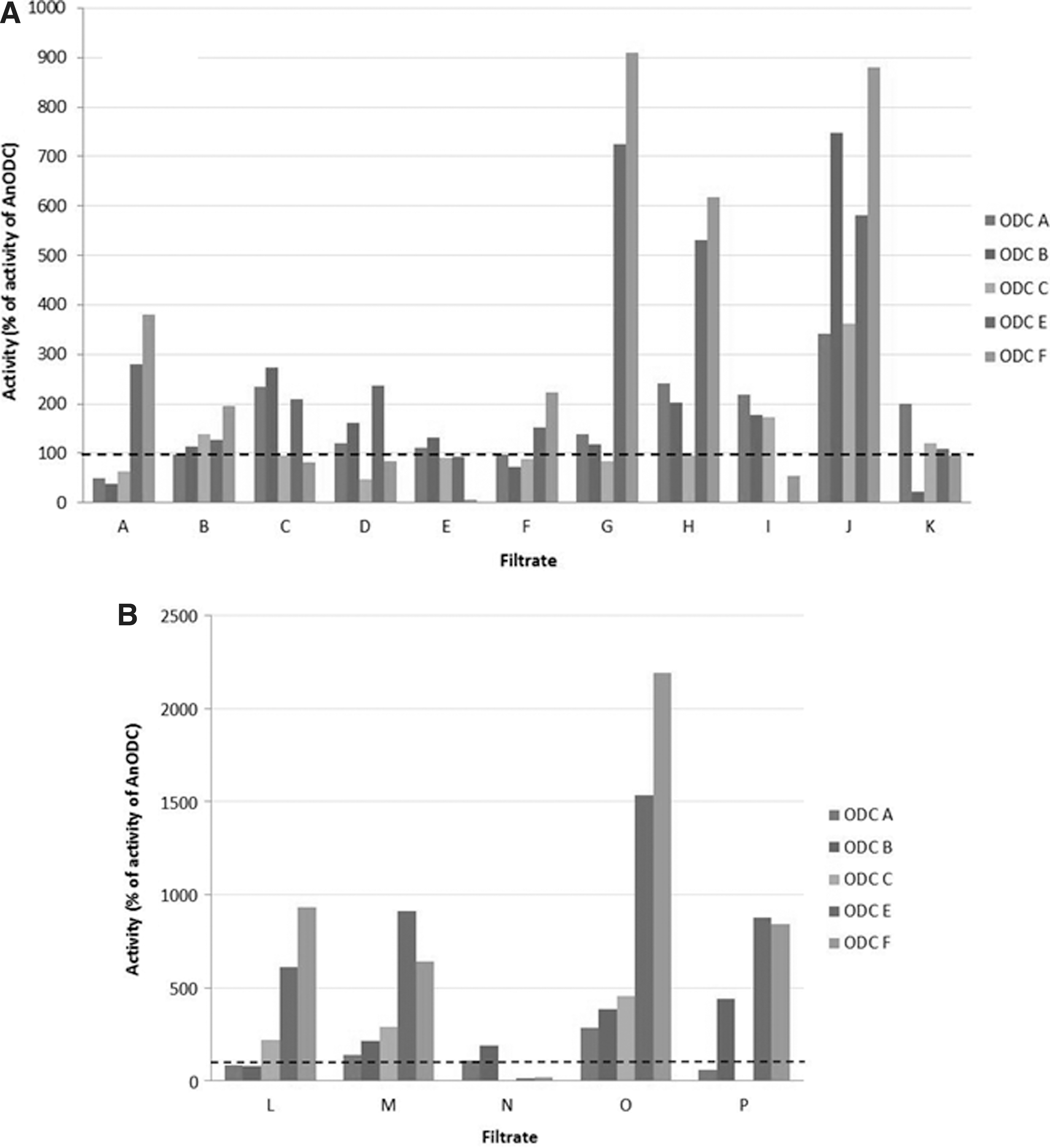
Degradation of oxalic acid in pH-adjusted filtrates from mechanical pulping (filtrates A–K)
In the experiment performed under mill-like conditions (Fig. 2), ODC F had the highest activity in three out of five filtrates (F, H and P); while ODC B had the highest activity in just one, filtrate I. ODC C had the highest activity in filtrate B, although ODCs A–F all underperformed compared to AnODC in that filtrate. On the basis of the results shown in Figs. 1 and 2, ODC F was chosen for a small-scale experiment in a pulp mill to test whether this novel enzyme would perform better than the well-studied AnODC under realistic industrial conditions (Fig. 3). Fresh filtrate was collected for the experiment, and a sample was also taken for analysis of the properties of the filtrate. The pH of the filtrate (at room temperature) was 6.1. The concentration of soluble oxalic acid was 30 mg/L, and the total oxalic acid concentration was 34 mg/L. ODC F degraded 20% of the oxalic acid in the filtrate after 15 min and 70% after 60 min (Fig. 3). AnODC had significantly lower activity and was only able to degrade 4% of the oxalic acid after 15 min (Fig. 3). No further degradation was observed after 60 min, which indicates that the enzyme had lost all of its activity during the first 15 min. AnODC has been reported to lose 50% of its activity after incubation at 65°C for 10 min in acetate buffer at pH 5.6, and the relatively poor stability of AnODC at this temperature is probably the main reason for the low activity. 14 The acidity of the filtrate (pH 6.1) was close to optimal for AnODC (pH 5.5). 7 The concentration of residual hydrogen peroxide in the filtrate was determined directly at the mill to be 3.9 mM. In a previous study, concentrations of up to 77 mM of hydrogen peroxide were measured in the studied filtrates. 8 However, in that data set no correlation between a high hydrogen peroxide concentration and a low enzymatic activity of AnODC could be identified using multivariate data analysis. The concentration of 3.9 mM hydrogen peroxide is, therefore, not expected to have a negative effect on the activity of AnODC.
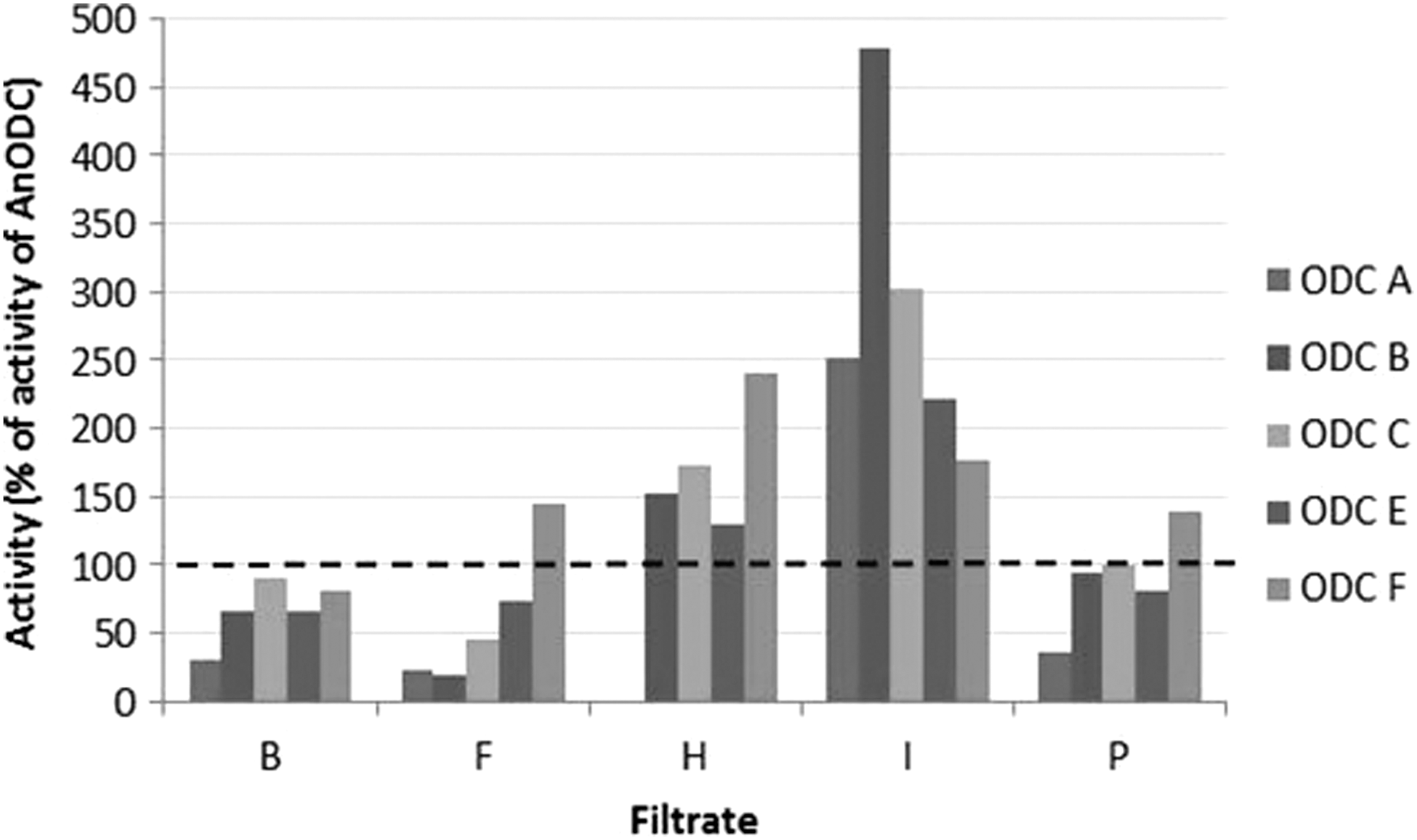
Degradation of oxalic acid under mill-like conditions. The performance of the oxalate decarboxylases are compared to that of AnODC (from A. niger), the activity of which has been set to 100% (dashed line). (ODC A–F are represented by the bars read from left to right for each filtrate.)
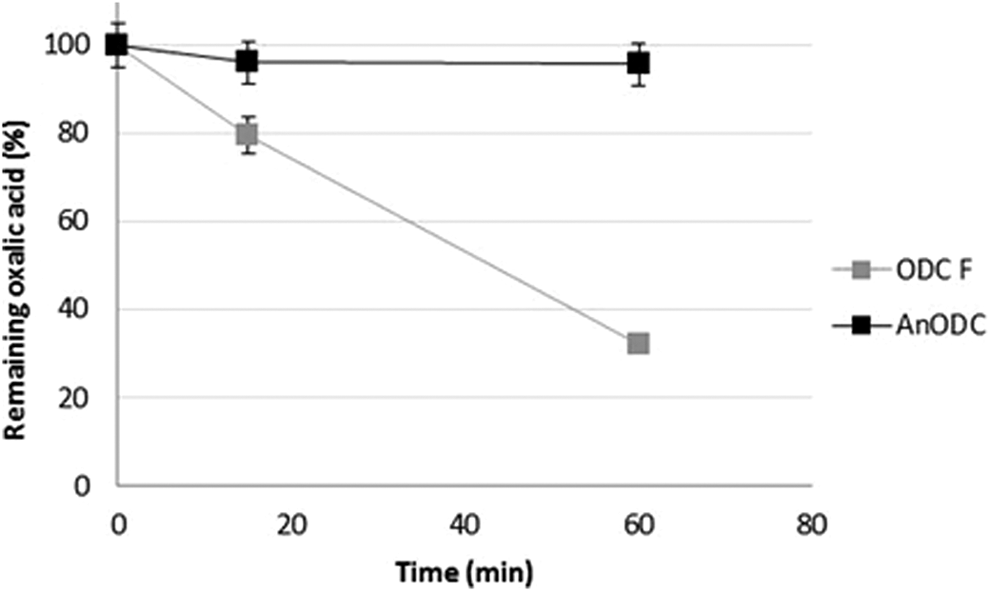
Enzymatic degradation of oxalic acid by ODC F (Novozymes) and AnODC (from A. niger) in an experiment carried out in a mechanical pulp mill. The error bars show the standard deviation.
Without equipment modifications, it is possible that an oxalate-degrading step could be introduced into the mill's process by adding a 15-min enzymatic treatment. With minor modifications, that duration could realistically be extended to 60 min.
The oxalic acid degradation rate of ODC F in the pulp mill experiment was lower compared to the degradation rate in all the pH-adjusted filtrates except one, filtrate E, in which ODC F showed low activity compared to the other enzymes. When comparing the enzymatic degradation as percent degraded oxalic acid after 60 min, ODC F degraded 100% of the oxalic acid in the pH-adjusted filtrates G and H; 87% in filtrate A; 63% in filtrate B; over 50% in filtrates F and J; over 30% in filtrates L and P; and over 20% in filtrates M and O. In the rest of the pH-adjusted filtrates, ODC F degraded less than 20% of the oxalic acid. These results show that ODC F performed better in the pulp mill experiment compared to some of the pH-adjusted filtrates.
The results presented in this study demonstrate that ODCs with superior properties can be identified from natural sources. This study also indicates that enzymatic degradation of oxalic acid directly in a pulp mill is a technically realistic scenario. The feasibility of this approach under industrial conditions was demonstrated with at least with one of the novel ODCs studied at small scale.
Footnotes
Acknowledgments
This work was supported by grants from the Knowledge Foundation (KK-stiftelsen; Stockholm, Sweden) and the Bio4Energy (Umeå, Sweden) research initiative. (
Author Disclosure Statement
Pierre Cassland is an employee of Novozymes A/S.