




Abstract
Energy production and development have impacts on non-energy sector concerns including food security, water security, and sustainable land-use. Biofuel pathways differ in the tradeoffs they present within this “energy-water-food nexus” (EWFN). In this study, we focus on algal systems in the context of these interrelated challenges. We present areas of key consideration within the EWFN for large-scale algal system planning and commercialization, consider key resource inputs and outputs in the context of traditional biofuels compared with algal biofuels, provide examples of current global practices and EWFN impacts pertaining to liquid biofuels, and discuss potential opportunities and tradeoffs in applications of algal systems to EWFN challenges. The work described here could be used as a guide for future analysis that could quantitatively evaluate algal system feasibility in terms of economic viability, spatially and temporally explicit environmental impacts and production levels, and cross-sectorial impacts.
Introduction
Sufficient and secure supplies of energy, water, and food are required to support the basic functioning of society and help achieve sustainable social, economic, and environmental development. 1,2 Biofuels have been identified as a renewable fuel category that can contribute to these aspirations, and government policies worldwide are providing incentives to stimulate production. 3 –6 Biofuels created from food crops (first generation) are relatively inefficient at converting sunlight to biomass (∼0.2%), which is a key factor that determines the amount of water and land required for biofuel production. Currently, land and water requirements of such conventional fuel crops can cause disruptions to ecosystems, animal habitats, and natural waterways. 7 –11 In some cases, fuel crops displace traditional food crops. 12 –14 Second generation biofuels are derived from non-edible lignocellulosic biomass such as wood chips, agricultural and forest residues, and municipal solid waste, thereby alleviating some of the food-vs.-fuel challenges. 15 An assessment of the benefits and drawbacks of various biofuels pathways can help guide decisions regarding allocation of limited resources and alleviate unwanted environmental, social, and economic impacts. Framing the assessment in terms of a set of interconnected systems, through the lens of an energy-water-food nexus (EWFN), can allow for more robust decision-making about options for meeting sustainability. In this paper, we discuss algal systems, a third generation biofuel production method that is more efficient than terrestrial plants in converting sunlight to biomass (up to 6%) and could be considered, as a part of solutions to challenges in the EWFN. 15 –24
Because the variety of algal strains is large, algal systems can be adaptable to a diverse range of geographies, economies, and climates. 17 Algal systems may provide a multitude of products, co-products, and remediation opportunities including algae oil (potentially suitable for transportation fuel), algal biomass (potentially for electricity generation), human nutrition, animal feed, cosmetics, wastewater treatment and fertilizer. 25 –27
There has been considerable progress in understanding the physical resource input requirements and product outputs of specific algal strains, their cultivation methods and potential environmental impacts. Some studies build on such findings to consider resource requirements and algae productivity over regional and national scales. 15 –38 However, large-scale commercialization of algal systems is limited today to food and nutraceutical production; commercial-scale fuel production would require further development. R&D planning and decision-making regarding the integration of algal biofuel production in energy systems can be done with consideration of local, regional, and national energy needs, tradeoffs with other sectors of the economy, competition for natural resources, economic viability, and potential constraints posed by a changing climate. 33,37 Consideration of the EWFN during commercial scale deployment can help identify opportunities, avoid some mistakes, and articulate a realistic understanding of the true potential of algal systems.
Materials and Methods
Here, we present elements of a framework (Fig. 1) under which algal systems can be designed while considering impacts and tradeoffs across the EWFN. In so doing, we address the current landscape of biofuels within the EWFN and highlight key aspects of the framework that relate to policy and societal goals specifically relating to the EWFN; algal system optimization and planning to match EWFN policy and societal goals; and potential impacts and tradeoffs within the EWFN. We recognize that there are geospatial and geopolitical variances in energy, water, and food policies and goals, historical resource management, environmental regulations, economic conditions, impacts across other nexus issues and natural resources. An understanding of EWFN tradeoffs, can guide quantitative integrated assessments that analyze potential pathways of algal systems by identifying key challenges, risks (social, environmental, and economic) and tradeoffs that are important to consider for sustainable energy planning. The approach can be applied at local, regional, or global scales to supply scientific information that can be used to identify and evaluate actionable policies.

Some key elements of a framework for algal-system design and planning in the energy-water-food nexus.
Results
Planning for Algal Systems
Here we describe the key components and concepts of designing and planning algal systems within the EWFN (Fig. 1), beginning with policy goals related to the energy, water, and food sectors. We then discuss the design of algal systems and output options aimed at meeting policy targets, followed by a description of the potential tradeoffs and impacts pertaining to energy, water, and food security.
Policy goals as drivers of algal system design
Incentives for algae production, when used, are typically under the umbrella of general biofuel programs and renewable energy polices worldwide. 5,39 –41 Countries that set liquid biofuel production targets typically do so to lower carbon emissions and decrease oil imports. Food security and biofuel policies contrast across differing geospatial and geopolitical circumstances. Developed nations convert a high percentage of food crops (40% of corn in the US, 60% of rapeseed in Europe) to produce most of the world's liquid biofuels (US, 45.4%; EU, 16.4%); developing countries (including China, India, Malaysia, and Nigeria) convert a low percentage of food crops to energy. A study by the World Bank links biofuel production and food security, highlighting that conversion of food crops to biofuels adds another barrier to achieving global food security. 10,42 –44 It should be noted that adequate global food supply does not guarantee food security, because food distribution systems and other support systems may not be adequate to place food in the hands of the hungry. 45,46
Strategic water policies and management can help ensure sufficient water supplies for food and energy production, especially in water stressed regions such as Sub-Saharan Africa and India. 46 Water security is not bounded geographically and economically. The “Report to the President on Agricultural Preparedness & the Agriculture Research Enterprise” (2012) has also prioritized the need for efficient water use and the reconciliation of bioenergy demands with food security. 47 Water policies, management, and investments promote efficient water use, but policies addressing nexus challenges and the implementation of sustainable resource use and thinking in day-to-day practices are still in their infancy.
Water policies and management decisions can be informed by social, environmental, and economic needs at both local and global scales. Algal system investments, design, and planning can be based on data and scientific literature on social, geospatial, and geophysical conditions including land and freshwater availability, current water use methods, and food demand (Table 1). 7,11,48 –52 Accounting for EWFN challenges and investment risks in this way can maximize the effectiveness of algal systems.
A Sample List of Potential Indicators and Variables Matched with Corresponding Energy-Water-Food Nexus Topics They Affect, as Well as Some Secondary Nexus Topics that Could be Considered (Cells Marked with xxx). These Indicators Could be Used To Drive Algal System Design, Especially in Regions with Low Levels of Natural Resources (i.e., Fresh Water) and to Help Identify Potential Tradeoffs within the EWFN
Algal systems design
The inputs and outputs for algal systems can be optimized to help meet an array of EWFN challenges (Fig. 2). Inputs and outputs vary depending on the algal strain, cultivation process, and targeted product(s). Algal cultivation has a multitude of water input options, light and carbon dioxide requirements, nutrient balancing demands, and energy inputs (e.g., culture mixing, water management, and biomass processing), all of which impact overall productivity. Figure 3 shows an example of the main inputs, processes, and outputs for an algal system. 17 Location and costs of resource inputs (i.e., water, carbon, and land) can guide algal strain selection and cultivation methods and affect production costs and return on investment. Other considerations that affect the success of algae production are climate conditions (i.e., air and/or water temperature, solar radiation, precipitation, and other weather events), and external factors such as the potential for algal crop failure due to pests, predators, and pathogens.

General examples of regions experiencing EWFN challenges, policy targets aimed at reducing EWFN stresses, algal system solution options that could help achieve policy targets, and their potential positive and negative tradeoffs.
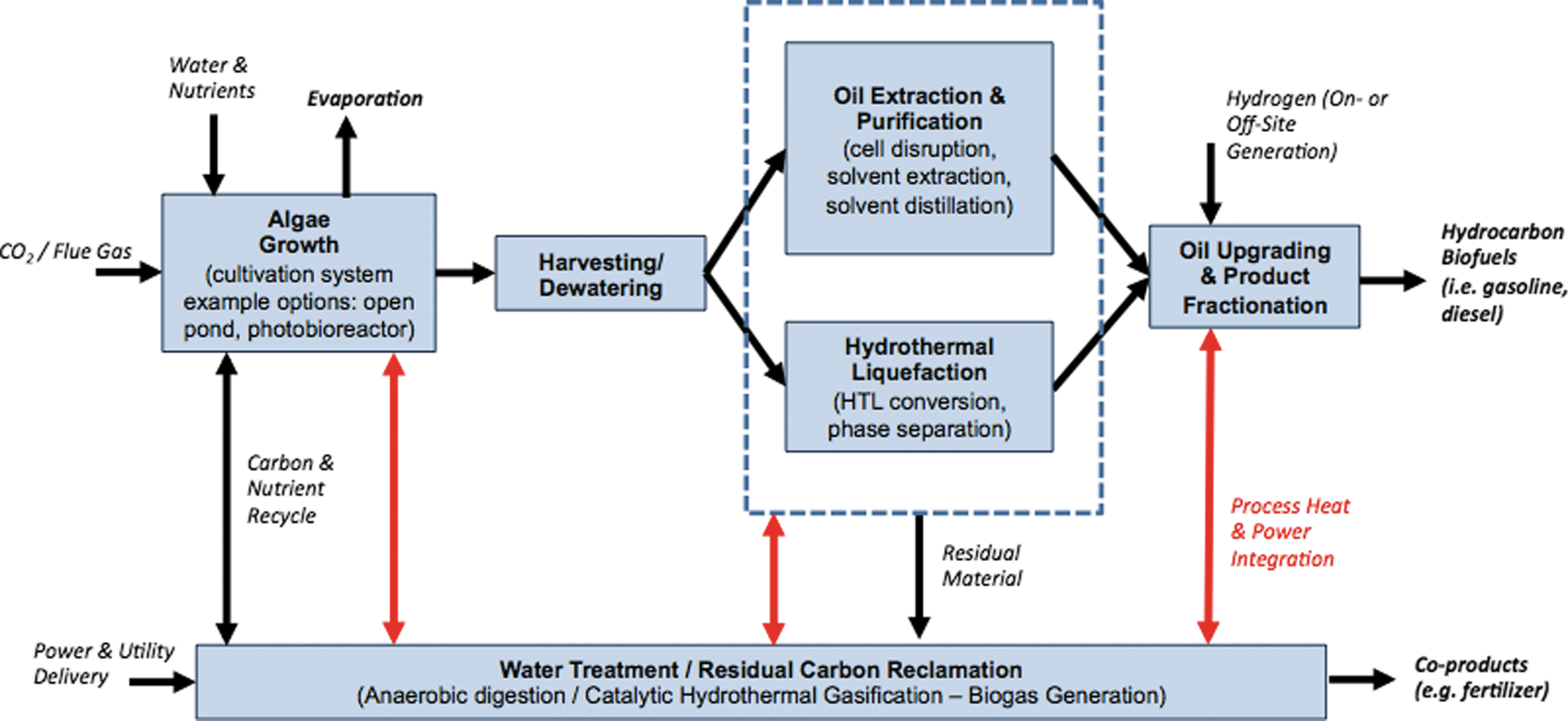
Process diagram of algal system inputs, processes, and outputs as an example of an integrated process facility targeting biofuels and co-utilization of residues.
Algal systems can recycle carbon and increase the ratio of renewable to fossil fuel on a commodity scale. Case studies have shown that some algal strains (i.e., Spirulina sp. and Chlorella sp.) can reduce carbon dioxide concentration in flue gases by 50% (for 6% v/v) while absorbing harmful pollutants that threaten human health (sulfur and nitrogen oxides). 53 –56 Renewable diesel (hydrocarbons) and biodiesel (fatty acid methyl esters) produced from algae, both of which are based on the fatty acid content of algal lipids, have several potential advantages over petroleum: they are renewable and can be produced locally; are relatively non-toxic; contain lower levels of harmful gases when combusted; and can reduce carbon emissions by being blended with or replacing petroleum diesel. 17,55 –57 Furthermore, algal biomass can be fed into anaerobic digesters and the resulting biogas can be combusted to provide heat and power, while left-over residue from the process may be used as fertilizer or recycled as nutrients for continued cultivation of algae (Fig. 3). 25,26
Certain algal strains can use agricultural, industrial, and municipal wastewater, brackish water, or saline water as a growth medium rather than freshwater, thereby lowering water stress. 58 These algae absorb nutrients and may remove heavy metals, chemicals, and pathogens that exist in urban wastewater. The success of algae growth, wastewater treatment, and economic feasibility can vary depending on the co-location of wastewater treatment plants, algal cultivation facilities, the target market for biomass sales, and the quality of the input wastewater, which may need to be treated prior to use if the level of compounds (e.g., heavy metals) is too high, which would add to production costs.
Co-products of algal strains may support the agriculture and food industries by providing fertilizer and feed for animals, and may improve aquaculture practices. 59 –61 Some algal strains (i.e., Chlorella, Scenedesmus, and Spirulina) have been shown to improve weight, growth, and health for fish and animals when used as feed or as feed additives. 17,20 Algae are used in aquaculture practices as a growth medium and as feed, and have also been observed to improve the immune system of fish. 20,26,60,61 However, several attributes of algae feed are required to be evaluated (i.e., toxicity levels and other long-term health implications) before commercialization to ensure animal and fish safety. 26 Spolaore et al. report that some algal strains can be harmful and affect the physiology of animals if fed over long periods in high concentration (i.e., coloring of chicken skin and egg yolk). 26 Meanwhile, whole algal biomass and nutraceuticals derived from algae are used for human nutrition and in the health food industry, but algal strain options for human consumption are limited due to food safety regulations. 17
Algal system resource requirements, net energy output, and economic feasibility depend on the type of cultivation system employed, such as open pond versus photobioreactor (Fig. 3). Economic feasibility is an important consideration in the evaluation of impacts on the EWFN, as ultimate deployment, impacts, and benefits will largely be determined by market viability. Open pond systems (most often represented as raceway ponds, though other designs have been proposed) are the most common commercial systems producing almost all of the 15,000 tons of global algal biomass. 37,62 They are comprised of a shallow pond (20–50 cm deep), which can be a natural or (more commonly) an artificial water body that is exposed to the atmosphere. Carbon inputs are absorbed from the atmosphere, but additional carbon may be required beyond that and requires continuous mixing to sustain algae growth. 16 Photobioreactors, which could also be deployed on a commercial scale, are closed systems for cultivation and vary in design type (i.e., tubular, flat-plate, and column). These closed systems allow for more efficient algae growth and are less vulnerable to contamination when compared with open pond systems. Closed systems typically require higher capital costs, more energy inputs, and are more expensive overall. 62
R&D advances in other aspects of algal biofuel production (i.e., increased growth rates and lower cost harvesting steps) and value-added co-products can further decrease production costs and the selling price of algal biofuels. 63 For instance, new approaches to algal biomass processing such as fractionation to the major components of lipids, carbohydrates, and proteins with conversion of multiple constituents to biofuels could lower the price by an estimated 40%. 64 The algal protein derived from this approach could be used for animal feed or even human food, if issues with quality and pricing are considered. Alternative strategies are also being pursued to convert additional biomass constituents beyond lipids to bio-oils (i.e., whole biomass conversion), such as hydrothermal liquefaction (HTL) (Fig. 3). 65 –67 HTL is reportedly more efficient at converting algal biomass to oil, but overall processability and fuel quality differences between HTL and lipid upgrading remain open questions given the lack of detailed public data.
Reported benefits of algal systems typically relate to a specific algal strain, but no single strain exists today that can collectively achieve all benefits (i.e., upper bound theoretical estimates of remediation, biofuel production volumes, and co-products). For instance, placing an algal system in the optimal location for algae growth (i.e., high solar radiation) may not allow co-location with wastewater treatment systems or yield co-products that can be used for aquaculture purposes. The complexity of such tradeoffs across the many algal strain and cultivation options means that algal systems are too complex to be evaluated as a single input/output technology. 37 Holistic assessments can determine feasibility and consider tradeoffs across algal system design options and performance standards throughout various individual components of the EWFN. Early test production sites could provide data and learning-curve cost reduction insights that could inform paths for expansion to less ideal sites.
Planning for energy security
Liquid biofuels are produced worldwide. Developing countries account for 29% of global liquid biofuels production, including Brazil, which produces 4,290 million gallons of oil equivalent (mgoe), as well as China (540 mgoe), Indonesia (380 mgoe), and Thailand (315 mgoe). The US (8,705 mgoe) and the EU (3,145 mgoe) account for 62% of global production. 43 The EU produces most of the world's biodiesel, with rapeseed as the main feedstock, and is targeting a minimum 10% renewable fuel share in transportation by 2020 to lower carbon emissions (current share is ∼5%). 39 Meanwhile, the US is targeting 36 billion gallons of renewable fuel to be blended annually by 2022, with today's production level at an estimated 8.7 billion gallons (primarily ethanol from corn). 41,43 Previous EU biofuel targets—(5.75% share of transportation by 2010 (Biofuels Directive, 2003))—have not been met in time and a report on biofuel markets (Algae 2020, 2009) outlined that it is unlikely that the EU and the US will be able to meet their respective biofuel targets due to the low production rates from current biomass feedstocks. 39,63,68 In addition, the EU and the US have outlined sustainability criteria related to land use and carbon emissions that would allow biofuel products to contribute toward biofuel production targets. 69 Algal systems may be viable parts of larger biofuels and sustainability programs if they can achieve economically viable production rates. Increased productivity is required to lower costs and may offer commercial-scale opportunities for algal systems if they can produce 600–10,500 gal oil equivalent per acre annually (goe/acre-y) (low-to-high productivity) estimated from lab studies compared to 20, 70, and 105 gal from corn, soybean, and rapeseed, respectively. 28,70 Some studies report even higher theoretical estimates for productivity (up to 38,000 goe/acre-y). 71 However, current production benchmarks are estimated at approximately 1,000 goe/acre-y (with an upper limit of 6,500 goe/acre-y) at a production cost of approximately $18/gal, with a need to reach approximately $3/GGE to be profitable and competitive with gasoline, meaning that large-scale commercialization is yet to be economically viable. 36,69,72 The US Department of Energy has set a target for annual algal oil production at 2,500 and 5,200 goe/acre-y by 2018 and 2022, respectively, far below maximum theoretical estimates. 69,72 Advances in algal system production methods such as use of improved, faster growing strains, enhanced cultivation systems, cost-efficient harvesting methods, and novel co-product schemes could help lower production costs.
More robust assessments of the feasibility and potential magnitude of production of algal systems include evaluation of the cost of production including energy and water inputs, blending potential, ease of distribution, and other factors. For instance, Wigmosta et al. showed that algal biofuels could supply 57 billion gallons of oil, surpassing the Energy Independence and Security Act of 2007 (EISA 2007) 2022 target for advanced biofuel production volumes. 18,41 However, this production volume would require up to 120 trillion gal of water per year, including evaporative losses of 80 trillion gal of water per year. 17 Using water for algal biofuels could lower water availability for agriculture, electricity generation, and other uses. However, Wigmosta et al. do not explore the potential to use saline or brackish water with blowdown and subsequent brine disposal to reduce the amount of freshwater needed. 19 In addition, the land type chosen for algal systems in that study was classified as non-agricultural, non-competitive, and non-sensitive, but the authors estimate that producing 57 billion gal of oil would require 5.5% of conterminous US land. Such water and land requirements highlight the tradeoffs that could be required to attain large-scale algae oil production volumes. Associated tradeoffs including land disturbance also shape the net remediation potential and economic feasibility.
Flue gas carbon recycling by algal systems can lower the carbon intensity of electricity generation if treated as a supplemental secondary system to electricity generation (Fig. 3). Carbon recycling does not eliminate carbon emissions, and net carbon emission assessments are required to determine realistic estimates of any carbon mitigation. Such industrial synergies can lower the cost of material supplies to algal systems, and a higher rate of carbon availability (compared to atmospheric levels) could allow for otherwise unattainable algae growth rates. 37 Power plants could use algal systems to help achieve compliance with carbon regulations. The success of this strategy would depend on land and water availability at the power plant location, algae growth rates for biofuel production, and economic feasibility.
Synergistic opportunities for algal systems are dependent on several location-related conditions, including land availability of nearby industrial facilities, and distance to animal feed manufacturers, livestock producers, and refineries. Any regional and even local transport (by truck or train) needs for moving input resources or algae products can add to production costs, making algae products less competitive. Algal systems may be able to alleviate some of these challenges by taking into account local energy needs in a similar approach to micro grid design and planning to provide local communities with algal biofuels, food production, or water remediation. 73 By considering a broad set of tradeoffs and societal needs, algal system planning can be performed in a holistic way that could support sustainable energy production.
Planning for water security
Dedicated terrestrial biofuel crops withdraw and consume water for farming and refining processes 7,10,74 Several studies have quantified life-cycle water use by biofuel feedstocks (including algae), with some showing that certain algal strains produce more energy per gallon of water input compared to rapeseed, jatropha (irrigated), and sugarcane (non-irrigated), and similar ratios to corn-based ethanol. 7,33,75,76 Yet, some algal strains are reported to have higher water use rates compared to major biodiesel and ethanol feedstocks (i.e., soybeans and corn). 23,33 The reported life-cycle range of algae freshwater use can vary depending on the algal strain, cultivation method, and location, as well as the type of analysis executed in reported estimates and observations (i.e., assessing blue versus green water use). Algal cultivation also requires water, which can, at least in part, consist of saline, brackish, or wastewater, and evaporative losses will depend on the climatic conditions of the cultivation site. For instance, evaporation in large open pond systems may be higher for algal systems deployed in arid regions.
Water management for algal systems can greatly influence their success in terms of cost and net energy produced. 23,35 Murphy and Allen show that for typical open pond systems (and a subset of algal species) the energy return on investment (EROI), which is the ratio of energy produced to energy consumed by a system, is estimated at 0.14 (a calculated EROI greater than 1 indicates net positive energy production). 23,35,77 The use of wastewater, in place of saline, brackish, or freshwater, can lower energy costs associated with water delivery and provide a co-product in remediated water that can, in turn, lower energy input and costs for wastewater treatment facilities. The higher rate of nutrient application can also provide heightened algae growth rates, thereby further increasing the EROI and reducing production costs, assuming low energy nutrient inputs such as wastewater or effluent from anaerobic digesters, and assuming that the resulting biomass is satisfactory for its purpose. 58 Beal et al. show that by integrating algal systems with wastewater treatment, the EROI can reach an estimated 0.42 for algal biofuel production. 35 The wastewater treatment process can also benefit from the synergy. Park et al. show that the capital costs of an advanced open pond algal system (with a shallow, high-rate open raceway pond) that treats wastewater is less than half of typical wastewater treatment plants, and operational costs are 20% lower. 78 Brackish or saline water can also be used to avoid costs associated with freshwater use, but pumping of water between ponds and transporting saline water to algal sites are energy intensive practices, and in some cases 50% of energy inputs can be saved if freshwater is used. 23 The specific differences in pumping costs and energy inputs associated with water transport are highly site-dependent and calculating the costs and benefits needs to be done on a site-by-site basis.
The thermoelectric sector is responsible for 10% of total withdrawals of global freshwater supplies, mainly for its cooling process, to supply the majority (75%) of global electricity 43 The cooling process alters the conditions of natural water resources through evaporation and thermal pollution of rivers, which can harm aquatic wildlife and limit water available for efficient power plant operations downstream. 11,79 –81 In response, environmental regulations in the US (Clean Water Act 1972) and Europe (European Fish Directive, Water Framework Directive) have set limits on water intake volumes and river temperature increases that result from power plant thermal loads. 82,83 In recent summers, warm river temperatures have triggered regulatory temperature limit thresholds, forcing some power plants to shut down or curb electricity generation, sometimes resulting in blackouts and costing consumers in the US tens of millions of dollars. 80,84,85 A potential partial solution to thermal pollution constraints on electricity generation is co-locating biogas plants driven by anaerobic digesters with power plants that require cooling, especially those that adhere to thermal pollution regulation. In this case, the thermal load from the power plant could theoretically be run through an algal anaerobic digester biogas plant to maintain operating temperatures (30–40°C) and be cooled during the heat exchange to reach a temperature suitable for discharge back into rivers. 21,86 These anaerobic digester units could be supplied by algae or algal biomass residue in a fully integrated fashion and could potentially yield several associated benefits: increased on-site electricity production; decreased probability of power plant electricity generation constraints due to temperature limit regulation in the summer; reduced thermal pollution impacts on aquatic wildlife and downstream power plants; lower carbon emissions at the site per million kilowatt hours generated; and co-product benefits to algal processing facilities through the generation of biogas heat and power, as well as nutrient recovery, recycling back to cultivation, and nitrogen for land application. Similar co-location benefits may also be garnered through the algal cultivation operation itself, namely via the maintenance of cultivation temperatures over fluctuating seasonal conditions; maintaining optimal algae growth conditions under such settings can be challenging, though, as the power plant thermal load temperature range can also fluctuate depending on ambient temperatures and electricity demand. As such, seasonal considerations for operations and productivity are required, and life-cycle analyses point to the advantages of facility shutdown in winter months when algal productivity will be lowest. 22 Nonetheless, economic incentives for year-round operation remain in the amortization of capital equipment (the main contributor to overall production costs) and difficulty in maintaining a partial-year labor force.
Planning for food security
Developing nations grow a large share of the world's staple crops such as rice (60%) and wheat (40%) and hold 75% of the world's irrigated land. 87 China, India, and Sub-Saharan Africa are regions with high agricultural demand and are projected to account for 30% of global gross domestic product (GDP) and 42% of global water demand by 2030. 88 Investments in infrastructure and efficient agricultural practices may be able to help achieve sustainable growth. The US and China have increased maize yields per hectare by 400% in recent decades mainly due to improved irrigation practices and water efficiency, and, in contrast, production efficiencies in Sub-Saharan Africa have remained steady. 89 However, investments are not always successful and demand management of resources, and policies affecting the efficiency of agricultural practices may also shape resource use across the EWFN. 45,90 The process of irrigation requires energy and could result in groundwater depletion, which, in turn, leads to greater energy demands for pumping water that is deeper and deeper. 87 While algal systems may not be able to lower direct water use for irrigation purposes, they may be able to help support more efficient water use in agricultural practices. For instance, algal systems may be able to treat agricultural wastewater thereby potentially lowering water pollution associated with chemical fertilizers and allowing for recycling of water for other purposes, which may lower demand for freshwater (e.g., if used for power plant cooling) or ground water pumping. Other potential contributions to the food sector by algal systems include providing co-products that can be used for human nutrition, animal feed, and aquaculture and fertilizer.
Algal biomass (i.e., Nostoc, Spirulina, and Aphanizomenon) has been a source for human nutrition for millennia (e.g., in Central and South America), and co-production of food and energy products from algae at commercial scales may be possible. 91 The increased use of algal biomass for human nutrition could potentially ease stresses on traditional food production. Algae are unlikely to replace current agricultural crops, but could complement them. Today, algae is a food supplement in the US, India, Israel, and Australia and is a major source of protein (Spirulina) in some African countries. 15,17
Algal biomass used in anaerobic digesters can be converted to fertilizer for use in agriculture and remediation of waterways. 92 This potential benefit could help ease some of the environmental stresses caused by the production and use of chemical fertilizers, which require mining of nutrients (e.g., phosphorus). 93 At the same time, algae growth requires nutrients that may need to be supplied by chemical fertilizers. 94 However, algae may be able to derive nutrients from wastewater and nutrient recycle from anaerobic digesters or other processing options, lowering the need for artificial nutrient inputs. 92
Planning for climate change
Several studies have outlined the potential impacts of climate change on the EWFN, which could exacerbate constraints on energy and food production. 13,14,95 –98 . The changing climate is projected to elevate global river temperatures and lower water availability for power plant cooling. Vulnerability studies have shown this could constrain electricity generation in Europe and the US. 81,98 In addition, droughts worldwide have already resulted in lower crop yields and higher food prices. A changing climate is projected to intensify such extreme events causing further constraints on the agriculture sector and crop growth for both biofuel and food production. 99 –101
Algal systems might be able to alleviate some of these stresses, but are also affected by changes in climate. For instance, algal production facilities that rely on open ponds as a cultivation system may suffer increased evaporation rates and potential water input shortages. In addition, wastewater treatment plant capacity can be strained during flood events leaving some water untreated. Algae growth that utilizes wastewater can alleviate some damages, but may also overflow during periods of high precipitation and thus increase release of untreated wastewater.
Conclusions
We present here the importance of considering tradeoffs across the EWFN in large-scale planning of algal systems. While there are many challenges in making large-scale algal systems commercially viable, algal biofuels have the potential to increase renewable energy capacity while perhaps reducing some impacts on the environment. Because the ideal design of algal systems is location specific, it is difficult to build scenarios of global (or even national) production of multi-billion gallon algal biofuels based on a single production system or product target. Regional evaluations of potential algal system performance that take into account site specific details and local EWFN concerns could yield more helpful results. The tradeoff analyses across EWFN can be used to inform policy targets by considering local, regional, and international perspectives that account for land and water availability, and integrate cross-sectoral planning to avoid shifting stress and competition for natural resources.
Future analyses of algal systems can be conducted within the EFWN context and include methodologies that account for factors including the following: the topology and temporal aspect of river networks and subsurface reservoirs to estimate water availability and water use impacts; contemporary and future land use; climate conditions and potential climate change impacts; biofuel and algal system production models that account for physical (climate and water), regulatory, and economic conditions; population growth; and EWFN tradeoffs including food and oil prices. It may be beneficial to centralize the set of algal biofuel studies that discuss input requirements and product outputs according to algal strain selection, cultivation method, and location. The wide range of results in the literature (i.e., water requirements and algae production rates) could leave aspects of feasibility studies vulnerable to criticism as studies employ different analysis approaches (i.e., life-cycle water use studies), or may be lacking in some details (i.e., excluding labor costs or cost of transport of goods). The details of different algal system requirements and impacts could support more robust analysis that incorporates key metrics, including life-cycle natural resource requirements, within the context of the EWFN. Such assessments could provide valuable information for energy and environmental planners and decision-makers.
Footnotes
Acknowledgments
This work was supported by the US Department of Energy, Bioenergy Technology Office (BETO) under contract number DE-AC36-08-GO28308 to the National Renewable Energy Laboratory (NREL). NREL is a national laboratory of the US Department of Energy, Office of Energy Efficiency and Renewable Energy, operated by the Alliance for Sustainable Energy, LLC.
Author Disclosure Statement
No competing financial interests exist.