




Abstract
To provide the renewable energy industry in New Jersey with current and comprehensive information on biomass feedstocks, conversion technology yields and efficiencies, and bioenergy generation estimates, the New Jersey Agricultural Experiment Station at Rutgers University performed an assessment of biomass energy potential for the state in 2007. In 2014, an update and expansion of the 2007 Assessment of Bioenergy Potential in New Jersey was conducted. The study includes a detailed database of New Jersey's sustainable biomass and energy potential, containing data on more than 40 feedstocks and 7 bioenergy generation technologies. It also includes a unique bioenergy calculator for estimating potential biopower or biofuel yields by technology, feedstock, and county; a comprehensive evaluation of the bioenergy potential in the state; and greenhouse gas reduction scenarios. The research indicates that New Jersey produces approximately 7.4 million dry tons (MDT) of biomass annually, of which an estimated 4.32 MDT (∼58%) are practically recoverable and could ultimately be available to produce energy in the form of power or transportation fuels. This biomass could deliver up to 5.2 million megawatt hours of power (∼7% of NJ's annual electricity consumption) or 250 million gallons of gasoline equivalent (∼4.4% of NJ's annual transportation fuel consumption) if the appropriate technologies and infrastructure were in place.
Introduction
Increasing demand for energy and the link between fossil fuel combustion and climate change have created a need for lower-carbon alternatives to existing fossil fuel resources. Displacing fossil-based fuels and products with lower-carbon, sustainable, biomass-based fuels and products may not only reduce harmful emissions, but can also increase the potential for the success of an emerging biorefinery industry that can contribute to a low-carbon economy. Low-carbon energy sources and reliable conversion technologies are critical to achieve true sustainability and resiliency in providing for today's energy needs, while conserving limited resources for future generations.
Not all bioenergy/bioproduct options are actually lower in carbon than comparable fossil-based energy products. Thus, a critical element when considering bioenergy alternatives is to evaluate the environmental impact of all relevant energy options and pathways and assess the outcomes. Of primary importance is that the production of biomass used for bioenergy (power, heat, and transportation fuels) and bioproducts manufacturing should meet existing air, water, and soil quality standards. In addition, a field-to-wheels or cradle-to-grave greenhouse gas (GHG)-based life cycle analysis (LCA) should be conducted to assess whether the carbon footprint of the proposed bioenergy resource and/or bioproduct is lower than the carbon footprint associated with the fossil-based energy or products that would be displaced. Finally, biomass production should follow sustainable agricultural practices that include consideration of biodiversity, native species, wildlife and their habitats, natural resource protection and potential for invasive crop spread, soil erosion, and land conversion. Considering all of these factors will provide a basis for making a well-informed decision on bioenergy/bioproduct options that meet low-carbon and reduced environmental impact goals.
To achieve effective biomass-to-energy and bioproducts pathways, the clean energy industry also needs access to information that can reduce startup risks, including the following: strategies and information for securing local feedstocks; efficient conversion technologies that have been tested and verified; and policies to stimulate market demand for low carbon biofuels and bioproducts. The United States Department of Energy has stated that future growth of the US bioenergy industry will depend on the cost, quality, and quantity of biomass available to biorefineries. 1 The potential environmental benefits of low-carbon energy technologies must also be proven to ensure that the emerging pathways are not only economically viable, but also environmentally sustainable in mitigating climate change.
A secure and reliable feedstock supply is one of the most important components of the biomass-to-energy supply chain (Fig. 1). 1 Thus, the assessment of locally available, sustainable biomass resources is critical. The key to using sustainable biomass resources in a beneficial way is to focus on the right resources, and to use them at an appropriate scale. 2 For instance, in New Jersey, the development of advanced liquid transportation fuels from sustainable biomass has been hampered by many barriers, including the lack of availability of biomass feedstocks, high feedstock costs, inadequate project financing, and a lack of mature technologies to convert biomass efficiently into fuels.

Biomass to energy supply chain. 1
The New Jersey Agricultural Experiment Station (NJAES, New Brunswick, NJ) conducted the first ever assessment of bioenergy potential for the state of New Jersey in 2007 in an effort to identify and reduce some of the barriers to growth in the bioenergy sector. 3 The findings of this study were used to inform the biomass energy component of the 2011 New Jersey Energy Master Plan. 4 In 2014, this study was updated to reflect improvements in technology efficiencies, as well as to update biomass information and trends. The updated study entitled, Assessment of Biomass Energy Potential in New Jersey 2.0, is comprised of a comprehensive biomass feedstock assessment, including characteristics, quantity and location by county, a unique interactive bioenergy calculator, an updated conversion technology assessment, statewide mapping of waste/biomass resources and bioenergy potential, estimated potential GHG emission reductions based on various scenarios, and policy recommendations for moving New Jersey and the region into the forefront of bioenergy innovation and utilization. 5 This paper provides a summary of the 2014 study approach and findings.
New Jersey Energy Facts
Power Supply, Costs, and Demand
Currently, fuel sources for electricity production in New Jersey are dominated by nuclear energy (50.1%) and natural gas (43.1%), with minimal utilization of renewables (3.3%), coal (2.3%), and oil (1.2%) (Fig. 2). 6 Photovoltaics are New Jersey's primary renewable fuel source for power generation. In terms of power costs, New Jersey has one of the highest energy costs in the United States. The state's electricity prices were the ninth highest in the nation as of April 2014, far exceeding the national averages in residential, commercial, and industrial energy consumption costs by 27.7%, 25.5%, and 63.6%, respectively. 7 Though New Jersey households consume less electricity per year than the national average, they still pay more for electricity on average than both US and Mid-Atlantic households (Fig. 3). 8
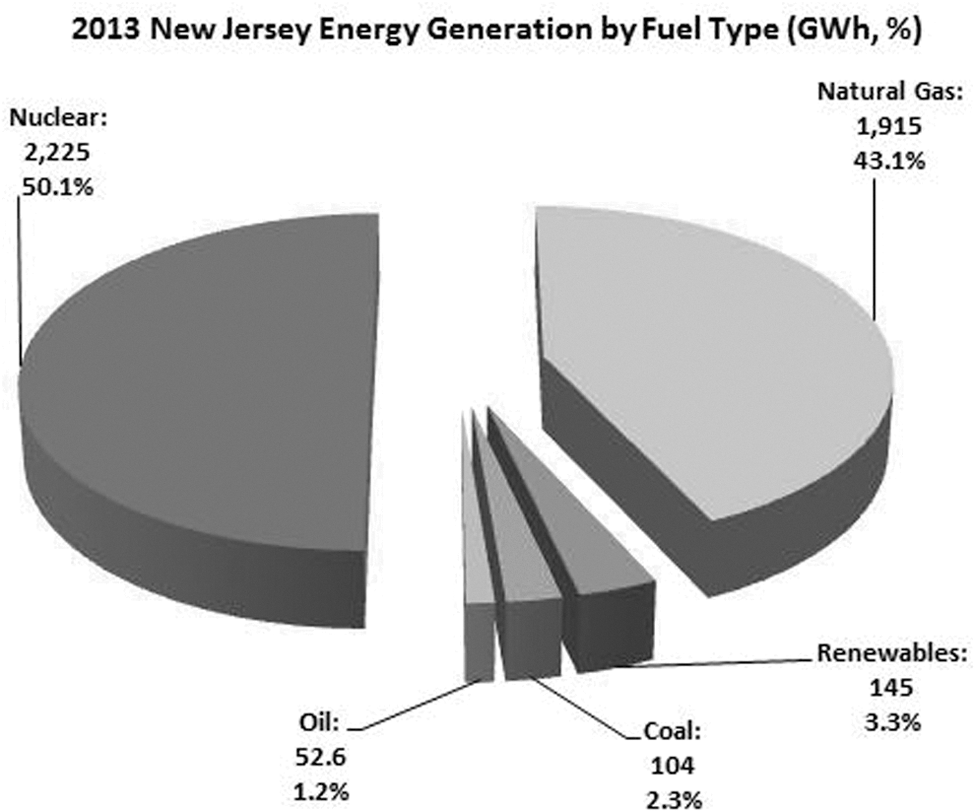
New Jersey power-generation fuel sources. 6
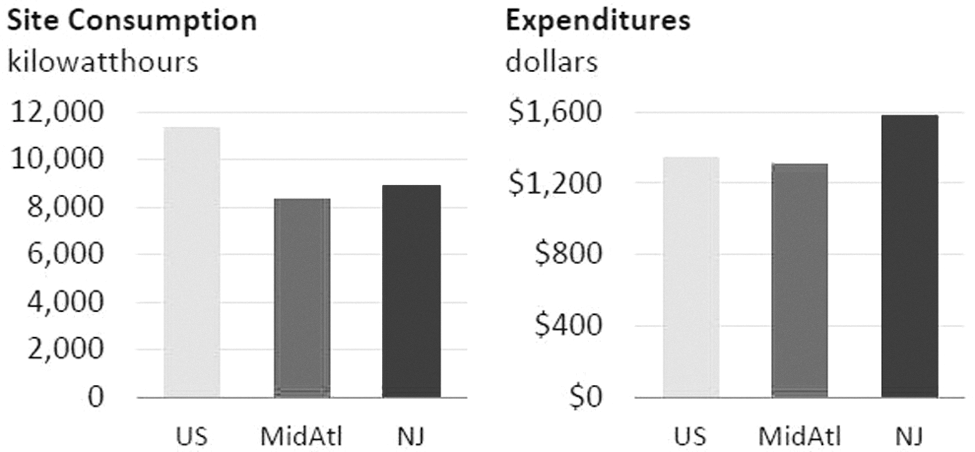
Average household electricity consumption. 8
In addition to high costs for electricity, the in-state fuel supply for power in New Jersey will be impacted when the nation's oldest nuclear reactor, Oyster Creek Generating Station, is decommissioned in 2019. 9 Oyster Creek has a 645-megawatt (MW) generation capacity and provides power to approximately 600,000 homes. Low-carbon power generation and biomass-based combined heat and power could be potential candidates for filling this gap. Additionally, New Jersey's Renewable Portfolio Standard requires that 22.5% of electricity sold in the state will come from renewable energy sources by 2021. 10 The State Energy Master Plan has identified biomass and waste-to-energy as one of the energy-generation resource options. 4
Transportation Fuel Demand
New Jersey has the nation's largest statewide public mass transportation system, providing more than 895,000 weekday trips on 240 bus routes, 3 light rail lines, and 12 commuter rail lines. 4 About 10% of New Jersey's workforce use mass transit to get to and from work—the highest statewide rate in the nation. 4 Despite these mass transit achievements, New Jersey still relies heavily on gasoline and diesel for transportation. 6 The transportation sector uses the most energy in New Jersey (Fig. 4), where the average commute time has been among the longest in the US. 4,11 Passenger vehicles continue to be dominated by gasoline fuel. New Jersey uses about 3.3% of the total energy used for transportation in the US. 4
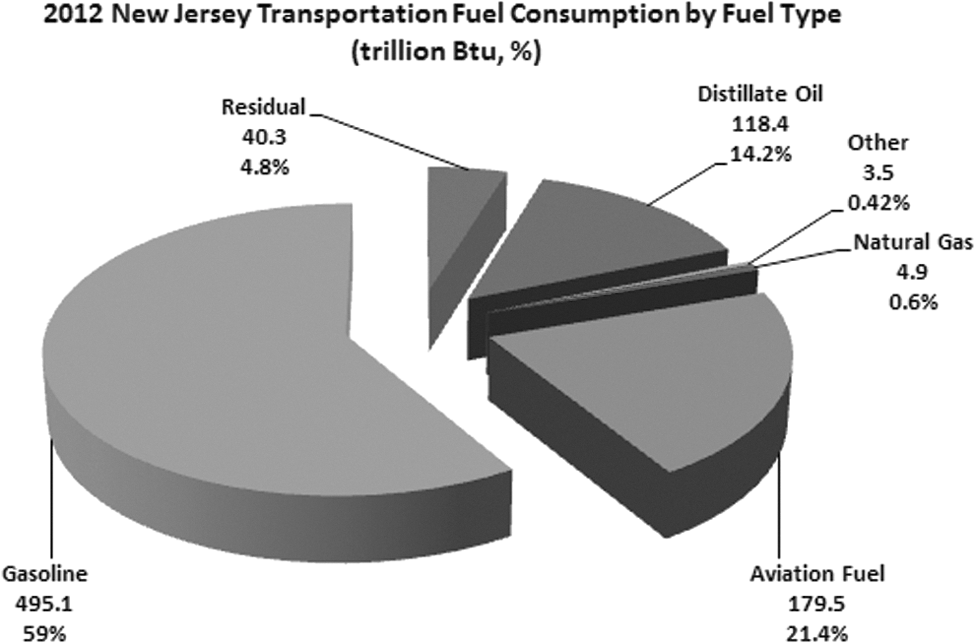
New Jersey transportation fuel facts. 11
New Jersey's 2011 State Energy Master Plan recommended supporting the development of innovative energy technologies, which includes decreasing reliance on gasoline and diesel fuel as the primary transportation fuels. 4 The urgency of this need was made clear when New Jersey experienced serious energy-related disruptions during Super Storm Sandy in 2012. This experience emphasized the importance for the state to diversify its transportation fuel resources and reduce its reliance on petroleum-based fuels.
In recognition of the need for New Jersey to explore and pursue alternative sources of power and fuel, the New Jersey Bioenergy Assessment 2.0 evaluated the supply of sustainable biomass resources, including waste biomass resources, and the degree to which they could support the state's efforts for low-carbon electricity, clean fuels development, and GHG emissions reductions.
Biomass Assessment
Feedstock Categorization
Biomass is a broad definition for biologically derived renewable materials that can be used to produce heat, electric power, transportation fuels, and biobased intermediaries, as well as biobased products and chemicals. Sustainable biomass, however, can be more narrowly defined and does not include biomass feedstocks that follow food-to-fuel pathways and/or that result in the conversion of forests to plantations or require land to be cleared for biomass production. 12 –14
The 2007 study employed a categorization methodology that grouped biomass feedstocks into five categories: sugars/starches, lignocellulosic biomass, fats and oils, solid wastes, and other waste-based biomass (Table 1). 15 In the updated 2014 study, this methodology was also used, as it provides a logical way to categorize feedstocks and provides useful information regarding the types of biomass that can serve as feedstocks for biopower and biofuel production. All biomass data were collected at the county level.
Biomass Categories, Definitions and Types
Biomass Quantification and Availability
The study researchers utilized a multistep process to determine the quantity of biomass available for bioenergy generation in New Jersey. The first step was to quantify the theoretical biomass, or the total amount of biomass generated, not accounting for factors that could impede its use for bioenergy production. Biomass data were collected from the Department of Environmental Protection, US Department of Agriculture, US Forestry Service, and US Census Bureau. As shown in Table 2, the research showed that the total theoretical biomass generated in New Jersey is approximately 7.40 million dry tons (MDT) per year. 5 Table 2 also highlights the New Jersey counties with the highest and lowest feedstock generation.
New Jersey's Biomass Feedstock Availability
While Table 2 captures all the biomass generation in the state, it is not an accurate representation of the biomass that could be utilized for bioenergy generation. The availability of biomass as a source for bioenergy generation is affected by several factors:
Lack of collection and transport infrastructure for certain feedstocks
New Jersey's municipal solid waste and harvested agricultural crops maintain a well-established collection and delivery infrastructure. However, such a system does not exist for agricultural and forestry residues and would have to be created or modified before owners of collection operations would consider the retrieval of these residues.
Co-mingling of significant quantities of biomass with other wastes
Further feedstock separation practices would be needed if New Jersey were to take advantage of wastes that are now co-mingled, such as food waste and construction and demolition (C&D) wood. This would require a change in behavior for both businesses and residents, which may be difficult to implement.
Competition from existing uses
Much of New Jersey's waste biomass is currently recycled and sold in alternative markets. Many agricultural biomass feedstocks are used as animal feed and bedding. These markets are well established and may offer a higher value than energy production, especially given the high costs for energy conversion technologies and low energy prices.
To account for these realities, the researchers utilized a unique screening process, detailed in Fig. 5, to determine how much of New Jersey's theoretical quantity of biomass is practically recoverable. 15 Based on this screening process, it was determined that approximately 4.32 MDT (∼58%) of New Jersey's biomass could ultimately be available for electricity or fuel production. The screening process was incorporated into a biomass database and provides flexible “what-if” scenario analysis capabilities for the user. It must be noted, however, that this screening process is preliminary and would require further analysis for specific project development purposes.
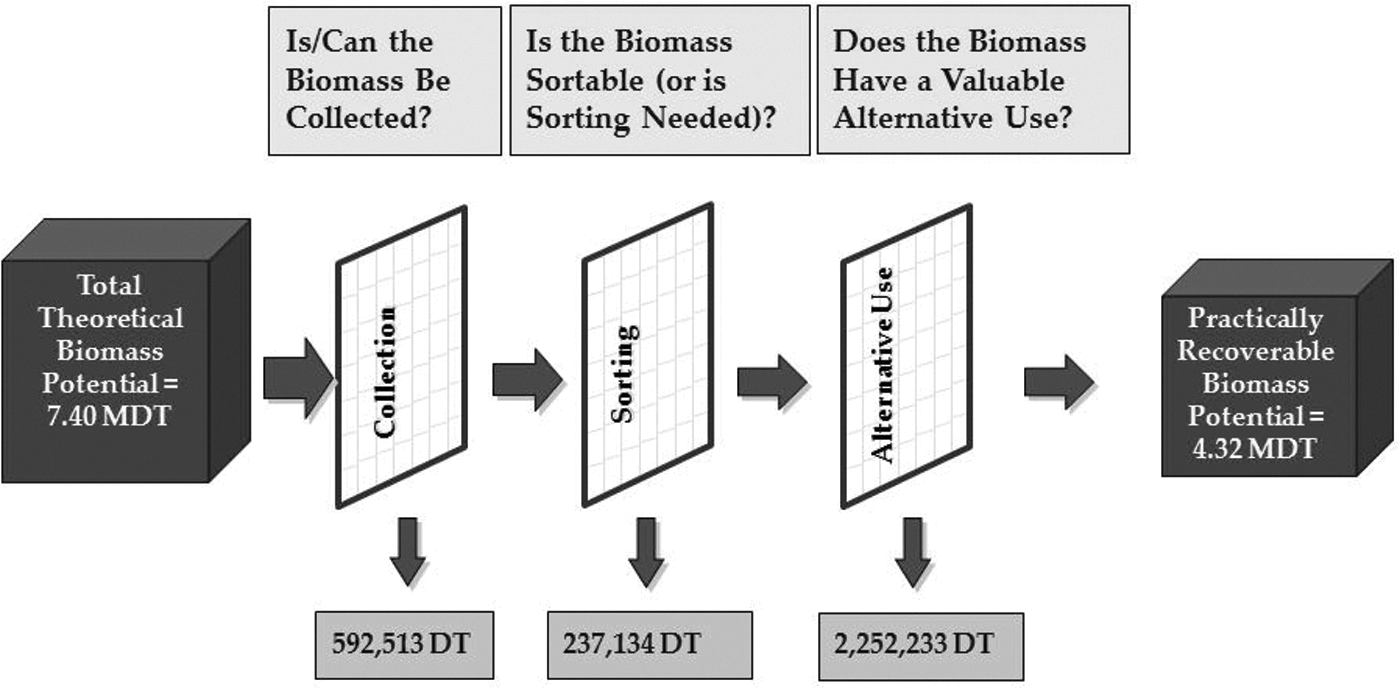
Screening process for determining the practically recoverable biomass potential. 5
The assessment, which was conducted at the county level, indicates that much of the state's biomass resources are concentrated in the central and northeastern counties (Figs. 6 & 7), which are also the most populated. Similarly, the research also revealed that approximately 74% of New Jersey's biomass resources are produced directly by the state's population, with much of these resources being in the form of municipal solid waste. Statewide mappings of biomass concentrations were also developed (Fig. 8). 5

Biomass resources by county.
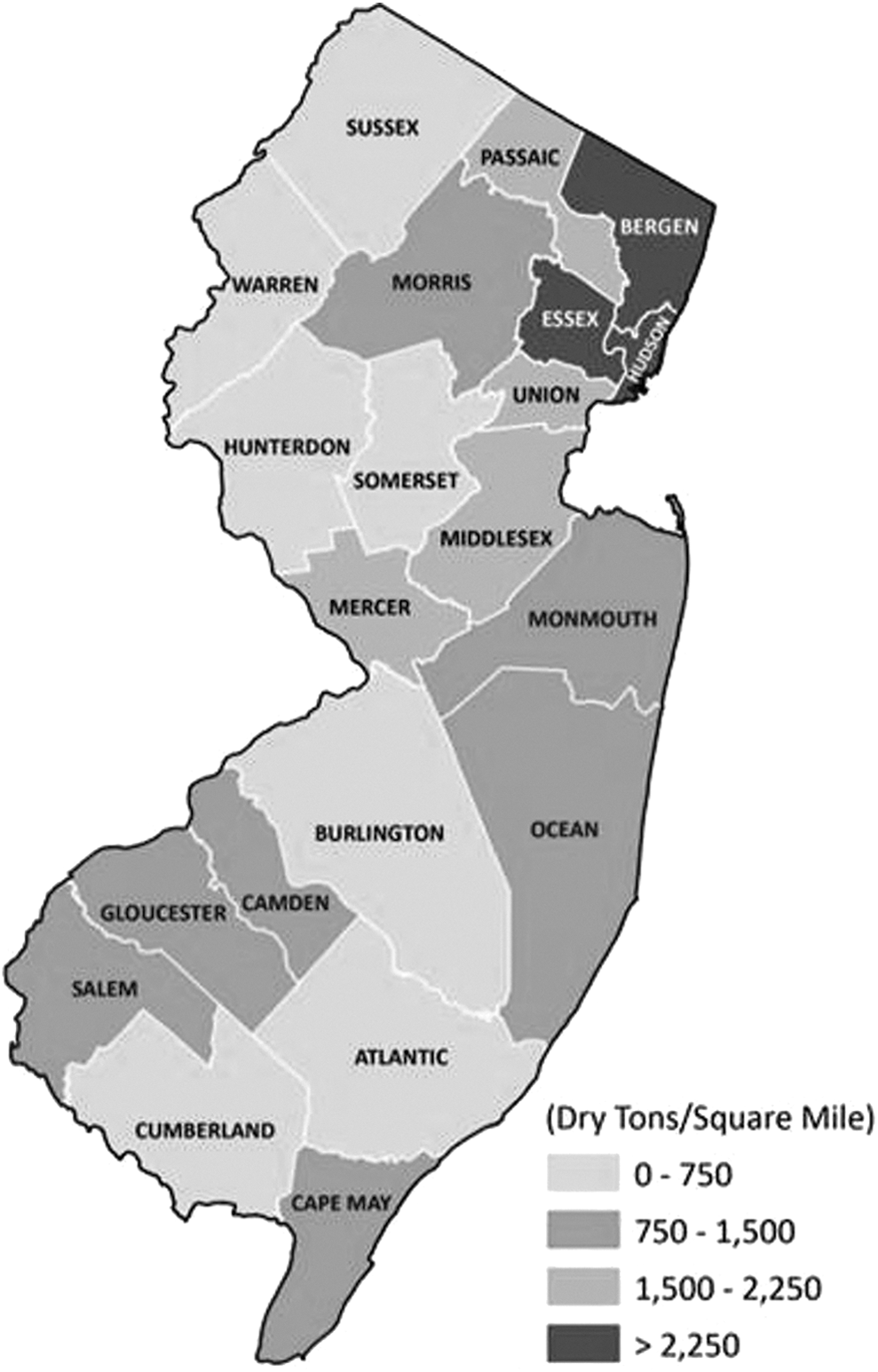
Biomass resources per square mile.
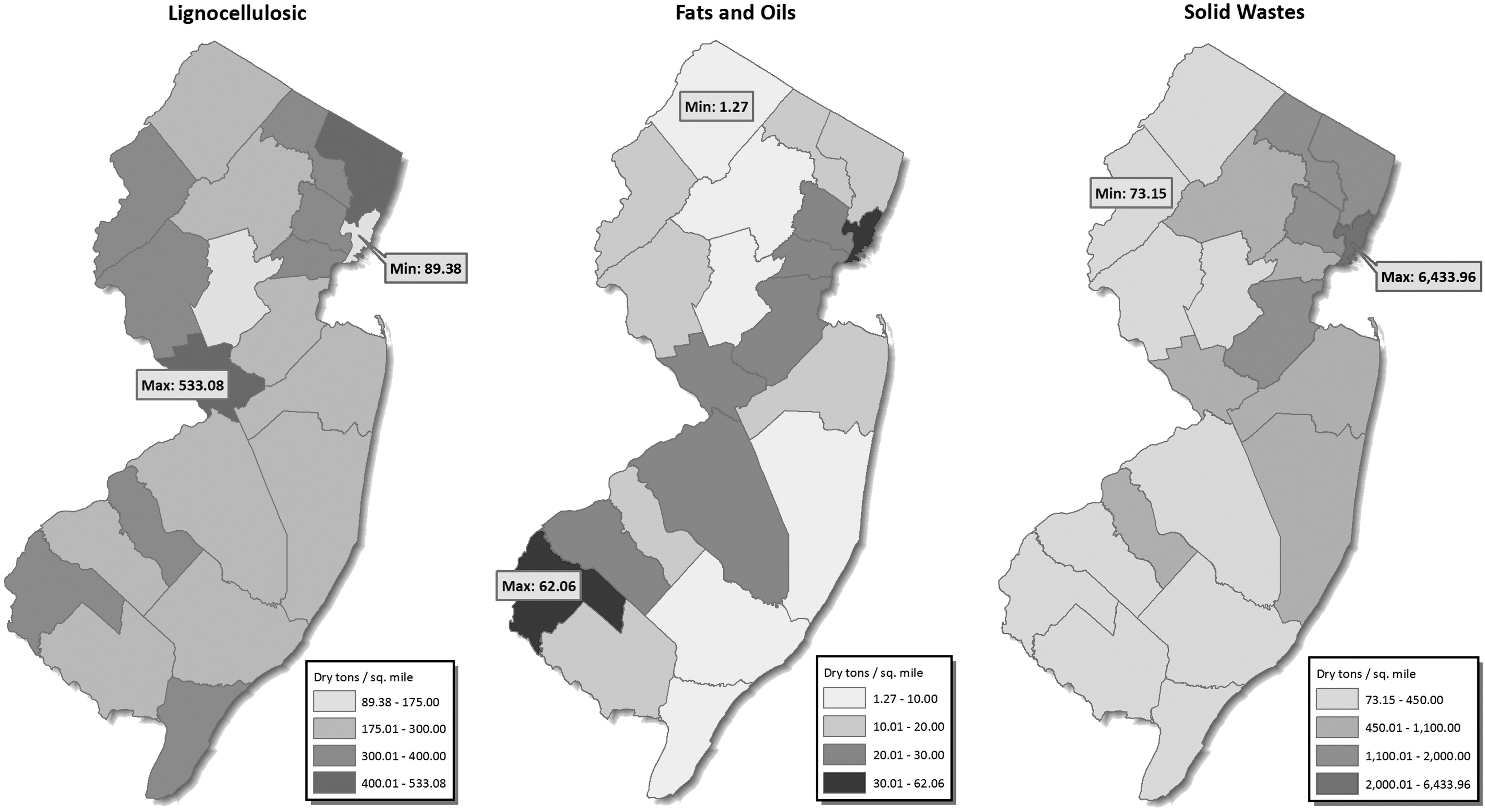
Concentration of New Jersey's biomass resources by feedstock category (%). 5
Biomass Database and Bioenergy Calculator
A biomass database was designed in the 2007 study as a repository for the biomass resource data and conversion technology data, and was updated with current information for the 2014 study. 5 The database is structured by county and resource type for more than 40 different biomass resources. The database also contains energy-conversion information for seven major bioenergy-generation technologies and takes into consideration advances in energy output and efficiency over time. The database also includes technology performance metrics for converting biomass into useful energy (electricity and fuel). Current data for 2010 and projections for 2015, 2020, and 2025 are included in the database.
A unique bioenergy calculator was also developed in the 2007 study and updated in the current study. 3 The calculator interacts with the biomass resource database to enable easy computation of the potential amount of electricity and transportation fuels that can be produced from New Jersey's practically recoverable biomass using selected conversion technologies and compatible feedstocks.
The calculations in the 2014 analysis revealed that the potential power generation from New Jersey's practically recoverable biomass could be as high as 5.6 million MWh/y by 2025, or that the potential biofuels production could be 271.7 million gasoline gallon equivalent (GGE)/y by 2025 (Table 3). 5 Direct combustion of solid biomass and anaerobic digestion (AD)/landfill gas (LFG) technologies were used to obtain the power-generation figure. The transportation fuels figure was obtained using transesterification, dilute acid hydrolysis, and AD/LFG to transportation fuels pathways. These technologies where chosen because they are near to or are already commercialized. Appropriate feedstocks for each technology were incorporated into the calculation.
Bioenergy Potential in New Jersey
GHG-Reduction Scenarios
A series of analyses of potential GHG reductions were conducted in the 2014 study. The researchers hypothesized that New Jersey has sufficient waste and biomass resources for GHG emissions reductions if more efficient use were made of these resources, i.e., for bioenergy production. Several scenarios were developed that provide GHG-reduction potentials based on available waste and biomass feedstocks and conversion technologies. Data from the scenarios were compared with GHG emissions from fossil fuel utilization.
Flared LFG Utilization for Power Generation and Transportation Fuels Production
Currently, New Jersey generates 21,516 million standard cubic feet per year (MMSCFY) of LFG, with 11,321.7 MMSCFYutilized for power generation. The remainder of the LFG is currently flared. Study researchers developed two different LFG-to-energy pathway scenarios for utilization of the flared portion of the total LFG generation. The first scenario considers using the flared portion for additional power generation, and the second considers transportation fuel applications in compressed natural gas (CNG) form.
Based on these scenarios, the analyses found that New Jersey's additional power generation potential from using flared LFG would be 440,893 MWh/y. The study researchers assumed that all current and potential LFG-generated power displaced coal-generated power, yielding a potential CO2 emissions reduction of 515,058 tons/y (Fig. 9). 5 If the flared LFG is converted to CNG form, it could displace 37 million GGE/y for light duty vehicles, resulting in total emissions reductions of 98,595 tons CO2/y. 5

Landfill-gas-to-power generation and GHG-reduction potential in New Jersey. 5
Biogas Production from Food Waste and Yard Waste Followed by Anaerobic Digestion for Power Generation and Transportation Fuels Production
Currently, almost all of the food waste generated in New Jersey is disposed of in landfills or transported out of state. The study researchers developed a scenario in which recoverable food waste is anaerobically digested for biogas generation. The generated biogas can be utilized either for power generation or used in CNG form as transportation fuel.
Based on these scenario pathways, the food waste-to-energy scenario has the potential to generate 312,075 MWh/y of low-carbon electricity. If this clean power generation is assumed to displace coal-generated electricity, the potential reduction in CO2 emissions is estimated at 175,453 tons/y. This analysis only considered the CO2 emissions that would result from biogas-to-energy conversion as compared to CO2 generated from coal combustion. If the analysis considers The Greenhouse Gases, Regulated Emissions and Energy Use in Transportation (GREET) model numbers, total reductions in CO2 emissions could potentially reach 368,262 tons/y (Fig. 10). 5,16

Food-waste-to-power-generation and GHG-reduction potential in New Jersey. 5
An analysis of using biogas generated from food waste via AD for CNG production showed that approximately 27.8 million gallons of fossil gasoline and 273,757 tons of fossil CO2 could be displaced by recycled CO2, with a total emissions reduction of 98,126 tons CO2/y.
Biodiesel Produced from Yellow Grease as a Transportation Fuel
Currently, 77,368,667 lbs of yellow grease is generated in New Jersey. Study researchers estimated that if this amount of yellow grease were converted into sustainable biodiesel and utilized for transportation, it would displace approximately 8.7 million gallons of fossil-based diesel and 125,478 tons of fossil CO2 equivalent per year.
Second-Generation Ethanol from Forestry Biomass Through Gasification With Mixed Alcohol Synthesis, Utilized as Gasoline Blendstock (E10)
The final scenario developed for this study considers the conversion of New Jersey's forestry residuals into second-generation ethanol through gasification and mixed alcohol synthesis. Under this scenario, New Jersey could potentially reduce emissions generated by first-generation ethanol by 221,201tons CO2/y.
Policy Approach
These scenario-based GHG emission reduction estimates show that New Jersey has adequate biomass-to-energy generation potential, and, consequently, resulting GHG emissions reduction potential, which should encourage developers, investors, and policy makers to pursue this energy pathway.
Sustainable biomass resources can provide valuable opportunities to move from fossil fuels to cleaner, renewable sources of power and fuel. Though the scale of these biomass resources is large, the land that they are produced on is finite. Consequently, utilization must be balanced with the necessity of preserving land for food production and ecosystem services. Smart policies are therefore required to accelerate bio-energy production while protecting our food system, water quality, climate, and land. A systems approach to policy making that maximizes bioenergy potential and incorporates the interaction of a large scope of issues (including social, environmental, regulatory, economic, technological, etc.) is needed to realize the long-term benefits that bioenergy can offer.
Creating an effective regulatory, management, and implementation infrastructure at the state level is key to the successful achievement of bioenergy goals. Policies that facilitate and catalyze the establishment of this infrastructure, as well as markets and technologies, are needed for rapid biofuels and biorefinery development, and are essential for the growth of this industry. Market transformation will take place once the technological and infrastructural capabilities exist and can function in an economical and environmentally viable fashion.
Conclusions
The Rutgers New Jersey Agricultural Experiment Station's 2014 report, Assessment of Biomass Energy Potential in New Jersey 2.0, provides detailed information on the state's biomass resources that can serve as a platform for the development of a bioenergy industry in the state and surrounding region. The study found that New Jersey produces an estimated 7.40 MDT of biomass annually. Almost 74% of the state's biomass resources are produced directly by its population, mostly in the form of solid waste (e.g., municipal waste). Agricultural and forestry feedstocks are also important potential sources of biomass and account for the majority of the remaining amount.
A screening process was employed to estimate the practically recoverable biomass. This process determined that approximately 4.32 MDT (∼58%) of New Jersey's biomass could ultimately be available to produce energy in the form of electricity or transportation fuels. It is estimated that New Jersey's 4.32 MDT of biomass could deliver up to 5.2 million MWh of power, (∼7% of the state's electricity consumption) or 250 million GGE (∼4.4% of transportation fuel consumed in the state annually) if the appropriate technologies and infrastructure were in place. GHG reduction scenarios were developed to estimate the impact of utilizing bioenergy pathways in place of fossil fuels. The scenario-based estimates show that New Jersey has substantial waste biomass-to-energy generation potential and that the GHG reduction impacts are significant. The study also concluded that supportive, consistent policies that create positive market signals, market stability, and market demand are necessary to encourage the development and growth of the bioenergy industry in New Jersey and the nation.
Footnotes
Author Disclosure Statement
No competing financial interests exist.