




Abstract

Introduction
As concerns increase over plastic waste pollution and the shortage of petroleum resources, interest continues to grow in the production and utilization of polymers that are derived from renewable resources and are biodegradable, such as poly(lactic acid) (PLA) and polyhydroxyalkanoates (PHA). 1 –5 Biobased plastics can be classified into two types according to their degradation performance: biodegradable or non-biodegradable plastics. In terms of their source of derivation, biodegradable plastics have three possible origins: from fossil fuel, from renewable resources, and as blends of these two types of plastics. 6 We provide an overview of the status of biodegradable, biobased plastics development and commercialization in China's market.
Policy and Investment to Support Biobased Materials
China's National Development and Reform Committee (NDRC) set up a Special Biomass Fund in 2006 to support development projects for biobased materials. Beginning June 1, 2008, the “Plastic Limit Order” came into effect, and during the 2008 Olympic Games in Beijing, biodegradable plastic products were successfully implemented in China, including biodegradable garbage bags, office supplies, and table wares. In addition, the General Administration of China Customs published a series of customs tariff numbers: e.g., 3097700000 for polylactic acid in primary forms and 3905300000 for polyvinyl alcohol in primary forms.
These types of policies have accelerated the development of biobased and biodegradable plastics. During the Beijing Olympics in 2008, the Olympic village and Media Tower used more than 186 tons of biodegradable garbage bags. Biobased office supplies, table wares, and restaurant supplies were also used in large quantities in the Olympic venues and hotels. More recently, the Ministry of Science and Technology (MOST) of the People's Republic of China started a science and technology support plan for biobased materials in 2012. 7 A new program instituted by the NDRC supports the development of biobased materials from 2014 to 2016. The funding for this program will total an investment of billions of dollars.
Biodegradable Plastics
Derived from Natural, Renewable Resources
Biodegradable plastics derived from renewable materials use natural polymers as raw materials that are processed into products. These materials may include starch, fiber, chitin, soy protein, and their derivatives and mixtures. The process of molding thermoplastic starch and plant fiber has been industrialized. Molding of plant fiber involves using plant fiber powder as the raw material and a molding process as the manufacturing method. A variety of other natural materials remain in the research stage of development. For example, Sichuan University has developed a natural polymer complex film based on plant fibers (the fragment crushed from crop stalks). They prepare films of pure or mixed natural polymers without the need for additional agents by a solvent-casting method, using a room temperature ionic liquid as solvent that can be recycled. The film that forms has good optical transparency, barrier properties, and biodegradability.
Poly(lactic acid)
PLA, a well known biobased material is derived through the chemical conversion of lactic acid produced from various starches, sugars, and other biomass materials through biological fermentation. PLA has high transparency and elasticity and is amenable to thermoplastic processing like conventional plastics. It is widely used in the application of disposable products such as cutlery, cups, and films. 8 –10 PLA is typically produced in a chemical synthesis process from L-lactic acid obtained by starch fermentation. The main suppliers of PLA in the market are NatureWorks (Minnetonka, MN) and Zhejiang Hisun Biomaterials (Taizhou). The four main PLA manufacturers in China are listed in Table 1. The largest producer, Zhejiang Hisun Biomaterials, has a capacity of 5 kt/y at present and manufactures products with a melt flow rate of 2–15 g/10 min and a tensile strength of ≥50 MPa.
Manufacturers and Production Capacity of Poly(lactic acid) (PLA) in China
To improve the thermal property, toughness, and processing ability, Sichuan University modifies PLA by copolymerization with other materials. The elongation at break of modified PLA reaches 300%, and the processing characteristics are improved, especially the blow molding process properties. Other companies such as Zhejiang Hangzhou Seemore New Material Technology (Zhejiang), Zhejiang Nanyi Biological Science and Technology (Yongkang), and Hefei Hengxin Environmental Science & Technology (Hefei) have also developed types of modified PLA resin. Sichuan Corn-T Biology Technology (Chengdu) developed modified PLA with a melt flow rate of 2–3 g/10 min, melting temperature range of 140–145°C, tensile strength ≥20MPa, elongation at break ≥130%, and angle tear strength ≥110N/min. The products in which these modified forms of PLA have been used include shrinkable film, plastic bags, and garbage bags. 11
Polyhydroxyalkanoates
PHA, which is produced by bacterial fermentation from agricultural raw materials, has good biodegradability, biocompatibility, and thermoplasticity. 12 –14 At present it is mainly used in biomedical materials and biodegradable packaging and has become a hot area worldwide in the biobased materials sector. In China, PHA research began relatively early and is fairly advanced on the world stage. The chemical structures of various forms of PHA are shown in Figure 1. 12 –16
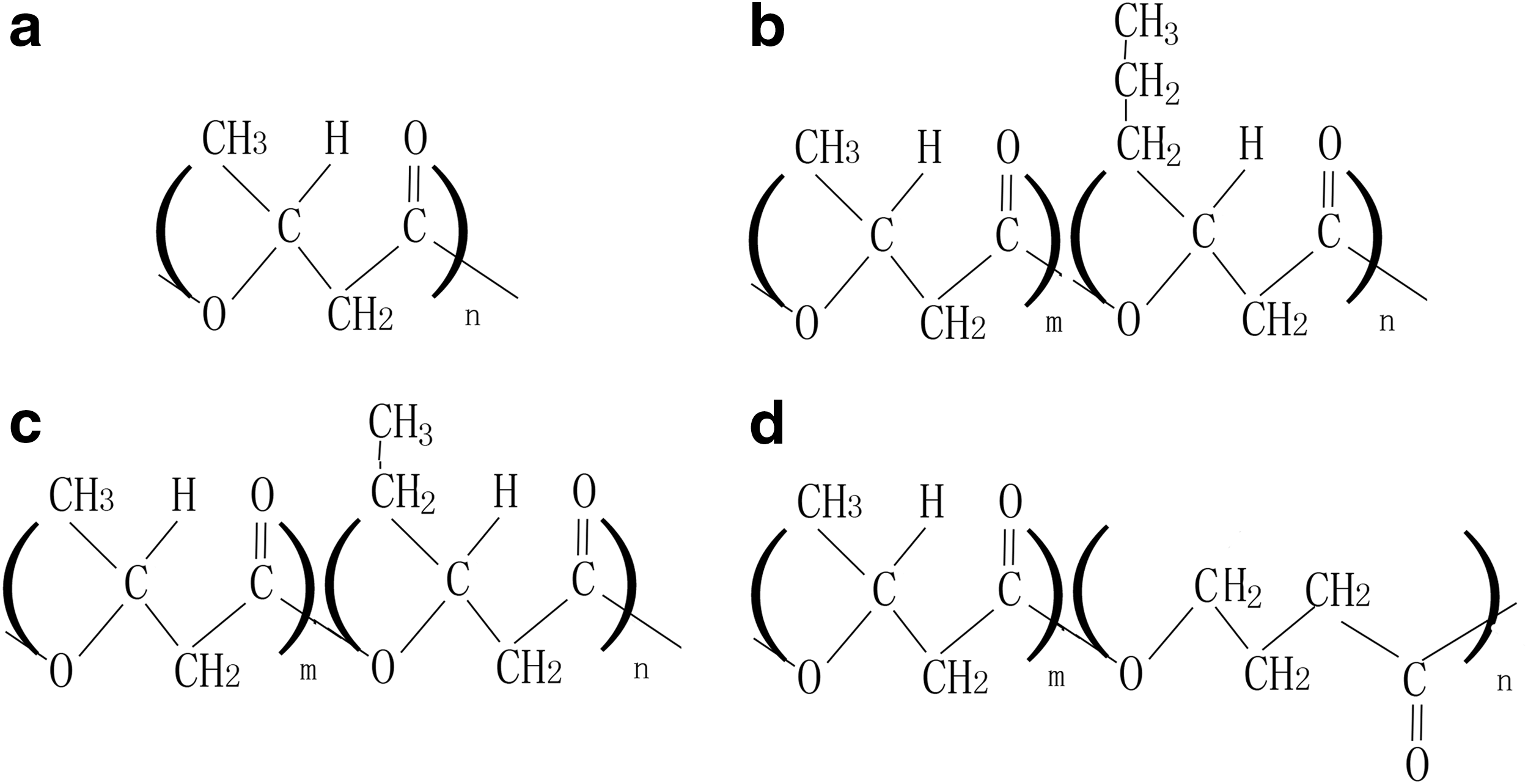
The chemical structures of polyhydroxyalkanoates (PHA):
Ningbo Tianan Biologic Material (Ningbo), a manufacturer of poly (hydroxybutyrate-co-hydroxyvalerate) (PHBV), has achieved 3 kt/y production capacity and is now preparing a 10,000-ton scale production line. PHBV is a good example of this type of material, which is produced by bacterial fermentation from agricultural raw materials. It has attracted attention from both academia and industry because of its biodegradability, biocompatibility, and thermoplasticity. PHBV can be processed into a variety of useful products, for which biodegradability and natural sourcing are quite beneficial. Tianjin GreenBio Materials (“GreenBio,” Tianjin) has commercialized poly(3-hydroxybutyrate-co-4-hydroxybutyrate) [P(3HB,4HB)] at a scale of 10 t/y. Shenzhen Ecomann Biotechnology (Shenzhen) has also announced that it has the capability to produce 5 kt/y of P(3HB,4-PHB). 17
Derived from Fossil FUEL
Biodegradable plastics derived from fossil fuel are polymers synthesized by chemical processes from petrochemical monomers. Poly(butylene succinate) (PBS), poly(butylene succinate-co-adipate) (PBSA), and poly(butylene adipate-co-terephthalate) (PBAT) are examples. They are used to manufacture products such as foams, films, injection molding, and packaging materials.
PBS and PBSA
PBS is the polycondensation product of butanediol and succinic acid, and PBSA is the copolymer of butane diacid, butanediol, and adipate. Currently, some manufacturers have accomplished large scale production, as listed in Table 2. The products made from PBS or PBSA include foams, films, and injection products.
Manufacturers and Production Capacity of Poly(butylene succinate) (PBS) and Poly(butylene succinate-co-adipate) (PBSA) in China
The main research institutes working on PBS in China are the Technical Institute of Physics and Chemistry of the Chinese Academy of Sciences (CAS, Beijing), Tsinghua University, and Sichuan University. The five main PBS manufacturers in China are Zhejiang Hangzhou Xinfu Pharmaceutical (Zhejiang), Anqing Hexing Chemical (Anhui), Shandong Fuwin New Material (Shandong), Xinjiang Blue Ridge Tunhe Polyester (Xinjiang), and Jinhui Zhaolong High Technology (Shanxi). PBS resins for injection molding and extrusion have been introduced into the market. Zhejiang Hangzhou Xinfu Pharmaceutical, in cooperation with the Chinese Academy of Sciences, has built up a production line of 10 kt/y and developed several series of PBS with a melting point of 110–120°C, Vicat softening point of 101°C, tensile strength ≥35MPa, and elongation at break ≥600%. Anqing Hexing Chemical, using the technology of Tsinghua University, has completed a pilot plant at a scale of 10 kt/y that can produce PBS with the following properties: number average molar weight (
Poly(butylene adipate-co-terephthalate) (PBAT)
PBAT is a copolymer polymerized from adipate, terephthalic acid, and 1,4-butanediol and is a well-known biodegradable plastic. It is a flexible material with a high elongation at break and has good hydrophilic and processing properties. PBAT has been widely used in the processing of blown films and other associated membrane products. 21 –23
BASF's (Ludwigshafen am Rhein, Germany) product, Ecoflex®, has a very similar processing property as polyethylene-low density (PE-LD), and thus it could be extruded into films. The Ecoflex® FBX 7100 trademark has the following properties: product density 1.25g/cm3; melt flow index (MFI) 2.7–4.9g/10 min; melting point 110–120°C; heat deflection temperature 82°C; tensile strength ≥45 MPa; elongation at break ≥560%. Sichuan University investigated aliphatic-aromatic copolyesters of polyethylene terephthalate (PET), polyethersulfone (PES), and PBS, and has been awarded a patent. Beijing Chemistry Technology Institute pursues research on the modification of aliphatic-aromatic copolyester. It obtained the copolymer (PBST) of terephthalic acid, butane diacid, and butanediol and is preparing to initiate pilot-scale production. The weight-average molecular weight of the resulting PBST is greater than 60,000, and the melting point is about 135°C, tensile strength ≥20MPa, and elongation at break ≥700%. 24–25
Carbon dioxide copolymer
This is a family of polymers produced using carbon dioxide waste gas as the raw material, copolymerized with propylene oxide or epoxy ethane. Poly(propylene carbonate) (PPC) is an alternating copolymer of carbon dioxide and propylene oxide that has the molecular structure shown in Figure 2. Inoue Shiyouhei in Japan showed that carbon dioxide could be copolymerized with epoxy compounds to form aliphatic polycarbonate, with numerous application and development prospects. 26 At present, the main application of PPC focuses on packaging and medical materials.
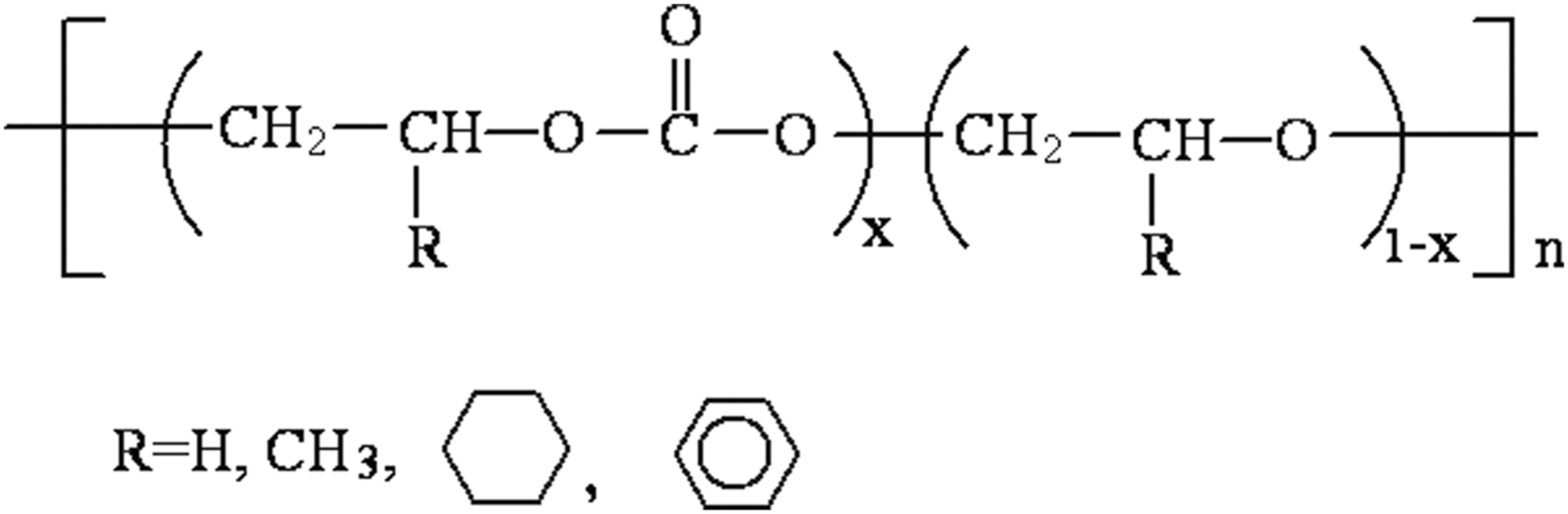
Molecular structural formula of poly(propylene carbonate) (PPC).
Early research in China on PPC was carried out by the National Natural Science Foundation of China. Now, several institutes are focused on this area, such as Changchun Institute of Applied Chemistry of Chinese Academy Of Sciences, Sun Yat-sen University Guangzhou Institute of Chemistry of Chinese Academy Of Sciences, and Zhejiang University (Hangzhau). Companies that have achieved large-scale production are listed in Table 3.
Manufacturers and Production Capacity of Poly(propylene carbonate) (PPC) in China
Inner Mongolia Mengxi High-Tech Group (Wuhai), in cooperation with Changchun Institute of Applied Chemistry, has established a plant with annual production capacity of 3 kt/y using carbon dioxide released from cement manufacturing. The product is mainly used in the field to produce packaging and for medical applications. Mass-produced PPC has a density of 1.25–1.30 g/cm3; and tensile strength of 30 MPa. In partnership with Changchun Institute of Applied Chemistry, Zhejiang Bangfeng Science and Technology (Taizhou) set up a plant with a capacity of 10 kt/y in Zhejiang Province. Henan Tianguan Group (Nanyang), using technology of Sun Yet-sen University, uses CO2 raw material produced by alcoholic fermentation. Under the catalytic effects of efficient nano-catalysts, the CO2 is copolymerized with propylene oxide to form PPC. The company set up a 5 kt/y production line. 27 Technology developed at Guangzhou Institute of Chemistry is being used by Jiangsu Zhongke Jinlong-cas Chemical (Taixing) to produce low molecular weight polycarbonate at 50 kt/y scale, which is then polymerized with other compounds such as isocyanate. The product is used in a variety of materials and in packaging of household electrical products.
Polycaprolactone (PCL)
PCL is synthesized by ring opening and polymerization of heptatomic ring ɛ-caprolactone in the presence of a catalyst. The main research institutes focusing on PLA in China are the National University of Defense Technology and Sichuan University. Sichuan University has developed a one-step method using hexylene glycol to synthesize monomers of caprolactone polymer. Shenzhen Esun Industrial is manufacturing the product at pilot scale.
Poly(p-dioxanone) (PPDO)
PPDO is synthesized by ring opening and polymerization of p-dioxanone, as showed in Figure 3. The glass transition temperature of PPDO is in the range of -17-10°C; the melting point is 110°C; and heat deflection temperature is at 90°C. This type of material exhibits high strength and toughness and has good prospects for application and extension. The material was first identified by the American company Ethicon in the 1970s and was used in surgical sutures with the trademark PDS. However, because of its high cost, it did not enter the general materials market. In recent years, Sichuan University achieved a breakthrough in the synthesis method, making it possible to produce PPDO at low cost and high performance, making it a competitive product among synthetic biodegradable plastics. One outstanding feature of this material is its relative high molecular mass and ability to be processed through blow molding. Another feature is the ability of PDO monomer to be recycled through a thermochemical method, with a coefficient of recovery reaching 93–96%. The recycled monomers can be used for direct synthesis of PPDO. Sichuan University`s PPDO has a tensile strength ≥29MPa and elongation at break ≥200%. Furthermore, PPDO nano-composite material has even better properties: tensile strength ≥50MPa; elongation at break ≥500%. Manufacturers are now industrializing the production process. 28
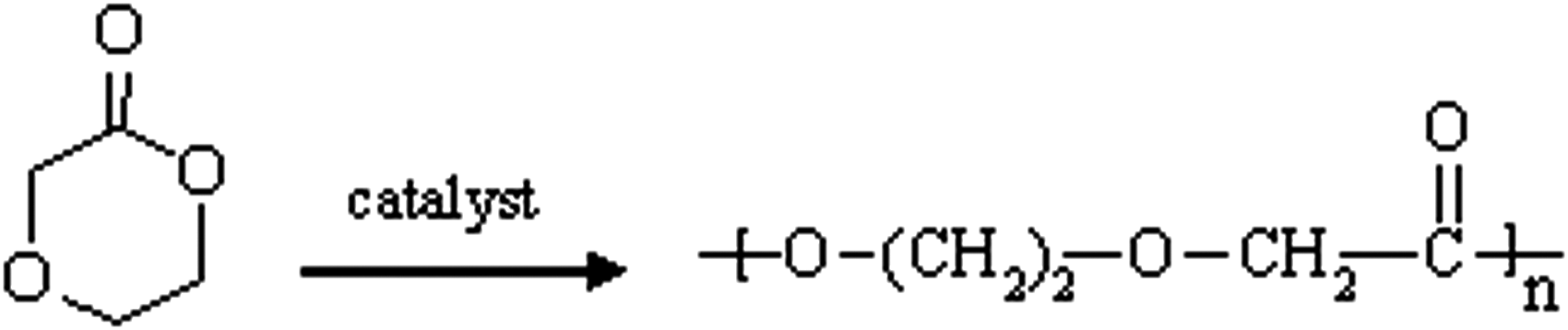
Polymerization scheme of poly(p-dioxanone) (PPDO).
Other Biodegradable Plastics
In addition to the biodegradable plastics described above, researchers in China have investigated other biodegradable polymers such as cellulose, chitosan, and soy protein, but without industrialization. 29 –33
Polymer Blends
Blending is a commonly used method to lower the cost and improve the properties of biodegradable resins. For example, PBAT can be blended with PLA to improve the strength of the polymer. 34 –41 Sichuan University, in cooperation with Bayer (Barmen, Germany), developed a new material comprised of PLA blended with PC. 42
Several companies are blending their products with starch. Some companies with products in the 10 kt/y industrialization scale or at pilot scale are listed in Table 4. Among these companies, Wuhan Huali Environmental Technology (Wuhan) has achieved a production capacity of 30,000 t/y. Its blend is being used in applications such as granules, film, polymer sheets, and injection products.
Some Manufacturers and Production Capacity of Blended Biodegradable Plastics in China
Non-Biodegradable Biobased Plastics
Biobased plastics that are not biodegradable include bioPA, bio-polytrimethylene terephthalate (bioPTT), bio-polyurethane (bioPU), polyvinyl acetate (bioPVA), bioPET, and bioPE. Forms of bioPA include PA410, PA610, PA1010, PA1012, PA10T, and PA11.
Shanghai Celluloid manufactures PA1010; Suzhou HIPRO Polymers (Zhangjiagang) produces PA1010 and PA 1012; and Kingfa Scientific and Technological (Guangzhou) makes PA10T. Zhengzhou University is studying PA612 and PA12T and plans to build a pilot-scale plant in Shandong Province. 43 –48
Changchun Dacheng Industrial Group (Lvyuan) has set up a plant to produce alcohol in quantities of 200 kt/y and has tried to produce propylene glycol and ethylene glycol, which can be used to manufacture biobased PTT, PET, etc. Jiangsu Shenghong Science and Technology (Wujiang) has developed a pilot-scale plant facility to produce PTT 1–3 propylene glycol ester fibers. 49 Guangxi Guangwei Chemical Industrial (Yizhou) has used sugarcane biomass to manufacture biobased polyvinyl alcohol polymer material with a capacity of 50 kt/y. 50